
 Lissywollen Direct Provision centre for asylum seekers, Athlone, Co. Westmeath
@CharlieFlanagan be hilarious if @BarackObama hits back with a Q or 2 on direct provisioning
— Brendan Dunne (@TheGtWesternSq) September 30, 2014



Lissywollen Direct Provision centre for asylum seekers, Athlone, Co. Westmeath
@CharlieFlanagan be hilarious if @BarackObama hits back with a Q or 2 on direct provisioning
— Brendan Dunne (@TheGtWesternSq) September 30, 2014

Minister for Foreign Affairs, Charlie Flanagan, pictured arriving at Leinster House in July
Foreign affairs minister Charlie Flanagan spoke to Seán O’Rourke this morning and, at one point, they discussed the abortion story. Specifically, they talked about how the HSE are currently carrying out a review of the care given to the young woman.
Seán O’Rourke: “What about the possibility that what emerges from the report may suggest to you and colleagues that the Protection of Life During Pregnancy Act be revisited in some way?”
Charlie Flanagan: “Well there is a suggestion that the act isn’t working. However, I think before we can be conclusive on that, or before we can form an opinion on that, we need to be appraised fully of the facts and the circumstances. There is, built into the legislation, and you know, we’re not going to revisit the lengthy hearings, the submissions and the engagement that ultimately formed the act about this time last year. I think it’s important that the review mechanism, under the act, be allowed take place. If the current case means bringing that forward a few months, then so bet it. There doesn’t appear to be an appetite for a further referendum. However, it’s important that Government does address the issue in the context of the facts of this, of this particularly harrowing case so early into the operation of the legislation.”
O’Rourke: “What would you say to the suggestion, and it’s put forward increasingly by your partners, in Government, in the Labour Party, that 31 years on from the original amendment, the article 40.3.3 that was inserted into the constitution, that that should now, in the round, be examined with a view perhaps to putting the issue before the people again.”
Flanagan: “Yeah, well, I think it’s important that we look at, we’d say the Fine Gael position, my party position. And before the last election we made three essential and important points. Firstly, we said that we wouldn’t legislate for abortion in Ireland and we didn’t. Secondly, we said… ”
O’Rourke: “That’s disputed, but we’ll let that go.”
Flanagan: “We had to address, it was incumbent upon us to address the issue of the European Court of Human Rights’ judgement in the A, B, C case and that was addressed, in the form of legislation. And, thirdly, we promised that we women in pregnancy would receive an appropriate level of medical treatment that was necessary. That is inbuilt in the legislation and it’s important in the context of this case that you now mentioned, that there is adequate follow through on that and that we satisfy ourselves that there was an appropriate level of medical treatment and attention available to that person.”
Previously: At The Mercy Of The State
Listen back here

Foreign Minister Charlie Flanagan (third from left) and officials from the Department of Foreign Affairs and Trade discussing Gaza with the Palestinian Ambassador together with the Ambassadors of Morroco, and Saudi Arabia, and representatives from the Embassies of Egypt and UAE.
As told by Fine Gael’s Minister for Foreign Affairs, Charlie Flanagan, to Rachel English on RTÉ Radio One’s Morning Ireland earlier.
Rachel English: “Why did Ireland abstain?”
Charlie Flanagan: “Well there were two issues involved here. Firstly, due to the urgency. We wanted a more swift and direct response to using existing and current structures to the appalling situation and upsurge of violence, resulting from this conflict. So there was the time issue involved, we didn’t think it was appropriate to allow for a new, further investigation, having regard to current existing UN structures and secondly, we’d problems with the text. We wanted to include all violent acts on all sides, including Hamas and other militant groups in the region. We referred to the fact that the resolution failed to recognise the right of Israel as a democratic state in the region to defend itself and we worked quite intensely, all day long with, and in partnership, with our European colleagues and others to try and bring about a balanced resolution . That didn’t prove possible. And there are times, in the context of a four or five-page document when it isn’t possible to perfect the text in a way that we would have thought.”
English: “You talk there about using the current structures. But isn’t the problem at the moment that the normal approach isn’t working. We saw that yesterday with the shelling of a UN school. Something a senior UN official described to us earlier here as “a trend”.”
Flanagan: “That’s very true and that’s why I’ve clearly and consistently condemned the upsurge in violence and, on Tuesday, at the Foreign Affairs Council in Brussels, we played a very important and active role in ensuring that the European Union, with a voice of 28 states, in unison for the first time, condemning the very high level of casualty rate, resulting from actions and is important in the context of ensuring that we’re going forward firmly within the European Union and firmly within the UN. And there are times when we won’t get what we’d like out of these discussions.”
English: “But are you getting anything at the moment. Isn’t the EU being ignored?”
Flanagan: “Well what Ireland is doing, on the one hand, bi-laterally, and on the other hand, through the UN and the EU, it’s doing everything in our power to ensure that we can halt this cycle of violence. Last week I met with the Israeli ambassador. I conveyed to him, in no uncertain terms, the deep concern on the parts of the Irish people at the appalling level of casualties in Gaza. Yesterday I had the opportunity of meeting face to face with representatives of the Arab League. I had a first-hand engagement with the Palestinian representative. I spoke to the Egyptian embassy. It’s important that we, as a neutral country, with significant influence do what we can in order to mould this process because the absolute priority is a ceasefire and an end to all violence.”
Later
Flanagan: “We have a recurring problem in Gaza, every few years now and this crisis, however appalling as it is, it’s not the first such crisis and what we have to do is to hope that this is going to be the last one and that the underlying issues which contribute to the violence can be dealt with…”
Later
Rachel: “Many people who would normally be loathe to criticise Israel have been appalled by what they’ve witnessed over the past couple of weeks.”
Flanagan: “That’s true but I believe it must be in the context of the right of Israel as a democratic state to defend itself and to defend its territory. But we in Ireland have to be clear-sighted here because our voice, and this is important in the context of the EU foreign ministers’ meeting on Tuesday which I attended and the UN meeting in Geneva on Wednesday: our voice is stronger and our influence greater if we use it firmly within these institutions. There are times when we wont’ get all we like in these discussions but the best contribution that we can make is to ensure that both the EU and the UN are strong and effective players in adding our voice.”
Rachel: “So you’ve no regrets then, about the abstention then? You have no regrets about the abstention the other day? You still believe that that was the right decision?”
Flanagan: “I believe that it was an opportunity lost because the resolution could have been stronger, it could have been better. But we now have it. And we’ll now move forward within the context of what we have.”
Later
English: “I know you’ve spoken in the past about attitudes towards Israel and the Palestinians in this country, indeed you told the Sunday Independent last year that ‘Israel had been demonised an Irish media who were content to dance to the Palestinian drum beat’. Is that still your view?”
Flanagan: “Well, listen, this conflict is serving nobody’s interests and it needs to be brought to an end, as speedily and as quickly as possible and there needs to be accountability for what has occurred and that’s why we will continue to call for investigations into breaches of all humanitarian law, we will continue to be clear and consistent in our condemnation of violence resulting from this conflict and from whatever source, that includes rockets fired by Hamas and it also includes Israeli military actions which have resulted in a huge and unacceptable level of civilian casualties.”
Listen back in full here
Previously: Abstained
(DFA/Photocall Ireland)

[Children’s minister Charles Flanagan outside Leinster House, Dublin today]
“My determination is to ensure all of the issues are dealt with in a way which is comprehensive,” said Mr []Charlie] Flanagan. He added that it was essential the facts were established and a “light was shone on this dark period”.
Inquiry into mother and baby homes to be set up (Irish Times)
He’s all light and heart.
“They can’t earn money. They can’t earn, if you like, a living. What the State does is provides a sum of €19 a week. Of course it’s insufficient but this is the direct provision regime.”
Charlie Flanagan, January 2014.
Oh.
Céad Míle Fáilte (Jan 14, 2014)
(Laura Hutton/Photocall Ireland)
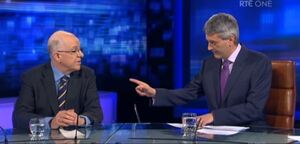

On Prime Time last night RTÉ’s David McCullagh held a debate with Fine Gael TD Charlie Flanagan and Fianna Fáil TD Niall Collins in light of Taoiseach Enda Kenny’s announcement yesterday that he has appointed Sean Guerin, SC, to look into Sgt Maurice McCabe’s dossier which alleges Garda mishandling of a number of serious crimes.
They also discussed the so-called directive that Garda Commissioner Martin Callinan sent to former Garda John Wilson and Sgt Maurice McCabe separately on December 14, 2012. The ‘directive’ was delivered verbally to the two gardaí. Mr Wilson said last night that the superintendent that gave him the message told Mr Wilson that he was under instructions from Commissioner Callinan not to furnish Mr Wilson with a written copy of the directive.
Commissioner Callinan maintains this directive called on both men to co-operate with the penalty points inquiry, led by Assistant Commissioner John O’Mahoney.
But Sgt McCabe released a statement on Monday night saying the Commissioner’s claims were ‘gravely misleading and false’ while last night Mr Wilson said he believed the directive was the equivalent of a ‘gagging order’.
Sgt McCabe taped the conversation during which his directive was delivered, while in the case of Mr Wilson, he took notes. Mr Wilson’s notes – in so far as the message that was read out to him – match what was read out to Sgt McCabe, in Sgt McCabe’s transcript.
The directive was issued just a few days after Mr Wilson was found printing off records from the PULSE system in Cavan and days after several high-profile people were named in the Dáil as having had penalty points quashed.
On this specific matter, RTE’s David McCullagh took issue with Charlie Flanagan.
David McCullagh: “I want to ask you a question. Gerry Adams made the point in the Dáil during those exchanges that the Taoiseach was given that dossier less than a week ago and now we have an independent barrister appointed to look into it to see if there’s anything to investigate there, as you say, the Taoiseach has moved fast. Alan Shatter was given this two years ago.”
Charlie Flanagan: “There are two charges levelled on a continuous basis by Niall Collins and Fianna Fáil against Alan Shatter and they are as follows. Firstly, that he was given documentation two years ago, which he sat on. Not true. We will see tomorrow and we’ve already evidence that Alan Shatter acted on documentation that was before him: some of these issues and allegations have already been the subject of an examination by the GSOC office. In fact, in fact…”
McCullagh: “Then why has Mr Guerin been appointed?”
Flanagan: “In fact, David, in some cases, in some cases, charges have been brought, due process has taken place in the courts, and people have been convicted, that’s exactly as it should be through the criminal law. The second charge against Alan Shatter is that in some way he misled the Dáil by saying that Sgt McCabe, a central figure, did not cooperate with the investigation. I say, having read the documentation now published and having regard to what Sgt McCabe, an honourable man, said last night, I believe there are failures on both sides. I find it inexplicable that an investigation could take place at the behest of the gardaí, under Assistant Commissioner O’Mahoney without Sgt McCabe, a central figure being involved. How is it? How is it the investigation took place?..”
McCullagh: “Well that’s a very good question.”
Talk over each other
McCullagh: “How is it that Alan Shatter didn’t seem in the least bit concerned about it?”
Flanagan: “No, I believe that this, that this issue is, has been the subject of a review of papers in Alan Shatter’s office over the last and I believe we’ll know this tomorrow. The second issue is, as far as Sgt McCabe is concerned, there are reports that he was asked on more than one occasion…”
McCullagh: “What reports?”
Flanagan: “..that his issues would be…letters from the Department of Justice directly to him and the content of the transcript of the tape last night.”
McCullagh: “Hold on, hold on, hold on, hold on, hold on. Hold on, hold on, hold on, hold on.”
Flanagan: “It seems to me inexplicable that Sgt McCabe didn’t know that there was an investigation under way.”
McCullagh: “Hold on. The thing last night is quite clear. What he was told: ‘The Commissioner is now directing you to stop accessing PULSE and he disputes whether he was doing that and, anyway..’And if you have any concerns they can be brought to the attention of the Assistant Commissioner’. How is that a direction?”
Flanagan: “Yes, well, I find it inexplicable that Sgt McCabe wasn’t aware of the fact that an investigation was taking place.”
McCullagh: “But the Commissioner and the Minister said that he was directed to cooperate with the inquiry, now is that a direction?”
Flanagan: “Well, I believe that there is more to the story than we’ve seen and I look forward to the minister making that statement tomorrow in the Dáil.”
McCullagh: “The Commissioner said that on that date…”
Flanagan: “And standing over what the minister has said, under Dáil privilege.”
McCullagh: “The Commissioner said that on that date that Sgt McCabe was directed to cooperate with the inquiry and quite clearly if that, if that transcription is correct, he quite clearly wasn’t.”
Flanagan: “Listen the fact of the matter here is that Sgt McCabe knew that an investigation of some form was taking place because he was given more information than was actually contained in the transcript.”
McCullagh: “And did he have the Assistant Commissioner’s phone number in his, in his iPhone.”
Flanagan: “Listen, I’m not in a position to answer as to whether Sgt McCabe had people’s phone numbers on his person. What I am saying, David, and you know this is a complex and serious issue, what I’m saying is there were failures on both sides. How an investigation could take place over a period of months, the central figure wasn’t involved and happened to ring up wondering what the story was when the whole thing was finished.”
McCullagh: “What was Minister Shatter’s failure then? Well, Niall Collins is the one who..”
Niall Collins: “No you just said there’s failures on both sides, Charlie, I mean you’re being entirely inconsistent here.”
Talk over each other.
Collins: “Is it good enough that the Minister for Justice will come in to Dáil Éireann under privilege and seek to completely discredit the character of Maurice McCabe.”
Flanagan: “No I don’t accept that will happen.”
Collins: “You have testified on numerous occasions that Maurice McCabe is very credible so has Pat Rabbitte, so has members of the PAC [Public Accounts Committee]. Anybody that has met Maurice McCabe is happy that he is credible in terms of what he is saying. Yet the minister choose to come into the Dáil and seek to assassinate his character.”
Talk over each other.
McCullagh: “Let Charlie answer that.”
Flanagan: “I think that is the kind of hyperbole that is actually damaging to the process.”
McCullagh: “Well hold on a second.”
Talk over each other.
Flanagan: “What Minister Shatter said under Dáil privilege was that it was his view that Sgt McCabe did not cooperate with the investigation.”
McCullagh: “But how could he cooperate when he wasn’t asked?”
Flanagan: “Well, you know, that’s a moot question and it’s not perfectly clear that he wasn’t asked. And I looked at the evidence of the Garda Commissioner and the evidence of the Department of Justice as far as that’s concerned.”
McCullagh: “Ok, well just in relation to the revelation last night, you know, you, some people say that’s a direction – I don’t see how anybody who understands the use of the English language could think that was a direction but anyway that’s beside the point. Why was it delivered verbally and not in written form? Why, if he did disobey a direction, was he not disciplined for it, and why on earth did the Assistant Commissioner not pick up the phone and ring him?”
Flanagan: “These are questions that are better put to the Garda Commissioner and the Assistant Commissioner. I would have thought that the Assistant Commissioner might have made a call to him over the course of weeks before the investigation got under way and in fact when the investigation was under way, having regard for the fact that Sgt McCabe was at all times a central figure.”
Watch back in full here.
Related: GSOC Saga: Uncovering truth amidst confusion (Mick Clifford, Irish Examiner)

[Charlie Flanagan TD. Knife out of shot]
This isn’t either.
Further to the GSOC/Whistleblower crisis Charlie Flanagan, chairman of the Fine Gael Parliamentary party, appeared on Morning Ireland this morning to give his backing to justice minister Alan Shatter.
Sort of.
Fran McNulty: “I have read this transcript in full and there are a number of details in it and it has been indicated by Micheal Martin that there are a number of crimes detailed, there are sexual assaults, there are murders, there are abductions and kidnappings wouldn’t it be a matter of the most grave political consequences if it is found that these issues having been flagged up by a whistleblower haven’t been dealt with and people have suffered as a result? Wouldn’t the political consequences of this be very grave?”
Charlie Flanagan: “I agree. These are very disturbing and serious allegations of a very grave nature. The Taoiseach yesterday received a copy of the transcript from Micheal Martin, he is considering the matter, he will ensure that the detail is passed on the appropriate authorities, some of this I understand has already been examined by the whistleblower (sic) in any event but I haven’t seen the allegations let’s see what the allegations are first and lest, let’s ensure that we have due process but you can take it from me that no one in government will be sitting on any aspect of this.”
Fran McNulty: “Can I ask you, do you agree with the decision to sack Oliver Connolly?”
Charlie Flanagan: “It was quite clear having regard again to the release of a transcript of a conversation which was highly defamatory of the Minister of Justice that the position of the whistleblower (sic) was untenable and he had to go.”
Fran McNulty: “Was it a knee jerk reaction, because we heard [Garda whistleblower] John Wilson saying earlier that members of the Force now have nowhere to turn?”
Charlie Flanagan: “No, you see, a knee-jerk reaction, I heard criticism earlier that it took too long, so really, really, we are in a situation here where on the one hand the opposition is talking about the delay and on the other hand other commentators are talking about a knee-jerk reaction. The fact of the matter was that there must be an element of process here. Over the past week an investigation has taken place between officials in the Department of Justice and the Office of the Confidential Recipient, the Report was handed to the Taoiseach on Tuesday and the Recipient was relieved of his duties.”
Fran McNulty: “And his office is now vacant and members of the Force have nowhere to turn.”
Charlie Flanagan: “Well the Office was used on 12 occasions in a period of six years. The legislation – and already the Minister for Justice has indicated some time ago that he was not happy with functions and operation of the office, already that legislation, the Protective Disclosures legislation is at an advanced stage in the Dail. The Minister has indicated his amendment and there’s every reason Fran, with all party co-operation, that that legislation can be enacted within a couple of months.”
Fran McNulty: “What do you say in response to the commentary this morning that Mr Connolly was just a fall guy and attempt by the Minister for Justice to kill this story?”
Charlie Flanagan: “No I don’t believe he was, I believe it was clear that Mr Connolly made very, very serious allegations against the Minister for Justice of a highly defamatory nature and, his, his position was untenable.”
Listen here
It may be worth noting that Alan Shatter has known about the contents of the McCabe/Connolly transcript since May 2013.
Yes.
Most odd.
Meanwhile: Eight Independent TDs call on Shatter to step down (Independent.ie)
Dail now has Serie A Prima Squadra Tim Torino. 1st round v the RA. pic.twitter.com/ZKzG4s4t18
— Charlie Flanagan (@CharlieFlanagan) January 30, 2014
Via Wikipedia:
“Torino was founded as “Football Club Torino” in 1906 when Football Club Torinese merged with a group of Juventus dissidents led by Alfredo Dick…”
FIGHT!
