
Tag Archives: Dail

shatter[Justice Minister Alan Shatter in the Dail this morning]

A Cheann Comhairle

Could I start by again paying tribute to Martin Callinan on his retirement as Commissioner of An Garda Síochána. Martin Callinan had a long and distinguished service in An Garda Síochána. He dedicated his career to the fight against crime, and has a record of which he can justly be proud. I want to express my sincere thanks for his commitment and service to the State. In its statement yesterday, the Government indicated that information had come to light indicating that a system for the recording of phone calls to and from many Garda stations had been in place for many years before it was discontinued last November. The fact that such a system was in place, and for so long, is clearly a matter of serious concern, which the Government believes warrants the establishment of a Commission of Investigation.

Let me say at the outset that the circumstances surrounding the establishment of this system of recording, exactly when it started, the number of Garda stations involved, the extent to which recordings were retained, and their relevance to any Garda investigations are still unclear. One of the main functions of the Commission of Investigation will be to establish the facts relating to these and all other relevant issues. I recognise of course that Deputies will have many very reasonable questions on these and other aspects of this matter, but I am greatly constrained in what I can say. We need to establish the facts before we can draw any firm conclusions, and it would be wrong to engage in speculation in advance of that.
Let me, however, say what I know from a letter by the outgoing Garda Commissioner, Martin Callinan.

This letter was sent to my Department on 10 March, and was made under section 41 of the Garda Síochána Act 2005, which provides a mechanism for the submission of information by the Garda Commissioner. This letter was not furnished to me by my officials until approximately 12.40 pm yesterday and I did not have an opportunity to read and consider it until some time later. The letter started off by referring, by way of background, to a case in which civil proceedings are being taken by two persons against the Garda Síochána and the State for wrongful arrest and related matters. Can I say here that I am aware of speculation on the identity of these proceedings, but the House will understand that I cannot comment on proceedings currently before the courts.

The letter from the Garda Commissioner referred to recordings of telephone conversations into and out of a particular Garda station which had come to light as part of the process of discovering documents of relevance to the plaintiffs. That process is still under way, and again I must emphasise the constraints on commenting on a case which is currently being litigated in the courts.

I am advised that my Departmental officials were made aware of recordings of relevance to the specific civil proceedings previously mentioned on 28th February by the Garda Síochána and the Chief State’s Solicitor’s office arising from its involvement in the response to the civil proceedings. I am informed that what was at issue was the discovery of recordings in a specific Garda station, not a more general system of recording calls in Garda stations generally and that no reference to such general recording of calls was made at that time.

In this letter of 10th March, the Garda Commissioner went on to say that it had subsequently transpired that systems would appear to have been installed during the 1980s in Garda stations to allow for the recording of incoming and outgoing calls from designated extensions. The Commissioner explained that the rationale behind this was the recording of Garda radio traffic to and from control rooms, and 999 calls, and the gathering of evidence around calls made to Garda stations regarding bomb threats and other code messages. This practice had continued in some stations over the years, with the recordings being retained within each station, with the original recorders being replaced in the 1990s and again in 2008.

The letter states that the original recorders were replaced with dictaphone recorders during the 1990s (I do not presently know what specific years), and further replaced by what is referred to as NICE recorders, which I understand is a brand name, which were installed in 2008. The Commissioner explained that he had consulted the Attorney General’s office on the matter, and expected that consultation with the office of the Data Protection Commissioner would be necessary, as well as further advice from the office of the Attorney General. However, he made clear in the letter that he had directed that the routine recording of non-999 calls to Garda stations should cease, and he confirmed that all recordings except those made on dedicated 999 lines were fully stopped nationally on 27 November 2013.

In relation to the continued recording of 999 calls, which I think everyone would instinctively understand, the Commissioner, in his letter, explained that there was a legislative underpinning of such recording contained an Act of 2007. The Commissioner went on to say that he was awaiting written confirmation from each Divisional Officer that all audio recordings that had been stored at each Divisional Headquarters outside Dublin had been collected and were now stored securely at Garda Headquarters. The Commissioner noted that the total amount of tapes collected at that stage was 2,485.

The issue the Commissioner identified in the letter was the action he should now take in relation to these recordings, and he particularly referenced his role as Data Controller in respect of the recordings. He stated that he had consulted the Attorney General’s office on 11th November 2013 and established a Working Group to report to him on the issue and that he expected that consultation with the office of the Data Protection Commissioner would be necessary, as well as further advices from the Attorney General.
Whilst the Attorney General, in the context of the civil proceedings previously mentioned, was made aware of the existence of tapes, and the possible existence of other tapes, I am advised that she had no knowledge at that time of the circumstances surrounding the making of tapes, the legal background to their being made, the contents of such tapes, or the number of such tapes.

I understand that on the day the letter from the Commissioner was received there was a consultation held with the senior counsel representing the state in this case to discuss the issues arising, I also understand that on the day after the receipt of this letter of the 10th March in my Department, that is to say 11th March 2014, there was a follow-up meeting between the Garda Commissioner, the Department of Justice and the office of the Attorney General, and I am advised that the discussion covered the ongoing legal consultation in relation to the civil proceedings.

I also understand that the matters covered in the letter of 10th March were being considered by my Department in the context of the ongoing legal consultation in relation to the specific case in question and I am informed that, subsequently, on 19 and 20 March 2014, Garda Headquarters copied my Department with correspondence between the Garda Síochána and both the office of the Attorney General and the office of the Data Protection Commissioner.

As Members of the House may be aware, I flew to Mexico to undertake my duties in respect of Government Ministers St Patrick’s Day arrangements on 15th March and did not return until the 21st March. I was not briefed on this matter until approximately 6pm on Monday 24th March 2014 in the Department of Justice and, as previously stated, was first furnished with the letter from the Garda Commissioner of 10th March 2014 yesterday at approximately 12.40 pm.

Following the initial briefing by my Departmental officials, I met together with both the Taoiseach and the Attorney General on Monday evening to discuss these matters. I know that there are reports that I knew of the system of recording in Garda stations last year, but this is not the case. Reference has been made, for example, to a case investigated by GSOC of a member of the public who was assaulted by members of the Garda Síochána in Waterford. GSOC, I have since learnt, reported on this on 16th June of last year and did make reference in their report to the recording of phone calls in Waterford Garda Station.

However, this was not a report to me or my Department but a press release by GSOC and there was no indication or suggestion of any nationwide system of recording in Garda Stations. I am aware of various commentators referencing this short GSOC report in broadcast and print media since the Governments statement was published yesterday afternoon on this issue and questioning the truthfulness of the account given to date of these matters. Unfortunately, we live in a world where, regardless of the issue, some commentators and opposition Deputies, on first learning of an issue detailed by Government of which they were unaware, feel compelled to accuse those who make the issue known, and seek to address it, of telling untruths or of some incompetence. It is something of an industry, and with members opposite, a wearisome repetitive refrain followed by the usual dosage of contrived outrage.

The simple truth is GSOC did not furnish the report mentioned to me and I am advised that they did not furnish it to my Departmental officials nor bring it to the Departments attention. GSOC no doubt can confirm that. Because of the background to the GSOC Report, GSOC had no obligation under the 2005 Act to furnish it to me but did have a discretion to furnish it to any “person that the Commission considers has a sufficient interest in the matter”.

GSOC obviously did not regard this report as of sufficient importance to furnish it specifically to me or my Department, but issued it as a press release. It also seems, from the checking my officials have been able to undertake to date, that no Deputy in this House regarded the publication of sufficient importance to table a Dail question on it but I am open to correction on that. It may be the case that no member of this House read this report until yesterday or, if they did, they placed no importance on it. Insofar as it received any media coverage, it does not appear as if any member of the media regarded the report as of any major importance. Again, I am open to correction. This is understandable as the report gives no insight into the extent of recordings made by An Garda Siochana, nor did GSOC determine it an issue worthy of further investigation.

GSOC could, if they wished, have initiated a public interest investigation into the matter under Section 102 (4) of the Garda Siochana Act 2002. Had they done so, they would also have had to notify me of such investigation under Section 103 (1) (b) of the Act unless GSOC invoked Section 103 (2) but I cannot see how that subsection could be of relevance. In case I am misunderstood, I am making no criticisms of any nature of GSOC. I am merely setting out what is the position. These are the facts as I have been informed of them, but of course there are many questions which need to be answered. That is why the Government has decided that it is necessary to establish the facts and has announced that there will be a statutory inquiry.Continue reading →

dailprotest2dailprotest1

Cake!

Annette Hughes, as Marie Antoinette (top) and Gerard Tier and his two-year-old daughter Kyria (above) joined members and supporters of the Anti-Austerity Alliance to protest outside Leinster House, Kildare Street this morning calling for rent control and new social housing construction.

Laura writes:

“Gerard and his family have been living in emergency accommodation in hotels for the past six months as he can’t find anywhere that will accept rent allowance. Local election candidate in the Mulhuddart ward, for the protest.”

Laura Hutton/Photocall Ireland

JW1

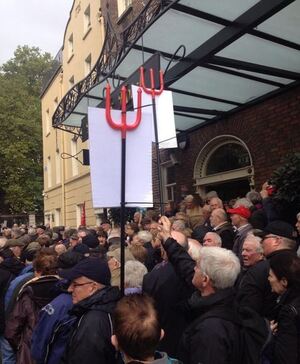
Justice Minister Alan Shatter will appear before the Oireachtas Joint Committee on Public Service Oversight and Petitions today in relation to the GSOC bugging affair at 4pm.

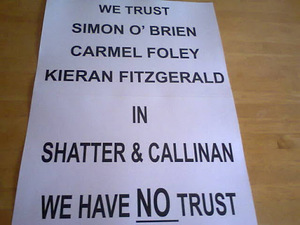
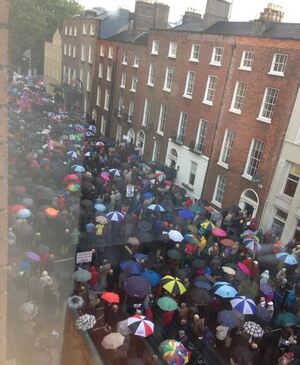
Garda whistleblower John Wilson, who created the placards above, is organising a protest outside the Dáil at this time.

He says:

“It’s to support GSOC’s Simon O’Brien, Kieran Fitzgerald and to express a total lack of confidence and trust in Alan Shatter and Martin Callinan. It’s also to highlight the abuse of numerous people by certain gardaí.”

Earlier: Putting It On Rits

ShatterDail

Justice Minister Alan Shatter spoke in the Dáil yesterday evening about the reported bugging of the Garda Síochána Ombudsman Commission’s offices during a 5.30pm debate on the matter, saying:

“It is important to say at the outset that the Garda Síochána Ombudsman Commission has informed me that, after an investigation, they concluded that no definitive evidence of unauthorised technical or electronic surveillance of their offices was found. Moreover, they have informed me that their databases have not been compromised. In other words, it has not been established that the offices of the Ombudsman Commission were subject to surveillance. Some public comment has proceeded on the basis that it is an established fact that the offices of the Commission were bugged when clearly it is not.”
…
“The issue in question arose following a security sweep, in September 2013, of GSOC’s offices in Dublin. I am informed that there was no specific concern which caused GSOC to organise the security sweep, which was carried out by a security firm based in Britain. It was a routine sweep of a nature which had occurred previously. I do not think anyone could argue that it is unreasonable for a body which, of its nature, holds sensitive information to take measures to ensure the security of its communications.”
…
“I am advised by GSOC that the sweep identified what they refer to as two technical anomalies which raised a concern of a surveillance threat to GSOC. I should emphasise that my understanding is that what was at issue were potential threats or vulnerabilities, not evidence that surveillance had, in fact, taken place. A subsequent sweep identified a third potential issue. There was no suggestion that there was any risk of unauthorised access to the GSOC databases and the documentation on them.”

Kennybug

Taoiseach Enda Kenny, above, also addressed the Dáil, saying:

“So, if you’re asking me ‘was the office bugged, what I’m saying to you, in the words of GSOC that they found, following the investigation, no evidence of sophisticated evidence of unauthorised technical or electronic surveillance of their offices found, I think that’s pretty clear.”

RTE9

RTÉ’s political correspondent David Davin-Power on the 9pm news last night, speaking to Eileen Dunne, from Leinster House.

Eileen Dunne: “David, the focus of this story seems to be changing all the time, where are we tonight?”

David Davin Power: “That’s right Eileen, the focus of this controversy has weaved about a bit but I think tonight it’s settled on the Garda Ombudsman Commission and its handling of events. The original newspaper story that sparked this controversy was pretty accurate in its detail, in that it mentioned wi-fi networks, conference phonecalls and so on but it also went on to cite unnamed sources, saying that there was ‘government-level technology involved’. Well, obviously, there doesn’t appear to have been and that raises the question of who leaked the information and, to borrow a phrase from a couple of years ago, who sexed up this particular dossier? And then there’s the question of not telling the minister, understandable perhaps at the time but scarcely credible now that the whole controversy seems to have been nothing more than something of a bottle of smoke. And then, finally, there’s last night’s statement, which infuriated ministers, aswell as the Garda Commissioner, in mentioning the gardaí specifically. Now the Ombudsman chairman [Simon O’Brien] wanted, in his comments, just to put the gardaí out of the frame completely, saying they weren’t involved in anyway but it had the effect of providing ammunition to people who have always been sceptical and suspicion, suspicious of the Ombudsman Commission. So, plenty of questions, serious questions for the chairman of the Ombudsman Commission to ponder, along with his colleagues. They appear before a Dáil committee tomorrow. They’d want to put in a pretty credible performance and present a united front, if the whole process of rebuilding trust and credibility is to have any chance of success.”

Fitzgerald

Garda Ombudsman Commissioner Kieran Fitzgerald then went on Prime Time with Miriam O’Callaghan, following the news, last night.

Miriam O’Callaghan: “So, Kieran Fitzgerald, the minister today seems pretty clear, there’s no evidence at all that you were bugged. So were you bugged?”

Kieran Fitzgerald: “Miriam, it would be very, very good if we were able to say definitively yes, or definitively no. Unfortunately, the reality of modern surveillance and intrusive surveillance mechanisms, is that it’s very often an inconclusive result. So what we got were credible threats to our own security, we hired consultants, experts, international experts to consider those for us, examine those and test them. At the conclusion of their testing and their sweeps, their security sweeps, they were able to tell us that certain things did not look likely and other things, they could not be definitively sure.”

O’Callaghan: “What were the credible threats?”

Fitzgerald: “The credible threats were three-fold. One was a piece of equipment which was connecting to an external network, a wi-fi device. Now it should have been activated by a password, in actual fact it was activated, seemingly, without the need for a password and transmitting. It did not compromise our data, it did not connect with out internal security. But, having found it, we certainly needed to take it very, very seriously. That was one. The second was more worrying, it was a conference call telephone, a conference call facility that we use, not infrequently,  and that was tested, and the test showed up what we called, in our first report, an anomaly, but it showed up something that gave them cause for concern and their judgement was that the strange behaviour of this device, in response to their test, was such that, it could have been coincidental, it could be accidental, it could be explained away but they rated in their report the possibility of it being coincidental as close to zero.”

O’Callaghan: “And the third one?”

Fitzgerald: “And the third one was a sophisticated piece of equipment that does sweeps of buildings, from an external, it doesn’t have to be in a building, just in the vicinity and that can, if you like, attack mobile phones and mobile devices.”

O’Callaghan: “It sounds like, still, like your statement last night from GSOC which more or less confirms what you’re saying now: you still believe that there could have been bugging of your building and your equipment. And that is not what the minister is saying today.”

Fitzgerald: “Well, we’ve no disagreement at all with the minister and we…”

O’Callaghan: “Well you clearly have…because he came out today saying there was none.”

Fitzgerald: “Well, what the minster actually said was that he had received a thorough briefing from us yesterday and further again today, with his officials and what he said was that we said that there was no definitive evidence of…”

O’Callaghan: “He said actually, just to quote him, he said that what was identified was ‘potential threats and vulnerabilities but there was no evidence that any surveillance had, in fact, taken place’.”

Fitzgerald: “There is no evidence to sugge-to confirm that surveillance has taken place. The minister is absolutely right and we have no, as a result of our briefing to him, we have no disagreement on that topic.”

O’Callaghan: “But on the balance of probability, Kieran Fitzgerald, do you believe you were bugged?”

Fitzgerald: “It is very difficult to say, I mean…”

O’Callaghan: “But what do you believe?”

Fitzgerald: “Well, hold on, Miriam, it would be lovely to be able to say we could be certain one way or another. What we are faced with, at the conclusion of this, is that we could more or less dismiss some of these threats and if you like, on a balance of probabilities, on others, we just do not know. What we have learned though, are the threats to our building and ensure that they no longer exist.”

O’Callaghan: “OK but on one of the anomalies you just mentioned, you said the likelihood, you know, that it’s an innocent thing was remote to zero, the possibility?”

Fitzgerald: “Well that’s what was reported to us, exactly.”

O’Callaghan: “So you can’t still believe, or say to me tonight that that would make you believe that there was some form of surveillance.”

Fitzgerald: “Well we cannot definitively, as the minister said and as I’m saying now,  we cannot definitively say that we were bugged, certainly we cannot say that.”

Later

O’Callaghan: “But was it routine, Kieran Fitzgerald? To go to a British firm? To do it in the middle of the night, to do it at weekends, or did something make you do it?”

Fitzgerald: “Can I just say, there aren’t an awful lot of people engaged in this work so the pool of people…”

O’Callaghan: “Ok. But was there something that sparked you to do this?”

Fitzgerald: “If you recall, throughout 2012, we were involved in some serious investigations and we…”

O’Callaghan: “The Kieran Boylan case?”

Fitzgerald: “And we submitted a special report to the Oireachtas, something we very rarely do, something we do only in grave and exceptional circumstances. We were obviously in a state of heightened awareness of our security at that point. And some things appeared in the public discourse that gave us rise to concern, nothing terribly specific but things that worried us and we thought this is a good time to do this.”

Watch back in full here

Members

A menu for a Valentine’s Day-themed dinner at the Members’ Restaurant in Leinster House next Tuesday and Wednesday (February 11 and 12) for €25pp.

Price includes roses on arrival ‘for the ladies’ and four courses, which include a steak option and complimentary chocolate truffles.

Prosecco will be sold for €5 a glass.

The courses:

A quick embrace:

Tony’s Cashel blue experience, pickled pear, tossed salad
Baked asparagus, lemon & lime seduction
Dublin bay prawn bisque, brown bread
Fresh beetroot & orange salad, honey & walnut dressing, croutons of love

The proposal:

Romantic duo of cod & salmon, red pepper soubise
Grilled rib eye steak, garlic herb butter
Ricotta & spinach tortellini, oregano & basil pomodora
Tray bake togetherness of chicken breast, preserved lemon & chorizo
Served with Sweet Potato & duchess potato

Sealed with a kiss:

Lover’s shortbread & fresh strawberries, on a bed of rose petals
Exotic Fruit Melody
Cleopatra’s Tiramisu
Passion fruit Mousse, luscious ice cream

Hand roasted coffee and real leaf tea

Crikey.

It’s all well and good these peNOMNOMNOMNOM

Thanks Tumbledry

Pic: Oireachtas.ie


Via Wikipedia:

“Torino was founded as “Football Club Torino” in 1906 when Football Club Torinese merged with a group of Juventus dissidents led by Alfredo Dick…”

FIGHT!

Torino FC


LuciaHusband

(Top: Lucia and Jim O’Farrell hold a picture of their late son, Shane)

Shane O’Farrell, 23, died in a hit-and-run just outside Carrickmacross, Co. Monaghan on August 2, 2011. The man who struck Shane, Zigimantas Gridzuiska, 39, from Lithuania, had 42 previous convictions in three different jurisdictions and was out on bail at the time.

After he hit Shane, he drove to his friend’s house, left the car he was driving there and walked to his home where he told his wife he knocked someone down. Neither of them contacted the gardaí or emergency services, and they went to bed.

Gridzuiska pleaded guilty to failing to stop his car at the scene of the accident, failing to failing to report the accident as soon as possible to gardai, and driving a vehicle in a dangerously defective condition. Judge Pat McCartan acquitted him of dangerous driving causing death. Gridzuiska was then given the choice of eight months in prison or to leave the country within 21 days. He chose to leave.

This morning the Dáil heard a debate on the Road Traffic Bill 2013. During the debate Fianna Fáil TD Timothy Dooley proposed that the maximum jail sentence for fleeing the scene of an accident causing injury would be up to 10 years and/or a fine of up to €5,000 instead of the current six months. He also proposed that the length of time a garda can test a hit-and-run suspect for alcohol and drugs be extended from three hours to 24 hours after the incident. Mr Dooley was approached by Shane O’Farrell’s family last summer about these legislation changes. Transport Minister Leo Varadkar said he looked forward to working with Mr Dooley on the bill.

Independent TD Finian McGrath also took part in the debate and brought up the case of Shane O’Farrell. He told the Dáil how the man who knocked down Shane was stopped by gardaí just an hour before the hit-and-run.

He started off by telling how Shane’s mother Lucia came to Dublin to meet Mr McGrath a few weeks ago.

Finian McGrath: “Her beautiful son, Shane, was killed on the 2nd of August, 2011. He was a young student here in college, in Dublin, and he was hit by a hit-and-run person and killed on the side of the road, while that person was out on bail. Now (Lucia) had written to everybody, she had made her case. She had written to the Attorney General, she had written to the Minister for Justice. I actually raised their case in the Dáil and everyone basically said, ‘there was nothing that could be done about it’. And there was an example of a case. And the reason I raise this case, Cathaoirleach, and it’s because it’s very relevant. Because the family themselves feel they’re being let down by the justice system because there was a number of incidences that happened prior to Shane’s death in this hit-and-run killing. And she describes it very, very clearly, a hit-and-run murder. An hour before her son, Shane, was killed, the particular individuals were pulled up an hour earlier at a Garda checkpoint and there was no alcohol on the driver. The driver was asked to switch as he was also uninsured.This implied that an hour earlier he was alcohol free when he murdered her son, Shane. This was not a Garda checkpoint. This was an unmarked drug squad car, sitting in a ditch, that had pulled up this car as the registration was flagged on their system. No breathalyser was used, no drink test at the side of the road. They were asked then to switch the drivers and they were searched. They were waved on. [Reads letter] ‘Our family want to stand up and tell the truth but we knew that that was not allowed. Unfortunately we are law-abiding people and we expected the State to do what they are expected to do: do their job.’ This is a letter from Mrs Lucia O’Farrell, the mother of the victim of this particular case. And there are serious questions to answer in relation to this issue: what was going on in relation to these people and these people involved in her son. And she quotes in her letter as well, and I think it’s appropriate that I mention it. She says “Her lovely son Shane would frequently say ‘you’re guilty of all the wrong you do but you are guilty of all the good you don’t do as well’. And how right he is Cathaoirleach, when I listen to this debate. So what I’m saying is, you’ve the minister in the house today. I’d ask him to look at the Shane O’Farrell case, the 2nd of August, 2011, and find out what’s going on there. I’d also like, and I’ll be contacting the Minister for Justice again on this particular issue. But I’d like to ask what about Shane’s human rights? What about Shane’s constitutional rights? This case should have been about Shane, not about hiding the truth so that some people don’t get into trouble. And the particular individual in this case got off scot-free in relation to this issue.”

Meanwhile, earlier this morning Shane’s sister Gemma O’Farrell spoke with Seán O’Rourke about her brother’s case.

Gemma O’Farrell: “Shane was my only brother. He was 23. He has just finished his Masters in Law in Trinity College, and had just handed in his dissertation, it was the 2nd of August. And he was coming home, he was training for a triathlon which was to take place in a few days time. And he went out for a cycle and he didn’t come home.”

Sean O’Rourke: “A young man, with the world at his feet, clearly a bright guy academically, interested in sport if he was doing a triathlon. What happened him?”

O’Farrell: “Shane went out for a cycle. He was hit from behind by a Lithuanian national who was driving without insurance, without tax, without NCT, who was on bail at the time, who was serving a suspended sentence  both sides of the Border and had 40 convictions the night he killed Shane. He was driving at 100km per hour and hit him from behind and didn’t break. He returned back to Carrickmacross. This happened just a couple of miles outside of Carrickmacross and left his car in his friend’s house and walked back 20 minutes to where he lived, where he told his wife that he had knocked someone down and neither of them called the guards or an ambulance and they both went to bed.”

Sean O’Rourke: “How was he traced, that individual?”

O’Farrell: “The gardaí located the car the next morning and I think things unravelled a little bit from there. This gentleman was known to the guards so things kind of unravelled from there.”

O’Rourke: “And how long was Shane left there before he was found? Was he dead when he was found?”

O’Farrell: “He was. He was found a few minutes later, we believe a few minutes later. It was on the N2, outside of Carrickmacross which is a busy road so it was two or three minutes later we believe.”

O’Rourke: “And what time of the day or night was this?”

O’Farrell: “It was about 10 past 10 at night. It was the middle of the summer, it was the 2nd of August so..”

O’Rourke: “So it was bright and..”

O’Farrell: “Well it was between the lights at that stage.”

O’Rourke: “Right. And what happened then, when the matter went to court?”

O’Farrell: “When the matter went to court, this man pleaded guilty to the offences of leaving the scene of an accident. So these are the summary offences, district court offences which carry a maximum of six months, so he pleaded guilty to leaving the scene and failing to call the emergency services. And he also pleaded guilty to driving a defective vehicle on the night.”

O’Rourke: “And the question of dangerous driving was thrown out by the judge, was it?”

O’Farrell: “He was charged with dangerous driving causing death which he was acquitted of by Judge McCartan. The difficulty for my experience, now going through dangerous driving causing death is it’s, as I see it, it’s impossible to show that someone was driving dangerously and prove that beyond a reasonable doubt in the case of a hit-and-run because the vast majority of the time with hit-and-runs there are no witnesses to an accident. So you’re never going to be able to show that the individual was driving dangerously. So there was a lack of evidence and on that basis, the judge acquitted this man.”

O’Rourke: “So, on that particular charge, so what was the maximum sentence that could be imposed then, for leaving the scene of the accident?”

O’Farrell: “The maximum sentence is six months that can be imposed.”

O’Rourke: “But, instead of which, he was given another option?”

O’Farrell: “Yes. So the judge imposed a sentence of eight months, four months for leaving the scene and four months for failing to call the emergency services. So he gave him the option of either serving an eight-month sentence or returning to Lithuania and he chose the latter.”

O’Rourke: “And this was someone who was an acknowledged heroin user, there was no question of him being tested for alcohol or being above the limit because, of what, a time-lapse?”

O’Farrell: “The law, as it stands at the moment, the gardaí only have a three-hour window in which to test someone for alcohol or drugs and this individual wasn’t, didn’t present to the garda station for over 18 hours later so he wasn’t able to be tested for anything when he was in the garda station.”

O’Rourke: “Clearly you weren’t happy with the outcome of this. You lost your only brother, a young man of 23. What prompted you then to take action and say right this isn’t good enough, we need to have a change of the law?”

O’Farrell: “So, last August 2012, so before the case actually came to trial, I approached Fianna Fáil and I raised a number of issues with them. This was one of them. And they really took it on board that this was a loophole in the law and that this was something that could be addressed and a bill was drafted to which was then launched last May by Deputy Timmy Dooley, addressing the law as it stands at the moment. So, while at then moment, it’s a six-month sentence it’s dealt with in the District Court so whether it’s property damage or you cause a fatality, six months, there’s no distinction between the two. The Bill proposes to introduce a maximum sentence of 10 years which is in line with other jurisdictions, so where you cause a fatality, a maximum sentence of 10 years may be imposed.”

Full interview here.

Previously: Meanwhile, At INM

Related: Grieving mum of hit-and-run victim claims system of justice failed son (Allison Bray, Irish Independent)

Pic: Independent.ie


Daill

Paraicc

Brian

Hannah writes:

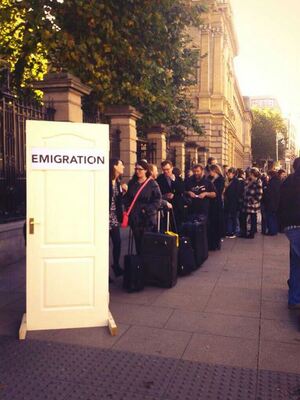
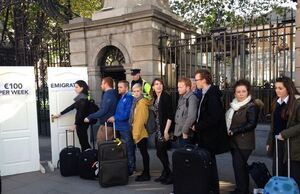
“The group ‘we’re not leaving’ had a protest against cuts to social welfare for young people. It’s impossible to survive on €100 a week. They’re giving us no other option but to emigrate.”

Previously: “You’ve Targeted A Group Of People Based On Age”

Pics: (From top) Hannah, Páraic Gallagher and Brian O’Donovan

We’re Not Leaving