
Tag Archives: Dan on Thursday

rte

dan

From top: RTÉ coverage begins for the first of five general elections held during the 1980s; Dan Boyle

Each Great Leap Forward is followed by several steps back.

Dan Boyle writes:

I first cast my vote in 1981. Ronald Reagan was the US President, Margaret Thatcher the British Prime Minister, and Leonid Brezhnev was General Secretary of the Central Committee of the Communist Party of the Union of Soviet Socialist Republics.

In the general election of that year the Trinity of Irish politics – Fianna Fáil, Fine Gael and the Labour Party, had won its usual 95% of the vote. Those of us coming of age then had little expectation that things could change quickly, or indeed change at all.

There were small signs indicating otherwise. A handful of interesting independents were elected. In Limerick, a speak as you found him socialist, Jim Kemmy, was arousing interest. The most that could be said about Seán Dublin Bay Rockall Loftus was his name.

Noel Browne was being elected for his fifth and final political party, Socialist Labour. Sinn Féin, in its Workers Party incarnation, won its first seat since 1957. The first Sinn Féin TD to take their seat in the Free State parliament.

The abstentionists were represented by the election of two H-Blocks hunger strikers. Those behind their election would later claim sole proprietorship of the Sinn Féin handle.

The Abortion Referendum of 1983 allowed some of us at least to fly a flag for another Ireland, even if we never believed that holy, Catholic Ireland was ever possible to shift.

It wouldn’t be until 1990, with the election of Mary Robinson as President, that any election I invested in yielded a positive result.

The nineties and onset of the millennium brought social change at a rate that had barely seemed possible in the previous seventy years of independent statehood before that.

Maybe those of us of a progressive bent got greedy, wanting more change more quickly. More likely having been denied change for so long, progressives have forgotten that change is never relentless nor is it linear. Each Great Leap Forward is followed by several steps back.

I fear that once again we are entering a dark age. The momentum has been gained, and the agenda has been won back by reactionaries. Hard won rights will recede amid much gnashing of teeth.

Despite that I’m not overcome with any sense of impending apocalyptic doom. Or with the feeling of powerlessness of the 1980s. Let them do their worse. They cannot roll back everything. When the argument has been won again, we will be starting from a place still far ahead from where we had begun.

Social justice can’t be guaranteed but it is inevitable. For now, at least temporarily, this is the new normal. We had better get used to it, but not for too long.

Dan Boyle is a former Green Party TD and Senator. Follow Dan on Twitter: @sendboyle

Top Pic: RTÉ Archive
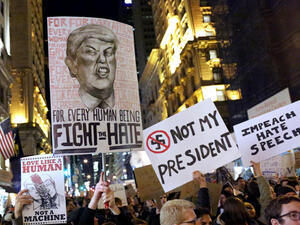
NEW YORK, NY - NOVEMBER 12: A crowd marches from Union Square to Trump Tower in protest of new Republican president-elect Donald Trump on November 12, 2016 in New York, United States. The election of Trump as president has sparked protests in cities across the country. (Photo by Yana Paskova/Getty Images)

dan

From top: Anti-Trump protests in New York, November 12; Dan Boyle

Liberal smugness has been quite content to allow previously inactive portions of the electorate to wallow in their indifference.

Dan Boyle writer:

Political correctness is in the firing line. Its existence threatened by an unlikely coalition of preciousness and prejudice. Those of the lofty left have weakened the tolerance of needing to prevent the use of any language of hate, by zeroing in on what often have been the most petty examples of such speech.

The rabid right exaggerates that the right of free speech itself has been compromised by PC practice and doctrine, when what they really are being denied is the right to express prejudice. 

PC is a convenient crutch for either the left or right. By focussing on it we are ignoring the far more serious trends that have created the shifting political sands of today.

The current shift, which we need to recognise is quite a narrow shift, is based on seeds sowed forty years ago by followers of Ronald Reagan in the US, and Margaret Thatcher in Britain.

This nexus promoted the creed that individualism rather than the common good should inform policy making. For liberals the State exists to meet unmet social needs, needs that become exacerbated in a totally unregulated society.

The real failure of liberalism has been the smug and patronising assumption, that enough of the electorate would always support the common good above individualism.

We are led to believe that this shift has come about because of the participation of those who usually chose not to vote. Those left behind, those who had come to believe that voting changed little.

This has been only partially true.

The political advance of individualism has been led by those who, on the whole, have been doing very well, thank you very much. Their motivation has been to protect their entitlement from uppity others intent on (as they perceive) spoiling their way of life.

These needed to add to their columns by attracting enough of the deactivated votes of the discontented/disconnected to make a difference. Again they have been able to do so by liberal smugness, that has been quite content to allow previously inactive portions of the electorate to wallow in their indifference.

This smugness has left unchallenged the alt. right narrative that has played so strongly to the ingrained prejudices of the individualists and their convenient compatriots from the neglected reaches of society.

This is the template that has been used just as much for Trump as it had been for Brexit, and may yet do in a number of European theatres in 2017.

For liberals to win back the narrative there has to be less head in the air, less Mr. Nice Guy. The extremes of politics, both right and left, have been well prepared to lie to secure their narratives.

Liberals seem to be more prepared to deceive themselves.

Dan Boyle is a former Green Party TD and Senator. Follow Dan on Twitter: @sendboyle

Top pic: Getty

hillarysuppoorters

dan

From top: Hillary Clinton supporters at ther Javits Centre, New York City on Tuesday night: Dan Boyle

Time to bury our misplaced faith in truth – and opinion polls.

Dan Boyle writes:

I could get angry but what would be the point. A world, not mine, exists on an entirely different set of values.

Anger is its soundtrack. It presents itself as the anger of the dispossessed. It has attracted many who are without and many who are left behind, but it is really the anger of entitlement.

The long neglected seek the unlikeliest of heroes. They don’t require logic or consistency. If it isn’t what has been there before, by extension it has to be better.

Characteristics that should be viewed as positives, such the value of experience, are deemed to be negative, if the individual is seen as an embedded part of the system. Paradoxically a maverick can be celebrated for not being experienced or competent or just by being downright gauche.

Too many years ago the BBC ran a entertainingly amusing sketch programme called Not The Nine O’Clock News. One of my favourite sketches had a social worker affecting empathy. He was talking to an interviewer saying “I know these kids. I’ve lived with them for ten years. I understand their problems. Through this I’ve come to the conclusion that the only thing that can work is to cut off their goolies.”

Gooly cutting should be an activity we lily-livered liberals could consider taking up. Decades of seeking to understand and trying to empathise with those plights we sought to identify with, only ended up with our patronising them. This is one of those factors that has brought about the world of Trump and of Brexit.

We are now living in an in your face time. To thrive requires an in your face attitude. Ours is not to reason why, ours is to shout loudly and incoherently.

Anger is an energy. Not necessarily a positive energy. It’s enough that it exists. To direct it would be to spoil its effect.

If discourse now consists of irate ramblings, the content of such ramblings need not underpinned by anything as inconvenient as facts. Time was when facts were facts. Now facts are anything you want them to be. As Homer Simpson has memorably said “You can prove anything with statistics. 62% of people know that.”

If anything is to be is to welcomed in these uncertain times let it be that we don’t need to be protected from surprise. The art of opinion polling tells us things we need not know. It leads us astray.

As we bury the effects of a past that seems to have served us badly – an unfortunate attachment to absolute truth; a far too romantic expectation that debate should be civil; or that somewhat silly belief that progress is achieved through consistent behaviour – if we also include in that burial a misplaced faith in opinion polling, then our regret need not be total.

A Brave New World awaits. We have always loved Big Brother.

Dan Boyle is a former Green Party TD and Senator. Follow Dan on Twitter: @sendboyle

trumpsupporters

dan

From top” Donald Trump supporters last month; Dan Boyle

Instead of addressing the reasons why anger has been produced, the successful political strategy now seems to be to ride this anger.

Dan Boyle writes:

For about fifty years not a lot has changed in the art of electioneering in Ireland. Most campaigning revolved around the after mass speech from an open deck lorry.

It was during the 1973 Presidential election that American style electioneering was introduced here with gusto. The late Seamus Brennan, then General Secretary of Fianna Fáil, felt that campaign needed some pizazz.

Balloons, streamers, buttons, printed t-shirts, even campaign songs were introduced to entice voters on whom the ever more faded oratory of the past was failing to move.

The 1977 General Election campaign, the one for every voter in the country election, completed this transformation. From then on everything American had to be adopted.

It has led us since to the politics of the lowest common denominator. One feature of this has been government by focus group. Killing any initiative, discouraging any out of the box thinking. If it couldn’t be approved by the marketing gurus with their groups of guinea pigs, it wouldn’t be worth running with.

This in turn has led to the rush to the centre, and with that the bunching of political parties to the point of being virtually indistinguishable from each other.

Bunching in the centre, and the near total reliance on focus groups, has increased the distance between the governed and the governing. Who needs informed consent when the straws in the wind can be gleaned through the best in up to date political technology?

At least that has been the theory. The distance created by the politics of the focus group has generated huge reservoirs of anger, an anger which may become the next trend US electoral trend we are about to follow.

Instead of addressing the reasons why anger has been produced, the successful political strategy now seems to be to ride this anger. Echo its incoherence. Never to verify its veracity.

Always to play upon difference. Vilify, demonise, objectivise, criminalise and especially dehumanise anyone who dares to speak, much less think otherwise. Dumbed down Trumped up politics. It’s coming our way soon.

It isn’t though a formula that is unique to the US. We are seeing it in the behaviour of the Brexiters, Le Pen in France, Wilders in The Netherlands, AfD in Germany and The Freedom Party in Austria.

However it is in the US now that we are seeing it at its most ugly, most blatant, and to its most obvious logical conclusion.

Conclusion is what will follow. But neither should we succumb to the political snobbery of upholding some Platonic ideal of restricting voting to those deemed to be educated enough. Informed consent through mass democracy is still our only hope.

Life isn’t simple neither should democracy be.

Dan Boyle is a former Green Party TD and Senator. Follow Dan on Twitter: @sendboyle

stop-ttip-e-cetadan

From top: Protests against CETA and TTIP in Brussels, Belgium; Dan Boyle

No trade deal is worth the introduction of anti-democratic measure to produce a newly created corporate ‘right’.

Dan Boyle writes:

CETA has been thwarted. For the uninitiated CETA is the Comprehensive Economic and Trade Agreement agreed, but yet to be ratified, between Canada and The European Union.

It was to be the precursor agreement, the John The Baptist of trade deals, before the bringing into being of the TTIP (Transatlantic Trade and Investment Partnership) agreement with the United States.

This Messiah trade deal had been expected to kickstart the global economy.

The European Union elite is now aghast. There isn’t, nor has there ever been, a Plan B. The continuing strategy will be to keep trying to make the square fit the round hole.

Anti-globalisation activists are whooping in delight. For them a new world view can be perceived. However it’s probable that both the horror of the elite and the delight of the activists is misplaced.

Eventually trade deals will be put in place. The real question is whether the interval brought about by this stumble, will be used to achieve trade deals that don’t erode the best hopes for systems of participative democracy or the structures of fair societies.

The real lesson of Brexit, of Trump in the US, and the growth of a slew of far right parties across Europe, is that globalisation (as it has been applied) stinks. In developed countries it furthers the marginalisation for those already on the peripheries of such societies.

It widens the existing unacceptable levels of income inequality. It lessens the role of the State, through democratically elected governments, to affect positive change for citizens.

The mantra for any trade deal should be that you are free to trade with us as long as you adhere to our standards; standards on workers rights, on consumer protection, on preservation of the environment.

The willingness to dilute such rights for some questionable economic benefit, has helped to create the uncertain world of today.

CETA is less of a threat than TTIP in this regard. Where the stench remains is the attempt, through these agreements, to produce a newly created corporate ‘right’ to protect profit.

Through this ‘right’ corporations would be able to sue states that produce legislation, designed to enhance the rights of their citizens, if the result of the enforcement of such rights impact on corporations’ profits.

No trade deal is worth the introduction of such an anti-democratic measure.

It is time to step back. Time to do this better. Time to admit that free trade is never quite free. Time to accept that trade is but a part, and only a small part, of a more open world.

If we can get these things right then we might begin to think of a world that is really free.

Dan Boyle is a former Green Party TD and Senator. Follow Dan on Twitter: @sendboyle

Yesterday: The Set Menu

syriadan

From top: Syrian refugee children at a refugee camp in Jordan; Dan Boyle

Some will take perverse satisfaction that the recent budget instituted a further cut in Ireland’s level of overseas development aid.

But we all lose from this parsimony.

Dan Boyle writes:

This weekend I posted my US ballot paper. The confluence of my American birth along with my partial UK residency, combined with my being Irish, has seen me vote in three different jurisdictions this year.

In making people aware of this quirky fact, it seems that I have upset some. It’s been suggested to me that I am somehow in breach of the ‘one man one vote’ principle.

I’ve always taken that to apply only to a particular election. If taken as being literal than maybe we each should only vote once in an election and then never do so again. Anytime. Anywhere.

It’s a privilege I’m unlikely to hold again. What it raises for me are questions about citizenship and residency. The having of a some sense of belonging.

We Irish have a history of migration. It has been and is part of my own family’s story. Our’s is far from a unique experience. How this has informed me is a lack of tolerance I hold towards people who argue we should ‘look after our own first’.

Outside of the likelihood that people who make this argument don’t usually seem inclined to look after anyone, the question of who gets to determine who our own are is something I find deeply disturbing.

This questioning isn’t purely an Irish experience. We unfortunately live in a time where isolationism, fear of others, and an exaggerated sense of patriotism, hold too great an influence.

Our affinities are and should be complex. We identify with the idea of community at many levels. Investing all, or a high degree of such affinity entirely towards the nation state, diminishes us all. If we ignore the international dimension of our lives we resign ourselves to living in bleak bunkers.

There are many needs within our ambit that we can and should be addressing – homelessness, growing inequality, limiting opportunities.

These are unaddressed needs whose existence shames us. Where our problems differ from those found elsewhere is that we don’t lack the means, but we are unable to provide the will towards solving these social wrongs, once and for all.

This ongoing failure on our part should never be an excuse to ignore our responsibility towards the wider World. The recent budget instituted a further cut in Ireland’s level of overseas development aid. This now stands at less than one third of one per cent of our national wealth, less than half of what we have promised to commit at the United Nations.

Some will take perverse satisfaction from this. However we all lose from this parsimony. A poorer World becomes a more dangerous World – a reverse self fulfilling prophecy where ignorance holds ever greater sway.

Nowhere can this effect be more clearly seen than the collective international response to the humanitarian crisis of our time – that of Syria.

The overwhelming number of refugees, hundreds of thousands of them, are living in tented cities in Lebanon, Turkey and in Jordan. A far smaller proportion of people are seeking new lives in Europe.

For their having the desire to live better lives, they get to be described as a hoard of probable murders intent on undermining our way of life.

Naked racism may be more obvious and more prevalent elsewhere, but that should give no comfort for us in Ireland for failing to live up to our global obligations. We live these days in a more open World, where millions move and are being moved from their homes, their communities, and their long held certainties.

For those of us who live in democratic societies, we have the privilege of encouraging the more effective use of resources, the more appropriate application of policy, the most human approach from our public services.

Wherever my vote can influence such outcomes I will always act to ensure that it will be cast.

Dan Boyle is a former Green Party TD and Senator. Follow Dan on Twitter: @sendboyle

Pic: Getty

90431915

dan

From top: Paschal Donohoe and Michael Noonan on Tuesday; Dan Boyle

The procedural aspects of the financial management of the country are not to be found in any single event at any given time.

Dan Boyle writes:

It would save a great deal of air space, bandwidth and newsprint if the budget unveiled in Leinster House this week by Michael Noonan and Paschal Donohue, would be the last Budget presented in such a way.

This isn’t so much because of its content. This year’s combination of cynical box ticking carried less obvious offence than usual. What we should put to bed is the arch and archaic protocols that seek to portray the budget as something mystical that is happening.

I got to respond directly to five budgets from the floor of Dáil Éireann. Two of these were presented by Charlie McCreevy, the other three by Brian Cowen. For those years I was the RTÉ 2 alternative to the Six One News. Apologies for that.

Not that it mattered in those Celtic Tiger Version 2 days. Those budgets were all about spending for the tomorrow that was never meant to exist.

During that time some evolution occurred, most reflecting the nature of society that was being created. The typewritten speech given at the start of the debate was replaced by a printed book. This was added to subsequently with a CD-ROM. The ‘truth’ truly did exist in many forms.

This even extended to the prose attaching to the documents themselves. The decades long use of Sean and Mary and their circumstances, to highlight the effects of taxation changes, saw them being unceremoniously replaced by Ken and Nicola, the aspiring couple of the new thrusting Ireland.

The pretence that the contents of a budget could not be revealed before the Minister stood up to speak, was stated to be a measure to prevent spooking the financial markets.

I suspected it was more a device to prevent accountability by restricting opposition spokespersons to speed reading detailed documents, whilst thinking of how to construct something coherent to say.

It isn’t as if there is even a vote on the Budget. At the end of the set pieces there are sometimes some financial measures that become effective at midnight of that day, but there is not single vote that asks the question ‘So this Budget – a good thing or not?’.

There shouldn’t be any mystery here.

The procedural aspects of the financial management of the country are not to be found in any single event at any given time. It is an everyday, year long responsibility.

We have a Book of Estimates. We have a Finance Bill. We have a Social Welfare Bill. That’s where and when the details can be analysed and decisions get made.

The real cut we should be making is to The Budget itself.

Dan Boyle is a former Green Party TD and Senator. Follow Dan on Twitter: @sendboyle

trumpfarage

dan

From top: Donald Trump and former UKIP leader Nigel Farage; Dan Boyle

While irrationality throughout the Globe may present itself in different forms, its consequences are universal.

Dan Boyle writes:

Some years ago when the scale of economic collapse was becoming apparent, John Gormley (as leader of The Greens), made a statement that appealed for a greater sense of fair play from the electorate.

In making the statement he was outlining his own sense of frustration. What he said then was that he was aware of the growing sense of anger, that much of the anger was justified, but in how some of it was being applied was ‘irrational’.

The shorthand version of this was presented as “the voters are irrational”. This wasn’t exactly the nuance he was trying to get across. He was though wrong to say it. When making a negative observation the connotation will always be developed. However he wasn’t wrong in what he said.

Since his making that comment the practice of irrationality has moved beyond our shores, and has become very much part of the international experience.

We live in a dark age. Argument and debate have been deemed superfluous. Facts don’t need to be proven. When cited their existence is intrinsic. The right to be right is instinctive. It is others who are wrong. Always wrong. Wrong about everything.

While irrationality throughout the Globe may present itself in different forms, its consequences are universal. It seeks to bring about the easy answer, the obvious target, the convenient Messiah.

It can be found in an obsession with issues, which in more normal times, would barely be given such consideration. It exists by shying away from any sense of collective responsibility. It creates the pretence that there is equivalence amid many shades of grey. It mythologises the perceived Outsider as being the ultimate in purity.

It is convenience thought for those of us who would prefer not to have to think. We now deal with the wider World through the comfort of self contained boxes of absoluteness. The need or requirement to change only applies to others. Those of us fixed in opinion live with the delusion that we no longer need to challenge ourselves, much less be challenged by others.

Future historians are to be pitied in trying to understand this context. In our time logic has become a luxury; tolerance is seen as a mark of weakness, and acceptance is portrayed as being the actions of a fool.

Not that we can be without hope. History, our story, is a cycle where bleakness sometimes holds sway. As someone who sips from a half full glass, I am seeing some signs that the glass might be replenished.

To achieve that we need an intellectual equivalent of the three hundred Spartans holding thousands at bay at Thermopylae. A vanguard that protects free and open thinking. There is a battle ahead to bring back the light.

This battle between the thoughtful and the unthinking may linger longer and may yet take us into darker recesses, but it has to be fought. It has to be won. There can be no thinking about this.

Dan Boyle is a former Green Party TD and Senator. Follow Dan on Twitter: @sendboyle

Pics: Getty

peadardan

From top: Peadar O’Donnell and  Dan Boyle

Radical socialist Peadar O’Donnell never let pragmatism interfere with his principles.

Dan Boyle writes:

We’re now half way through our national decade of commemoration. The fears, of some of us, of re-opening old sores don’t seem to have come to pass. It may be that the more difficult remembrances are still ahead of us. We can only hope that the spirit that has pervaded so far can continue.

Part of the success has been in bringing about a greater understanding, that the Ireland of one hundred years ago was a far more complex place than we’ve ever considered it to be.

I’ve been greatly taken with the double headed An Post stamps showing an Easter Rising participant alongside a Great War counterpart. As a country that obsesses about our past, being able to so respectfully, is a long awaited sign of maturity.

I think we are learning more about ourselves away from the big ticket events. It’s the smaller, more hidden stories that are telling us more about the journey that has taken us here.

I was disappointed last weekend to learn, too late, and so not be able to attend an event, on my Dad’s island of Arranmore. It was marking the arrival there, as a teacher, of the radical activist Peadar O’Donnell, one hundred years ago.

He only taught on the island for about two years, but certainly made his presence felt. Outside of his teaching he formed there a union for migratory workers, which many islanders joined.

Living half their lives each year as Tattie Hokers in Scotland was a reality for the islanders. My grandparents were part of this annual exodus.

O’Donnell’s promotion of an agrarian socialism shook the complacency of the established order of the early days of the state. This establishment did what it could to ensure that its potential never took hold.

More of an allergic than a reluctant politician O’Donnell never let pragmatism interfere with his principles. Elected as an abstentionist TD in 1923, he made a number of attempts of to form a radical socialist party.

The first attempt, Saor Éire, was declared illegal by the Cumann na nGaedheal government. The second entitled, Republican Congress, succeeded in having a number of councillors elected before succumbing to the Behan dictum of splitting at its first convention.

O’Donnell achievements on issues like land distribution, and bringing an end to land annuities, were brought about outside of parliamentary politics, towards which he held much disdain.

Because of that he is seen more as a busker than a concert performer on the stage bill of Irish politics.

Before the end of O’Donnell’s life my Dad had a conversation with him. Being too young I didn’t appreciate the significance of the meeting or seek to ask what they had talked about.

We could do worse than listen now to what he was saying then.

Dan Boyle is a former Green Party TD and Senator. Follow Dan on Twitter: @sendboyle

Pic via Donegal Daily

90214368

dan

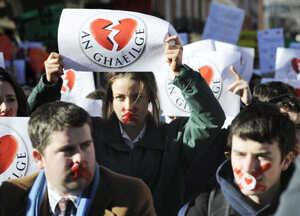
From top: Irish language protest at government buildings; Dan Boyle

The author hails our first language and gives Little Irelanders a tongue lashing.

Dan Boyle writes:

Two curious events have occurred in recent weeks that question our understanding of what we mean when we think of Irish culture.

The first event happened in Cork, although I say that with no sense of pride. Here, a bar owner/restaurateur (an affable man, quite popular in these parts) dismissed an employee for addressing customers in the Irish language.

His argument was that he wouldn’t expect his Polish employees to address his customers in their native language. English being the language of the hospitality industry, the lingua franca, so to speak.

In this our friend is wrong. As honourable and poetic as the Polish language is, its use isn’t, like Irish, protected by our Constitution.

The second event saw a GAA referee in Galway insist that players from a Gaeltacht team stop speaking to each in Irish lest they would be insulting him. You would wonder what the protocol for this would be for international soccer games?

Those who have made it thus far into my entreaty may have noticed that I’m writing this in English. Having been born in the US I had the option of not taking the subject of Irish up at all when becoming part of the education system here. I choose to try to catch up, reaching no further than a passable standard.

Again not something I take a great deal of pride in. My father was a native speaker. That said his Donegal dialect, in its intonation and delivery, sounded to me like a very foreign language!

My Mam did her Ardteistiméireachta as Gaeilge. Her Irish was Munster Irish, the RP version of the language. It’s a wonder my parents could communicate at all.

Immersion in the language did not happen for us while we lived in the States. I was grateful though that my parents did disabuse us of the notion that the Erin Go Bragh version of Ireland, so beloved of many in Irish America, was not an Ireland we were a part of.

I could have continued with our shared indifference towards our national language if it hadn’t been for my recent sojourn in Wales.

I was really impressed with how the Welsh have made their language a living language. From what I could see this has been because of the emphasis on spoken language, as opposed to the defeatist emphasis on grammar in how Irish is taught.

It was expected that all election material there had to be bilingual. Making my efforts at proofreading quite pathetic.

Most of the interactions the Welsh have with their language are seen to be positive. There it is seen, not only as an important cultural icon for them, but also something that assists in the learning of other languages.

It has made me want to acquire some cúpla focal eile, despite the behaviour of Little Irelanders wanting us to be otherwise.

Dan Boyle is a former Green Party TD and Senator. Follow Dan on Twitter: @sendboyle

Rollingnews