
Tag Archives: Dan on Thursday

IrishSupportersPosters_largedan


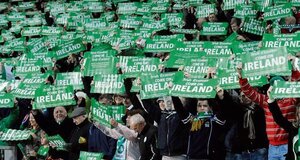
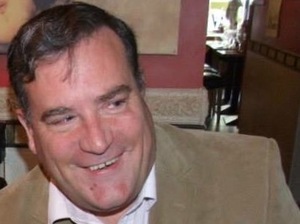
From top: Irish Rugby fans and Dan Boyle

Tight heads.

Loose heads.

And more than one flanker.

Who will answer Ireland’s call?

Dan Boyle writes:

Now that the Rugby World Cup is up and running, we can assess the health of the Irish squad, in a campaign that for many will be their last.

Full Back and Captain: E.C.B (Enda) Kenny
Kenny has been criticised for not leading from the front. He has seemed more inclined for others in the team to do his dirty work. More likely to surround himself with team members than operate under his own initiative.

Right Wing: Leo (The Lion) Varadkar
Leo will reliably hug the right hand touchline. If he could he would try to extend play even further to the right.

Inside Centre: M.N.M (Mourning) Noonan (Knight)
The veteran of the side. The jury remains out on whether he has over stayed his welcome. Annoys the rest of the squad with his constant singing of ‘There Is An Isle’.

Outside Centre: Brendan (Wolf) Howlin
Diminutive in stature he succeeds in making himself appear larger than life through puffed out self importance. The squad member most likely to come out of the dressing room last.

Left Wing: Alex (Smart) White
One of the more recent entrants to the squad. Not particularly comfortable in this position as he keeps crowding those to his right.

Out Half: Joan (Laporte) Burton
Being half out Joan bears the burden of Labour club mates in being misunderstood or miscommunicated by.

Scrum Half: Francie (Fitz) Fitzgerald
While new to this position Francie seems a better option than the predecessor in the role, Alan (Chatter) Shatter, whose wayward passes couldn’t be picked up by any of his teammates.

Open Side Flanker: Richard (Dick) Bruton.
Survived the experience of being turned down as captain by his club side. Survival seems his prime asset.

Number Eight: Simon (Air Apparent) Coveney
His natural height advantage is not made best use by conflicting management tactics that require him to either dig in, or fire salvos at the opposition.

Blind Side Flanker: Jan (Claude Can Damme) O’Sullivan.
Blind side had been seen as an ideal position for the Labour club member. However O’Sullivan has shipped most of the blame for a recent shock defeat by a team from the junior ranks.

Second Rows: Paschal (Theorem) Donohoe and Heather (Gloaming) Humphreys
Both automatic choices for being well hidden within the pack.

Tight Head Prop: Charles (Right Charlie) Flanagan
Seems ill suited to international duty. Is not helping the national team assert its position.

Loose Head Prop: James (Really) Reilly
Another whose position has been changed in the hope that he would carry the ball less.

Hooker: Alan (The Bull) Kelly
With an epithet earned more from poor temperament than physique, he seems to perform particularly poorly in waterlogged conditions.

Recently the team has been showing dangerous signs of complacency, believing their own training notes. It could succeed if an appropriate of humility were to be found. However, having disappointed consistently since 2011, it isn’t thought than a turnaround in performance is possible.

Dan Boyle is a former Green Party TD. Follow Dan on Twitter: @sendboyle

leinster-house

dan

 By Dan Boyle

(with apologies to Myles na gCopaleen)

What contradictory emotional state is expressed by a political representative when asked that question?
(S)He is glad that question was asked.

What unnecessary adverb is added to express disappointment at being asked that question?
(S)He is really glad that question was asked.

What added phrase is necessary when after three minutes no answer to that question has been given?
I am getting to that question.

What phrase, found in the future conditional tense, creates the promise that all will be right eventually?
The phrase is going forward.

What timescale is given to decisions made today eventually bearing fruit?
After the election after next.

What unit of intensity must people possess to be the beneficiaries of government policies?
They must be hard working.

What length and duration must an economic plan be?
It must be long term.

What sports analogy should no issue ever be?
A political football.

At what radial intersection is the country to be found at every coming election?
At a crossroads.

What serious consequence to important pacific endeavour follows criticism of any type, of the words or actions of the Sinn Féin party?
It damages the Peace Process.

What exaggerated expression of seriousness must be applied to every disagreement that occurs in Northern Ireland?
Such disagreements must always be described as a crisis.

What legal requirement is not said to exist, if individual approval has not been given in exercising access to the utility of water?
No consent no contract.

What sense of direction should apply to the payment of water charges?
No way

From where should this direction be applied?
From many places – days out in Dublin; football matches in Portugal; or swimming pools in Florida.

To what state of physical well being are many public bodies thought to be in their utilisation?
They are not thought to be fit for purpose.

In whose interest are all political decisions made?
The national interest.

Whose debt is not it?
It is not our debt.

Who is responsible for everything in the country that is working well?
The Government is.

Who is responsible for everything in the country that isn’t working well?
Somebody else is. Anybody else is.

What type of failure does government admit to?
A communications failure.

To what political party does communication failure most impact upon?
The Labour Party.

What alternative state negates a forced resignation of any high level public official, not being seen as a dismissal?
When such public officials retire.

If the Fianna Fáil party is unable to be in government with the Fine Gael party or with the Sinn Féin party, who can it be in government with?
No one. It is a perfect state of disgrace.

To what extent does the six syllable word sustainability feature in Irish political debate?
To no extent at all.

What time projection for this nation are our young people?
Young people are our future.

What type of coagulant are our young people also considered to be?
Our life blood.

Why are undocumented Irish people in the United States considered different to economic migrants who come to Ireland?
They just are.

Who is the Minister for the Environment?

There is no Minister FOR The Environment.

What is the relationship between Tribunals of Inquiry and subsequent convictions within the Irish judicial system?
There is no known relationship.

There is only one DOB.
Thou shalt take the name of the Lord thy DOB in vain.

If a war is over why does armed conflict continue? If an army has been stood down, why does a withered husk of an organisation still remain? If a tree falls in a forest, and no one is there to hear it, did it ever fall?
Don’t ask me. I’m not God.

Dan Boyle is a former Green Party TD. Follow Dan on Twitter: @sendboyle

CM6vyTPW8AEAaHh

dan

From top: Mural in the car park of Dalymount Park, Dublin last week; Dan Boyle

Not for many in Ireland a “common feeling” with the rest of the World, or the people who live in it.

We do it differently.

Dan Boyle writes:

I’m a fan of the Warren Beatty movie Bulworth (1998). The main character, a US Senator, having arranged his impending death, begins to speak and act according to his real convictions. A kind of Donald Trump of the left, he finds his offensive honesty strikes a chord with the people.

For the first time in 24 years I won’t be contesting the next general election for Dáil Éireann. I want my Bulworth moment.

(pause)

IRELAND COP YOURSELF ON.

Too many of us swallowed the belief that wealth was easily attained and we deserved it. Wealth is rarely created, more usually it is appropriated. For a couple of decades, through our corporate taxation policies, and through a grandiose pyramid scheme of adding a zero to property values, we believed this would be the making of us.

It wasn’t without value. The short term cash surpluses that arrived did allow us to catch up with much needed infrastructure. The fact the some pockets were filled unnecessarily was accepted. It was the Irish way. When the blown up balloon blew up, the real surprise is why we were surprised.

We had become one of the richest countries in the World. Even after our economy was devalued by a fifth, more than most countries, we remained one of wealthiest countries in the World. How wealthy? In 2014 the World Bank lists Ireland as the tenth wealthiest nation in the World, on a nominal GDP per capita basis. The IMF (boo hiss) places us eleventh. In 2013 the United Nations lists us as seventeenth.

Ah but what about inequality you say? There we’re not even as bad as we might think. Between 2007 and 2011 the burden of economic adjustment was borne properly and disproportionately by the richer sectors of our society. Since 2011 this began to change when the poorer sections, this government determined, should carry more of that burden. But even in 2014 Ireland remained below the European Union average for inequality.

None of this matters while we are masters of constructing the myth of Irish exceptionalism. Not for us normal international standards of capital taxation or having to pay for utilities. Not for many of us any common feeling with the rest of the World, or the people who live in it. We do it differently. As long we feel good about ourselves, none of it has to make sense.

Now we are being confronted with what real misery, poverty and inequality in this world is all about. Our response? Sadly too many of us demur, thinking if we are too generous, too giving, too human, we may affect, adversely, our own well being.

Do we have problems? Many. Most caused by a sleeveen approach to governance. Who voted for this approach and those who exercise it – you did. Even if you didn’t vote your non-participation allowed for it to happen.

Who are those deemed possible replacements for our failed politics? It’s those who never want to be in government. Those who are petrified with having to make any decision that might affect this form of popularity they have never before experienced.

Whether they are the whatever you want independents, the Castleknock Socialist Collective, or the bomb no more kill no more ‘republicans’, each are in their comfort zone of telling people what they want to hear, never wanting be honest with people.

Can’t be any worse you might think. That may turn out to be true. I suspect that is less likely to happen. Whoever the torch gets handed onto, the only thing that is certain is that we will get and continue to have the politics we deserve. The politics that reflects who we are as a society.

Dan Boyle is a former Green Party TD. Follow Dan on Twitter: @Sendboyle

CorkCityView_largedan

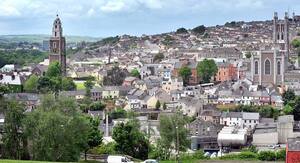
From top: Cork city; Dan Boyle

The proposed introduction of ‘unitary authorities’ – “two units of the lowest level of government” – for Cork and Galway – is a further assault on democracy in Ireland.

Dan Boyle writes:

Forgive me for being parochial for once….

You may dismiss what follows as the ravings of one who clings to the delusion of a ‘real’ capital. If so move on. What I write here is in no way informed by the banter that makes up that mythological argument.

I’m angry. More angry than I’ve been about any political issue for a long, long time.
I see what is happening not only as an undermining of my own sense of place, but also having me question what faith, if any, we place on democratic values in this country.

Recommendations are being made in Cork and Galway that would see unitary authorities being established in both counties.

Put this into context. Cork county with an area of 7500 sq km, and Galway county at 6000 sq km, together are larger in size than Northern Ireland. Between them their area is the equivalent of the size of three European Union member countries – Cyprus, Luxembourg and Malta.

Their collective population is more than twice that of Iceland. And yet it is being thought sufficient that two units of the lowest level of government can administer areas of this size.

It’s something that I should have seen coming. During John Gormley’s tenure as Minister for the Environment, a Green Paper on local government was produced. I found it anodyne. It was written by civil servants in civil service speak. The verbs used – review, examine, investigate – were deliberately vague to justify any subsequent decision. Or no decisions at all.

After a further year a draft White Paper was given to us in the Green parliamentary party. As we were considering its contents Fianna Fáil ‘sources’ were briefing the media that town councils were to be abolished, something they then thought to be a good thing.

I was horrified. The thrust of Green policy in this area was to make democracy more diffuse. The proposal had come from civil servants within the department in pursuit of a long term policy agenda. I told John I couldn’t stand over that. It seemed to confirm his own qualms. The draft White Paper was withdrawn and was never published.

Another proposal in that discarded paper was that a unitary authority be established in Limerick. Only Limerick was mentioned. There seemed to be some logic in sharing workforces and administration, but why would Limerick have to lose its City Council?

When Phil Hogan became Minister he enthusiastically adopted his officials’ recommendations. Town Councils were abolished. Limerick and Waterford became unitary authorities. Regret was expressed, a regret that counted for nothing.

Later, without any sense of irony, Brendan Howlin mused that his biggest regret, during this government, was having to abolish town councils. The new Minister for the Environment (and Deputy Leader of the Labour Party) doesn’t seem to be deviating from his officials’ policy.

Indeed it has been Alan Kelly who has established the review groups for Cork and Galway. Groups that seem determined to deliver their pre-determined views to apply a further scalpel to local democracy in this country.

Brian O’Nolan (who as a civil servant worked at the Customs House for the then Department of Local Government) or his alter egos of Flann O’Brien and Myles na gCopaleen, could not concoct a more surreal situation, where the department he worked for wanted to bring about less local government.

Dan Boyle is a former Green Party Td. Follow Dan on Twitter: @sendanboyle

90330812dan

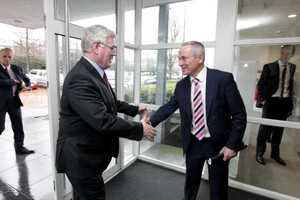
From top: Eamon Gilmore and Richard Bruton ; Dan Boyle

President Mary Davis.

Taoiseach Richard Bruton.

Two Greens in cabinet.

2007-2015.

An alternative history.

By Dan Boyle:

June 2007. The Green Party negotiators were chastened on withdrawing from talks on the formation of a government, but they wouldn’t be asked back to the table by Fianna Fáil.

Bertie Ahern, who wanted the assurance of additional Green votes, was re-elected Taoiseach by the members of the outgoing government, which included the much reduced Progressive Democrats and the gene pool independents.

Within a year testimony at the Mahon Tribunal had undone Ahern. Brian Cowen was elected leader of Fianna Fáil by acclamation.

Before being elected as Taoiseach Cowen sought talks with the new Labour Party leader, Eamon Gilmore. Stressing the need for a government with a stronger majority, he also stated that the 1993-94 government was one he felt was working and he wanted to re-establish that ‘natural’ relationship.

In June 2008 the second FF/Labour government was formed. The PDs and gene pool independents were jettisoned.

Eamon Gilmore was to be Tánaiste one of four Labour Party ministers with an additional five Labour Ministers of State. Brian Lenihan was appointed Minister for Finance.

One of the Labour’s conditions for entering government was an immediate budget, the effect of which was to greatly increase public expenditure.

The PDs, who had been discussing winding down the party, select Liz O’Donnell, now in the Seanad, as their new leader.

The Dáil had barely reconvened to consider the finance bill when a meeting was requested by the heads of the major financial institutions, to discuss fears of threats to the liquidity of banks.

The meeting hosted by Brian Cowen, was also attended by Brian Lenihan and Eamon Gilmore. It decides the government should introduce an all embracing bank guarantee.

Huge adjustments needed to be made to the finance bill, which included the introduction of a new universal social charge on gross income.

Whatever public goodwill was held by the government quickly dissipated. In the Local and European elections in 2009, Fine Gael and Sinn Féin were the big winners. Brian Crowley was the only FF MEP elected. Labour failed to win a seat. In Dublin, Eamon Ryan won a seat again for The Greens.

In the the resulting Dublin South by-election Liz O’Donnell returned to the Dáil.

Despite successful midterm elections a push against Enda Kenny begins in Fine Gael, where mumblings grow over his parliamentary performance. This results in Richard Bruton becoming leader. He appoints Lucinda Creighton as his deputy.

Labour in government tries to push a social change agenda and forces a referendum on Blasphemy, which passes, while also introducing civil partnership.

Public finances continue to deteriorate. By the middle of 2010 negative noises from Europe force the government to apply to the International Monetary Fund.

Collectively FF and Labour determine to serve full term to seek to regain lost public trust.

In 2011 the government selects Michael D. Higgins as a joint candidate. He loses to independent candidate Mary Davis.

Under the tutelage of the Trioka a number of measures are introduced, including water charges and a property tax. Three quarters of the budget adjustment is achieved by the time of the general election in 2012. The sad death of Brian Lenihan had seen Michéal Martin take over the Finance portfolio.

There is no political benefit. FF loses half its seats, Labour slips into single figures. Fine Gael, and to a lesser extent Sinn Féin, are again the big winners. Three Greens and two PDs were elected along with fifteen others. Michéal Martin becomes leader of Fianna Fáil.

Fine Gael, by far the largest party, forms a government with nine Labour and three Green TDs. Joan Burton becomes Tánaiste but is one of only two Labour cabinet ministers. Trevor Sargent becomes Minister for the Environment, with his colleague John Gormley a new Minister for State with responsibility for development aid.

Within six months of the new government the Trioka withdrew and Ireland came out of the IMF programme. Despite engaging in austerity light the new government was soon enjoying similar unpopularity levels as its predecessor. The Local and European elections of 2014 were not kind to any of the government parties.

By 2015 talk of a new political party being established and being successful was reaching a crescendo. The government’s main hopes to regain public support were for the country’s rugby team to win the World Cup, and for a new national spirit being found during the centenary 1916 celebrations…

Dan Boyle is a former Green Party TD. Follow him on Twitter: @sendboyle

(Mark Stedman/RollingNews)

poll

dan

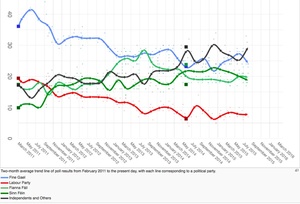
From top:  Polling patterns 2011-2015; Dan Boyle

Ignore the polls, Sinn Féin, the new parties and the ‘Megaphone Left’.

The next General Election will probably give us more of the same (minus Labour).

Dan Boyle writes:

One of staples of silly season journalism is predicting the outcome of the next general election, and from that the resulting government. They usually tend to be wildly wrong. So knowing the existence of the practice and the latitude that accompanies such prognostications, these are my somewhat modest predictions.

Between them Fine Gael and Fianna Fáil will have a majority of votes and Dáil seats. A bare majority, a long way short of the 90% levels that were once achieved.

While we’ve become more socially liberal, we remain an economically conservative people. FG/FF support reflects that. Most of us want to believe that low taxation can deliver good public services. More worryingly, many of us are also prepared to accept growing inequality as a unavoidable consequence of economic advancement.

Fine Gael and Fianna Fáil will be quite close to each other in terms of seats. It shouldn’t be a surprise if FF has the greater numbers.

Sinn Féin will make a further advance, perhaps an extra dozen seats. This will fit in with their masterplan but the progress will seem less fluent that it has been. There would be a couple of reasons for this. Opinion polls overstate SF support. Some say they will support the party for a shock effect, others want to but not enough to vote. The other factor is that the declared support seems to be stabilising, in Northern Ireland, as much as it is the Republic.

The SF masterplan will only see the party enter government if it is to be the majority of such a government. That won’t happen in 2016. Their hope is that it can happen from 2020 onwards. That would have to be subject to further analysis.

Labour seems to heading to a single figure representation in the next Dáil. The party’s lowest ever representation in Dáil Éireann. In many ways this is sad. As the longest established party in the country its decline should not be celebrated. For much of the history of the State, the party has offered the only political outlet for those who wanted to think and be otherwise, in this often all too stultifying country.

The political activist in me has less sympathy. Labour hugely over promised in 2011, believing a conceit that a window existed for it to become the largest party in the Dáil. This hubris has been what has led to its fate at the next general election.

Which brings us to the independents and ‘others’. That convenient catch all category that doesn’t tell us an awful lot. It’s the plague on all their houses vote, a vote that is itself split and split pretty evenly.

About half this vote is for newly emerging and non-traditional parties. Ten TDs would now carry these affiliations. This number is likely to double in a new Dáil. Renua and the Social Democrats will add to their numbers but not significantly, not having had a long enough lead in time. The next parliament will determine whether either party can be sustainable into the future.

There will be a Green Party presence again in the next Dáil. Whether this will be a plural presence will depend on circumstances.

Apparently the other left wings parties, who for convenience I will refer to as the Megaphone Left, are in discussion about presenting a united front. There is an obvious logic in this but it is unlikely to deliver many additional seats. Mick Barry in Cork North Central would benefit from such an arrangement. The other question is whether Clare Daly, Joan Collins, Mick Wallace or Seamus Healy will involve themselves in such an alliance.

Which brings us to the Maverick independents. I suspect that despite the larger vote, it will dissipate between a larger number of candidates and not deliver too many additional TDs.

Many independent TDs are and have been strong and excellent representatives. Too many though are blowhards, riding a zeitgeist of public disgust at a political system unwilling to reform itself.

As to what government we will have, it will involve Fine Gael and Fianna Fáil. It may be a coalition. It may be a supply and confidence arrangement. There may be a rotating Taoiseach. The one certain outcome is that there will not be a natural coming together of these parties. That may take another five years

Dan Boyle is a former Green Party TD. Follow him on Twitter: @sendanboyle

Hi-Bdan

From top: The Hi-B bar, Cork, Dan Boyle

Having missed out – so far – on two modern ‘rites of passage’ – getting barred from Cork’s Hi-B bar and sued by Denis O’Brien – what is Dan Boyle doing wrong?

He writes:

There is a bar in Cork. An excellent bar, a bar oozing with character. The size of an average living room, the Hi B is a bar that everyone should get to visit. It is an essential part of the Cork experience.

For those of us who grew up there it was not only a great place to be, it also represented a rite of passage that as young people we were expected to go through.

The owner of the bar was eccentric in the extreme. The way he might look at you, or the wrong answer to the most obtuse question he would ask, would determine if you were to be barred. Being barred became a badge of pride because eventually everyone was.

Everyone that is except me. It irked me and still does. Was I that bland, uninteresting and boring?

In recent weeks the unaccepted rebel in me has again been tormented, as I realise that I may be the last person in this country not to be threatened to be sued by Denis O’Brien.

And I can’t understand why. I’ve always understood the difference between creating wealth and accumulating it. I’ve known the advantage of knowing people who can convert public assets into private gain. I’ve especially understood that bullying is far more successful when you can pay the legal system to work on your behalf. Still no sign of a writ.

Even a writ by association would mollify me. I urge you Denis, whose perfect character has been so cruelly misrepresented, to cast your net further to include anyone who has ever been associated with those bodies, who have offended you and have refused to submit to your whims.

I have been a member of the Dáil’s Committee on Procedure and Privileges. I’ve written articles for The Irish Times. I’ve appeared on RTÉ news and current affairs programmes. I have liked and have reposted posts from the consistently brilliant Waterford Whispers News. I’ve even been known to provide copy for the notorious site Broadsheet.ie.

You and your legal minions have slighted me Mr. O’Brien. You have judicially challenged my sibling offenders, and have left me naked and isolated amongst my compatriots.
I am hurt and ignorant of what it is I haven’t said about you that you should marginalise me in such a way.

I haven’t been shy to state that I welcomed the findings of the Moriarty Tribunal. Especially those findings which showed that ethics in terms of public affairs and business practices had been fatally compromised.

I hoped, and still hope, that those findings could themselves be the subject of legal proceedings that can bring prosecutions against those whose actions have been contrary to the public interest.

I have condemned those who have criticised others whose decisions and analysis in this process has been questioned. Although I do have some sympathy for the view that any process that does not produce a result that isn’t personally acceptable is flawed. My fifteen year old self is especially agreeable to that notion.

I think where I may be going wrong is that I’ve never recognised that the value of a person could be measured in terms of currency or capital assets. It is human rather than economic values that should matter. Values like stoicism, maturity, generosity of spirit and even integrity, are those that really matter.

Unlike myself, Denis O’Brien was born in Cork. I wonder if he was ever barred from the Hi B? If he wasn’t then maybe we should form a club.

Dan Boyle is a former Green Party TD. Follow him on Twitter: @sendanboyle

(TripAdvisor)

arranmore19
dan

From top: Graveyard on Arranmore, Co Donegal, Dan Boyle

Mingling with ‘royalty’ at a family gathering on Arranmore island, Co Donegal and struggling with poor wi-fi, Dan Boyle writes:

I’m in my Father’s place. The Weather App on my iPhone, not wishing to be precise, locates me at the North Atlantic Ocean. It’s Arranmore Island off the coast of Donegal. I’m here for a family gathering. Not a wedding nor a funeral, just a once off occasion to share time with those with whom I have a genetic imprint.

My uncle, the eldest surviving brother since my Dad passed away, is King of the Island. It’s a honorary title but it does allow us to wallow in a pretence of being a ‘royal’ family.

Our being here coincides with the marking of other events. The primary school my Dad went to was opened one hundred years ago. Peadar O’Donnell, the radical socialist when that term meant something, taught there. He would still have something to say about people, place and dignity.

In the Seanad, in an act that some might say abused my position, I argued for retention of the one teacher twelve pupil school, I was glad that for once I seemed to be listened to.

A second occasion being marked is the sixtieth anniversary of the evacuation of the adjacent much smaller island of Inniscarra. A village street structure there stares poignantly up at its still inhabited bigger brother. The name of the island comes from the Irish ‘Island of the Sheep’. That’s just what it is, no irony, no overworked analogy.

Arranmore exists through the kindness of strangers. Strip by strip islanders have been denied the means to better provide for themselves. They can’t fish, there are few fish left. They can’t grow as the peaty soil doesn’t allow for it. There is some livestock. Only tourism offers some capacity.

Employment is exported to the mainland and beyond. Family life becomes a weekend activity. One of the skills that has been developed is that of tunnelling. Gangs of men from here have been linked with key infrastructure projects such as the Channel Tunnel.

My Dad used some of the accumulated expertise when he worked as a dynamiter at an uranium mine in Canada. My Mother told me only recently how he had been approached by ‘the lads’ to use his skill to help ‘the cause’. It seems he took great satisfaction in telling his hopeful recruiters what he thought of their cause and what they were doing to realise it.

What Arranmore needs, what all islands need, are the tools and infrastructure of the 21st century. This is the Digital Age where in theory work can be done from anywhere. Being perched on one leg with my iPhone out of a window isn’t exactly the ideal working environment.

Other countries, like Denmark, take the idea of sustaining island life more seriously, putting in place programmes to achieve those goals effectively. For island life we can also read life in rural towns and villages. There continues to be no real spatial policy in this country. A bloated Dublin continues to vacuum life from the rest of country. I’m tempted to summon up my Dad’s dynamiting skills for some more creative purposes.

That would, at least, give me another reason to remember him. Fifteen years ago this month he passed away. While letting nature take its course he seemed to plan his passing. He spent his last three months on the island arranging for all his grandchildren to visit him. When he lapsed into a coma after his third bout of cancer in twenty years, he was transported across the island on hay on a tractor and trailer. The island’s ambulance being repaired at time.

Micheál Martin was then Minister for Health. I was so angry at him because of that but eventually realised it had nothing to do with him. Besides he had his own reasons to grieve my Dad’s death.

It was Letterkenny General Hospital where my Mother and I had to decide to switch off his respirator. Cork where he was buried. His soul we knew stayed on the island. It’s what and why we go to visit.

Dan Boyle is a former Green Party TD.

90388187dan

From top: John Gormley (top), former Government Minister and Leader of the Green Party arriving at the Dail for the Banking Inquiry yesterday; Dan Boyle

Attending the Banking Inquiry with John Gormley on a bill that includes Mary Harney…

Something rings a bell.

Dan Boyle writes:

The quintessential Cork job is currently being advertised. For a giddy few moments I considered applying. St. Anne’s Church in Shandon is looking for someone to manage the bell ringing there. Whoever gets the job would instantly acquire perfect Cork credentials. Although I suspect after a few months of working there a Quasimodo type madness may set into their consciousness.

I’m thinking of this job, as a means of diversion but also as a very laboured literary device to justify the title of this piece. Where I’m sitting I sense that bells, or least things on which bells are attached, if not being rung are certainly being pulled.

I’m in the main committee room in Leinster House 2000. I used to sit around that table thinking I could change the World, or at least make the country a better place to be. Even changing procedures proved impossible.

I’m here at the Banking Inquiry with John Gormley. For some perverse reason the Inquiry has decided he be questioned at the same time as Mary Harney. The previous week The Taoiseach tagged team with Richard Bruton on behalf of Fine Gael. Labour’s ‘Dancing With The Stars’ routine was Joan Burton uncomfortably alongside the rapier wit of Pat ‘Zorro’ Rabbitte. Now the two parties who had been making up the numbers in government, the PDs and the Greens, were being asked to share the one berth.

Of course it was all part of a deliberate choreography. I remembered how a similar thing had happened to me, in the late 1990s during a by-election in Cork. Candidates were invited to participate in a political discussion programme hosted by Frank (Mahon Tribunal) Dunlop and Fergus (I’m not a Spin Doctor) Finlay.

The two presenters sat in the gaps between three strategically arranged couches. In the centre couch sat Fine Gael’s Simon Coveney alongside Toddy O’Sullivan of the Labour Party. To the right sat Sinéad Behan of Fianna Fáil who was with Peter Kelly of the PDs.

I sat on the left, mostly out of shot. With me was the candidate of the Natural Law Party. The inference was clear – this was the mad couch. To make the inference absolutely clear Fergus Finlay turned to me for my first question stating “Wouldn’t it be true to say that the two of you share many of the same policy positions?”

Now The Greens have never had a policy on levitation. I have heard that Labour Party strategists are considering adopting it as one of the better means out their current electoral situation though.

For those who engineer these situations there is an inherent logic to this. Politics is about perception. Only an idealist would think that politics should have depth, coherence or even honesty.

This is the context in which John Gormley is trying to explain. It is for the most part an impossible task. The narrative has developed that The Greens in government were dangerously naive, passive in the face of some of the worst governance the country has ever experienced.

That is narrative as perception. It is a perception helped in its development by The Greens choosing to do their questioning, their proposing and their counter proposing not in any public way, but strictly within the confines of government.

In relation to the Banking Inquiry there isn’t any need to ask who is tolling the bell. They appear obvious in their Quasimodo like grotesqueness. From its inception they have been perched around the bell tower knowing which bodies were to be thrown off. At least that’s my perception.

Dan Boyle is former Green Party TD

Top pic:RollingNews.ie

Irish-cottage-scenedan

From top: Donegal cottage, 1930s: Dan Boyle

Austerity now.

Austerity Then.

The similarities are not just superficial.

Dan Boyle writes:

It was The Mother’s birthday last weekend. She was born in the 1930s. It occurred to me that the time span between now and then, when applied to before her birth, would have brought her life towards the end of The Great Famine in Ireland and before the start of the American Civil War. So much history enveloped into two life spans.

Thinking of when she was born brought to mind that distinctly harrowing decade of the 1930s. A lot of parallels seem to exist between then and now. It was a decade entered into on the back of a collapse in the global economy, made worse in Ireland. Then we were engaged in an economic war with the British. Now we are economically in thrall to the whims of the Germans. We seem to have lived with austerity more often than we’re prepared to admit.

Then the coming force in Irish politics was a group of people, who several years previously, believed their political goals were best delivered through the barrel of a gun. The leader of that group, patrician like, sought to distance himself from such grubby activity. Thankfully shameless re-positioning like this isn’t practiced any longer in Irish politics.

Then, throughout the rest of Europe, the complacent centre was failing to hold. The disenfranchised and the dispossessed were being attracted to extremes both of the right and the left. Now rejecting old certainties is the reaction of the day.

The comparisons between then and now are largely superficial though. Take the example of poverty. Then poverty was absolute, now it tends to be relative. Then social needs were unmet because of a lack of resources. Now they exist because resources are misallocated.

My mother’s childhood was cloaked in a middle class comfort. Her dad, my grandfather, worked with the newly formed Electricity Supply Board. Apparently it was possible then to establish a state owned company, responsible for the fair and efficient distribution of a public utility.

My own Dad was at the same time living in another Ireland. On another island, Arranmore off the coast of Donegal, in a family home without electricity or plumbing.

How we remember history, especially our personal histories, determines how we make sense of the present. It’s the scale we often get wrong. The relationship between past, present and future isn’t necessarily linear, but it has tended to be progressive.

Are there still flaws? Many, with continuing injustices in place. Are we dealing with these with a sufficient sense of urgency? No, but the amount of what is wrong has been reduced.

In Ireland we have evolved as a society and have progressed as an economy. There have been steps back that have been followed by leaps forward. There have been collective qualities we have lost that we should seek to regain. Technology has helped make life easier but has also made life more complicated.

The future will always be uncertain. We shouldn’t burden it with prophecies of doom. We have no reason to believe that the journey from now to the future will be any less successful than the journey we have made from the past to now.

We should hope though that we don’t choose the route chosen by the rest of the World to escape the torpor of the 1930s. World War Three would be the last in that series.

Dan Boyle is a former Green Party Senator.

Top pic via irish Archaeology