Tag Archives: Elaine Byrne

elainebyrne:michaelmcdowell(Elaine Byrne with Michael McDowell last year)

…the claim that the Seanad is unreformable is simply not true. It has been reformed, and effectively so, in the past when claims of corruption were levelled against it.

The Seanad Electoral (Panel Members) Act, 1947 outlines the procedures for elections to the Seanad which have remained unchanged since they were introduced to the 1948 Seanad elections.

However, the other thing that this case from the 1940s illustrates is that only the executive can successfully carry through reform and, at present, there is no will within the executive to undertake such a programme. Ultimately, it is only the executive which retains the levers of power to pioneer how the Seanad is constituted.


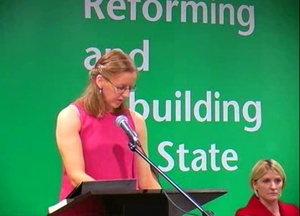
Elaine Byrne writing in The History Hub’s Seanad Special

Past Reforms and Present Policy: examining the Seanad Electoral Act, 1947 (HistoryHub.ie)

Previously:  “We Have To Look At The Situation Where Gerry Adams Could Be The Next Tánaiste”

Pic: Elaine Byrne.ie

Thanks Sarah

elainePolitical corruption sleuth Elaine Byrne, now based in Australia, has been tweeting about Alan Shatter’s insider knowledge of Mick Wallace’s motoring indiscretions revealed on Prime Time last night.

In summary:

1. The Minister for Justice abused his position of power by disclosing on national TV the details of a Garda discretionary decision

2. That the Minister did so to make a political point because the individual concerned was a politician is quite frankly, disgraceful.

3. Shatter:Deputy Wallace was stopped with a mobile last May and he was advised by the guard who stopped him that…

4. I’m going to explain why Section 4 of the Standards in Public Office Commission Act is relevant for a complaint.

5. Any person can make a complaint to Standards Commission where he considers that an office holder/Minister may have done a “specified act”

6. Section 4(1): Specified act is “the circumstances of which are, such as to be inconsistent with the proper performance by the specified..

7. “..person of the functions of the office or position by reference to which he or she is such a person or with the maintenance of…

8. “…confidence in such performance by the general public, and the matter is one of significant public importance.”

9. More information on complaints to the Standards Commission in this regard can be found here

10. To my mind, the Minister for Justice contravened section 1.5 of the Code of Conduct for Office Holders.

11. Ministers should “act in good faith with impartiality… respect confidences entrusted to them in the course of their official duties.”

12. Apart from concerns under section 4 of the Ethics Act and the Code of Conduct for Office Holders, there are Data Protection concerns.

13. “The Act places serious responsibilities on every employee of An Garda Síochána not to disclose data…”

14. “…in relation to any individual to any other individual who is not entitled by law to receive it.”

15. What confidence can the public have in the justice system if the Minister of Justice decides to disclose information whenever he likes?

16. Section 41 of 2005 Garda Act stipulates the information the Garda Commissioner has a duty to give to the Minister

17. (i) preservation of peace & public order, (ii) protection of life and property, and (iii) the protection of the security of the State;

18. In my humble opinion, an individual on a mobile phone doesn’t come under those categories of a duty to report by the Garda Commissioner.

For more click here.

Previously: How Did He Know?

(Elaine Byrne / Flickr)

Byrne

Yesterday, Elaine Byrne (above) described  in the Sunday Independent how RTÉ planned to use the Lowry Tapes as a story to re-launch Prime Time.

“The Sunday Independent ran the transcript in full, but there is no substitute for hearing the actual voices – preferably with the transcript to hand. That is why I had also gone to RTE’s Prime Time, to gauge their interest.”

“There, I dealt with David Nally, the managing editor of RTE’s television current affairs division, and Paul Maguire, Editor, RTE Investigations Unit. They were very interested and seemed keen to do a programme based on the tape. They listened to the tape and then had me play it for their lawyers. Then I gave them a transcript. However, they insisted that they would need to do an interview with Phelan and planned the whole thing for the opening night of the Prime Time re-launch.”

“After much to-ing and fro-ing, Phelan decided he would not do the interview and the show was dropped. But this was not because they did not think the material in the tapes was of great interest – on the contrary. It was because they could not get Phelan to sit down in front of a camera.”

However…

STRTEletterWhere this leaves Mr Nally’s letter to The Sunday Times last  week (above), that RTÉ believes the tape did not advance the story beyond the findings of the Moriarty tribunal is anyone’s guess.

Elaine Byrne: Shedding Light On Shady Dealings (Sunday Independent)

Previously: RTÉ And The Lowry Tape

Dr Elaine Byrne (above) spoke at the MacGill Summer School in Glenties, Co Donegal On Monday on the module entitled The Mahon & Moriarty Tribunal Reports- How Was It Allowed To Happen?

“The title of my short speech is Official Ireland and how official Ireland has tended to see things in the past.

So the title of this is Why Mahon and Moriarty Was Allowed To Happen? But this is not about Mahon and Moriarty. This is about the Ryan Report, the Murphy Report, the Ferns Report, the Cloyne Report. It’s about the Morris Tribunal. It’s about what happened with that Dr Neary in Drogheda and it’s about every single inquiry in public life that we’ve had in Ireland in the last 15 years because a lot of the same things happened.

For instance, in the Ryan Report, you have this incredible piece of testimony from a guard. A policeman. A man, the upholder of law and order, where he writes to the Department of Education in 1949 about his concerns about an industrial school. A guard is writing to the Department of Education about his concerns about an industrial school. Not the other way around.


‘For some time past I’ve been receiving complaints from parents having children in Greenmount Industrial Schools. They look cold and miserable looking. Now I’m a particular friend of the brothers in Greenmount and have no wish to do them any injury to them and their good work. I do hope this matter will be treated in confidence as I do not wish it to be known that it was I that brought that matter to attention.’

That’s what Official Ireland did in the 1940s, 50s, 60s, 70s and 80s in relation to child sexual abuse in this country. And when people, like, awkward people, people that kept asking questions, people like Frank Crummey, the social worker.

He kept writing to the departments in social welfare and kept confronting the people who were involved. He was threatened with physical violence and social ostracisation that his family first endured when he spoke about child abuse in the Christian Brothers 40 years ago.

And the other interesting thing that I found out about the Ryan Report was the Department of Education’s attitude to people who complained such as Tim O’Rourke. And, according to the Ryan Report, it was not about how to investigate his complaint but what to do about a troublemaker who had complained. And that really was Official Ireland’s attitude to many things in public life – whether it was the church or the other inquiries that I’ve listed.

And often it was outsiders who spoke the truth. It was people like Eugene McErlean, from Northern Ireland, the former head of the AIB who blew the whistle on fraudulent practices within the AIB in the early 2000s.

Or a man like Patrick McGuinness, who was the accountant for Larry Goodman who was interviewed by Susan O’Keeffe when Susan O’Keeffe was a journalist in the UK. Not a journalist in Ireland, a journalist in the UK.

And Patrick McGuinness had emigrated to Canada. He wasn’t able to say what he wanted to say from Ireland. And you had people like Joe Murray and Padraig Mannion who demonstrated how there was fraud within the meat industry.

And for their troubles an apology – I’ll come back to apologies in a moment – an apology was demanded and they were disciplined for their troubles.

And there’s a whole series of people in Irish public life, like those people I’ve mentioned and, in particular, someone like Joe McAnthony.

In 1973 he wrote about the stuff that Michael [Smith,Village magazine] spoke about, the stuff we already knew. But 40 years later it took for the Moriarty Tribunal, the Mahon Report and the McCracken Tribunal to confirm what he had already said.

And in an interview he did, in his experience, of being the troublemaker, of asking questions..

‘My life was pretty much over as a journalist. Everything I worked on in RTE was closed down. I couldn’t work in the Independent anymore. Nobody would hire me. I had four children. So we had to go. I was essentially expelled from Ireland.’

And that’s what Official Ireland has done to individuals who have tried to speak the truth. And I would argue that perhaps we’re still doing it. And I would also argue that people like Joe McAnthony and Padraig Mannion and Joe Murray and Sheenagh McMahon, who was the whistleblower in the Morris Tribunal.People like Michael Smith, and other people – there should be some official acknowledgement for their duties and citizenship that they have done and the service they have given to this country over a number of years.

Continue reading →

Should Enda Kenny be consorting with Denis O’Brien?

Pat Rabbitte, Elaine Byrne and Sam Smyth  on last night’s Prime Time on RTE 1.

Miriam O’Callaghan: “It’ll be the anniversary of Moriarty and I suppose minister, and I’ll ask the same of Sam and Elaine and I’ll bring you in in a moment Dara [Calleary], Is what has happened since Moriarty?

Rabbitte: “A great deal has happened, you know. There’s a raft of legislation now about to come in for the registration of lobbyists…”

O’Callaghan: “Yeah, but…”

Elaine Byrne: “Minister, on page 2, 541 of the report it says: ‘If anti-corruption measures are to succeed and high ethical standards are to prevail then the example
must be, must come from the top.’  And it doesn’t come from the top when you have the Taoiseach of this country standing on a number of occasions in the last week beside the man at the heart of a tribunal, that gave a benefit of over a quarter of a billion, the largest procurement of an award in the history of State.”

Rabbitte: “I, I, I mean, I have no idea of how the group that was referred to was assembled in Washington, I don’t know anything about it. But I do know that
whoever you stand beside is not going to resolve this problem.”

Sam Smyth: “It wasn’t by accident though, Pat.”

Byrne: “There was more than one occasion.”

Rabbitte: “This Government has a legislative registration of lobbyists for the exposure of the accounts of parties to investigation, for whistleblowers’ legislation and for a series of measures that were hinted at in the case of Moriarty and dealt with far more extensively in this report by the Mahon Tribunal.  There’s a whole…”

O’Callaghan: “I need to get..OK.”

Rabbitte:“There are a whole series of.. there are a whole series of measures for recommendation.”

Byrne: “OK. But it’s perception.”

[And earlier..].

Rabbitte: “It worries me that over all those years that Fianna Fail leadership was prepared to turn a blind eye to certain practices. And you know, Sam [Smyth], can well make points about proportions of the vote and all the rest, there is no way that you can convince the tribunal, or that anybody reading the tribunal, can’t say that this virus in our body politic was predominantly Fianna Fail.”

O’Callaghan: “Dara Calleary?”

Calleary: “I would remind the minister the current most senior political figure in the land, the Taoiseach was very happy to share a platform in New York earlier this week with an individual against whom very serious findings were found in the Moriarty Tribunal. We want to move this on. We were the first party to..”

[Talk over each other]

Miriam O’Callaghan: “They’re talking about Denis O’Brien.”

Rabbitte: “There is one thing that we can be comfortable about. And that is that the man that is presently Taoiseach, whatever his other defects, and we all have defects, he’s an honest politician.”

Calleary: “Absolutely, I completely agree.”

O’Callaghan: “But I suppose coming back to the Moriarty, and we’ll bring up that point. I suppose the point is if you have a Moriarty Tribunal, it makes findings, it makes recommendations and one of the people within it, who is seriously criticised then ends up standing beside the Taoiseach of the day. Maybe that’s what’s wrong with our country. The optics, apart from anything else, look wrong.”

Sam Smyth: “Well it was Pat who said it I think, it’s not just the person who receives the money, it’s the person who gives it is just as important. And there was someone very senior and eminent High Court judge said had made available £994,000, I think, to a Government minister, who he said secured the biggest contract in the history of the State. Now for them to be swanning around together in New York this week…I think Pat if you were on the other side you might see that point differently.”

Rabbitte: “Well I have no idea how the people who were there were there. But…”

O’Callaghan: “Were you happy? Are you happy with Denis O’Brien being on the same platform as the Taoiseach?

Rabbitte: “I’ll tell you something. After what I’ve seen over the last three years on Wall Street, I’d say it’s pretty difficult to walk down Wall St without fraternising…”

O’Callaghan: “But..my final attempt at the same question. Are you worried about Denis O’Brien? For instance… given the Moriarty findings, being on the same
platform as the Taoiseach?”

Rabbitte: “I think there’s a serious question over his conduct at that time, yes.”

O’Callaghan: “No but I’m..of whose conduct?”

Rabbitte: “Denis O’Brien’s conduct.”

O’Callaghan: “I know but therefore are you worried about the message it sends out, about the type of Ireland we now have. That somebody is found a certain way
in a tribunal and then, a few months later, he’s standing beside our prime minister.”

Rabbitte: “On the question of ethics, and on the question of honesty, I have no worries at all about the signals the Taoiseach sends out.”

Watch here

Previously: Last Night In DC