




 Start here.
Tag Archives: EU
The Department of the Taoiseach is seeking applications for temporary positions in its EU affairs division. irishexaminer.com/ireland/politi…
— Jim Higgins (@JimHigginsMEP) February 7, 2012
* No spine and/or balls.
* A mullet (so French eurocrats can give it a demeaning tug for the cameras).
* A penchant for gravy.
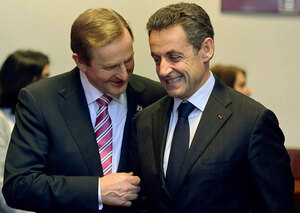
EUROPE’S NEW fiscal treaty was specifically crafted to minimise the prospect of a referendum in Ireland, The Irish Times has learned.
As Fianna Fáil joined other Opposition groups in demanding a referendum, a high-level European official said elements of the pact were written with the objective of avoiding a public vote in Ireland.
The official acknowledged that the matter was likely to end up in the hands of the Supreme Court but said the EU authorities still hoped there would be no plebiscite in Ireland.
“We drafted the text for the treaty so that he has a chance to avoid a referendum,” the official said in reference to Taoiseach Enda Kenny.
“But this is not a political decision. You know that this is a decision made by the constitutional court.”Asked whether the authorities in Brussels believed a referendum was likely, the official said it was more a matter of hope. “It’s not in terms of likely or not likely, it is hopefully or not hopefully, so we’d hope they don’t need to go to a referendum.”
On the challenge facing the Government in any referendum, the official said it was “perfectly well” known that the answer the public gave would not be the answer to the question posed. “So it is nothing to do with democracy.”
Fiscal treaty designed to avoid Irish referendum, official says (Irish Times)
(Photograph: Jock Fistick/Bloomberg)
Messers
at
Today’s Irish Independent cover photo.
It’s not a caption competition until you say so.


 Barbara Nolan is Director of the European Commission Representation. A former tax inspector, she has worked for the EC since 1989 serving as Head of Unit in the Education and Culture Directorate General and was the EC spokesperson for Employment, Social Affairs and Health matters between 1993-1999.
Her views were expressed most recently in an Irish Times article headlined ‘Reality Is That Austerity Would Be Worse Without EU-IMF’.
In it she states:
…the idea the EU-IMF programme was put in place to “save” German banks, while convenient, is far too simplistic. Most of the money being loaned to Ireland is to cover the day-to-day costs of running the State. Without this financing, the country would have no option but to immediately close the gap between spending and revenue. This would imply austerity on a draconian level.
The financing gives the Government the time and space to gradually reduce its budget deficit to a sustainable level.
If the programme were truly to rescue the German banks, why not keep the funds in Germany and directly inject them into that country’s financial institutions? Why risk lending money to Ireland? Why also lend money to Portugal and Greece?
She adds:
While the country is by no means out of the woods, it is important not to lose sight of the progress that has been achieved over the past year. Growth has resumed, on the basis of a strong rebound in Irish exports.
Of course, the domestic economy remains weak and unemployment is still far too high. But this is a reflection of the dramatic shrinking of construction’s share in the economy and the fact the high indebtedness of Irish households is holding back spending.
Furthermore, it is arguably only due to the programme that there has been such progress in repairing Ireland’s banking sector. While the job is not yet done, Ireland is on track to having a better-capitalised, smaller financial sector, vital to supporting the country’s economic revival.
And concluded:
Finally, thanks again to the programme, sheltered sectors of the economy, such as the legal and medical professions, are being opened up. This will bring prices down for Irish consumers and reduce costs for businesses.
With the ongoing turbulence in markets affecting more and more countries, the safest place for Ireland to be right now is in the programme, with its stable source of financing, now being made available at an interest rate that is far below what many countries are paying in the market.
While there is certainly an understandable temptation to blame others for the country’s predicament, Patrick Honohan concluded in his 2010 report that “although international pressures contributed to the timing, intensity and depth of the Irish banking crisis, the essential characteristic of the problem was domestic and classic”.
The simple truth is, the measures Ireland is taking under the programme would have had to happen anyway. Without the support of the EU and the IMF, they would have been far more painful to undertake. The real charade would be to pretend otherwise.
(RTE/Photocall Ireland)


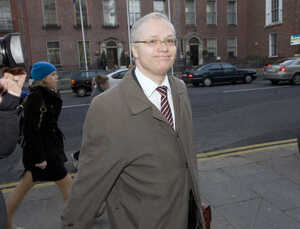
 They’re back. Literally rolling out of bed in the Merrion Hotel and crossing the road to the Department of Finance.
1. Senior Economist at the European Department of the IMF, Johan Mathisen (left).
2. Assistant Director at the (IMF) and Ireland mission chief, Craig Beaumont (front left).
3. European Commission representative Nigel Nagarajan (left).
4. Director of Economic and Financial Affairs at the European Commission, Istvan Szekely.
5. Economist at the European Commission, Sven Langedijk (front left).
Troika Begin Two-strand Mission To Dublin (RTE)
(Laura Hutton/Photocall Ireland)


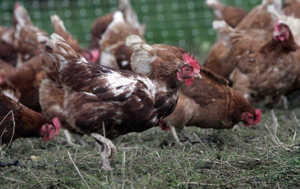 Free-range chicken farmer Tim McGlynn (top) of Oldcourt Hill Farm in Oldcourt, Tallaght, Dublin has been selling free-range eggs and chickens for 11 years, delivering direct to the customer’s door.
The European Union ban on ‘un-enriched’ cages for battery hens will come into force on Sunday, January 1. ‘Enriched’ cages – at 750 square cm per hen, allows the birds room to perform “natural behaviours” including nesting, roosting and scratching and provides them with perches and litter trays. Fourteen EU member states continue to keep 46 million hens in un-enriched cages. These countries will face infringement proceedings through the European Court of Justice for breaching EU law.
(Mark Stedman/Photocall Ireland)

BRITAIN’S DECISION to veto a new EU treaty has created “two Europes” and marks a major step towards integration within a smaller bloc, French president Nicolas Sarkozy has said.
Outlining what France sees as the far-reaching implications of the “fiscal compact” agreed in Brussels, Mr Sarkozy hailed “the birth of a different Europe” that would converge without the British.
Taoiseach Enda Kenny has invited the leaders of the Opposition parties into Government Buildings at 8am today to brief them on the outcome of the European summit.
Sarkozy hails birth of smaller European bloc without UK (Irish Times)
Kenny: No referendum decision before March (RTE News)