Tag Archives: Gaza

Screen Shot 2013-12-05 at 01.09.11

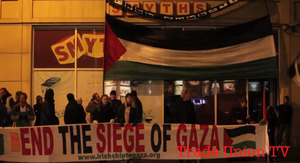
A protest was held last night at the opening of the ‘Made in Israel’ Film Festival at Cineworld, Parnell Street, Dublin.

The Israeli Embassy had billed the opening as a “Hanukkah Reception”. Hanukkah is the Jewish festival of lights, and the festival takes place at a time when the lights are off in Gaza, where people have been living without electricity for up to 20 hours per day for more than a month as a result of the Israeli siege and the closure of tunnels by Egypt.

Meanwhile, in Gaza..

For the last month, all of Gaza’s 1.7 million residents have been living without power for most of the time and in the shadow of a public health catastrophe, after their sole power plant was forced to shut down, causing the failure of several sewerage and water plants. The power plant, which until recently supplied 30 per cent of the Gaza Strip’s electricity, ran out of diesel fuel on 1 November. The resulting shutdown has exacerbated an ongoing water and sanitation crisis and has left Gaza residents without power.

Gaza power crisis has compounded blockade’s assault on human dignity (Amnesty International)

Via Paula Geraghty

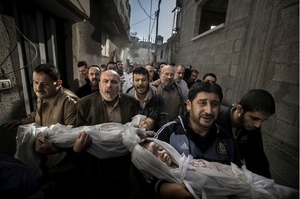
Gaza, November 20, 2012.

By Paul Hansen.

A group of men carrying the bodies of two dead children  to a mosque for the burial ceremony while their father’s body is carried behind on a stretcher. Two-year-old Suhaib Hijazi and his older brother Muhammad were killed when their house was destroyed by an Israeli missile strike. Their mother was put in intensive care.


Swedish Photographer Paul Hansen Wins Premier Photo-Contest Award (World Press Photo)

The Press Screen office in Gaza, this morning.

Gisela Schmidt-Martin, who works for The Palestinian Centre for Human Rights in Gaza, writes:

Throughout the past five days the sound of explosions has reverberated across theGaza Strip. As I write this, the buzzing of drones is constantly overhead. People are cowering in their homes, as there is no predicting where a missile might hit next, and threats of an imminent ground invasion are bringing back awful memories of Operation Cast Lead less than four years ago, in which more than 1,100 civilians were killed.

The nights have been particularly bad. Each evening has seen at least 100 airstrikes and, last night, I lay awake listening to the booms of at least 40 shells from Israeli naval vessels being fired upon the shore. Indeed, it has been impossible to sleep so, by now, people are both terrorised and exhausted.

Far from the ‘surgical’ strikes that Israel claims to be making, these attacks have indiscriminately and disproportionately targeted civilians and civilian properties.

Of the 51 confirmed dead as of 10am today Irish time, 27 have been civilians, including 10 children and 5 women. Of the 535 wounded, 520 have been civilians, that is, 97 per cent. This number includes 140 children and 83 women. And the numbers are rapidly rising.

The sites that have been struck have included family homes, a water well, a mosque, a football pitch, numerous plots of open space and agricultural land, and Gaza International Airport, which had already been destroyed in a previous attack.

Two media office buildings were targeted in the early hours of this morning. At 1.35am, the office of Press Screen Media in the Shawa and Hussani building, Gaza City, was targeted by an Israeli Apache helicopter and hit with one shell.

Later in the morning, the building was hit by 3 additional shells in a second attack. 7 journalists and trainees were injured, including one teenager. A 20-year-old man lost a leg.

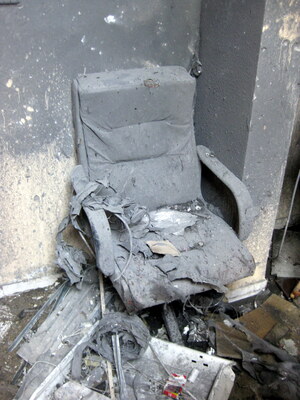
I attended a press conference outside the building, where journalists held up pieces of the shells and signs protesting the attack. As we climbed the stairs to view the destroyed office [above], we saw bloody footprints and broken glass on the steps. The scene was a surreal meeting of the mundane and the grotesque. Office chairs grey with dust, computers smashed to pieces, gaping holes in the roof and walls.

A second media office in the Al Shorouq building was also shelled this morning. Since then, international journalists have reportedly received messages from Israeli forces, telling them to leave the building. Under international humanitarian law, media personnel are given special protection in times of war. This means nothing to Israel.

As evening drew in, a number of family homes were eviscerated. The tiny bodies of four children of the Al Dalo family were pulled from the rubble and, at latest update, people were attempting to rescue others still alive but buried under the rubble.

Now, as the night deepens, people are gathered in their  homes, waiting for the next explosion. Parents cannot offer their children any protection. There are no air raid signals here, or bomb shelters. They can only hope that they will be among the lucky ones to make it through the night.

Pics by Gisela

Previously: Letter From Gaza

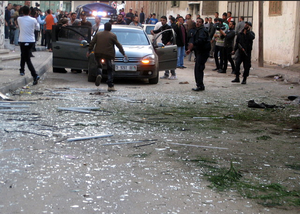
Gisela Schmidt-Martin writes:

I am working with the Palestinian Centre for Human Rights. Things have gotten a little hectic since Ahmed Al Jabari [Hamas military commander] was killed yesterday afternoon. I took the photo (above) about 45 minutes after the attack.
In my private capacity, I have gotten together with a group of internationals who are working in Gaza in the fields of journalism, human rights, education, and agriculture.
We have put together a call for action which has just been published on Mondoweiss and we would like to share it as widely as possible.
We are also interested in continuing to provide information on the attacks in Gaza as they are ongoing and are anxious to ensure that the facts get out.

Elaine Bradley, who travelled from Ireland  to the Middle East two months ago and works with a human rights organisation in Gaza, writes:

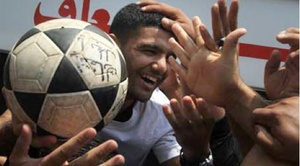
There has been little to celebrate in Gaza in recent times, but yesterday dramatically changed all that. Mahmoud Al-Sarsak (above), the Palestinian national footballer, arrested and held without charge in an Israeli prison for 3 years, was finally released and returned to his home.

The atmosphere here has been electric with scenes of jubilation. His family and well-wishers gathered at the Erez crossing to embrace the safe return of this young hero who almost gave his life to highlight the injustice of his illegal detention. Crowds thronged the entrance of Al-Shifa hospital in Gaza City where he was transferred in an ambulance for a medical check up, and when he finally arrived at his hometown of Rafah, he was hoisted onto the shoulders of friends, relatives, and supporters and carried through the streets.

The human rights community and NGOs here in Gaza collectively breathed a sigh of relief. For a while, it looked like Al-Sarsak was going to die. After more than 90 days on hunger strike, he was emaciated, having lost a third of his body weight, and was slipping in and out of consciousness. Israel finally agreed to release him following intervention from the international community that included prominent figures such as FIFA President Sepp Blatter and former footballer Eric Cantona. The fact that petitions for his release took place against the backdrop of EURO 2012 added to Israel’s embarrassment at the negative attention.

A university student and member of the Palestinian National Football team, Al-Sarsak was arrested in 2009 at the age of 22, when he crossed into the West Bank with all the necessary permits, to join the national team for one of the rare occasions when they could practice together. On his arrest, he was accused of association with Islamic Jihad – an accusation that he firmly denies. Despite the lack of evidence to back up their claim, he was given a detention order by Israel under their ‘Unlawful Combatants Law’. This allows for Palestinians from the Gaza Strip to be held for an unlimited amount of time without ever being charged or brought to trial, and affords even fewer protections than the controversial administrative detention.

Al-Sarsak is one of the lucky ones, if you can call it lucky to have lost 3 years of your life, a promising football career and, in a probability, your good health.  There are currently over 300 Palestinians being held in Israeli jails without charge, some on hunger strike, some close to death.

The story of Al-Sarsak has become known around the world because of his status as a footballer, but even that was barely enough to save him.  In Palestine, the struggle goes on to end Israel’s illegal actions and the injustices inflicted on the Palestinian people.

But yesterday, for one day at least, we celebrated this small but wonderful victory.