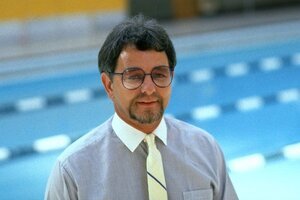




George Gibney (left); Journalist and author Irvin Muchnik
With a major new BBC/Second Captains podcast series on George Gibney scheduled for release in May, Irvin Muchnik, who has been on the trail of the swimming coach for years, details recent developments in the US and his lengthy struggle getting even Irish media interested in Gibney.
Irvin writes:
Hobbled by George Gibney’s lack of name recognition on this side of the Atlantic, and pusillanimous by nature when it comes to tackling important sexual assault narratives until they are either the flavour of the month or have risen, in the cliché, to the level of “a dead girl or a live boy”, major American outlets have been slow to pick up on the documented reporting so far published only at my modest-circulation platforms.
The current connection to the more general and better-understood federal grand jury investigation of USA Swimming is a hook for which I remain hopeful for major coverage, though I am not unrealistically optimistic.
Definitive action on George Gibney seems to be one of those chicken-and-egg or “Alphonse-and-Gaston” processes, with multiple moving parts.
Will the Irish government ask for Gibney’s extradition before they are certain that the return answer would be ‘yes’?
Will the US government seek to deport Gibney before being issued a formal extradition request?
And perhaps equally important: In the realpolitik always factoring into such matters, will US Department of Justice’s Money Laundering and Asset Recovery Section (MALRS) office ever flip the switch on absent pressure from a more powerful media player than myself?
In 2016, during an early stage of my Freedom of Information Act (FOIA) litigation, I was interviewed for a segment on Fox News called Sports Court. You can view the clip, “Gov’t hiding immigration docs on accused pedophile,” here.
Ironically, the interviewer and producer of Sports Court, Tamara Holder, herself would resign from Fox News late that year as part of a multimillion-dollar settlement of a claim that she was sexually harassed and assaulted by an executive.
Holder thus became part of the real-life narrative of the current movie Bombshell, which is mostly about Megyn Kelly and Gretchen Carlson, two higher-profile ex-Fox News personalities.
Later in 2016, with the help of a friend of mine who was a San Francisco Chronicle columnist, the newspaper’s long-time federal courts reporter, Bob Egelko, was enlisted to write about Judge Breyer’s FOIA ruling.
And that’s it for American media on George Gibney.
Heinous scandals with long tails — whether they’re Jeffrey Epstein or Bill Cosby or Harvey Weinstein or George Gibney — are always festivals of missed opportunities.
In 2014 Chuck Wielgus, the chief executive of USA Swimming, withdrew from his scheduled induction into the International Swimming Hall of Fame in response to a petition campaign by abuse victims who raised the public consciousness of his two-decade role in covering up their cases — and in at least one of them, committing unindicted perjury.
At the time, George Diaz, a columnist for the Orlando Sentinel, bragged to me that his column opining “Why does this man still have a job?” was “one of the five entries that got me a Top 10 acknowledgment by Associated Press Sports Editors as one of the top columnists in the country.”
I found this a strange boast, insofar as (a) on the front end, Diaz had not been responsible for exposing Wielgus’s administration and lies, and (b) on the back end, in any case, Wielgus would remain in his million-dollar-a-year post until he died in 2017. One of the top ten yapping jackals of a fortnight’s media scrum? For sure. Hands down.
But the reason I bring this up is something else: The Orlando Sentinel was George Gibney’s now-home market, and for years I importuned Diaz to jump into the pool on this story, which looked to be right in his wheelhouse. (He did columns mentioning his adoption of a foster child and he advocated for that population.) Yet nothing ever happened.
In November 2014, Diaz told me he had been out sick for three weeks.
In February 2015, Diaz said he was tied up with coverage of the Daytona 500 motor race, but he promised to put Gibney “on the radar screen ASAP”.
In August 2015, Diaz wrote to me, “I have to be honest, I really have been meaning to get to this, but so slammed…”
June 2017: “I will be in touch with editors today. Trust me the issue is not lack of interest…it’s lack of manpower and time…given all the cutbacks that have faced newspapers through the years it’s simply a matter of Last Man (or Woman) standing.”
April 2018: Diaz was downsized out of his column at the Sentinel.
November 2018: The Orlando Sentinel laid off George Diaz.
Then we have the tale of Outside magazine. In early 2018, in the wake of the FOIA settlement with the government and the then-exploding scandal of USA Gymnastics doctor Larry Nassar, I was approached by an old college friend who is the No. 2 editor at Outside.
He suggested that I write the definitive George Gibney feature article for his publication. “Let’s go win a National Magazine Award,” he said. This editor told me he had served as a panelist for the award in the past. Again — the solicitation was from him to me, not the other way around.
Over the course of three months, and with the editor’s guidance, I wrote, then rewrote, then re-rewrote, a story pitch. It was a verbal beatdown of little journalistic acuity. But it did have all trappings of a Hollywood scenarist vying for studio funding.
At long last, my friend the No. 2 editor came back with definitive word from his boss, the No. 1 editor: Outside would be thrilled to have me write a few hundred words about this little brouhaha for the magazine’s website. Then, perhaps, somewhere down the road, a print feature when … when … when …
Saying anything further about all this would be redundant and petulant. The Gibney story is not about me.
Irish media
Irish media counterparts have been a different kettle of fish. They know who George Gibney is, of course, and they episodically obsess over how he was “the one who got away,” while other prominent Irish swimming coaches of his generation went to prison for less (Derry O’Rourke, Ger Doyle), and one for perhaps more (Frank McCann — he murdered his wife and their baby daughter, by burning down their house with them in it, to prevent them from learning that he had raped and impregnated one of his young swimmers).
The Irish media are also hamstrung by the lack of a First Amendment and an accompanying tradition of chilling defamation laws.
And like the public at large, they are often uniquely fatigued and paralysed by the agonizing unspooling of the historical legacies of sexual abuses at many institutions — especially but not only the Catholic Church.