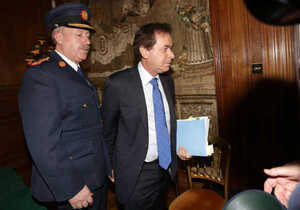
[Garda Commissioner Martin Callinan and Alan Shatter]
For the week that’s in it.
A comprehensive GSOC bugging/ Garda whistleblower timeline.
December 2, 2003: Kieran Boylan, from Ardee, Co. Louth is caught by members of the National Bureau of Criminal Investigation in a ‘Garda stakeout’ receiving more than €700,000 worth of cocaine and heroin at Dublin Port. He’s charged and released on bail.
October 6, 2005: Boylan is caught with €1.7million of cocaine and heroin in Ardee, Co. Louth, by members of the Garda National Drugs Unit.
December 21, 2005: It’s reported Boylan was remanded on bail by Judge Desmond Hogan pending sentence at Dublin Circuit Criminal Court in relation to the Dublin Port charges. The court heard a detective garda agree with Boylan’s defence lawyers that Boylan believed the heroin he collected was cocaine and that this indicated that he was not ‘in the hierarchy of the operation’. The court also heard the detective accept that Boylan was in debt and under pressure from his associates in England – whom Boylan was involved with before when he was jailed for 7 and a 1/2 years in England over cannabis possession, in 1997.
February 16, 2006: It’s reported that Judge Desmond Hogan – again in relation to the Dublin Port charges – sentences Boylan for five years and suspends the final two years, on condition Boylan keeps the peace.
February 4, 2007: John Mooney reports in The Sunday Times that charges against Boylan, in relation to the €1.7million drugs haul, were struck out in June 2006 because the DPP failed to give detectives from the Garda National Drugs Unit any direction in the case. Mr Mooney also reports that Fine Gael leader Enda Kenny and Labour’s Brendan Howlin are demanding to know why the charges in relation to the €1.7million drug haul were not pursued against Boylan. It’s reported that Boylan is said to have boasted that he is ‘untouchable’ and will never stand trial in relation to the €1.7m drugs find, while an internal Garda inquiry into the case is under way by Garda Commssioner Noel Conroy and Chief Superintendent Kevin Ludlow. It’s reported that Mr Kenny said: ‘Drugs are the single greatest threat to Irish society. I want the government to give a full explanation on this case. I will be tabling questions on the nature of the inquiry into Boylan and why he isn’t before the courts when he was caught with such a large amount of heroin and cocaine’.
February 11, 2007: Mr Mooney reports that his sources informed him Boylan evaded prosecution because he knows of ‘rogue Garda operations’ with drug dealers. Mr Mooney reports a source saying: ‘Boylan cannot be charged because he will start talking. They (the gardai) can’t afford for him to air his allegations in a public forum because he could cause a tribunal.’
April 30, 2007: Taxi driver Mary Lynch is violently assaulted by Jerry McGrath in Virginia, Co. Cavan. McGrath had his zip undone as he bit her, viciously kicked her and pulled out lumps of her hair. He left her with a black eye, bruising down her side and bruises on her neck, as he held his hands around her neck during the assault. McGrath was released on station bail of €300 the next day, before Mary Lynch gave a statement. McGrath was never questioned about details of her statement. He was charged with assault with no conditions attached to his bail.
October 2007: A file on Mary Lynch’s assault is finally sent to the DPP with a recommendation that the case be dealt with in the district court. Micheal Clifford, of the Irish Examiner, has reported that “the file came back within three weeks, upgrading the charge to Section 3, “assault causing harm” and a robbery charge. The DPP instructed that it should be dealt with by the district court only if a guilty plea was entered on both charges. Otherwise, it should go to trial in the Circuit Court.”
October 9, 2007: McGrath tried to abduct a five-year-old girl from a house which he had broken into, in Dundrum, Co. Tipperary. The girl’s father managed to overpower McGrath and hold him until the gardaí arrived. McGrath was charged with assault causing harm, burglary and false imprisonment. He was held in Limerick Prison.
October 18, 2007: McGrath’s Cavan assault case involving Mary Lynch was due for a routine review of bail in Virginia District Court. McGrath’s solicitor was told McGrath didn’t need to attend the two-minute routine hearing. No objection was made at Virginia District Court to renew McGrath’s bail on the Cavan assault charge – even though it was known that McGrath was in custody for assault causing harm, burglary and false imprisonment.
October 30, 2007: An application for bail by McGrath was made in Clonmel Circuit Court on the Tipperary false imprisonment charge. Detective Sergeant John Long objected but the court was not told about the Cavan assault and McGrath was granted bail. Michael Clifford, of the Irish Examiner, has reported: “In a subsequent investigation, Sgt Long said that prior to the bail application, he had checked McGrath’s background on the garda Pulse system. (This would be second nature to any garda investigating a violent incident). On seeing an entry about Cavan, he rang an “unidentified garda” in a “Cavan station” — also unidentified — and was told that the case involved a minor assault over a taxi fare.”
December 7, 2007: McGrath murdered separated mother-of-two Silvia Roche Kelly in the Clarion Hotel in Limerick.
January 5, 2008: Mary Lynch, who at this point was eventually told her case would be heard in Virginia District Court on January 7, received a phone call, telling her there was no need for her to show up at the case hearing as it would be held over.
January 7, 2008: Mary Lynch received a call from an inspector saying McGrath received a nine-month sentence for the assault on her. The Irish Examiner reported Ms Lynch saying: “I told him that I was told the case was not going ahead and he said he knew nothing about that. I told him I was informed I would be given the opportunity to make a victim impact statement to the court. He said he did not know anything about that and he was only handed the case file that morning and told to go into the court. He also told me that if I wanted to see Jerry McGrath he was still in Virginia garda station. I said I do not want to see Jerry McGrath in a garda station, I wanted to see him in court.”
January 15, 2008: It’s reported that the charges against Boylan in relation to the €1.7m drugs haul are to be reinstated.
June 2008: Garda Commissioner Fachtna Murphy sets up an internal inquiry to examine Boylan’s relationship with certain members of the Gardaí.
June 2008: Sgt Maurice McCabe transfers out of Bailieboro Garda Station in Co. Cavan to Mullingar [where he works now]. Sgt McCabe had details of cases he believed were not investigated properly at Bailieboro, including false imprisonment and physical and sexual assaults, which he relayed to the then Garda Confidential Recipient Brian McCarthy. Mr McCarthy notified then Garda Commissioner Fachtna Murphy of Sgt McCabe’s complaints. Commissioner Murphy ordered an internal inquiry to be led by Assistant Commissioner Derek Byrne.
July 31, 2008: On the day the courts recessed for the summer, the charges against Boylan are dropped in an unscheduled court hearing, with the State entered a nolle prosequi. The barrister for the DPP said the decision was made at a high level but didn’t give any further explanation.
August 3, 2008: John Mooney reports in The Sunday Times that the charges against Boylan were dropped because he had threatened to reveal details of his involvement with certain members of the gardaí. Mr Mooney also reports that Boylan claimed that he was involved in several entrapment-style operations where gardai would deliver drugs which he supplied to petty criminals, who were then later arrested and charged with certain gardaí’s careers benefiting from such operations. Then Garda Commissioner Fachtna Murphy and his deputy Martin Callinan both refused to comment on the matter to The Sunday Times.
It’s also reported that the then chief superintendent of the GNDU wrote to Martin Callinan asking if Boylan was a Garda informer. Mr Mooney reported that Callinan had confirmed in writing, on December 2, 2005, that Boylan was ‘not a registered source’. [Since the Morris Tribunal, all Garda informers have to be officially registered in the Covert Human Intelligence Source (CHIS) system]
October 19, 2008: John Mooney reports in The Sunday Times that the Garda Síochana Ombudsman Commission is to hold a public interest inquiry into the relationship between Kieran Boylan and a number of gardaí.
March 5, 2009: In the Dáil, Labour TD Pat Rabbitte spoke in relation to the charges dropped against Boylan, saying: “The only reasonable inference is that Boylan was saved from prison by the intervention of corrupt gardai or he was protected because he is a garda informant.”
April 19, 2009: John Mooney reports that in September 2008, the Department of Transport contravened its own rules and issued Boylan a road-haulage operator’s licence, following discussions with gardaí. He registered the licence under the Irish version of his name, Ciaran O’Baoighallan and that, while officials at the haulage licensing department in Galway at first refused to make the name change, they were instructed to do so by the Department of Transport. As proof of his identity, when he was getting the licence, Boylan produced a new passport and driving licence. The licence allows him to travel freely across Europe until September 2013.
November 14, 2010: It’s reported how an internal garda investigation into allegations of malpractice in the Cavan/Monaghan division – following complaints made in 2008 by Sgt Maurice McCabe, moved from Cavan to Mullingar, Co. Westmeath after he made his complaints – upheld some of the complaints but found no evidence of corruption. The investigation is led by Assistant Garda Commissioner Derek Byrne. Among Sgt McCabe’s allegations are claims that gardaí in Cavan, where he previously worked, didn’t carry out proper investigations into incidents including physical assaults, sexual assaults and false imprisonment.
It’s also reported a second internal probe was launched a month previous (October 2010) after Sgt McCabe claimed Assistant Commissioner Byrne assaulted and falsely imprisoned Sgt McCabe in the Hillgrove Hotel in Co. Monaghan on October 11, 2010, after Sgt McCabe revealed that he had removed hundreds of files from Pulse which showed gardaí had falsely claimed that certain people were involved in criminality. Sgt McCabe produced the files in front of Assistant Commissioner Byrne at the hotel when they – and two other officers – met to tell Sgt McCabe the results of the first investigation. Sgt McCabe claimed Assistant Commissioner Byrne would not let Sgt McCabe leave the hotel with the files. Assistant Commissioner Byrne took the files from Sgt McCabe.
It’s reported Nacie Rice, the deputy Garda Commissioner was appointed to investigate these claims of false imprisonment and assault, while the Garda Síochána Ombudsman Commission had been notified of the allegations.
January [day unknown] 2012: Maurice McCabe went to the Garda Confidential Recipient, Oliver Connolly, with a dossier of 12 complaints alleging Garda malpractice and incompetence regarding serious cases of criminality. The dossier included allegations of malpractice and incompetence in relation to the case of Mary Lynch – the taxi driver who was assaulted by Jerry McGrath who went on to kill Sylvia Roche Kelly – cases of assault causing harm, charges that were allegedly not properly investigated, a case involving abduction and false imprisonment – a case which was not investigated and resulted in an attempt being made to offer the victim money on behalf of the suspects, and one involving falsification of records. Mr Connolly handed over details of these complaints to the Minister for Justice, Alan Shatter, who then handed the dossier over to the Mr Callinan.
GSOC investigated a section of the Sylvia Roche Kelly case and it recommended that disciplinary action be taken against two officers. But Garda Commissioner Martin Callinan declined to discipline the two officers.
February [day unknown] 2012: It’s understood Mr Connolly spoke to Mr Shatter and told him about the whistleblowers and that Mr Connolly met with Mr Shatter again before Easter and discussed the allegations.
February 9, 2012: Mr Connolly met Sgt McCabe, who taped their conversation. They discussed Sgt McCabe’s 12 complaints, including a previous complaint Sgt McCabe made against the Garda Commissioner Martin Callinan in relation to his intentions to the promote a senior officer. Mr Connolly tells Sgt McCabe that no further action will be taken on his complaints. Mr Connolly also warns Sgt McCabe: ‘I’ll tell you something Maurice – and this is just personal advice to you – if Shatter thinks you’re screwing him, you’re finished.’ Mr Connolly advised Sgt McCabe to avoid going to the media and to go through the courts system. Mr Connolly assures Sgt McCabe that Minister Shatter looked into Sgt McCabe’s complaints in detail.
March [day unknown] 2012: Garda John Wilson and Sgt Maurice McCabe make a complaint to the Garda Confidential Recipient, Oliver Connolly, about the quashing of penalty points. Mr Connolly gave this complaint to the Garda Commissioner Martin Callinan.
May [day unknown] 2012: Mr McCabe sends Mr Connolly more information, alleging the quashing of penalty points.
July [day unknown] 2012: Mr McCabe gave Enda Kenny information of alleged misconduct concerning penalty points and offered to meet Mr Shatter, with his legal team, including former Attorney General and former Minister for Justice Michael McDowell, and to provide him with files and information. Enda Kenny replied to McCabe and said Mr Shatter would deal with his request.
August [day unknown] 2012: Mr McCabe wrote to Mr Kenny again, in relation to the penalty points.
September [day unknown] 2012: Mr McCabe wrote to Mr Kenny again.
November 11, 2012: John Mooney reports in The Sunday Times that the conviction of Andrew Kearns is one of several being investigated by GSOC, as part of its public interest inquiry into Boylan’s relationship with certain gardaí. Mr Mooney reports that Kearns, a single father from Crumlin, had agreed to collect a shipment of cocaine in March 2005, in order for a gang to waive a debt of €3,000. His contact was Boylan. When Kearns collected the cocaine in Ardee, Co.Louth, Boylan was present at the handover of cocaine worth €280,000. Mr Mooney reported certain gardaí used Boylan as an agent provocateur in order for the gardaí to secure promotions and praise in the media.
November 13, 2012: In response to reports that Garda management had blocked and obstructed GSOC’s investigation into the Boylan affair, Garda Commissioner Martin Callinan rejected the claims and insisted he and members of the gardaí fully assisted the four-year investigation into Boylan.
November 13, 2012: Justice Minister Alan Shatter announces that he will extend Commissioner Martin Callinan’s retirement from August 2013 to August 2015.
December 4, 2012: After receiving no response from the Garda Commissioner, the two garda whistleblowers approach United Left Alliance TD, Clare Daly to voice their concerns to her. United Left Alliance TDs Clare Daly and Joan Collins use parliamentary privilege in the Dáil to name Judge Mary Devins as someone who has had their penalty points quashed.
December 7, 2012: Commissioner Callinan issues a press statement in relation to the penalty points, saying he has appointed Assistant Commissioner John O’Mahoney to look into the allegations before adding: “There is no question of what has been described as a culture of non-enforcement of penalties being tolerated by An Garda Síochána.”
December 9, 2012: John Mooney reports in The Sunday Times that GSOC’s report into Boylan is due within a week and that Garda Commissioner Martin Callinan, and his predecessor Fachtna Murphy, may be embarrassed by GSOC’s eventual findings, given that they oversaw three internal investigations into the links between Boylan and certain gardaí which didn’t find any evidence of wrongdoing.
December 11, 2012: Under privilege in the Dáil, United Left Alliance TD, Joan Collins names several high-profile people who had penalty points quashed including rugby player Ronan O’Gara, Irish Independent crime reporter, Paul Williams and Judge Mary Devins, again.
December 16, 2012: John Mooney reports in The Sunday Times that GSOC’s investigation resulted in a 500-page report which was sent to the DPP, and recommends that charges be brought against Boylan and a garda. Mr Mooney reports that the inquiry found some operations were run ‘off the books’ and not in line with regulations brought in after the Morris Tribunal. It’s reported that GSOC were also critical of Garda Commissioner Martin Callinan, who it’s reported, made representations to the DPP about Boylan’s €1.7m drugs case before the charges were dropped in July 2008. And it’s reported that GSOC questioned the reliability of information sent from gardaí to the DPP after Boylan’s €1.7m drugs arrest in Ardee.
December 17, 2012: A letter is sent to Sgt McCabe, from the assistant secretary at the Department of Justice, which is also forwarded to Enda Kenny and Leo Varadkar. The letter is, in the main, in response to an email Sgt McCabe sent on December 12, 2012 in relation to the quashing of penalty points. However, it also refers to the dossier of serious complaints that Sgt McCabe made to the confidential recipient in January. It states: “While your email mainly relates to the current allegations regarding the cancellation of fixed charge notices, you also refer back to a response by the Minister in February to the Garda confidential recipient in relation to an investigation by the Garda Commissioner of other allegations. As you know, of the 12 individual allegations made in the report to the confidential recipient, the Commissioner advised that 11 had already been thoroughly investigated by an Assistant Commissioner and a Chief Superintendent, that this investigation had been reviewed by a Deputy Commissioner (because of a related complaint made against the Assistant Commissioner), and that no evidence of corruption or malpractice had been discovered. You will also recall that the Commissioner, as regards the other case, was of the view that the investigation complained of was in fact efficiently and speedily carried out.”
January 28, 2013: Clare Daly is arrested on suspicion of drink driving. She’s brought in a patrol car to the Kilmainham Garda Station where she was placed in a cell on her own at one point. She provides a urine sample and when she’s released a female Garda tells her to ‘come back when you are sober’. Ms Daly is handcuffed during her arrest. Details of her arrest are leaked to the press. She says she had taken a hot whiskey for a cold during a meeting at a house prior to her arrest.
February 8, 2013: Clare Daly receives the official result of the urine sample. It was 45 milligrammes per 100 millilitres of urine – 33% below the allowable limit. Ms Daly tells RTÉ that she made a complaint to GSOC about the leaking of the arrest to sections of the media and that the body was investigating this.
April 19, 2013: Irish Independent published journalist Gemma O’Doherty’s story that Garda Commissioner Martin Callinan had penalty points quashed. More than a week previous, after she confirmed that the address she had was that of Martin Callinan – and essentially confirmed her story – she was given a dressing-down by her bosses at Independent News and Media, including Ian Mallon, Michael Denieffe and editor Stephen Rae – who told Ms O’Doherty that her behaviour was that of a ‘rogue reporter’. Some weeks later she lost her position as Travel Editor, which it’s reported Mr Rae ordered and then, another few weeks later, she’s informed by managing director Declan Carlisle that she is being made redundant. She is told that if she doesn’t take it voluntarily, she will receive notice of compulsory redundancy. She doesn’t accept it voluntarily and therefore immediately receives compulsory redundancy. Ms O’Doherty is now suing INM and Mr Rae.
April 21, 2013: Sgt McCabe writes to Enda Kenny to relay his concerns over not being interviewed for the internal Garda inquiry into the quashing of penalty points, saying he had “serious concerns regarding not being contacted or interviewed regarding my allegations. It would appear that the (O’Mahony) investigation is complete and if this is the case it’s a shocking development. One would imagine that I would be one of the first to be interviewed“. [This is reported by RTÉ on February 23, 2014].
May 5, 2013: Philip Ryan, in the Sunday Independent reports that the original allegations made by Sgt McCabe and John Wilson include details that some motorists, who were involved in fatal accidents, had penalty points quashed both before and after fatal accidents.
May 9, 2013: GSOC publishes a 12-page report in relation to its Boylan inquiry on its website but can’t publish its actual findings or report. The publication of the 12-page report follows the decision by the DPP – on April 23, 2013 – that no prosecutions were warranted after it received a 500-page report into the Kieran Boylan collusion allegations by GSOC in December 2012. GSOC reports ‘grave concern’ about ‘deficiencies’ in the Garda informant management system and criticises An Garda Síochána for delaying their investigation.
It states that: “Delays in access to documentation and intelligence held by the Garda Síochána were a consistent feature of this inquiry. The Ombudsman Commission, under the present protocols, is wholly reliant upon assurances from the Garda Síochána that the evidence and information they have supplied represents the totality of such information held. This leaves scope to question the completeness and independence of oversight.”
It also stated: “The Ombudsman Commission is reliant upon Garda members to access the PULSE System and other computerised intelligence systems on its behalf. The absence of any independent access to these systems again raises issues around the effectiveness of the Ombudsman Commission’s oversight investigative function.”
And it recommended that: “…the disclosure and transfer, to the Ombudsman Commission, of evidence and information belonging to, held by or in the possession of the Garda Síochána, in criminal investigations, be bolstered, either through legislation or other means, to ensure full, verifiable, timely and unredacted provision. This should include the supply of sensitive and/or informant-related intelligence to the Ombudsman Commission.”
The report also states that GSOC believes that many of the recommendations made by the Morris Tribunal remain relevant. Garda Commissioner Martin Callinan rejects the criticism and says gardaí did co-operate with GSOC.
May 15, 2013: An internal Garda report into the penalty point allegations led by Assistant Commissioner John O’Mahoney concludes there was no such widespread quashing of penalty points.
May 16, 2013: Justice Minister Alan Shatter and Mick Wallace appear on Prime Time to talk about the Assistant Commissioner John O’Mahoney’s penalty points report. During their discussion, Mr Shatter accuses Mr Wallace of having been stopped by the Gardaí in May 2012. Mr Shatter says Mr Wallace was on his phone while driving, saying: “Deputy Wallace himself was stopped with a mobile, on a mobile phone last May, by members of An Garda Síochána and he was advised by the guard who stopped him that a fixed ticket charge could issue and you would be, he could be given penalty points.”
May 20, 2013: Mick Wallace goes on RTÉ’s Pat Kenny Show and says he can recall an incident involving Gardaí a the Five Lamps on the North Circular Road but that he was neither stopped nor warned. Instead, he says: “I was parked at the lights and a Garda vehicle came up beside me. And I was on the phone…which I know, I was wrong, I shouldn’t have been on it. The guard..I rolled down the window, the guard rolled down his window. There was two guards there. And I said ‘oh’, I just had my hand up and they said ‘it’s OK’. And, left it at that. And we just, we made small talk after for maybe about 15/20 seconds and the lights went green and I drove on straight and they pulled out. The guards were friendly.”
Mr Wallace says he plans to make a complaint to the Standards In Public Office Commission (SIPO). He lodges a complaint with the Data Protection Commissioner Billy Hawkes about the disclosure of information by Minister Shatter.
May 21, 2013: Minister Shatter tells the Dáil, Garda Commissioner Martin Callinan told him about Mr Wallace and the incident at the Five Lamps.
May 27, 2013: Sgt McCabe emails Enda Kenny about the penalty points controversy, in which he refers to what Mr Connolly warned him, writing: “Mr Shatter is in the public spotlight at the moment, and unlike him, I do not intend to play the man and not the ball. It is suffice to say that my figures are correct, my allegations are correct, and despite receiving information that Mr Shatter would ‘go after me’ if I brought the matter further, I am standing firm.” [This is reported by Michael Clifford, in the Irish Examiner on February 20, 2014]
Summer [date unknown] 2013: It’s understood GSOC decided to take out a section of a report into Kieran Boylan out of the report, prior to publication but a couple of weeks later this section was mentioned to GSOC chairman Simon O’Brien. The person who mentioned the section was Martin Callinan. A few months previous a senior member of Garda management rang GSOC and threatened to use analysts to find out where The Sunday Times were getting their information from. [John Mooney, of the Sunday Times, reported this on Tonight With Vincent Browne on February 18, 2014]
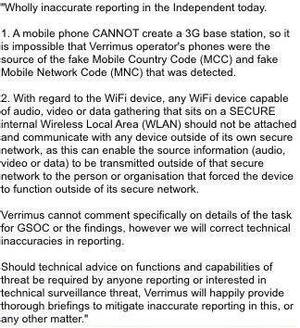
September 2013: GSOC hires UK security experts Verrimus to carry out a secret surveillance sweep of its offices in Upper Abbey Street, Dublin 1. Two ‘technical anomalies’ or security threats were discovered by Verrimus.
September 16, 2013: Broadsheet reports that group editor of the Irish Independent, The Herald and the Sunday Independent, Stephen Rae had penalty points, which were incurred on November 5, 2009, quashed.
September 20, 2013: A Justice Department senior official wrote to Sgt MCabe telling him he should give any material he had to a member of the Oireachtas, or an Oireachtas Committee or to another legally-allowed recipient. [RTÉ reports this on February 23, 20140].
October 1, 2013: The Comptroller and Auditor General issues a report which finds one in five motorists avoided penalty points because their cases were not pursued. For 2011 and 2012 – the C&AG found approximately 2,900 cases were terminated for around 700 vehicles, with three or more cases terminated each. [On February 22, 2014, Fianna Fáil John McGuinness said on RTÉ Saturday With Claire Byrne that Sgt McCabe gave the C&AG information to help them with their report into the quashing of penalty points].
October 2, 2013: In light of the C&AG report, Minister Shatter referred to the two whistleblowers when he accuses them of not cooperating with the garda investigation that had taken place, saying: ‘In so far as individuals who raised issues, are alleging that the Garda reports published are untrue, let them bring forward the chapter and verse and proof of that. I’m open to being convinced, but they haven’t done so. Indeed, having engaged with members of this House, and published material, they didn’t cooperate with the Garda investigations that took place. Now I don’t know why that is.’
October 7, 2013: Verrimus identifies a third security threat and it’s understood the equipment used is only available to government-level agencies.
October 8, 2013: GSOC launches a public interest investigation under the Garda Síochána Act on suspicion surveillance may have originated from within the force.
Late October [day unknown], 2013: Sgt McCabe writes to Minister Shatter asking him to explain who told him that Sgt McCabe was “offered the opportunity… to submit any evidence or other relevant information…. but did not do so”, before adding that he was “never afforded a right of reply or a right of response” after he complained about alleged quashing of points by certain gardaí. Sgt McCabe asked the Justice Department to supply him with any documents that suppoted the claim that he had not co-operated. [RTÉ reports this on February 23, 2014]
November 20, 2013: Garda Commissioner Martin Callinan appears before the Public Service Oversight and Petitions Committee in relation to GSOC’s Boylan report. Responding to claims that certain informants were run ‘off the books’, Mr Callinan said neither he nor any of his senior team was aware of gardaí bypassing the Covert Human Intelligence Source (CHIS) system. He said: “I can assure you that, as far as I am aware, I am not aware of any such activity and if GSOC have any evidence that that is occurring I will deal with it very, very firmly. ” When asked how a person could have the oversight to catch gardaí who worked outside of CHIS, he said: “How do you cater for something you don’t know about?”.
He also said that if GSOC had any information that informants were being run ‘off the books’ then it should be passed on to him and he’d deal with it firmly.
November 21, 2013: It’s reported that Garda Commissioner Martin Callinan has written to the Public Accounts Committee asking for the return of a ‘box of evidence’ that a whistleblower [Sgt Maurice McCabe] gave to the chair of the committee, John McGuinness. It’s believed to contain previously undisclosed information about the alleged quashing of points and subsequent loss of revenue to the State.
November 22, 2013: The Dáil hears a debate on the Road Traffic Bill 2013. During the debate Fianna Fáil TD Timothy Dooley proposed that the maximum jail sentence for fleeing the scene of an accident causing injury would be up to 10 years and/or a fine of up to €5,000 instead of the current six months. He also proposed that the length of time a garda can test a hit-and-run suspect for alcohol and drugs be extended from three hours to 24 hours after the incident. Mr Dooley was approached by hit-and-run victim Shane O’Farrell’s family about these legislation changes. During the debate Independent TD, Finian McGrath addressed Transport Minister Leo Varadkar about how the man who killed Mr O’Farrell, 23 – and who was later acquitted of his killing – was stopped by gardaí just an hour before the hit-and-run.
Mr McGrath said: “An hour before her [Lucia O’Farrell’s] son, Shane, was killed, the particular individuals were pulled up an hour earlier at a Garda checkpoint and there was no alcohol on the driver. The driver was asked to switch as he was also uninsured. This implied that an hour earlier he was alcohol free when he murdered her son, Shane. This was not a Garda checkpoint. This was an unmarked drug squad car, sitting in a ditch that had pulled up this car as the registration was flagged on their system. No breathalyser was used, no drink test at the side of the road. They were asked then to switch the drivers and they were searched. They were waved on.”
December 3, 2013: Sgt McCabe writes to Minister Shatter again to say he’s “very concerned that someone has told Minister Shatter information about me of a very serious nature and I am being refused the right to know the identity of the person or persons who advised him. I want to know now who advised Minister Shatter of this and when. If you refuse to give me this information I would like to know the reason why you are refusing me? I have the right to know who passed this information to Minister Shatter and when.’ [RTE reports this on February 23, 2014].
December 4, 2013: A Justice Department senior official emails Sgt McCabe saying Sgt McCabe was offered the chance to provide more evidence to the head of the internal penalty points inquiry, Assistant Commissioner John O’Mahony, saying “our understanding on this comes from the Garda Commissioner“. [RTÉ reports this on February 23, 2014].
December [day unknown] 2013: GSOC decides to improve the security at its offices on Abbey Street, in Dublin. GSOC chairman Simon O’Brien decides not to tell Justice Minister Alan Shatter of Verrimus’ findings.
January 23, 2014: Garda Commissioner Martin Callinan appears before the Public Accounts Committee to discuss the C&AG report in relation to the fixed charge notice system. Commissioner Callinan was accompanied by Assistant Commissioner John O’Mahoney, who carried out the internal Garda investigation into the penalty point allegations. During their discussions, Sinn Féin’s Mary Lou McDonald asked Mr O’Mahoney: “Am I right to state that at no stage in the course of Assistant Commissioner O’Mahoney’s investigation did he speak to or interview the whistleblowers?” Mr O’Mahoney replied: “That is correct.” The TD asked why and Mr O’Mahoney replied: “First and foremost the documentation provided to the Commissioner and subsequently to me was unsigned and unattributed. I proceeded with my examination on the basis I was dealing with anonymous allegations.” Also during his appearance, the Commissioner describes it as ‘quite disgusting’ that two members of a 13,000-strong Garda force would make ‘extraordinary allegations’ while there’s not a ‘whisper’ from other members of the Gardaí of ‘corruption or malpractice’.
January 24, 2014: It’s reported that Commissioner Callinan has consulted the Attorney General’s office about preventing Sgt McCabe from going before PAC.
January 28, 2014: Minister Shatter reveals that GSOC will hold a new penalty points inquiry.
January 29, 2014: GSOC’s chairman Kieran Fitzgerald says, in relation to its investigation into the quashing of penalty points, it would seek access to the Garda PULSE system. He also said he hopes the probe will get better and quicker co-operation from Garda management than in previous investigations.
January 30, 2014: Sgt Maurice McCabe gives nearly three hours of evidence to the Public Accounts Committee. He later requests a transcript of this meeting, the outcome of which is understood to be still pending.
February 5, 2014: Independent TD Mick Wallace reads into the Dáil record a section of a transcript of a conversation between Sgt McCabe and the Garda Confidential Recipient Oliver Connolly, from February 9, 2012. Mr Wallace says: ‘It includes the following: “I’ll tell you something, Maurice, and this is just personal advice to you. If Shatter thinks you’re screwing him, you’re finished”.’ This is the second time Mick Wallace reads this into Dáil record. He first read it out on December 4, 2012.
February 8, 2014: Michael Clifford, of the Irish Examiner, writes that a complaint was made to the Garda Confidential Recipient in January 2012 against Commissioner Martin Callinan – over his intentions to promote a senior officer who was under investigation. Mr Clifford writes that the complaint against the Commissioner was given to the Commissioner to deal with. The Commissioner ‘quickly responded that the complaint had no basis’.
February 9, 2014: John Mooney, of The Sunday Times, reports there were three attempts to either spy on or bug GSOC’s offices in Dublin.
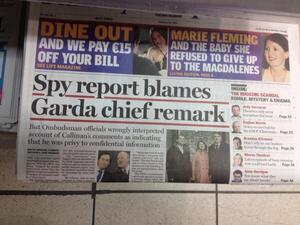
February 10, 2014: Taoiseach Enda Kenny claims thatthe GSOC under Mr O’Brien should have reported the Verrimus investigation to Minister Shatter but this is not the case. The minister holds a two-hour meeting with Mr O’Brien, who later makes a statement to say the threats could not be comprehensively explained, that ‘there was no evidence of Garda misconduct’ and that he regretted not telling Minister Shatter about the Verrimus investigation. Fine Gael/Labour coalition reject calls for an independent inquiry.
February 11, 2014: Mr O’Brien and Mr Callinan meet for two hours and both agree to move on from the incident. The Association of Garda Sergeants and Inspectors call on Mr O’Brien to resign. Minister Shatter tells Dáil the claims of bugging were ‘baseless innuendo’. He says GSOC ‘ concluded that no definitive evidence of unauthorised technical or electronic surveillance of their offices was found. Moreover, they have informed me that their databases have not been compromised. In other words, it has not been established that the offices of the Ombudsman Commission were subject to surveillance.’ He also said: ‘There was no specific concern which caused GSOC to organise the security sweep, which was carried out by a security firm based in Britain. It was a routine sweep.’ Also in the Dáil, Enda Kenny said: ‘If you’re asking me ‘was the office bugged, what I’m saying to you, in the words of GSOC that they found, following the investigation, no evidence of sophisticated evidence of unauthorised technical or electronic surveillance of their offices found, I think that’s pretty clear.”
GSOC’s Kieran Fitzgerald goes on RTÉ’s Prime Time and says that while GSOC cannot say definitively they were under surveillance, the chance that one of the anomalies being innocent was ‘remote to zero’.
February 11, 2014: Fianna Fáil leader Mícheal Martin, during Leader’s Questions, repeats some of what Mr Wallace read into the Dáil a week previous and some more – from the taped conversation between Sgt McCabe and Oliver Connolly on February 9, 2012.
February 12, 2014: Enda Kenny announces that he has asked the Department of Justice to furnish him with a report into the alleged comments about Shatter going after Sgt McCabe.
February 12, 2014: Minister Shatter says: “There’s a reference to some transcript. I’m not privy to the transcript, I don’t know anything about the meeting that took place, I don’t know how the transcript was created.”
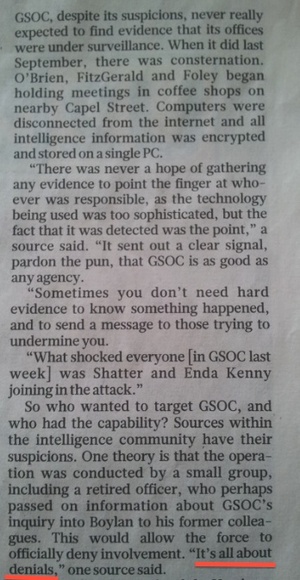
February 12, 2014: Mr O’Brien tells the Public Service Oversight and Petitions Oireachtas Committee that he suspects GSOC was bugged and that it could have been gardaí. He tells the committee that GSOC held meetings in cafés on Capel Street in Dublin because they were afraid they were being bugged.
February 13, 2014: Tánaiste Eamon Gilmore tells the Dáil he believes no State agency was involved in any suspected GSOC bugging. On RTÉ’s Prime Time, Minister Shatter is asked why his account of events in the Dáil on February 11 was different to that given by the GSOC chairman Simon O’Brien to the Oireachtas committee on February 12, and to that of Kieran Fitzgerald on Prime Time on February 11. Mr Shatter put it down to general confusion while also insisting what he said in the Dáil was exactly what GSOC told him.
February 18, 2014: Broadsheet posts the full transcript of the conversation between Oliver Connolly and Sgt Maurice McCabe.
February 19, 2014: Garda Confidential Recipient Oliver Connolly is sacked.
February 19, 2014: Fianna Fáil leader Micheal Martin says he has documents, obtained from Sgt McCabe, suggesting that gardaí failed to act on allegations of abduction, assault, murder and other serious crimes. He says he’s passed them on to the Department of the Taoiseach for full investigation.
February 19, 2014: Government appoints retired High Court Judge John Cooke to conduct the Independent Inquiry into Reports of Unlawful Surveillance of GSOC.
February 20, 2014: Minister Shatter releases a statement into the sacking of Mr Connolly, saying: “I informed him that in the context of his failure to unequivocally repudiate the content of the alleged conversation or take the necessary action to restore public confidence in the office of Confidential Recipient, I believed his position was untenable and I had no alternative but to relieve him of the position.”
February 21, 2014: Broadsheet posts a letter dated December 17, 2012, which was sent from the assistant secretary at the Department of Justice, and which was forwarded to Enda Kenny and Leo Varadkar’s departments. As mentioned above, the letter is, in the main, in response to an email Sgt McCabe sent on December 12, 2012 in relation to the quashing of penalty points. But it also refers to the dossier of serious complaints that Sgt McCabe made to the confidential recipient in January and which has been passed on to the Taoiseach, via Fianna Fáil’s Mícheal Martin.
February 22, 2014: Fianna Fáil TD John McGuinness, speaking on Saturday With Claire Byrne, reveals a third whistleblower, believed to be a female Garda, is set to come forward with fresh allegations against Garda practices within the next week. Mr McGuinness also recalls the case of 23-year-old Shane O’Farrell who was killed in a hit-and-run outside Carrickmacross, Co.Monaghan on August 2, 2011 by Zigimantas Gridzuiska, 39, from Lithuania. Gridzuiska had 42 previous convictions in three different jurisdictions and was out on bail at the time of the killing. Judge Pat McCartan acquitted him of dangerous driving causing death. He was then given the choice of eight months in prison or to leave the country within 21 days. He chose to leave.
February 23, 2014: Philip Ryan, in the Sunday Independent, reports that attempts were made by Garda colleagues to blame Sgt McCabe for releasing Jerry McGrath from custody before McGrath went on to kill Sylvia Roche Kelly.
Sources: Sunday Times, Irish Examiner, Phoenix magazine, RTÉ, Sunday Independent, Irish Times, Irish Independent, Irish Daily Mail, Mail on Sunday, and RTÉ.