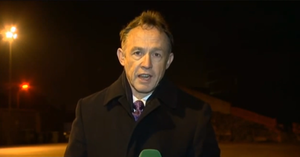
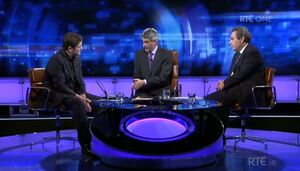
Last night Justice Minister Alan Shatter’s appeared on Prime Time in relation to the alleged bugging of the Garda Síochána Ombudsman Commission.
During his appearance, presenter Claire Byrne asked Mr Shatter about the different versions of events told by him in the Dáil on Tuesday, compared with that of the GSOC chairman Simon O’Brien, told at an oireachtas committee meeting on Wednesday, and indeed what GSOC commissioner Kieran Fitzgerald said on Prime Time on Tuesday.
Mr Shatter put it down to general confusion while also insisting what he said in the Dáil was exactly what GSOC told him.
Claire Byrne: “Just to clear what you said in the Dáil was based exactly on what Simon O’Brien told you during your meeting on Monday. So did he have a different story then? When he went to the committee. I mean, let’s admit it, he gave an incredibly different account of what had happened?”
Alan Shatter: “I’m very conscious that Mr O’Brien and the other members of GSOC were at a committee meeting for up to four hours and a series of questions were put to them. And I think, in the course of that event, there were different answers given, with regard to particular issues and these, some of what was said during the course of that seemed to me to be a little confused or contradictory.”
Byrne: “So you were surprised by at least some of what was said during that committee hearing by the chairman of GSOC?”
Shatter:“At no stage during his oral briefing of me, in the context of a written brief, or indeed the press release that GSOC issued, was it stated that he or members of GSOC believed they were under surveillance. What was stated was that, in the context of a security sweep that had been undertaken, vulnerabilities, or potential threats or abnormalities had been identified. And I acted, I acted on foot of that.”
Byrne: “Ok. But this is very important. Do you believe that you were given information that led you to mislead the Dáil?”
Shatter: “No, I was given information that I brought to the Dáil…”
Byrne: “But it was wrong, it was contradicted afterwards..”
Shatter:…”the brief…well no, it was, the brief that I received from GSOC, which was very important, I forwarded this evening to Joint Oireachtas Petitions Committee, before whom the GSOC members were yesterday [Wednesday]. I’ve been asked to present at the committee next Wednesday, I’m very happy to do so. I do think that it’s important that there’s absolute clarity in regard to these issues.”
Byrne: “So you weren’t told the full story?”
Shatter: “No I was told a, the story…”
Byrne: “A story but not the whole story.”
Shatter: “I was told the story that I told the Dáil and I do think there’s now some confusion arising from the four hours of hearings that took place.”
Later
Byrne: “Quite aside from the hearings, Kieran Fitzgerald was in here, the Garda Ombudsman Commissioner the other night and he said that the first security sweep was done because there was a credible threat they believed, now that wasn’t what you said in the Dáil? You said it was routine.”
Shatter: “Kieran Fitzgerald, I think I recollect correctly, said that he agreed with my account in the Dáil..”
Byrne: “But he did say there was a credible threat.”
Shatter:“I repeat: my objective, and my only objective, was to tell the Dáil the truth of what I knew about these matters. What I knew about these matters was based on the briefing I got from the chairman of GSOC and also from the written submission that they made to me. It was absolutely clear and the written submission they furnished sets it out. They referenced the importance of confidentiality and security and that because, for some considerable time, going all the way back to 2007 apparently, there hadn’t been a general security sweep, they determined what should be undertaken. No threat was ever identified to me as stimulating the need for that sweep.”
“Yeah, I mean, in fairness to the journalist John Mooney, he broke this story, he got a scoop, he did his job, and he published it in the public interest. But it has caused a major problem for the Ombudsman. Because Simon O’Brien knows that he has a major security problem in GSOC, he has at least one mole and possibly more than one mole leaking secret information and details, possibly documents, in an organisation that holds highly secret and confidential information, and it’s been going on for almost a year. And GSOC still doesn’t know if it was under electronic surveillance. And if it was, by whom?”
Paul Reynolds, RTE Crime Corrrespondent on today’s News at One. Full transcript here
“The original newspaper story that sparked this controversy was pretty accurate in its detail, in that it mentioned wi-fi networks, conference phonecalls and so on but it also went on to cite unnamed sources, saying that there was ‘government-level technology involved’. Well, obviously, there doesn’t appear to have been and that raises the question of who leaked the information and, to borrow a phrase from a couple of years ago, who sexed up this particular dossier? And then there’s the question of not telling the minister, understandable perhaps at the time but scarcely credible now that the whole controversy seems to have been nothing more than something of a bottle of smoke.”
David Davin Power, RTE Political Correspondent, RTE, February 11. Full transcript here
Really RTE News?
Really?
REALLY?
REALLY?
Meanwhile…
From today’s Indo. Ever get the feeling some people want the #gsoc spying scandal to disappear ASAP? pic.twitter.com/OfuDRO7PdE
[Sunday Times security correspondent John Mooney, above, and Justice Minister Alan Shatter and Garda Commissioner Martin Callinan, top]
Last night Mr Mooney, who broke the GSOC bugging story last Sunday; Padraig MacLochlainn, Sinn Féin Donegal TD; Michelle Mulherin, Fine Gael Mayo TD; and Mark Kelly, director of the Irish Council for Civil Liberties, appeared on RTÉ’s Late Debate with Audrey Carville last night to talk about the story.
During their discussion, Mr Mooney set out to explain what he believed was behind the surveillance, while also accusing the Fine Gael/Labour coalition of trying to cover up the story.
John Mooney: “This whole matter goes back to a collusion investigation, a Garda Ombudsman Commission investigation going back a number of years, I was actually involved in it. Actually, I suppose to quote Enda Kenny, when he was in Opposition, saying – this was the Kieran Boylan affair – where he was demanding that the Government of the day provide explanations: ‘I want to give the Government…to give a full explanation of these cases, I will be tabling questions on the nature of the inquiry into both Boylan and why he isn’t before the courts when he was caught with large amounts of drugs, heroin and cocaine’. This was a drug trafficker who was working with a group of guards in the Dublin area, who served their way to promotion on the basis of turning a blind eye to these activities, in return for setting up people, including very young men in the Dublin area for arrests, and GSOC were in the middle of a very, very sensitive investigation into that which revealed all sorts of wrongdoing and all sorts of what could only be described as corruption within the intelligence services. And this particular escapade or what’s been happening, to the Commission, followed on, as they were drawing to a close, their big, public interest inquiry into this. And there were various people within the State apparatus who were desperately needed to know what they knew. And if you’re asking me, and it’s a very well-informed opinion, this is what this is all about. To be perfectly frank, I’m astonished at what’s going on in Government level.
I remember Pat Rabbitte, when he was a justice spokesman in Opposition, screaming from the rooftops about Kieran Boylan getting given a haulage licence on the basis of false documentation and information to the Department of Transport. I remember when this individual, whom I should say whose associates were issuing threats against myself and others, was being brought up and being charged, and then the charges would be dropped secretly and then recharged again and again charges dropped secretly in discreet manners, to try and get this man off because he has so much dirt on the guards. There was a lot of, there was a lot of people at risk over what had happened, because this all totally contravened the new rules that were brought in, following the Morris Tribunal. And I am actually astounded at what’s happening in Government at this level. Brendan Howlin himself, I was a witness in the Morris Tribunal, I’ve done a lot of work in security issues in the last 15 years, Brendan Howlin was one of, I remember he played a very noble role in exposing what happened there. And the silence of the Labour party in this matter is absolutely deafening. How anyone, at all, could suggest and you know, I’m just, I’m just speechless at these kind of defences that ‘well nothing can be proven’. Simon O’Brien was very categoric tonight [last night] right.
And I know modern surveillance, because I deal with this stuff for a living, it doesn’t leave traces, you can’t prove that someone has done something because it’s so high tech. We published a report last week, which has proved to be pretty accurate, despite Alan Shatter and Enda Kenny’s attempts to [inaudible] to cover this up…”
Audrey Carville: “And your implications, John, about who was behind it, is pretty clear as well.”
Mooney: “I’m not saying who is behind it because I think there’s two issues here: you have to differentiate between the guards as an organisation and elements within the State security forces that are doing their own thing and they’ve the know-how and the knack to do this stuff, on the QT and abuse State systems. I can hazard a guess, at this, because I’m pretty familiar with the types of people that may be suspected of involvement in this and what might be motivating them. But, at the end of the day, this has developed into something else now. We had the Justice Minister stood up in the Dáil yesterday and poured cold water on the most serious allegations to come out, concerning spying an espionage, illegal, I should say.”
Carville: “But he was doing it on the basis, it seemed, of GSOC’s own statement from the day before?”
Mooney: “I’m not so sure that Alan Shatter is being so forthcoming, again ‘baseless innuendo’, given the security report has stated and what he published in the Sunday Times. It’s quite clear this isn’t baseless innuendo, they were running state-of-the-art countersurveillance tests on their internal communications and external communication system and anyone who knows anything about a black operation, which this is, that’s a spying operation that’s run off the books and is deniable, that the first thing you do when you organise these, you give yourself and exit strategy. And if you’re asking me, my worthless opinion, the bits and pieces that they found during these screening tests were the loose ends that those involved in this forgot to tie up and have left a signature which showed that something was going on.
But, again, I think you have to go back to this. You’ve a number of issues here: you’ve the comments and the statements that Alan Shatter gave the Dáil yesterday [Tuesday], you have the unprecedented situation where Enda Kenny, the Taoiseach of this State, went off and gave comments that were completely inaccurate about the legislative requirements of the Garda Ombudsman and you have the bizarre situation, like it, it’s just feeding into this problem about the administration of justice, whereby Alan Shatter, for example. There was information read into the Dáil record about the Confidential Recipient [a transcript of a conversation between Garda whistleblower Maurice McCabe and the Confidential Recipient Oliver Connolly in which Mr Connolly warned Sgt McCabe that Alan Shatter ‘will go after you’], we were trying to seek, to find out, has the Justice Department done anything about this?
These are the most incredible allegations being made and I don’t think there has been…I was asking tonight, there was something that I’m very deeply interested in – as it seems now I’m the subject of some sort of investigation – did Alan Shatter sign a warrant for surveillance on the Garda Ombudsman? I still can’t get an answer on that. So I think this is gravely important, I think there’s been a really serious attempt by the State to cover this up over the last couple of days and it’s blown up in their faces.”
The Oireachtas Petitions and Public Service Oversight Committee held a private session tonight, following its discussions with members of the Garda Síochána Ombudsman Commission, including GSOC chairman Simon O’Brien, above.
Since this private session, the committee, chaired by Sinn Féin TD, Pádraig Mac Lochlainn, has released the following statement:
The Committee has grave concerns about some of the issues raised during the detailed discussions with the Garda Ombudsman Commissioners. Serious questions remain unanswered. Reflecting on the need for further consideration of these matters, the Committee has decided:
To contact the GSOC requesting the unredacted reports by security company Verrimus, and any other related information in connection with the investigation into suspected surveillance at GSOC offices, be made available to the Committee on a confidential basis, and to invite the Minister for Justice, Equality and Defence Alan Shatter TD to address the Committee on these developments and to assess the approach he and his Department propose to take to respond to the concerns raised.
The Committee is undertaking this process conscious of the need to secure public confidence in the administration of justice.
From right: Kieran Fitzgerald, Garda Siochana Ombudsman Commissioner (GSOC), Carmel Foley, Commissioner GSOC, and Simon O’Brien, Chairman GSOC, arriving at the Public Service Oversight and Petitions Committee in Leinster House, Dublin today.
[GSOC]’s Simon O’Brien says the Commission investigated possible bugging under a legal clause that allows it to investigate possible offences by members of the Gardaí. However, he says he personally decided not to report the suspicions to the Minister for Justice Alan Shatter, because he did not want to suggest that Gardaí had organised the surveillance of the office. However he is clear that he believes the office was targeted.
Justice Minister Alan Shatter spoke in the Dáil yesterday evening about the reported bugging of the Garda Síochána Ombudsman Commission’s offices during a 5.30pm debate on the matter, saying:
“It is important to say at the outset that the Garda Síochána Ombudsman Commission has informed me that, after an investigation, they concluded that no definitive evidence of unauthorised technical or electronic surveillance of their offices was found. Moreover, they have informed me that their databases have not been compromised. In other words, it has not been established that the offices of the Ombudsman Commission were subject to surveillance. Some public comment has proceeded on the basis that it is an established fact that the offices of the Commission were bugged when clearly it is not.”
… “The issue in question arose following a security sweep, in September 2013, of GSOC’s offices in Dublin. I am informed that there was no specific concern which caused GSOC to organise the security sweep, which was carried out by a security firm based in Britain. It was a routine sweep of a nature which had occurred previously. I do not think anyone could argue that it is unreasonable for a body which, of its nature, holds sensitive information to take measures to ensure the security of its communications.” … “I am advised by GSOC that the sweep identified what they refer to as two technical anomalies which raised a concern of a surveillance threat to GSOC. I should emphasise that my understanding is that what was at issue were potential threats or vulnerabilities, not evidence that surveillance had, in fact, taken place. A subsequent sweep identified a third potential issue. There was no suggestion that there was any risk of unauthorised access to the GSOC databases and the documentation on them.”
Taoiseach Enda Kenny, above, also addressed the Dáil, saying:
“So, if you’re asking me ‘was the office bugged, what I’m saying to you, in the words of GSOC that they found, following the investigation, no evidence of sophisticated evidence of unauthorised technical or electronic surveillance of their offices found, I think that’s pretty clear.”
RTÉ’s political correspondent David Davin-Power on the 9pm news last night, speaking to Eileen Dunne, from Leinster House.
Eileen Dunne: “David, the focus of this story seems to be changing all the time, where are we tonight?”
David Davin Power: “That’s right Eileen, the focus of this controversy has weaved about a bit but I think tonight it’s settled on the Garda Ombudsman Commission and its handling of events. The original newspaper story that sparked this controversy was pretty accurate in its detail, in that it mentioned wi-fi networks, conference phonecalls and so on but it also went on to cite unnamed sources, saying that there was ‘government-level technology involved’. Well, obviously, there doesn’t appear to have been and that raises the question of who leaked the information and, to borrow a phrase from a couple of years ago, who sexed up this particular dossier? And then there’s the question of not telling the minister, understandable perhaps at the time but scarcely credible now that the whole controversy seems to have been nothing more than something of a bottle of smoke. And then, finally, there’s last night’s statement, which infuriated ministers, aswell as the Garda Commissioner, in mentioning the gardaí specifically. Now the Ombudsman chairman [Simon O’Brien] wanted, in his comments, just to put the gardaí out of the frame completely, saying they weren’t involved in anyway but it had the effect of providing ammunition to people who have always been sceptical and suspicion, suspicious of the Ombudsman Commission. So, plenty of questions, serious questions for the chairman of the Ombudsman Commission to ponder, along with his colleagues. They appear before a Dáil committee tomorrow. They’d want to put in a pretty credible performance and present a united front, if the whole process of rebuilding trust and credibility is to have any chance of success.”
Garda Ombudsman Commissioner Kieran Fitzgerald then went on Prime Time with Miriam O’Callaghan, following the news, last night.
Miriam O’Callaghan: “So, Kieran Fitzgerald, the minister today seems pretty clear, there’s no evidence at all that you were bugged. So were you bugged?”
Kieran Fitzgerald: “Miriam, it would be very, very good if we were able to say definitively yes, or definitively no. Unfortunately, the reality of modern surveillance and intrusive surveillance mechanisms, is that it’s very often an inconclusive result. So what we got were credible threats to our own security, we hired consultants, experts, international experts to consider those for us, examine those and test them. At the conclusion of their testing and their sweeps, their security sweeps, they were able to tell us that certain things did not look likely and other things, they could not be definitively sure.”
O’Callaghan: “What were the credible threats?”
Fitzgerald: “The credible threats were three-fold. One was a piece of equipment which was connecting to an external network, a wi-fi device. Now it should have been activated by a password, in actual fact it was activated, seemingly, without the need for a password and transmitting. It did not compromise our data, it did not connect with out internal security. But, having found it, we certainly needed to take it very, very seriously. That was one. The second was more worrying, it was a conference call telephone, a conference call facility that we use, not infrequently, and that was tested, and the test showed up what we called, in our first report, an anomaly, but it showed up something that gave them cause for concern and their judgement was that the strange behaviour of this device, in response to their test, was such that, it could have been coincidental, it could be accidental, it could be explained away but they rated in their report the possibility of it being coincidental as close to zero.”
O’Callaghan: “And the third one?”
Fitzgerald: “And the third one was a sophisticated piece of equipment that does sweeps of buildings, from an external, it doesn’t have to be in a building, just in the vicinity and that can, if you like, attack mobile phones and mobile devices.”
O’Callaghan: “It sounds like, still, like your statement last night from GSOC which more or less confirms what you’re saying now: you still believe that there could have been bugging of your building and your equipment. And that is not what the minister is saying today.”
Fitzgerald: “Well, we’ve no disagreement at all with the minister and we…”
O’Callaghan: “Well you clearly have…because he came out today saying there was none.”
Fitzgerald: “Well, what the minster actually said was that he had received a thorough briefing from us yesterday and further again today, with his officials and what he said was that we said that there was no definitive evidence of…”
O’Callaghan: “He said actually, just to quote him, he said that what was identified was ‘potential threats and vulnerabilities but there was no evidence that any surveillance had, in fact, taken place’.”
Fitzgerald: “There is no evidence to sugge-to confirm that surveillance has taken place. The minister is absolutely right and we have no, as a result of our briefing to him, we have no disagreement on that topic.”
O’Callaghan: “But on the balance of probability, Kieran Fitzgerald, do you believe you were bugged?”
Fitzgerald: “It is very difficult to say, I mean…”
O’Callaghan: “But what do you believe?”
Fitzgerald: “Well, hold on, Miriam, it would be lovely to be able to say we could be certain one way or another. What we are faced with, at the conclusion of this, is that we could more or less dismiss some of these threats and if you like, on a balance of probabilities, on others, we just do not know. What we have learned though, are the threats to our building and ensure that they no longer exist.”
O’Callaghan: “OK but on one of the anomalies you just mentioned, you said the likelihood, you know, that it’s an innocent thing was remote to zero, the possibility?”
Fitzgerald: “Well that’s what was reported to us, exactly.”
O’Callaghan: “So you can’t still believe, or say to me tonight that that would make you believe that there was some form of surveillance.”
Fitzgerald: “Well we cannot definitively, as the minister said and as I’m saying now, we cannot definitively say that we were bugged, certainly we cannot say that.”
Later
O’Callaghan: “But was it routine, Kieran Fitzgerald? To go to a British firm? To do it in the middle of the night, to do it at weekends, or did something make you do it?”
Fitzgerald: “Can I just say, there aren’t an awful lot of people engaged in this work so the pool of people…”
O’Callaghan: “Ok. But was there something that sparked you to do this?”
Fitzgerald: “If you recall, throughout 2012, we were involved in some serious investigations and we…”
Fitzgerald: “And we submitted a special report to the Oireachtas, something we very rarely do, something we do only in grave and exceptional circumstances. We were obviously in a state of heightened awareness of our security at that point. And some things appeared in the public discourse that gave us rise to concern, nothing terribly specific but things that worried us and we thought this is a good time to do this.”
John Mooney, of the Sunday Times, and Mark Kelly, of the Irish Council for Civil Liberties, joined David McCullagh on RTÉ’s Prime Time last night to talk about Mr Mooney’s story concerning the bugging of the Garda Síochana Ombudsman Commission building.
Their appearance followed the release of a statement by GSOC which stated there was “no evidence of Garda misconduct” and which also confirmed the existence of “three technical and electronic anomalies”. It also followed the release of a statement by Garda Commissioner Martin Callinan in which he demanded to know why gardaí were “suspected of complicity” by GSOC.
Mr Mooney explained that, while the GSOC statement didn’t detail the ‘anomalies’, he claimed they were in fact: a phone in a conference room was being monitored, a Wi-Fi device was accessed but deleted all data accessed/potentially collected once it realised it was detected, and a shadow Wi-Fi was set up around the GSOC building which “piggybacked” on GSOC’s own Wi-Fi system which allowed for further monitoring.
Mr Mooney said some of the monitoring was traced back to a British IP address which, he said, was “clever” because it prohibited GSOC from pursuing an inquiry into the UK, as such a move would be beyond its remit.
Then Mark Kelly talked about a potential paper trail if the surveillance was legal before Mr Mooney said he knows certain events prompted the surveillance sweep.
Mark Kelly: “There has yet to be an unequivocal statement that there has been no surveillance of GSOC by An Garda because there is a legal power in the [Criminal Justice Surveillance] Act, from 2009 for Special Branch, a section of the Defence Forces, called G2, and also for Revenue Commissioners to lawfully engage in surveillance, but that leaves a paper trail. I think a starting point in answering the central question which is: who bugged GSOC? It’s not about who reported to the Minister [for Justice, Alan Shatter] and when. It’s not about what did GSOC know that they haven’t told us, it’s about who bugged GSOC? And a central part of getting to the truth about that, I think is what people want to hear is eliminating people who are innocent. So, if it is the case that the guards have had no involvement whatsoever, in terms of the existing legal framework, let that clearly be said.”
David McCullagh: “Ok, and for a legal surveillance operation, you need to go to a judge and you need to get approval and all that sort of thing so, as you say, there would be a paper trail, there would be records of all of that and it should be roughly straightforward then to issue a statement?”
Kelly: “It should and I’m quite surprised that hasn’t happened yet been done. Perhaps the minister will do it tomorrow. But then, there’s a second element to a possible investigation. If this surveillance is not being carried out lawfully, and we’ve no reason to think it has been carried out lawfully, or a reason is there for it to be carried out lawfully, has it been carried out unlawfully? But by agents of the state who have access to the appropriate technology…”
McCullagh: “So we’re talking about rogue elements, the possibility of rogue elements?”
Kelly: “The possibility of rogue elements.”
Later
Mooney: “I think it’s just very important as well to ask why did they [GSOC] do this? What made them feel that they were under surveillance and someone was monitoring them? Simon O’Brien, the GSOC chairman, made a reference to RTÉ tonight that this was a general search: I don’t believe that. In fact, I know that there was certain events [that] prompted this particular security sweep. And that is the omission in this [the GSOC] statement that really, urgently needs to be clarified.”
“In this State, two specific agencies, Garda Special Branch and the Defence Forces Intelligence Branch (G2) have been granted specific surveillance powers under legislation (the Interception of Postal Packets and Telecommunications Messages (Regulation) Act 1993 and the Criminal Justice (Surveillance) Act 2009).
Since both of these agencies fall under the ultimate authority of one Minister, Mr Alan Shatter TD (in his capacities as Minister for Justice & Equality and Minister for Defence), the ICCL trusts that the Minister will provide unequivocal assurances that neither agency has been involved in spying on GSOC. In the event that it remains impossible to identify the culprits with the necessary degree of certainty, an inquiry of a judicial nature may be required.
…There is no direct Parliamentary scrutiny of the intelligence activities of Garda Special Branch or Defence Forces Intelligence Branch and, under the existing legislation, ministerial and judicial oversight is very limited. Irrespective of whether the integrity of GSOC has been compromised by agents of this State, or by other rogue elements, our national safeguards against unlawful surveillance urgently require to be strengthened.”
You may recall The Observer reporting in August on claims made by a small oil services company called OSSL. It claimed it gave sweeteners to residents and gardaí in Rossport, Co. Mayo, on behalf of Shell from 2002 to 2010. OSSL claimed these gifts included a delivery of €35,000 of alcohol to Belmullet Garda Station in 2007.
This morning, RTÉ are reporting that the Garda Síochána Ombudsman Commission have launched an investigation into the allegations, on foot of a preliminary Garda examination into the allegations.
RTÉ reports:
“The Commission said that contained in the complaints are allegations that gardaí have been involved in improper practices in accepting alcohol from OSSL on behalf of Shell E&P Ireland Limited.”
“It is also alleged that gardaí have been neglectful in that they have failed to correctly address or properly investigate these matters since they were reported to them by OSSL in 2011.”