
Tag Archives: Harry’s Dublin

A Little History of Sandymount Beach.

Harry writes:

Walking along the beach at Sandymount today and glancing across at the houses along Strand Road it’s hard to believe that in the 18th century there were very few buildings in what was then Brickfield Town (Brickfield Town was later named Sandymount around 1810). The name Brickfield was derived from a major brickworks in the area.

The brickworks manufactured bricks for the new Georgian houses that were being constructed in the likes of Fitzwilliam Square, Fitzwilliam Street and the Pembroke Estate. At that time only ten families lived around a triangle of workers cottages in what later became Sandymount Green. It wasn’t until the arrival of the 19th century and the building of the sea wall that the area became popular for wealthy merchant Dubliners to build fine houses along the coast line and in Sandymount.

Strand road along the beachfront is a good one-kilometre stroll and worth the walk. Looking out to sea at the view of the coast, it is understandable why James Joyce and his beloved Nora Barnacle from Galway loved the area so much with its beautiful views of Dublin Bay. Joyce wrote of the beach being “at the lace fringe of the tide”.

The view towards Dun Laoire on a sunny day is splendid. Looking back towards Pigeon House and Poolbeg along with the iconic twin chimneys with Howth in the distance is a fine view, it’s the sight of the albeit, very environmentally clean Poolbeg incinerator that ruins it for me, but still its architecture has a very brutalist style that I am sure some folks would enjoy.

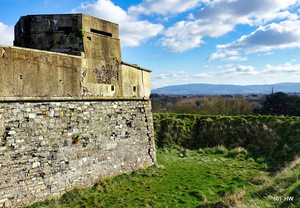
Halfway along the road is a notable Martello Tower with 2.75-metre-thick walls that was completed in 1804. It is one of the larger ones along the coastline. Twenty soldiers manned the tower for guarding the coast. The tower had a one-storey building attached with a stores for weaponry along with two 24 pound roof cannons to engage with any enemy ships across Dublin Bay.

The present incarnation of the tower has been modified with an additional window and metal shutters designed for a restaurant but unfortunately it never came to fruition and is closed to the public. There was a total of fifty Martello towers built along the coast of Ireland in the early 1800s as a defensive measure by our British chums in case that the French Emperor Napoleon would invade Ireland during the Napoleonic war between England and France.

A contemporary account of military exercises at Sandymount in 1806 records how the towers functioned as a complement to other military forces:

“INTERESTING MILITARY SPECTACLE, At an early hour on Friday morning the troop of horse artillery, and two car brigades of light artillery marched on the sands between the Pigeon-house fort and Sandymount … a shell was thrown from the Pigeon-house fort as a signal for the commencement of the novel and interesting scene that was to follow: the horse artillery immediately advanced from behind Sandymount, as did the light artillery from Ringsend and Irishtown (where they had been concealed), upon the sands, where targets were placed for their practice; during their advance, the Pigeon-house fort and the Martello towers on that line of coast kept up a steady fire of shot and shell”.

I would imagine that day was not a good day for a quiet walk on the beach!

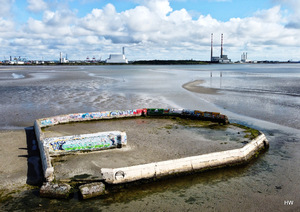
Halfway along the beach and out to sea there are the ruins and walls of what once was Merrion Pier and Sandymount swimming baths. The Merrion Promenade Pier and Baths Company Ltd built Sandymount swimming baths, opening them in 1883 to take advantage of Dubliner’s leisure time during the summer.

The baths were very popular in their day and they measured approximately 40 by 40 metres with separate pools for ladies and gentlemen. A 73-metre pier built of iron girders and timber planks for flooring was added in 1884. With the convenience of Merrion and Sandymount then having both tram and rail, the pier and baths were a popular destination for Dubliners.

At the height of their popularity in 1890 over 30,0000 bathers visited during that summer season, swimming in the fresh seawater baths, partaking of refreshments along the pier accompanied by the enjoyment of music concerts on the bandstand.

When the tide was out the gaps between the planks along the pier attracted “Peeping Toms” and from time-to-time bath attendants would attempt to cool their ardour by dumping buckets of cold sea water on them.

Sadly, the pier and baths fell out of favour and slowly turned to dereliction. By 1923 the seaward wall had collapsed resulting in the baths being dismantled and the iron from the pier being sold as scrap to the Hammond Lane Foundry. At low tide you can still walk out to the baths to day and visit their ruins.

So, the next time you are walking along Sandymount strand have a gaze at the unused Martello tower that with a bit of imagination could be turned into a civic building, perhaps a museum and wonder at the ruins of the old baths, then ponder awhile as to why Dublin City council in all these years hasn’t bothered to either develop the Martello tower or demolish and remove the ruins of the baths as they are a dangerous eyesore, or even to refurbish them into something more modern. Perhaps Broadsheet readers know?

Harry’s Dublin appears here every Friday.

All pics by Harry Warren

Watch towers and cages were built at Glasnevin cemetery to protect the dead from the epidemic of grave robbing in early 19th-century Dublin

A Dying Business.

Harry writes:

Stories warning children of the bogeyman often have a historical basis. One of my favourite stories from the Blackpitts area of Dublin dated from a time when horse and carts were still employed for deliveries.

Mothers trying to get their children to come in from play during the long summer evenings would warn them that the headless horseman would be along soon and would take them away if they didn’t come in.

The origin of the “headless horseman” in this instance was due to the deeds of the body snatchers, conveying a stolen cadaver or two on their back of their cart. To evade the law and to hide their identity they would pull up the large collar of their 19th century coat to hide their faces making them to all intents and purposes appear headless as they passed by on their grim business with their delivery for one of Dublin’s anatomy colleges of the day.

During the 18th and 19th centuries, body snatchers who looted the cemeteries for cadavers to supply the anatomy colleges were known as “Resurrectionists”, or more commonly as the “sack-em-ups”. In the earlier years medical students often procured the bodies themselves by raiding a graveyard in the middle of the night.

A fresh burial was preferred and the pauper’s cemetery beside the Royal Hospital Kilmainham, “Bully’s Acre”, was a favoured one for grave robbing. The deceased were frequently buried in a shallow grave a metre or so down making access easy.

Robbing a body was a grisly business as related in the biography of the Irish physician Sir Dominic Corrigan, describing an incident when he was a student,

“We moved with our hands the recently deposited clay and stones which covered the head and shoulders of the coffin –  no more was uncovered; then a rope was let down and the grapple, an iron hook with the end flattened out attached to the rope, was inserted under the edge of the coffin-lid.

“The student then pulled on the rope until the lid of the coffin cracked across. The other end of the rope was now inserted round the neck of the dead, and the whole body was then drawn upwards and carried across the churchyard to some convenient situation, until four or six were gathered together awaiting the arrival of the car that was to convey them to some dissecting theatre.

“What added to the ghastly character of the moonlight scene was, that the bodies were stripped stark naked, for the possession of a shroud subjects us to prosecution.”

Due to the law of the day nobody could own a dead body, it was easier to bring a prosecution for stealing property i.e., a shroud rather than having possession of a stolen body!

Body snatching soon became a lucrative business. The demand for cadavers was very high and the anatomy colleges including the Royal College of Surgeons in Dublin paid well for good specimens, an adult cadaver could fetch as much as 4 Guineas, (less than €5 in today’s money but a substantial amount back in the day), while children’s bodies were sold by the inch.

A letter to the medical journal, The Lancet, in the 1800’s, strongly criticised surgeons paying body snatchers for illegally-obtained cadavers. In the 1829 issue, there was a report of bodies being shipped from Ireland’s ports (for shipment, the cadavers were folded into barrels of whiskey, a “stiff drink” anyone?) and sent over to England and Scotland for dissection.

Mentioning that if Irish resurrectionists were being hired from overseas with no questions asked to the source of the bodies, how would surgeons in Britain know if the cadavers were furnished by foul means or good? The suspicion being that the resurrectionists may be murdering people to supply the trade rather than robbing a grave for a fresh corpse and soon enough the suspicions were proved to be true.

Two infamous Irishmen, Burke and Hare, murdered sixteen people in the city of Edinburgh, much easier than digging up corpses in graveyards and they sold them to Dr. Robert Knox at the Edinburgh Medical School. They preferred friendless individuals who were alone in the world, much less fuss if they unfortunately passed away. Most victims were guests in Hare’s lodging house, after plying them with drink and with the victim sound asleep, they murdered them by pinching the nose and lying on the chest to cause suffocation leaving no marks on the body.

The law eventually caught up with them and they were put on trial in 1828. Hare saved his neck by turning king’s evidence. Burke was hanged in 1829 and ironically publicly dissected. In a macabre turn of events grisly souvenirs were made from his remains. A calling card case was fashioned from a portion of his treated and tanned skin, embellished with decorative gold engraving. The skin was sliced from the back of William Burke’s left hand.

Many years later it was bought at auction in 1988 for £1050. The story made the national dailies but The Sun newspapers headline ‘£1000 Bid for Bit of a Burke’, was probably the most darkly amusing. Today Burke’s skeleton is preserved in the Anatomical Museum of Edinburgh Medical School.

With the demand for fresh cadavers resulting in multiple raids on various cemeteries many methods were employed to thwart body snatchers, placing heavy stone slabs over graves, installing cages (Mortsafes) around them, employing watchmen and erecting walls and watch towers in cemeteries.

Glasnevin cemetery in Dublin is surrounded by a high stone wall along with multiple towers. The towers look nicely decorative today but they were built to protect the dead from the epidemic of grave robbing in early 19th-century Dublin. Glasnevin even had a mobile watchtower that was moved around the graveyard when fresh graves were dug to prevent the bodies being stolen and ending up being dissected in one of Dublin’s anatomy schools. A pack of bloodhounds were also used to patrol the cemetery at night.

Public outrage eventually forced legislators to pass the British 1832 Anatomy Act, which enabled medical schools to use unclaimed bodies from workhouses and asylums providing anatomists with a legal source of cadavers, and grave robbing quickly declined.

So, if you are having stroll in the Botanic gardens in Glasnevin and you follow the wall it shares with Glasnevin Cemetery you will soon see some of the very same watch towers that were employed to prevent grave robbing back in the 19th century, enjoy your walk!

Harry’s Dublin appears here regularly, often on a Friday.

All pics by Harry Warren

From top: Dalkey Island: gun battery; Martello Tower and the ruins of St. Begnat’s Church

Dalkey Island.

Harry writes:

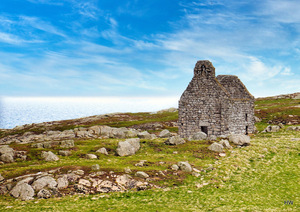
Dalkey Island appeared wonderful in the Spring sunshine. It is a beautiful compact island of 22 acres. It is only 300 metres across Dalkey Sound off the mainland and can be visited by a boat from Collimore harbour.

It’s many years since I first strolled around the island and I look forward to visiting it again hopefully sooner than later. It is deserted now but it wasn’t always so and the island has a long history. A human skull filled with periwinkle shells was discovered during an excavation in the 1960s and it was radio carbon dated all the way back to 2,500 BC.

Archaeologists have shown that the island was home to some of the first Stone Age settlers on the east coast of Ireland. There have been finds of flints, arrowheads, axes and pottery relating to the Mesolithic, Neolithic, Iron and Bronze age.

There is evidence that the island appears to have had a metalworker after the discovery of clay moulds for socketed spearheads, knives, axes and a sword along with crucible fragments for metalwork. Later excavations recovered medieval glassware and pottery from the Mediterranean region and from Gaul, English pottery and an 11th Century silver coin from Normandy. There are also signs that the island was once used for farming.

The original Irish name for the island was Deilg Inis or Thorn Island supposedly due to it resembling a thorn in shape. With the arrival of the Vikings the name Dalk-Ei came into use. The Danish word Dalk means thorn and Ey means island so at least our Viking chums kept the original meaning of the Irish name for the island.

One of the earliest mentions of Dalkey relates to a Viking raid on Dalkey: “Coibhdeanach, Abbot of Cill-achaidh, was drowned in the sea of Delginis-cualann while fleeing from the foreigners”

Viking raiders kept slaves there and it was also used as a refuge by the Vikings when in 942AD the Vikings fled to the island after being beaten at a battle in Dublin.

Evidence of Christianity in Dalkey island dates back a long time and you can see the stone ruins today of the 11th century St. Begnat’s Church overlooking the shoreline. Archaeologists recovered evidence of an earlier 7th century wooden church on the same location. Saint Begnet’s Church and its burial ground is dedicated to Saint Begnet also known as Begh or Bee and is associated with Saint Bea’s Head in Cumberland and Killibeaes in Scotland.

In the 19th century changes were made to the church by workmen constructing the islands Martello tower and gun battery: “The masons and other workmen finding it inconvenient and often dangerous to cross the Sound to their lodgings, fitted up the ruin as a dwelling house, added a fireplace, and enlarged a doorway and some of the windows.” Quite a home from home.

On the south-east of the Island are the remains the gun battery and nearby on higher ground is the Martello Tower. The tower is built in a sentinel position with excellent views out to sea of any incoming vessels. The tower was also used for semaphore signalling and it can be clearly seen from Howth Peninsula twelve miles to the north-east across Dublin Bay.

Along the south-east side it can be seen from other Martello towers along the coast from Sandymount to Bray. Both the tower and gun battery were built in response to the threat of invasion by French forces around 1804 to 1805. The roof of the Martello tower had two 24 pounder cannons as offensive armament. The tower was designed to work in tandem with the gun battery armed with three cannons to control a ships approach to Dublin Bay and anchorage in Dalkey Sound: ‘For the defence of the Sound, and passage between the Muglins, to keep an enemy’s boats & vessels at a distance and oblige them to work up to fetch the South Bull.’

If you visit it today it is in fairly good condition but unfortunately its floor has collapsed so you enter at your own risk.

Just off Dalkey Island are three small rocky islets, Clare Rock, Lamb Island and Maiden Rock that is said to have received its name after some girls from the mainland were foraging and were unfortunately drowned in a tragic accident.

North-east of the island are a group of rocks known as the Muglins and they have a macabre history. In 1776, the executed bodies of the pirates MacKinley and Gidley were hung in chains and left to rot on the Muglins. They were executed for the murder of Captain Cochrane, Captain Glass, and other passengers of the Ship “Sandwich”, on the high seas in the previous year.

In 1765 the ship Sandwich sailed from one of the Canary Islands with a cargo of Madeira wine and a large treasure of Spanish milled dollars, ingots of gold, some jewels and a quantity of gold dust. Before leaving the Canaries MacKinley the ships boatswain and Gidley the ships cook along with two others conspired to murder all on board and to plunder the vessel. When the ship was in the English Channel on her way to London, they killed all on board apart from two boys.

The pirates landed in Duncannon, Wexford and were eventually arrested with their booty. Suspicions were aroused when they brought too much attention to themselves by carousing and drunkenness. They were put on trial in Dublin and on March the 1st in 1776 found guilty.

The pirates were executed in Stephen’s Green with the bodies of MacKinley and Gidley eventually being hung in chains to rot, tied to the Muglin rocks in Dalkey, as a warning to would be pirates. Today there remains are reputed to be buried beneath the concrete base of a beacon on the Muglins.

So, if you want to give yourself a treat then find your way to Collimore harbour in Dalkey where you can get a ferry across the sound to enjoy an island with historic ruins to explore along with rare flora, fauna and wildlife to view.

Harry’s Dublin appears here regularly, often on a Friday.

All pics by Harry Warren
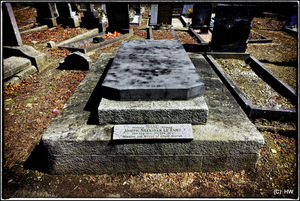
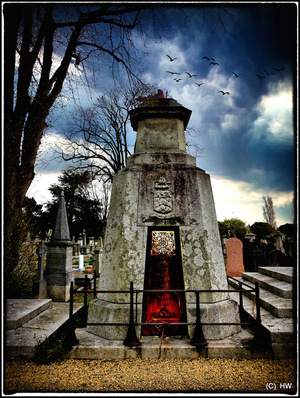
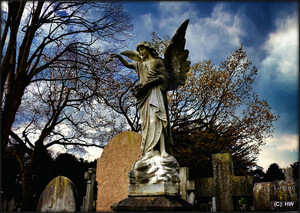
From top Mount Jerome’s ‘long walk’; Angel statue; the grave of Gothic writer Sheridan La Fanu; The vertical Gresham Vault; The Weir Tomb featuring an anguished ‘Cesar’

Mount Jerome Cemetery.

Harry writes:

Mount Jerome cemetery opened in 1836 with the sad burial of the infant twins of Matthew Pollock. The Victorian 50-acre cemetery in Harold’s Cross on the south side of Dublin is a peaceful place. Inside the gates and walking up the avenue towards the Victorian Chapel the most you will hear is bird song and perhaps the gentle sound of leaves rustling in the breeze. It is a good place for a stroll and to collect your thoughts.

In 1836 Mount Jerome was the first privately owned cemetery in Ireland, today over 300,000 rest there.

Originally Mount Jerome was opened as a non-denominational cemetery.Glasnevin on the North side of Dublin was an established Catholic cemetery but mostly Protestants lived around the Harold’s Cross area and with them favouring Mt Jerome, it consequently became a Protestant cemetery for most of the 19th and early 20th centuries. It wasn’t until the 1920’s and the formation of the Irish Free State that the first Catholic burials became more common.

Walking along its avenues you will see some wonderful echoes of Victorian Dublin and its wealthy and notable citizens. Understandably, with its Victorian monuments and layout it has often been compared to Highgate Cemetery in London and Père Lachaise in Paris and like them it has a very similar atmosphere with exquisite Victorian funerary art including ornate memorials, shrouded urns, tombs, angels, vaults and crypts.

Many notaries rest in Mount Jerome, the artists Jack Butler Yeats and AE Russell, William Wilde the father of Oscar Wilde and “Oculist to Her Majesty, Queen Victoria”, the authors Sheridan Le Fanu ‘the Father of the English Ghost Story’ and one of the “best loved writers of her generation” Maeve Binchy, the broadcaster Derek Davis, playwright John Millington Synge, the patriot Thomas Davis and brewer Arthur Guinness the Second along with many members of the Guinness family to name but a few.

What I personally find most interesting are the Victorian graves and monuments. If you are contemplating visiting, here is a little information to hopefully whet your appetite.

Entering the cemetery head towards the Victorian Chapel then take a right along the Hawthorn Walk. Along here there is a fine monument depicting a very sad dog, howling to the heavens whilst standing on his master’s cloak atop a large tomb. The pathways of Mount Jerome are reputed to be haunted by this faithful dog, Caesar.

The legend goes that his master was William Weir, who drowned swimming off the coast of Wicklow. Caesar, refused to leave the area where Weir had left his clothes on the beach and soon died of a broken-heart. After Weir’s body was recovered from the sea and his tomb eventually erected in Mount Jerome, the sculpture of his ever-faithful companion was placed on top of the tomb and ever since then, the phantom dog of Caesar is reputed to be seen wandering along the avenues in the cemetery.

Le Fanu, the Victorian writer of superb Gothic ghost stories rests nearby along the Nun’s Walk. His grave has a notable plaque” Here Lies Dublin’s Invisible Prince, Novelist and Writer of Ghost Stories”.

And somewhat unusually but perhaps not unsurprisingly we find a curious shaped tomb, the “Gresham Vault”. Due to its owner suffering from a severe case of taphophobia they had a very elaborate upright tomb constructed. The lady interred here was so terrified of being buried alive that she was laid in a coffin with a spring-loaded lid. A bell was installed on top of the tomb linked to an interior cable back to her coffin so that she could stand upright and ring for help if she awoke from her eternal or not so eternal slumber.

Taphophobia or the fear of being buried alive was not without reason. In the 18th and 19th centuries, the fear of being buried alive terrified some individuals. There were gruesome news stories of bodies being exhumed with broken fingernails being stuck into the lid of their coffins, skeletons lying near the doors of their tombs and most horribly babies born to women post mortem who had been left for dead. Throughout history, there have been numerous cases of people being buried alive by accident.

During Famine times there were mass burials with bodies being dumped into mass grave pits. One of the most famous instances involved a boy called Tom Guerin. He was only three years old when he was buried alive in a mass grave in Abbeystrewry near Skibbereen.

The details of exactly what happened are somewhat limited. Some reports say he was buried for two days before the mistake was discovered, possibly when more bodies were being placed into the same pit. Others say the mistake was discovered during his burial. The gravedigger accidentally struck his legs with a spade, causing Guerin to moan in pain. Disabled by the spade he later wrote of his premature burial in a poem and made a pittance by recounting his story of being buried alive and rescued to passers-by.

The English reformer William Tebb in 1905 collected accounts of premature burials. He found 219 cases of near live burial, 149 actual live burials, 10 cases of live dissections and 2 cases of the “corpse” waking while being embalmed. Of course, there have been many novels and movies depicting someone being buried alive like Edgar Allan Poe’s, “The Premature Burial” and the 2012 movie, the very unnerving “Buried”. Despite all of today’s medical advances the fear of being buried alive continues. When the time comes, I think I may be wise to have myself cremated.

So, today Mount Jerome is a place well worth a visit where you can explore its historic past, view its fine funerary art and idle away a few hours in quiet contemplative solitude.

Harry’s Dublin appears here regularly, often on a Friday.

All pics by Harry Warren

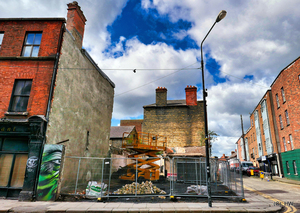
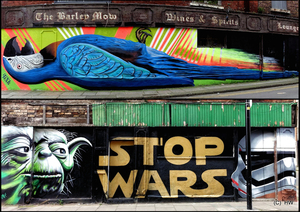
From top: Murals by street artist FiNK on the The Barley Mow (above) in Dublin 8, now demolished

A Corner of Francis Street.

Harry writes:

I always feel a little poignant when I see another piece of auld Dublin disappearing. The old derelict building on the corner of Francis Street and Mark’s Alley West in Dublin 8 has been demolished. And like many such corners in Dublin it has a history to tell.

It was originally the site of the Barley Mow Pub. It has now been reduced to a small pyramidical pile of broken bricks, looking like the sad remnants of a miniature collapsed Inca temple. It is now being swept away as I write. There are only ghosts there now.

A new apart-hotel was planned for the site despite Dublin City Council’s initial refusal of planning permission, because it would, “exacerbate the existing overconcentration of hotel developments and prevent the delivery of residential development” and “the existing historic facades of the building should be retained or reconstructed in order to preserve the character of the Architectural Conservation Area”, but after the site was allowed to fall into dereliction, apparently safety works showed the building was beyond repair and Dublin City Council subsequently allowed it to be torn down. Once again exposing the inept failure of Dublin City Council’s mandarins to either protect structures or look after the best interest of its citizens.

In its hey-day the pub was a busy local when Gerry the barman was serving pints and toasting sandwiches for denizens of the Liberties and the proprietors of the Antique shops in Francis St, but like too many local style pubs across Dublin it closed its doors during the last property boom for development.

The pub made a good location for a movie and it was used during the filming of “Rat”, a comedic film about a Dublin bread-delivery man who is turned into a rat, starring the late great Pete Postlethwaite.

And about the pub’s name The Barley Mow? Apologies to all of the well-read seasoned beer drinkers but I only recently discovered what a “Mow” is, a barley mow is a stack (Mow) of barley, especially barley that was cultivated and then harvested. Barley is a grain that is of course, commonly malted for brewing beer.

In 1999 an offsite commission by the Project Arts Centre, a work by Tina O’Connell, “In Dublin”, used the recently shut but then fully intact pub for an innovative art project. Tina created the sculpture, a deconstruction piece, while on residency at IMMA, with support from multiple organisations including Irish Tar.

A room upstairs in the pub had a circular hole cut into the floor, after the upstairs windows were removed the artwork, a one-ton bitumen sphere, was brought in and placed upon the cut-out hole. The bitumen then slowly melted through the hole to the bar beneath. The private viewing audience allegedly took bets as to how long it would take before the melting bitumen would reach the floor below, if anyone made a bet on 4 hours then they happily won the wager. The art was afterwards opened to the public to view for the following 3 weeks. The pub was hoarded up and over the years the building slowly sank into a state of decay.

In recent years the superb artist FiNK (sic) created some excellent and original mural style artworks using the walls of the defunct pub as his canvas. I believe he had an agreement with the owner to paint his murals on the old pub’s walls. FiNK’s work was colourful, provocative and entertaining, long lasting and brought a vibrancy to an otherwise sad piece of dereliction. It is a pity that in the many areas of the city with similar hoarded up sites that they can’t be used as canvases for street art in a similar manner.

It is a shame Dublin has lost many of its old pubs. Many were closed for development as part of an emerging property boom in the capital in the late 1990’s and many also disappeared during the financial crash after the property boom. Perhaps Broadsheet readers would like to nominate and share a few memories of their favourite pubs that have ceased to be?

Unfortunately, I expect many of the recent pandemically and “temporarily” closed ones, will be unable to reopen due to financial difficulties when the pandemic finally eases. Only time will tell.

Harry’s Dublin appears here regularly, often on a Friday

All photos by Harry Warren

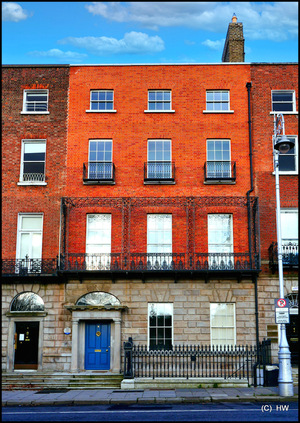
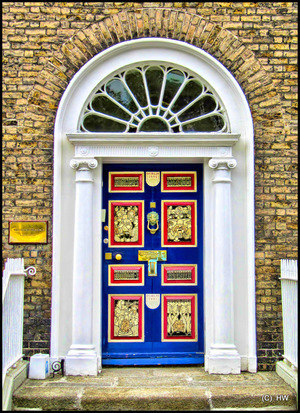
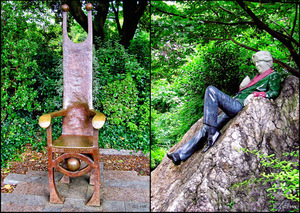
From top: a classic Merrion Square house; manholes for ‘coal deliveries’; a selection of Georgian doorways on the Square; sculpture of Oscar Wilde and the Joker’s Chair, in memory of Dermot Morgan; a Merrion row

Merrion Square.

Harry writes:

Walking across Dublin, a visit to Merrion Square makes a fine diversion to view some excellent Georgian architecture along with a beautiful city park replete with some excellent sculptures. Merrion Square harks back to a time when Dublin was one of the most sophisticated and ambitious cities in Europe.

Richard Fitzwilliam, the 6th viscount Fitzwilliam of Merrion owned a vast estate stretching all the way from Merrion St to the Dublin mountains and he had an eye on developing it. James Fitzgerald, the Earl of Kildare, arguably Irelands foremost aristocrat, gave him his opportunity when the Earl built Dublin’s grandest palace, Kildare House, in 1745-48, at the edge of Fitzwilliam’s estate. Kildare House was the largest and most palatial Georgian mansion in Dublin.

After the Earl was made the first Duke of Leinster in 1766, Kildare House was renamed as Leinster House. It was said to the Earl that his new mansion was located in a decidedly unfashionable area of the city, to which FitzGerald replied, ‘They will follow me wherever I go’. And follow him they did as the fashionable upper tier of society now desired property near the Earl. Merrion Square soon became known as a smart address for the aristocracy and the building of Merrion Square then began in earnest.

Fitzwilliam laid out Merrion Square in the early 1760s. The construction of the Georgian houses at Merrion Square began in 1762 and continued for 30 years with building beginning clockwise on its North side. Three sides of the square feature some of the finest Georgian houses on view in Ireland. The fourth side has the Government Buildings, Leinster House and two superb museums, The Victorian style Natural History Museum, popularly known to generations of Dubliner’s as “The Dead Zoo” and the National Gallery of Ireland.

The houses were built in tranches by various builders two or three at a time, resulting in a variety of different styles. Walking around the square you will see some individual designs and houses of different heights along your way. You will also note that among the red brick houses you will see some granite fronted ones.

In the 19th century wealthy residents also added wrought iron balconies to their homes. Watch out for the circular manhole covers on the ground outside of the houses. This was to facilitate coal deliveries to be poured into the basement of the buildings with no “coal men” having to traipse through the houses.

A major feature of the square is the often-colourful Georgian doors topped with elegant fanlights and detailed brass knockers’ Some of the doors have beautifully styled door panels.

Merrion Square has had many famous former residents and here is a few of them in no particular preference.:-

The childhood home of Oscar Wilde, is at number 1. His mother Lady Wilde, held salons each Saturday afternoon gathering together Dublin’s most talented writers, poets, singers and musicians. Friends like Bram Stoker, Sheridan le Fanu and Isaac Butt attended their house, which is now part of the American College Dublin

The great “Emancipator” Daniel O’Connell Dublin’s home was at number 58

WB Yeats lived at number 82 and was lucky to be missed by an IRA sniper in the 1920s during the Civil War when the sniper fired into his sitting-room from a roof across the square.

One of my favourite artists & mystic, George (Æ) Russell resided at number 84

Sheridan Le Fanu the Gothic novelist resided at number 70

In April 1926, Violet Gibson, who was raised in 12 Merrion Square attempted to assassinate the Italian fascist leader Benito Mussolini

The Austrian quantum physicist Erwin Schrödinger lived or perhaps didn’t live at no. 65. Depending on the nature of reality, of quantum theory and the interaction with the observer of course.

Over the years some major changes were made to the square. In 1933 the national maternity hospital was built and in 1972 the British Embassy at number 39 was violently burnt down by Dublin rioters in response to the Bloody Sunday murders in Derry.

The 48-hectare private central garden, later Merrion Square Park nearly had the Wellington Monument, dedicated to the Anglo-Irish soldier and statesman Arthur Wellesley, built on it in 1817. But in an early act of nimbyism, after residents of the square complained, it was then erected in the Phoenix Park.

In 1930, Dublin’s Archbishop Edward Byrne, bought the park for £10,000 as the site for a cathedral, but building difficulties and increasing costs put an end to this. The Church eventually chose to build the Pro-Cathedral on Marlborough St. Over the years the park became neglected and overgrown when, in 1974, Archbishop Dermot Ryan and the St Laurence Trust leased the park to Dublin City Council for 127 years at a token rent, to be made into a public park for the people of Dublin.

After Dr Ryan’s death in 1985, it was renamed in his memory. Later in 2010 after the Murphy Report into clerical child abuse was highly critical of Ryan’s “failure to investigate complaints” a decision was taken to rename the park and the public were invited to suggest a new name. The overwhelming majority that responded asked that it be named, “The Oscar Wilde Park”, but saying a lot for the mandarins in Dublin City Council, the park was then officially named “Merrion Square Park”

Excellent work by DCC has created a beautifully laid out park attracting over 100,000 visitors a year. If you visit be sure to note the small grassy hill that contains one of Dublin’s WW2 bomb shelters. Take a stroll around the park, it has some excellent sculptures to view among many, like Oscar Wilde, (opposite his home) and the “Joker’s Chair” in memory of Dermot Morgan of “Father Ted” fame.

There are many other things to enjoy about Merrion Square and its park, my favourite during the summer months is the weekly Sunday Open Air Art Gallery where artists have their paintings on view for sale, with their work hung on the railings on the west, north and east sides of the Square.

So, be sure to visit and perhaps Broadsheet readers may like to share their own particular pleasures and stories of Dublin’s Merrion’s Square in the comments section below.

Harry’s Dublin appears here regularly, often on a Friday.

All pics by Harry Warren
The Magazine Fort.

Harry Warren writes:

On a fine Spring day, I was strolling along near the Magazine Fort in the Phoenix Park. Some children playing football kicked their ball near me and with a quick instep kick I tapped the ball back. It brought to mind a historic raid on the Fort that involved of all things a game of football but more of that anon.

Dating back to the 18th century the Duke of Dorset directed that a powder magazine be provided for Dublin.  The Phoenix Lodge built in 1611, standing on top of St. Thomas Hill (The Phoenix Park took its name from the lodge) was demolished so that the Magazine Fort with its five feet thick walls and surrounding dry moat could be built on the same spot.

The new fort was designed by the architect John Corneille and it was constructed in 1734 to 1736 for storing munitions for the Crown in Ireland. The Fort was never properly utilised for this purpose and early on, was seen as a symbol of British occupation. In 1737 Jonathan Swift (author of Gulliver’s Travels) satirised the fort suggesting that there was nothing worthwhile to defend in an impoverished Dublin at that time anyway so why waste time building it?

He wrote:  Now’s here’s a proof of Irish sense, here Irish wit is seen, when nothing’s left that’s worth defending, we build a Magazine!”

In 1801, a barracks was added to the fort to accommodate troops. And in 1830, an older and larger earthwork fort that stood nearby was demolished.

The Magazine fort was a British garrison until 1922 until it was handed over to the National Army (1922-1924) after the Anglo-Irish Treaty. The Irish Army (1924 -) continued to operate the site as an ammunition store until it was demilitarised during the late 1980’s and it is now in the care of the Office of Public Works.

Unsurprisingly the fort was raided on two occasions in its history. Now about that football I mentioned earlier. On Easter Monday 1916 the IRA raided the fort, with one recalling:

“We arrived at the outside of the Fort, pretending to be a Football Team, and by passing the ball from one to the other got near enough to the outside sentry to rush and disarm him, while the remainder of the unit doubled into the Fort with pistols and revolvers drawn. The Guard Room was rushed, the soldiers there were covered and their rifles, which were stacked, were collected.”

An attempt was made to explode the fort by the laying of mines but the IRA discovered that it did not contain any high explosives that could have demolished the building. The fort had a store of only a small supply of firearms and ammunition. After the mines detonated, modest explosive damage was done to the fort and a blaze broke out. Later the fire brigade subsequently succeeded in extinguishing the fire and the fort was restored to service.

Years later on the 23rd of December 1939, a daring raid was made by the IRA on the fort, now in the control of the Irish Army. The “Christmas Raid” as it became known, resulted in the successful seizure of a huge quantity of weapons and ammunition. The reason for the raid was, that although the IRA had copious amounts of Thompson submachine guns, the .45 calibre rounds used in the guns were difficult to come by. By coincidence the Irish Army also used the Thompson and the same ammo.  So, a raid was planned and soon took place.

At 8:30pm on the 23rd of December 1939, a civilian called to the fort saying he had a parcel to deliver to the officer-in-charge. At his court martial, a military policeman then on guard duty at the entrance gate, said he bent down to unbolt the gate to take the parcel and when he stood up there was a muzzle of a revolver pointed in his face. He was told to open the gate and put his hands up. At this point the IRA members appeared from both inside and outside the fort and with the rest of the soldiers caught unawares they were taken captive.

The raid resulted in the huge theft of 1.2 million rounds of ammunition and cases of Thompsons arms being taken away in thirteen lorries with no casualties inflicted on either side. Though the raid was initially successful the majority of the ammunition and arms were recovered in the next two weeks turning it into a major PR disaster for the IRA. The day after the raid the Irish Minister for Justice, Gerald Boland, introduced the Emergency Powers bill to reinstate internment, Military Tribunal, and executions for IRA members.

Today the Magazine Fort stands somewhat dilapidated but it is being renovated and when the pandemic restrictions are eased it will open reopen as an important military historic site on view to the public. It is part of our history as a nation and well worth a visit.

All pics by Harry Warren
Harry’s Dublin appears here regularly, often on a Friday.

St. Michan’s church, Church Street, Dublin 7 and what lies beneath

The Mummies of St. Michan’s Crypt.

Harry writes:

There are many cultures around the world known for the preservation of the dead through mummification.

The most well-known are the Egyptians who preserved soft tissues by a deliberate action of embalming, preparing a body, they left the heart in place due to their spiritual beliefs, removed the rest of the internal organs, rinsed the body with wine, covered and packed the body with natron, a natural salt, leaving it to dry out for 40 days. The now shrivelled body was then plumped up with padding and perfumed, finally coated in hot resin and wrapped in a football fields length of linen strips.

The National Museum of Ireland in Dublin’s Kildare Street. has a petite but very interesting Egyptian room well worth a visit, with several mummies on view, including the mummy and coffin of the lady Tentdinebu dating from the first millennium.

Arguably the earliest practitioners of mummification occurred in what is now the north coast of Chile by the Chincheros, they mummified their dead as early as 5000 B.C. They also eviscerated the internal organs, treating them with salt and clay before returning them to the body. The dry arid climate did the rest for preservation.

Surprisingly, here in Dublin we have an excellent example of natural mummification and the macabre preserved remains can be viewed in St. Michan’s church vaults in Church Street, Dublin. Both the church and its burial vaults have a history to be told.

St. Michan’s is the oldest church on the north side of Dublin. Originally a Catholic Church founded by the Danes in 1095, it has been a Protestant Church since the Reformation. St. Michan’s has been renovated twice over the centuries, in 1685 and 1825. Its current incarnation is little changed since Victorian times.

The church itself is well worth viewing, it features an original wooden interior and a 1725 pipe organ with an original casing that is the oldest in Ireland. Reputedly it was on this organ that the composer Handel on a visit to Dublin first played The Messiah. There are some other unusual items displayed inside the church including a Stool of Repentance, where ‘open and notoriously naughty livers’ did public penance and a skull that purports to represent Oliver Cromwell.

It is what lies beneath the church in the crypt that is of most interest.

Inside the crypt the vaults contain the remains of some of Dublin’s most influential 17th, 18th and 19th century families.

There are participants of the 1798 rebellion, the Sheares brothers, who met a gruesome end, they were executed by being partially hanged then drawn and quartered. What was left of them was brought to St. Michan’s. The mathematician William Rowan Hamilton rests here along with the Earls of Kenmare and there are highly decorated decaying coffins of the Earl’s of Leitrim on display. In the church graveyard are other notables, including Oliver Bond, who took part in the 1798 Rising.

But the most unusual remains are the mummified bodies on view.

Since Victorian times many visitors have descended the steps of the crypt to view the bodies. If you visit you will be in the footsteps of the author of Dracula, Bram Stoker. He may have gained inspiration for his masterpiece as he is believed to have visited the vaults in the company of his family.

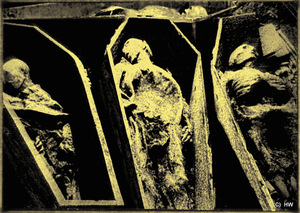
The last time I visited in pre pandemic times, there were four dusty mummified bodies, in decayed open coffins to view. Their skin turned to a leather like parchment stretched across their skeleton. Some dried out internal organs could be viewed where the abdominal area had split on one of the bodies.

The legend is that these four comprised of, “The Unknown”, “The Thief”, “The Nun” and “The Crusader” dating from 800 years ago.

The “Unknown” is a female of which perhaps unsurprisingly, there is no information.”The Thief” has had his hands amputated, supposedly as a punishment for his robberies. There was a body of a “Nun” and most famously there was a body of a “Crusader” who because of his tall stature had his legs broken and crossed under him in order to fit into his coffin. Legend has it that if you stroke his leathery hand, it will bring you good luck. I did stroke his hand and it had a texture like polished leather but about the good luck, no lottery wins but happily I can’t complain.

These bodies have been preserved in the crypt of St Michan’s Church for centuries. The church was built in close proximity to what was then Oxmantown marsh, gases from the marsh, mainly methane coupled with the limestone brickwork of the vaults along with a dry atmosphere and an ambient temperature that rarely varies from 14 degrees has resulted in the remarkable preservation of the bodies.

There is some conjecture as to the actual age of the bodies on display with some arguing that they “only” date from the 17th century. But if they are of more recent vintage, they are still remarkably well preserved as normal bodily remains would have been reduced to skeletons or dust by now. Marshes and bogs are excellent at preserving bodies.

Very sadly in 2019 the crypt was broken into and desecrated. The body of the “Nun” was severely damaged and is now no longer on display. The “Crusader’s” head was torn off, stolen and was missing for some time. Outside of the vault in a normal atmosphere it was feared the remains would rapidly deteriorate. Fortunately, with local input and good investigative work by the Gardai it eventually led to the recovery of the “Crusader’s” head. After restoration work by the National Museum, it is now reunited with its original body.

So, for now, the vaults are currently closed due to the pandemic lockdown but when they reopen, for an interesting and macabre bit of Dublin history St Michan’s is well worth visiting.

All photos by Harry Warren

Harry’s Dublin appears here regularly, often on a Friday.

The Knockmaree Linkardstown Dolmen in Phoenix Park, known as the Devil’s Altar

The Knockmaree Dolmen.

Harry writes:

The Phoenix park in Dublin is always worth exploring and its nooks and crannies have some wonderful surprises. Here’s one you may enjoy.

Take a stroll along Chapelizod Village and enter the south western side of the Phoenix via the Park Lane entrance just off Chapelizod Road. Continue up along the pathway that brings you to Upper Glen Rd. As you cross the road you will see a small keepers cottage, Knockmary Lodge, on top of a hill. Adjacent to Knockmary Lodge in a very pretty woods at the top of Knockmaree Hill, you will find one of the oldest man-made creations in Dublin, the Knockmaree Linkardstown Dolmen.

Knockmaree is derived from the Irish name “Cnoc-Maraidhe” meaning the hill of the mariners. Perhaps the maritime name was associated the occupants of the tomb or with the nearby river Liffey The Knockmaree Linkardstown Dolmen or popularly known, perhaps with some justification, as the Devil’s Altar, dates from a time earlier than the pyramids of Giza. Dating from 3,500 to 3000 BC during the Neolithic period.

Linkardstown style cists, or burials, consist of an earthen mound, with a stone-built tomb at the centre. The remains found inside these tombs are usually adult males and may occasionally be accompanied by a child. The stones today at Knockmaree are all that is left of the original tomb, the earthen mound is long since gone. Archaeologists have identified centuries of water erosion on the dolmen’s capstone making it highly likely that the capstone was brought all the way up from the River Liffey to the tomb by our ancestors.

When the mound was excavated by archaeologists, they discovered the tomb was reused on several occasions. The tombs centre was found to contain the remains of two male inhumations (uncremated bodies) from the Neolithic age. Grave goods were also discovered, a flint blade, a bone toggle and a shell necklace. Later burials were cremations and burnt human remains were found in the tombs outer area. The remains were contained in four small sepulchral vases dating from the Bronze Age approx. four thousand years ago.

As the great megalithic tombs in the Boyne valley like Newgrange, Knowth and Dowth have shown us, many of these ancient burial sites like Knockmaree are astronomically aligned with an axial alignment towards the rising and setting of the Sun at the winter and summer solstices. As the burial mound that once covered the dolmen has been removed, I imagine the dolmen itself would have shifted somewhat over the centuries.

Next Solstice, perhaps a Broadsheet reader will visit with a compass and see if they can figure out any alignment, they won’t be disappointed as the sun shining through the woods is a reward in itself.

The alignments had a ritual significance and many sites were certainly ceremonial and spiritual in nature. The summits of prominent hills and mountains may have been symbolically important places to locate tombs and cairns.

There is archaeological evidence that Neolithic people believed in a multi-stage journey of the dead to the afterlife, the final leg of which took the deceased upwards through the roof of the burial chamber and mound (situated on a hill like Knockmaree Hill or a mountain summit) to the sky, where ‘the dead, now revived, joined the cyclic Sun, and very likely, a god or gods associated with it in the eternal rounds of cosmological life, death and rebirth’.

There is a timeless quality about these megalithic sites, even a modest one like Knockmaree, it gives them enormous power. They were here before us. They will be here long after we’re gone.

So, if you find yourself in the Phoenix Park, perhaps visit the tomb and take the opportunity to pay your respects to an ancient culture and some of Dublin’s earliest Dubliners.

All pics by Harry Warren

Harry’s Dublin appears here regularly, often on a Friday

From top: King’s Inns and former tenement houses – including a museum at No. 14 (above), Henrietta Street, Dublin

Henrietta Street.

Harry writes:

The southside of Dublin has superb Georgian architecture in areas like Merrion square and Fitzwilliam square but the oldest and arguably the best designed Georgian street in Dublin is Henrietta Street on Dublin’s north side.

It has an elegant streetscape lined on both sides by fine Georgian mansions. The street itself is a cul-de-sac and it is capped at the top by the Honourable Society of King’s Inns buildings.

The King’s Inns were designed by James Gandon, construction began in 1795 and completed by his pupil Henry Aaron Baker in 1816. Henrietta Street has been featured many times as a location in TV shows and movies like Penny Dreadful, Foyle’s War, the Glenn Close movie Albert Nobb’s and John Huston’s The Dead to name but a few.

Number 12 has been used as a movie set and featured in over 40 different TV shows and films. Henrietta St is a favourite choice of period movie productions as it has the most intact collection of early to mid-18th century houses in Ireland.

Henrietta St was designed by Luke Gardiner. Work began on the street in the 1720s when mansions were built as homes for the upper tier of Dublin’s society. Gardiner a native of Dublin city, was an MP a treasury official and a wealthy speculative property developer.

In Henrietta St he designed a terrace of palatial townhouses facing each other across a broad street. It was once Dublin’s most exclusive residential address, being home to the country’s wealthiest and important figures from church, military and government.

Gardiner himself lived at number 10 in a house designed by Richard Cassels in 1730. Due to the Archbishop of Armagh owning a house on the street, the street became popularly known as Primate’s Hill. Later the bishop’s house along with two others was demolished to make way for the building of King’s Inns. The street was named for Henrietta, Duchess of Grafton whose husband was Lord Lieutenant of Ireland at the time.

The main rooms of the houses that were used for entertaining and living in was on the ground and first floors, these floors have the highest ceilings and highest windows. The servant’s rooms and the bedrooms were on the top floors.

All of the houses have a history to tell. The aristocrat Lady Kingsborough hired the proto feminist Mary Wollstonecraft, the mother of the author of Frankenstein, Mary Shelley, to be the governess of her daughters in Mitchelstown Castle, Co. Cork.

In February 1787 Wollstonecraft accompanied the Kingsboroughs to Dublin, living in 15 Henrietta Street. She later wrote in a letter home that the ‘wild Irish’ Kingsborough daughters, aged fourteen, twelve, and six, were ‘unformed and not very pleasing’, but she was pleased with her Dublin residence, “I have much more convenient apartments here,” she wrote. ‘A fine schoolroom and the use of one of the drawing rooms where the harpsichord is and a parlour to receive my male visitors in’.

Ten years later one of the daughters, Mary Kingsborough, scandalised Irish society by having an incestuous affair with her own uncle resulting in his murder by her father, the enraged Lord Kingsborough. At the time the supposedly malign influence of Wollstonecraft’s feminist teachings was widely blamed for Mary’s affair. The scandal inflamed Irish society and Lord Kingsborough was duly acquitted.

After the Acts of Union 1800 came into force in 1801 uniting the kingdoms of Great Britain and Ireland, Dublin lost its status as a capital, the country lost its own parliament and all power was transferred to London. Having lost its authority as a centre of legislation the upper echelon of Irish society now spent most of their time in Regency London and Georgian Dublin lost its grandeur.

During the 19th century the wealthy moved to the suburbs and their once elegant Georgian mansions were carved up by rapacious landlords and abandoned to the rent-paying poor.

Henrietta Street fell into disrepair.

For most of the 19th and 20th century it was a rundown tenement street. Each house was terribly overcrowded. Poor families and their malnourished children lived in squalid conditions resulting in rampant sickness with many children dying in infancy. Tuberculosis was a major disease. In Dublin alone, it killed more than 10,000 people a year, more than half of them children.

By 1901, Henerietta St. was home to 141 families, consisting of 897 people, on a street of only sixteen houses. In the mix were fish mongers, apprentice book binders, general labourers, corporation labourers, plumbers and housekeepers. By 1911, over 100 lived in one house.

At number 10, the Sisters of Charity ran a laundry housing more than 50 single women inside. Nineteen families comprising of 104 people resided in number 7. Among the 104 people who shared the house were ‘charwomen, domestic servants, labourers, porters, messengers, painters, carpenters, pensioners, a postman, a tailor, and a whole class of schoolchildren.’

Eventually in the latter days of the 20th century the residents of the tenements were rehoused and the dilapidated buildings were vacated.

Today some of the Henrietta Street buildings continue to need restoration but many houses have been restored. Their restoration is beyond the scope of this article but suffice to say the entrepreneurs, the voluntary and civic bodies involved should be supported.

When the pandemic restrictions are lifted, I would recommend a visit to Number 14 Henrietta St. It is an excellent museum that tells the story of the 300-hundred-year history of number 14 from its palatial Georgian origins to its time as a tenement, its occupants and of Henrietta St itself.

So, if you find yourself in that part of town reward yourself with a stroll up Henrietta St and in your mind’s eye you will find it very easy to be transported back to the vintage days of Georgian Dublin.

All pics by Harry Warren

Harry’s Dublin appears here regularly, often on a Friday.