

They’re moving in straight lines. See?
Original illusion by Arthur Shapiro and Alex Rose-Henig.



How-to guru Dave Hax demonstrates the nifty coup d’oeil you’ll be attempting to pass off as your own later.
(Thanks Dave)

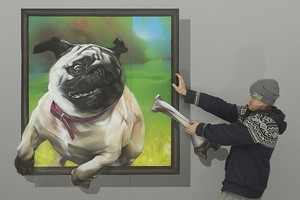

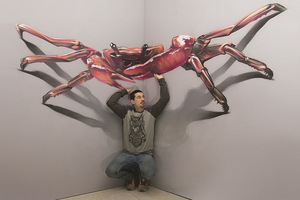
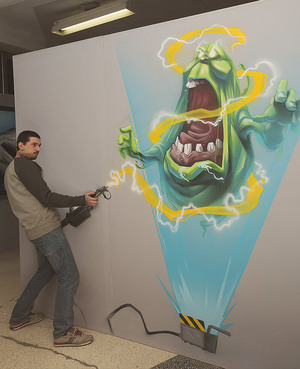

A mobile exhibition of interactive ‘3D’ paintings by Russian art and design studio Brain Mash.
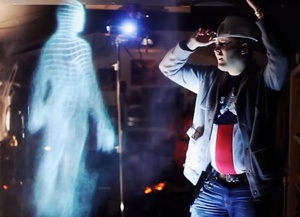
SFX boffin Joey Shanks writes:
You wrote an article on our Star Trek “Teleport” episode about a year ago.
Figured I should share our newest video on holograms!!!!


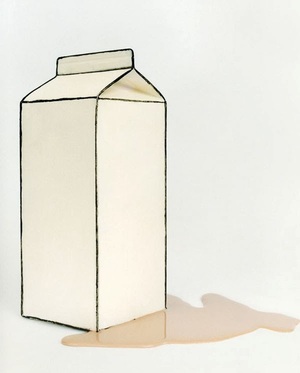

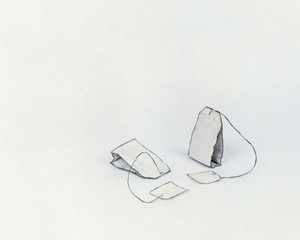 With the addition of white paint and charcoal edging, artist Cynthia Greig creates apparently two-dimensional anamorphics of everyday objects. Sez she:
I start by collecting everyday objects from the recent past — things made obsolete by technological changes and time; I then whitewash them with ordinary house paint as a method of erasure, and then draw directly onto their surfaces with charcoal to create visual hybrids that appear to vacillate between drawing and photography, black-and-white and color, signifier and signified, copy and original. No digital manipulation is involved, but the camera’s monocular point of view is imperative.

An impressive anamorphic illusion using plastic wrap and deftly applied spray paint unveiled this week by Daniel Siering and Mario Shu in rural Potsdam, Germany
 The ‘Wriggling Motion Trajectory Illusion’ – recently discovered by three scientists at Keio University in Japan.
Every white dot you see in the six looped sequences above is moving in a straight line. They are neither swerving to avoid one another, nor colliding.
When hundreds of dots move in straight trajectories and random directions without colliding, the trajectories are perceived as wriggling rather than straight. We examined the nature of this “wriggling motion trajectory illusion” via six separate experiments. The illusion was most pronounced when there were a large number of dots. The illusion was independent of both the distance covered and the observer’s eye movements as well as the dot types. We also showed that the proximity among the moving dots plays a role in the illusion.
Full scientific paper here.


