Tag Archives: Irish Times letter

wig-pic-wig_2644054b

As a woman about to sit final-year law exams, I read the Bar of Ireland’s research into barriers facing women barristers with great interest and much hope that it signalled change.

Of all my classmates, I am the only woman considering a career at the bar. Women who do not plan to go to the bar cite the same reasons women have been citing in similar research down through the years – discrimination, childcare issues, and so on.

Friends of mine have told me they cannot speak up on these matters, for fear of being branded “difficult” and receiving even less work.

The Bar of Ireland’s research is welcome, but far from ground-breaking, and is almost unnecessary in that it reveals little new.

I hope, as I imagine do most women studying law, that it signals the beginning of a huge cultural change at the bar, because nothing else will suffice.

The time has passed for research, and the time has long since come for action.

Ciara Ní Ghabhann,
Corofin,
Co Galway.

Discrimination at the bar (Irish Times letters page)

Related: Two in three women barristers face discrimination, study finds (Irish Times)

Pic: Telegraph

90298783

David Smith complains about what he calls ridiculously intrusive “haitches” in the pronunciation of taoiseach and tánaiste on the airwaves. These are both Irish words, and in the Irish language, the letters D and T, if followed by a broad vowel (a, o, u) are pronounced as if they were followed by the letter “h”. For convenience, I call them “soft” Ds and Ts. So the broadcasters are right – it should be “thaoiseach” and “thánaiste”.

And while I’m at it, “Fine”, as in Fine Gael, is also an Irish word, and is pronounced “finna”, and not “fine”, to rhyme with “wine”. Enda Kenny gets it right. Do his supporters not hear the difference?

Doireann Ní Bhriain,
Rathmines,
Dublin 6.

Finally.

Vowels – softy does it (Irish Times letters)

Pic: Laura Hutton

stream_img

As I sit here in my apartment, the persistent shrieking of a nearby house alarm that started eight hours ago continues to destroy the peace of the weekend. With the owners away and no way of communicating with them, there is little I can do about this situation short of trespass and vandalism.

Although legally all house alarms should have a maximum external alarm duration of 15 minutes, in reality very few meet this standard, and the Garda is essentially powerless unless evidence of repeated and persistent instances of noise pollution are brought before a judge.

In other countries, house alarm standards might be enforced, or officers of the law might be empowered to act when faced with a clear case of noise pollution.

In Ireland, however, we just shrug our shoulders and lament the inefficiency of our country. While I acknowledge that, typically, issues of greater import are discussed on this page, it is noteworthy that with each passing hour I can feel my vote increasingly promised to the first politician that pledges to solve this simple but recurrent and distressing problem.

Colin Davenposrt,

Dublin 9.

House alarms and noise pollution (Irish Times letter)

PA

10688305_826610594075709_211662174123440651_o

We would like to add our voices in support of Sharon O’Halloran of Safe Ireland, when she states (February 23rd) that the issue of domestic violence is a horrific reality faced every day by thousands of women and children in Ireland.

And not just by women and children.

The incidence of domestic violence where men are the victims is also on the increase. In 2014, slightly over 6,500 contacts were received by Amen, an increase of just over 35 per cent on the previous year.

Amen Support Services has been providing support and help to male victims of domestic abuse for almost 18 years.

We welcome the contribution by Hozier in the Cherry Wine video to increasing awareness of domestic violence and hope that the often ignored issue of male victims of such violence will continue to be highlighted.

Niamh Farrell,
Manager,
Amen Support Services,
St Anne’s Resource Centre,
Railway Street,
Navan,
Co Meath.

Male victims of domestic violence (Irish Times letters page)

Amen

Screen Shot 2016-02-22 at 11.03.53Screen Shot 2016-02-22 at 11.01.01

It appears as though nothing in this State is immune to the modern need for rebranding, even where there appears to be neither want nor need.

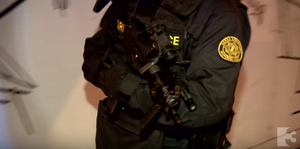
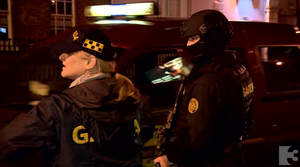
The new Swat-style uniform being worn by members of An Garda Síochána on the streets of Dublin last week now (above) no longer carries just the word “Garda” but also “Police”. Is this an image-enhancing marketing ploy?

Whatever next?

Trevor Tory,
Baile Átha Buí,­
Co na Mí.

Garda branding (Irish Times letters page)

Pics: TV3

Screen Shot 2016-01-28 at 10.40.35

Election posters during the 2014 local and European elections in Newbridge, Co. Kildare

Fine Gael hates Fianna Fáil and Sinn Féin. Fianna Fáil hates everyone but Fine Gael. Sinn Féin claims never to have hated anyone. The Social Democrats are rotating who they hate. Labour hates the position it is in, and everyone hates Michael Lowry (for now). I have a headache.

Des Doris,
Dún Laoghaire
Co Dublin.

FIGHT!

HUG!

Election fever (Irish Times letters)

Eamonn Farrell/Rollingnews

Screenshot from 2014-04-28 16-34-29

I can only agree with Gerard Bennett (January 11th) that Eircode was a huge waste of money. I was awaiting a package from Hong Kong. Using internet tracking I watched it make its way to Cork, from where it was quickly returned to Hong Kong.

The reason An Post gave was that it could not tell where to deliver the package as the address was incomplete. I consulted the company with whom I had placed the order, and they had left a line out of the postal address. However, it did have my name and the Eircode right. I contacted An Post to ask why that could not have been used? The answer was that it did not have the technology to look up the Eircode.

Matthew Lyons,
Charleville,
Co Cork.

FIGHT!

Getting used to Eircode (Irish Times letters page)

Previously: In Defence Of Eircode

eircode-finder-using-map-demo

Nothing encapsulates the awful level of Irish policy discourse like Eircode.

Rather than an objective analysis of the pros and cons, the “debate” is dominated by a series of illogical, contradictory and inaccurate tirades from individuals and vested interests who refuse to consider the bigger picture or long-term benefits.

First and most importantly it is never acknowledged that the only way to bring about a near-hierarchical addressing system would be to allocate road or route numbers to every single non-unique address in the country.

As most roads traverse more than one townland and most townlands contain more than one road, the traditional townland line will not fit properly into these new addresses. Space would have to be reserved for new buildings, resulting in address such as “J Murphy, No 3001 L3867, Ballymagash”.

Do your correspondents really think this would be a significant improvement over the Eircode system? Given the vast resources (dwarfing the Eircode outlay) that would be required to assign route numbers to every highway and byway, mansion and cottage in the country, it would need to be.

Eircode features code redundancy and checking so that a emergency telephone operator immediately sees if an Eircode is valid or if a character is incorrect.

That is not the case with regular street numbers or a GPS system; therefore Gerard Bennett’s advice (January 11th) that readers should avoid Eircode (presumably in favour of manual directions) is truly baffling, if not dangerous.

The Eircode website features an excellent mapping system that can link to a mobile phone’s mapping app. Offline maps from the leading manufacturers will soon be available and will work in areas with no mobile phone reception. This will be an enormous boon to the emergency services and lost tourists.

If adopted by Government and the public service, the new unique addresses have the potential to reduce fraud, waste and errors in many services and in revenue collection and disbursement. As a law-abiding and tax-compliant citizen, I would certainly welcome this.
I also look forward to the day when I can send birthday gifts to my niece without a courier telephoning me to request turn-by-turn directions.

Matthew Glover,
Lucan,
Co Dublin.

FIGHT!

Eircode – the bigger picture (Irish Times letters page)

Previously: Eircode Red

12e6beed6e8f7a725510128c3f4f4177

Michael Neary, the archbishop of Tuam

Michael Neary, the archbishop of Tuam,, says that we have mainly church-run schools because parents want it that way (“Parents must ensure the ethos of Catholic schools is maintained, says archbishop”, November 11th).

I would suggest we have predominantly church-run schools because parents have virtually no choice in the matter.

If the church is so sure of its position in the debate, then surely there would be no objection to asking the people of Ireland what they want, democratically, rather than dictating ever more from the pulpit. A vote to decide the matter once and for all would seem a reasonable proposition.

Vincent Hearne,
Nabinaud,
France.

Patronage and schools (Irish Times letters page)

Pic: Tuam Herald

Ireland-2016.5


Kitty Holland detailed the distressing, but not uncommon, experience of an Irish Hindu child’s difficulty in finding a place in her local primary schools. This was due to the fact she is not Catholic. She eventually secured a place in a school half an hour away. In 2016, this same school will receive one of the 3,300 Tricolours and copies of the Proclamation that are being sent to each primary school to mark the Rising. One of the oft-quoted sections of the Proclamation refers to “cherishing all the children of the nation equally”.

Instead of sending a copy of the Proclamation, could the Government not proclaim and legislate for equal education access for all the children of the State?

Miriam Barragry,
Rathmines,
Dublin 6.

School patronage (Irish Times letters page)

Previously: Educate Apart

No Faith No Place

Educate Together (Facebook)

Pic: Ireland 1916