Tag Archives: Irish Times letter

image

The elected members of Dublin City Council should be wary of being influenced by computer-generated images of how College Green might look if proposed changes in traffic management are implemented.

The image [above]  in your newspaper (“City council says College Green changes need to be agreed by Christmas”, September 17th) gives a fish-eye view of College Green that exaggerates the open space, reduces the height of the buildings and shrinks the size of the buses.

This is a ploy that was widely used in the past by car manufacturers but is now mainly used by property developers. It should never be used as a basis for solving traffic problems.
Louis O’Flaherty,
Santry,
Dublin 9.

FIGHT!

College Green traffic management plan (Irish Times)

Pic: Dublin City Council

00151620

Attorney General Máire Whelan and Taoiseach Enda Kenny

The Fennelly report has confirmed a serious problem that exists within our democratic process – matters of grave importance are being decided at the very highest echelons within the State without any official record of the discussions that led to them. This allows the participants in these discussions to give widely varying accounts of what actually happened and what was said.

This, in my opinion, is because none of the participants wish to have their actions and words scrutinised by the Irish people as a result of subsequent freedom of information requests from media or academic sources. There was a time when we had leaders who would stand over their words and deeds, but this is what “openness”, “accountability” and “transparency” have come to mean. It is not good enough.

Liam Stenson,
Knocknacarra,
Galway.

Taking note of the Fennelly report (Irish Times letters page)

Fennelly Report: The Digested Read

Irishwater

Further to yesterday’s post (link below) regarding water ‘conservation’ grant requirements.

 I received notification today from the Department of Social Protection concerning the application for €100 water conservation grant. The only option provided was to claim (or not claim!) the grant for which I had registered.

Of those who wish or feel compelled to pay their water bills, many, though not all, would no doubt wish to utilise this payment to pay their water bills.

Why did the Minister and relevant department not use this opportunity simply to allow claimants to authorise the assignment of this payment to Irish Water as a credit against preset or future bills rather than have to go to the bother of claiming it and then having to go to the further trouble of paying the bill?

It would have been so easy to offer the choice of a simple assignment, would have facilitated very many people, would have encouraged payment and been of considerable benefit to cash flow for Irish Water, given that most bills are far less than the amount of the said grant!

Irish Water and the Department of the Environment seem determined to seize every single opportunity to indulge in additional administration, with all the attendant costs. It seems that common sense is still not at all common where Irish Water is concerned!
E Dillon,
Farranshone,
Limerick.

The Water Conservation Grant (Irish Times letters page)

Previously: I Am Not A Number

Update:

Enda Rochford writes:

The simple answer to this person’s question is the Eurostat test. In order to pretend that Irish Water was a private company it could only have a specific level of funding from central government and the rest it would achieve via billing and loans.
If the conservation grant was paid directly from the government to Irish water it would be obvious that this was funding coming from the government, so in order to avoid this it became a grant to the home owner. Now you must claim it and then use it to either pay the bill or whatever you wanted, but this added level of costly administration was a “chinese wall” to make the funding of Irish water less transparent to the Eurostat test.
In the longer term its no doubt that the grant will “dry up”, and the cost of running the grant system could be seen as a short term cost to government.

Shopfront

Camerino bakery on Capel Street, Dublin 1

This year’s shortlist of 100 nominees for the Best Shops in Ireland 2015 (irish Times Magazine, August 15) makes for an interesting, and somewhat unsettling, observation. A quick tot of the geographical locations indicate that 49 of the shortlisted nominees are located in the general Dublin area, while 44 are to be found countrywide and seven are online.

On closer examination of the 49 Dublin-based nominees I ascertained that only one, the wonderful Camerino on Capel Street, lies north of the river Liffey. Shop horror! Could this signify a strong bias in favour of businesses situated in south Dublin? Surely not.

Yours, etc,
Clare Balfe
(north of the Liffey)
Dublin 7.

BUN FIGHT!

Shop horror! – ‘The Best Shops in Ireland’ (Irish Times letters page)

Camerino

Pic: Carynascakes

latest

 Though the next budget may be some way off in October, I would like to suggest at least one way the Government could do something for the long-suffering masses, and it wouldn’t cost them a penny – repeal the TV and radio licence fee, and let RTÉ fund itself however it wishes, in an open market where it already has a good headstart.

That would put €160 annually back in the pocket of every honest licence-payer in the State. It would also end the situation where anyone who wants to watch any television is obliged to pay a heavy subsidy towards a station they may never watch; and whose money may be used against them and their private views as citizens, as RTÉ pursues its own agendas.

If we were all still paying tithes to the Church of Ireland, despite not availing of its services, or obliged to subsidise a state newspaper, there would be uproar. Yet we are in much the same situation regarding the relic that is RTÉ. The tithes were finally abolished in 1869. Perhaps someone could start a campaign to liberate RTÉ and end its dependence on our pockets. – Is mise,

Nicolas O’Foghliu
Carrigaline,
Co Cork.

The television licence (Irish Times letters)

Previously: Ireland’s Biggest Problem Is RTÉ Says Max Keiser

485px-Irish_Grid.svg


A simple solution to a the postcode problem?

Only you can decide.

Apart from the UK and Canada, no European country nor the USA, use coded grid coordinates for postcodes. France, Spain, Sweden and Germany use a simpler hierarchical code based around the actual post distribution system.

The argument for Ireland and the UK is that rural dwellers are difficult to locate for deliveries and emergencies as they are not part of the town and street system. However, there is a cheaper and very effective alternative – the national grid coordinate.

A 10-digit code as used by hillwalkers will get you to within 10m of any house in rural Ireland and will work quite well even in towns and cities.

When shortened to eight digits as in my address below, the coordinate is good to within 100m, which would be adequate for most emergency services or a parcel delivery in a rural setting. The national grid is free, simple to understand and is printed on most Ordnance Survey maps.

It can also be found on every GPS and satnav system. The benefits are that no codification is required and ease of use. A 10 digit number is no longer than many telephone numbers with their area codes and an added benefit is that one can estimate the distance or proximity of another address by comparing the numbers. –
George Renolds
Blessington,
Co Wicklow,
2982-2139.

There you go now.

FIGHT!

Utterly useless postcodes? Use the Irish Grid (Irish Times letters)

Pic: Wikipedia (Irish grid reference system)

90083911

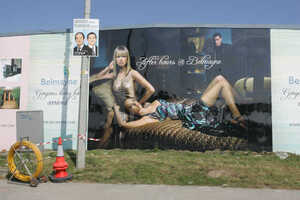
The tastefully-promoted Belmayne Estate on the Malahide Road at Clare Hall, Dublin in 2007.

It never stood a ghost of a chance.

Or did IT?

I refer to Olivia Kelly’s article “Dublin ghost estate of Belmayne redeveloped for social housing”  As a resident of Belmayne I am livid at such a negative and ill-informed portrayal.

Belmayne is an attractive, well-planned development, with a lovely sense of community, an active residents’ association, an amazing youth cluband wonderful community allotments. It is well served by two national schools, children’s playgrounds, excellent public transport links and is easily accessible to the local villages of Malahide and Portmarnock. I feel truly blessed to have wonderful neighbours, good hard working professional people I know I can rely on.

In particular, I take offence to the comments attributed tothe Clúid spokeswoman Karen Kennedy. While not without its problems, like any new estate, I have never witnessed anything remotely resembling the “highrates of anti-social behaviour, rubbish piled up on the streets” or dereliction which she depicts. And I have been here longer than Clúid has.

I also take issue with your reference to Belmayne as a ghost estate. The development has always had a high level of occupancy, as evidencedby the fact that it never appeared on the Revenue Commissioner’s list of some 2,700 ghost estates.

My neighbours have strived hard to build a community with asense of identity and pride. Belmayne might have been Ireland after the property crash. Your article makes it sound like Berlin after the war. It was never thus.

Dermot Regan,
Belmayne,
Dublin 13

Belmayne not a ghost estate (Irish Times letters)

Dublin ghost estate of Belmayne redeveloped for social housing (Olivia Kelly, Irish Times)

Previously: Remember When Gorgeous Living Came To Dublin?

Screen Shot 2015-06-30 at 02.32.16

If Ellen Rowley thinks Busáras is “a masterpiece of modern architecture” (“Modern Ireland in 100 Artworks: 1948 – Busáras by Michael Scotts”) she has obviously never tried to catch a bus there. I am tired of this building being held up as one of the greatest exponents of modern architecture in Ireland in a “king has no clothes” manner. Was it just a minor oversight by the designer that the actual place the bus is going to is always indicated at the front, rather than the back. All form, no function.
Liam Ryan Architect,
Ballina/Killaloe, Co Tipperary.

FIGHT!

Is Busáras really a masterpiece? (Irish Times letters)

Pic: Andy Sheridan

90383381

College Green, Dublin

Frank Byrne pleads for the retention of the trees in College Green as part of the car-free redevelopment proposals. I think Frank is wrong and that the trees seriously diminish the appreciation of one of Dublin’s great vistas.

Not all trees enhance an urban setting. Would St Peter’s Square in Rome be enhanced by the planting of trees? Of course not. I shall be glad to see the back of them in College Green and we can all revel fully in the facades of Grattan’s parliament building and Trinity College. O’Connell Street benefited greatly from reordering its treescape some years back.

Declan Doyle
Clontarf, Dublin 3.

FIGHT!

Trees and College Green (Irish Times letters)

Previously: Four Wheels Bad

Pic: Eamonn Farrell/Photocall Ireland

90380801

Prince Charles and Sinn Féin President Gerry Adams during Prince Charles’ visit to Galway last week

At the end of her otherwise lyrical piece on Prince Charles’s visit to Galway and the Burren, Miriam Lord concludes on a gratuitously negative and wrong note (“Fields of magic on trip to the Burren”, May 20th).

“As for Mr Adams, he didn’t stay for the speeches after the handshakes. Gerry had his Kodak moment.” Oh Lord.

I did stay. Upstairs. With Martin McGuinness and Trevor Ó Clochartaigh. But maybe Miriam didn’t know. We met privately with Charles and there wasn’t a negative word between us. Just saying. – Is mise,

GERRY ADAMS, TD
Leinster House,
Dublin 2.

Prince Charles’s visit (Irish Times letters)

Related: Miriam Lord: Fields of magic on trip to the Burren (Irish Times, May 20)
