Tag Archives: Legal Coffee Drinker

90339199

[Willie McAteer leaves the Central Criminal Court, Dublin yesterday following sentencing in the Anglo trial]

Dave writes:

“Now that the Anglo trial, such as it was, is concluded, can I ask about a point that seemed significant to me, but was largley ignored by the media. My understanding of the chain of event relating to the directive to find Fitzpatrick and Whelan not guilty in relation to the letters sent out to the Maple 10 is this:
Pretrial: Prosecution brings a number of charges in relation to the nature and the alteration of the letters/agreements, based on evidence allowable.
Trial: Judge directs prosecution to drop the charges and instead submit a charge directed (dictated) by himself. Following this, he then rules that the charges he has directed the prosecution to bring will not hold up in court, due to the phrasing of it – not because there is no evidence of wrongdoing, but because of the specific wording of the charge. He then tells prosecution that he will not allow them to bring another charge.
I’m just wondering if there is any legal precedent for this chain of events?; and does this mean that neither party can now be tried for any of the original charges the prosecution had brought, or do they just have indemnity for the single specific charge that they were found not guilty of? I’ve asked a few friends with various degrees of legal knowledge, and none of them seem quite sure of the answers – or the precedents this sets.”

(Legal Coffee Drinker has been alerted.)

Meanwhile, anyone?

Earlier: A Bystander In A Car Crash

Who Created Light Touch Regulation?

(Eamonn Farrell/Photocall Ireland)


90264588

[Members of the Survivors of Symphysiotomy campaign group in June 2012 after addressing the justice, defence and Equality committee]

Proposals to compensate more than 250 survivors of the medical procedure symphysiotomy will be placed before the cabinet in the coming weeks.

We asked Legal Coffee Drinker what’s it all about.

Broadsheet: “Legal Coffee Drinker, what’s it all about?”

LCD: “It’s about proposals to change the law to allow for compensation for women suffering the after-effects of symphysiotomies.”

Broadsheet: “Would it not be possible through the courts? Surely carrying out this procedure without consent is actionable?”

LCD: “Indeed it is. Most recently, in Kearney v McQuillan, where a damages award of €450,000 [subsequently reduced to €325,000 by the Supreme Court] was made in respect of a symphysiotomy carried out in 1969.”

Broadsheet: “On what ground?”

LCD: “The tort of negligence. It arises where someone who owes a duty of care to another fails to exercise reasonable care towards that other, as a result of which they suffer damage. This was a case of medical negligence involving a failure to exercise reasonable care in medical treatment.”

Broadsheet: “So the symphysiotomy survivors should sue?

LCD: “Not necessarily. Firstly, whether or not a symphysiostomy represents a breach of a hospital’s duty of reasonable care depends on the circumstances of each case: whether it was necessary; whether alternative treatments were available, or if not available whether something could have been done to prevent the necessity of a symphysiotomy arising in the first place. The circumstances of the individual case need to be looked at.
Secondly, Irish law has what is known as a limitation period of six years for actions in tort and contract. In the case of a negligence action, this means that proceedings must be brought within six years of the initial damage occurring. In the case of a symphysiostomy, that would be within six years of the operation. Most of these operations were carried out more than six years ago.”

Broadsheet: “But Kearney was 1969?”

LCD: [refills coffee] “Yes. The plaintiff in that case was able to avail of a provision in the Statute of Limitations (Amendment) Act 1991 which provides that time does not start running, for the purposes of an action in negligence, until the plaintiff can be reasonably aware of the damage having occurred. It’s known as the ‘discoverability’ principle.
Basically it means the six years run from the date on which the damage is reasonably discoverable. In this case Mrs Kearney was not told about the symphysiotomy at the time of it occurring, did not become reasonably aware of it in fact until years later. That’s why she was allowed to proceed with the case. Other women may not necessarily be able to make this argument. They may have known, or had reason to know, about the operation having been carried out at the time it occurred, more than six years before initiating litigation. If so their action risks being statute-barred.”

Broadsheet: “So would they then be precluded from suing?”

LCD: “Under current Irish law, yes. Although it would be open to the Oireachtas to amend the Statute of Limitations to change this.”

Broadsheet: “Will they?”

LCD: [Drains coffee] “At the moment it seems that the statutory compensation scheme is being favoured. Whether or not the damages awarded under such scheme will be similar to those which would have been awarded by the courts is another question. These survivors have endured a lifetime of suffering. I only hope the redress reflects this. ”

Broadsheet: “It was dark time of complete deference towards the professional classes.”

LCD: [pause] “Are we done?”

Broadsheet: “Yes. Absolutely. Thank you so much Legal Coffee Drinker. Most grateful as always”

[call ends]

Previously: “The Last Thing I Remember Was My Feet Being Pulled Up Into The Stirrups”

Redress proposal due for women who had symphysiotomies (Irish Times)

 (Sasko Lazarov/Photocall Ireland)

taxi[Sean Fitzpatrick leaving the Circuit Criminal Court this afternoon}

A number of charges against Sean FitzPatrick, former Chairman of Anglo Irish Bank, relating to loans to the Quinn family were dropped today in the High Court.

Judge Martin Nolan ruled that Mr FitzPatrick [who awaits judgement on several other charges] be found not guilty on six counts of illegal lending to the Quinn family. .

As closing arguments in the trial commenced this afternoon, we asked Legal Coffee Drinker what it’s all about

Broadsheet: “Legal Coffee Drinker what’s it all about?”

LCD: “It’s an exercise of the power, inherent in any judge presiding over a jury trial, direct an acquittal by the jury on a charge where they feel, at the end of the prosecution case and before the defence calls evidence, that a prima facie case has not been made out by the prosecution in relation to that charge.”

Broadsheet; “Imagine I am a non Latin speaker with a rudimentary  knowledge of the law.”

LCD: “A prima facie case is evidence on which a reasonable jury could conclude that the accused was guilty of the offence charged. The DPP’s own website describes it a ‘admissible, substantial and reliable evidence’.”

Broadsheet: “Thank you. So the judge felt there wasn’t sufficient evidence that Mr FitzPatrick was guilty of the offences in question?”

LCD: “Yes. In particular he felt that there wasn’t a prima facie case that Mr FitzPatrick had knowledge of the Quinn loan, which was something which needed to be shown to prove guilt.”

Broadsheet: “Is a judicial direction to acquit appealable?”

LCD: “No. Section 34 of the Criminal Procedure Act 1967, as amended by section 21 of the Criminal Justice Act 2006, provides that where, on a question of law, a verdict in favour of an accused person is found by direction of the trial judge, the Attorney General or the Director of Public Prosecutions may refer the question of law to the Supreme Court for determination. However Section 34 is without prejudice to a verdict in favour of the accused. That means he remains acquitted, even if the Supreme Court holds the trial judge was wrong in directing an acquittal.”

Broadsheet: “So Sean FitzPatrick is free on those charges?”

LCD: “Yes. [drains coffee] But the trial continues against him on other counts. If the jury feel satisfied beyond reasonable doubt that he is guilty on those counts, he may be convicted. After that, sentencing is a matter for the trial judge. Rumpole’s golden thread provides a good definition of reasonable doubt if you are interested.”

Broadsheet: “Good old Rumpole.”

LCD: “Are we done?’

Broadsheet: “Of course. You sound a bit like ‘She-Who-Must-Be Obeyed’ there” [laughs]

LCD: [pause]

Broadsheet: “Thank you very much Legal Coffee Drinker. A great help as always.”

[call ends]

Closing arguments commence in Anglo trial (RTE)

Thanks Stephen Byrne

(Sam Boal/Photocall ireland)

90335202_73123230_telephonebug

Gardai bugging their own stations?

Convictions in question?

Murderers set free?

We asked Legal Coffee Drinker what’s it all about.

Broadsheet: “Legal Coffee Drinker, what’s it all about?”

Legal Coffee Drinker: “The bugging by the gardai of phone calls in police stations, more specifically phone calls between detainees and their solicitors.”

Broadsheet: “Why is this serious?”

LCD: “It raises issues as to the legality of any confession subsequently obtained from the detainee, because of the principle that a confession obtained during a period of unlawful detention is inadmissible as having been obtained in breach of the accused’s constitutional right to liberty.”

Broadsheet: “How does the bugging make the detention unlawful?”

LCD: “Well, according to the Supreme Court in the People (DPP) v Buck [2002] 2 IR 268 detention of an accused for questioning automatically becomes unlawful whenever that accused is denied his constitutional right to a solicitor, though if the right is restored later on in the detention, the detention becomes lawful again.
Statements made during the period of unlawful detention are automatically inadmissible; where the detention subsequently becomes lawful, the statements may still be inadmissible if they can be shown to have been obtained as a result of information elicited while he was unlawfully detained.
This was applied in O’Brien v DPP [2005] IESC 29 in which statements made by a the detainee when he was being denied his right to legal advice were held to be inadmissible, whilst incriminating statements made later on, after legal advice had been given, were admitted on the basis that there was no causative link between them and the earlier unlawful detention.”

Broadsheet: “But is bugging an accused’s phone conversation with his solicitor the same as denying his constitutional right to legal advice?”

LCD: “Yes, because the right to legal advice means the right to private legal advice. In Director of Public Prosecutions v. Finnegan (unreported) 15th July 1997, an accused had had access to a solicitor, but subsequently in the course of being questioned he requested a telephone conversation with the solicitor. This conversation took place in the hearing of one or more members of the gardaí. It was held by Barrington J, delivering the judgment of the Court of Criminal Appeal, that evidence of the interview which subsequently took place was inadmissible. At page 42 of the judgment he said:

“Even though the right to make a telephone call to a solicitor may not be, per se, a constitutional right, once the telephone call is allowed, the detainee has a constitutional right to make that call in private.

In the present case there was a breach of Mr Finnegan’s constitutional rights when he was denied private access by telephone to his solicitor. From that point on he was in unlawful detention. No evidence was adduced to show that this unlawful detention came to an end at any particular time nor indeed was the point addressed at the trial.”

[The] Finnegan [decision] still remains the law and was referred to approvingly by the Supreme Court in the O’Brien case referenced above – [pause] well worth reading, by the way. From the moment the phone call to the solicitor is listened to, the accused becomes in unlawful detention, making any confession subsequently made by him inadmissible – unless it can be shown that the unlawfulness of the detention was cured in some way.”

Broadsheet: “How so?”

LCD: “Difficult to say. Perhaps the solicitor arriving at the station, and having a consultation with the accused which was genuinely in private? But even then, on the above authorities, a subsequent confession would still be invalid if it could be shown to have been obtained using information elicited as a result of the telephone conversation….”

Broadsheet: “Are there any circumstances in which a breach of constitutional rights could be justified?”

LCD: “Well, the breach of constitutional rights must be a deliberate and conscious breach, but this test is relatively easily satisfied and I feel it would be satisfied here. There is also provision that unconstitutionally obtained evidence may be admitted where there are extraordinary excusing circumstances justifying the unconstitutionality e.g. the need to save the life of a victim in peril, but I doubt that would apply in most cases of phone consultation bugging. And there’s a case, Ward v Minister for Justice [2007]  in which it was held that practical considerations precluded [drains coffee] a right to ad hoc private solicitor consultation in the vicinity of a courtroom – but that was a very different situation indeed.”

Broadsheet: “I’ll say. Summing up, what are likely to be the consequences of the discovery of any policy of widespread bugging of conversations between the accused and their solicitors?”

LCD:Any confession made by an accused whose prior conversation with his solicitor has been bugged by the gardai risks unconstitutionality – in some cases, as mentioned above, it may be possible to validate it, but in many cases it may not. That means not only that the confession cannot be put in evidence going forward but also that existing convictions are liable to be overturned. And – whatever else – there is going to be a lot of time – and legal fees paid for by taxes – expended in arguing this point.”

Broadsheet: “Treble brandies down the Law Library so.

LCD: “No.

Broadsheet: “More like a double espresso, what?”

LCD: “Right bye.”

Broadsheet: “Thanks Legal Coffee Drinker. Sorry.”

90328583[Garda whistleblower Sergeant Maurice McCabe arriving at the Public Accounts Committee hearing last week].

Whistleblowers meeting Garda recipients in cafes?

Garda recipients behaving like Iago.

We asked Legal Coffee Drinker, what’s it all about?

Broadsheet: Legal Coffee Drinker, what’s it all about?

Legal Coffee Drinker: “It’s about the procedure governing whistleblowing in the Garda Siochana, and in particular the role of the Confidential Informant. The statutory scheme governing whistleblowing is to be found in the Garda Síochána Confidential Reporting of Corruption or Malpractice Regulations 2007 (SI 168/2007), a statutory instrument enacted as a result of recommendations made by the Morris Tribunal in its report into garda corruption in Donegal. The Tribunal had found that fear on the part of ordinary members of the gardai that they would be treated badly if they complained was an important contributory factor to corruption and malpractice in the force. The Regulations were an attempt to do something about this”

Broadsheet: “And what do they do?”

LCD: “The Regulations provide that a member or civilian who has reasonable grounds for believing that a member of the Garda Síochána or civilian is engaged, has been engaged or is about to engage in corruption or malpractice may report in confidence to a Confidential Recipient any information that he or she has concerning the corruption or malpractice, disclosing any document, record or information in his or her possession or control which relates to the alleged corruption or malpractice.
The Confidential Recipient shall then transmit the report to the Commissioner who is under a statutory obligation to investigate the allegation or cause it to be investigated and take any action that is necessary as a result of the investigation – unless he has reason to believe that the allegation was not made in good faith or is false frivolous or vexatious.”

Broadsheet: “And the role of the Minister?”

LCD: “In circumstances where the report discloses malpractice or corruption on the part of the Commissioner, it must be transmitted directly to the Minister, who is under a similar obligation to cause it to be investigated.”

Broadsheet: “Can the complaint be made anonymously?”

LCD: “No. However the identity of the informant may be disclosed by the Confidential Recipient to the Minister or the Commissioner only if where essential for proper examination or investigation and all proper steps have been taken to advance the examination or investigation and the views of the informant on disclosure have been taken into account. In such case, the Minister/Commissioner must themselves keep the identity confidential and only disclose it to a member or civilian where essential for the investigation and such other persons cannot further disclose it without written authorisation of the Minister or Commissioner which again can only be given where essential for the investigation.”

Broadsheet: “What’s the relationship between the Confidential Informant and the Ombudsman?”

LCD: “The Garda Ombudsman deals with complaints by members of the public. The Confidential Informant deals with complaints by gardai or civilian employees. The Confidential Informant must notify reports to the Garda Ombudsman – but without disclosing the name of the informant.”

Broadsheet: “Is this all the regulations have to say?”

LCD:
“Yes. They are a bit sparse to say the least. They do however provide for a Garda Charter fleshing out the procedures to be applied in more detail. In fact the passing of such a Charter is an essential prerequisite to the Regulations coming into existence. it apparently happened in 2007-8.”

Broadsheet: “Apparently?”

LCD:  [refills coffee] “I haven’t been able to find a copy of the Charter online. But it seems that it was passed by July 9th 2008 because a question was submitted by Pat Rabbitte in the Dail on that date. The answer received from the then Minister confirms that the Charter was passed, but refuses to provide a copy, for the reason that the Charter is intended for the use of Garda members and civilian employees only. I did think of ringing the Office of the Confidential recipient for a copy – unfortunately the only place one can find details of the address/phone number of this office is apparently in the Charter itself.”

Broadsheet: “Gwan the Kafka!”

LCD: [Pause] “It is peculiar, and disappointing, that a system set up to increase transparency should itself be so oblique. Although it is correct that only Garda employees can make reports to the Confidential Informants, the public generally has an interest in knowing how the system of reporting operates. We are the people, at the end of the day, who suffer when corruption and malpractice this system is designed to prevent occurs.
Furthermore [drains cup] the Charter which we are not allowed to see is referenced in a law, passed by the Oireachtas, the coming into effect of which is conditional on the passing of the Charter. If a document is referenced in a statutory instrument, as conditional on the operation of that statue, surely it becomes part of our law by incorporation – and must be made available to the public. Failure to provide such access so is not only undemocratic – but risks unconstitutionality.”

Broadsheet: “And in English now?”

LCD:” It was in English. Are we done?

Broadsheet: “We are, thank you very much Legal Coffee Drinker. That was just a small joke about it not being English.”

LCD: “I know. Bye.”

Earlier: Garda Confidential

(Photocall ireland)


00136821missPantiok

Further to our irksome legal skirmish with solicitors acting for the extremely handsome businessman Denis O’Brien (top) on Friday and RTE’s apology after comments made by Miss Panti (above) on The Saturday Night Show.

We asked Legal Coffee Drinker, what’s it all about?

Broadsheet: “Legal Coffee Drinker, what’s it all about?”

LCD: “The Defamation Act 2009. It defines defamation as the publication, by any means, to one or more than one person, of a statement that tends to injure a person’s reputation in the eyes of reasonable members of society.”

Broadsheet: “Taken to its logical conclusion, you can’t say anything bad about anyone, right?

LCD: “Yes. That’s why there are also a number of defences available for the defendant in a defamation case. The first, naturally enough, is truth. If the defendant can prove that the ‘sting’ of their assertions is true, that is a complete defence to a defamation action.”

Broadsheet: “So once you stand over your facts?

LCD: “The facts may be correct, but the conclusion drawn from facts may not be, or may be a matter of opinion not susceptible to proof. That’s why there are two more defences which might be worth mentioning. The first is honest opinion and the second is fair and reasonable publication on a matter of public interest.
The defence of honest opinion has already been raised by some commenters on your site as something which might be relied on by Rory O’Neill (Miss Panti) in any libel action which might be brought against him by John Waters/Iona in respect of certain comments made by him on the Brendan O’Connor show. It applies to honestly held statements of opinion on matters of public interest based on provably true allegations of fact generally known or specified or referred to in the statement containing the opinion.
The defence of fair and reasonable publication on matters of public interest applies to factual statements and conclusions of fact rather than opinion. It has to be shown that the statement/conclusion was made/reached in good faith, and in the course of, or for the purpose of, the discussion of a subject of public interest, the discussion of which was for the public benefit, and, in all the circumstances of the case, it was fair and reasonable to publish the statement.

Broadsheet: “Are these new defences?

LCD: “Well, the defence of honest opinion (previously known as ‘fair comment’) has been round in more or less the same form for a long time. But the defence of fair and reasonable publication on matters of public interest is a new – and very interesting – one [refills coffee].
It was introduced because of concerns that defamation law, as it stood, might be used as a tool to unfairly restrict freedom of expression which, as you possibly know, is a human right protected by the Constitution and also by the European Convention on Human Rights. It’s one of the oldest human rights and absolutely integral to democracy because free exchange of information and discussion is necessary to enable citizens to make proper, informed judgments about how to exercise their democratic rights – the Universal Declaration of Human Rights describes it as ‘the highest aspiration of the common people’.

Broadsheet:Mmmf.”

LCD: {interrupting] “Obviously there can’t be complete and untrammelled freedom of expression because the right to a good name is also a right protected by the Constitution and human rights law generally and a balance has to be struck between the two. However it was felt by the drafters of the 2009 Act that discussion should be freer in circumstances where the subject matter is one of public interest and hence the two defences above.
Obviously the fact that the subject of discussion is one of public interest shouldn’t be a licence to deliberately or negligently misstate either – a defence of fair and reasonable publication on matters of public interest, for instance, exists to prevent freedom of expression being abused and shouldn’t be abused itself.”

Broadsheet: “Can you answer one final thing. Why do legal letters always seem to arrive on a Friday afternoon?

LCD: “To crush your spirit, fracture relations with friends and colleagues and ruin your weekend. Are we done?”

Broadsheet: “We are. Thank you very much Legal Coffee Drinker. We always appreciate your wise counsel.”

Legal Coffee Drinker: “Right bye.”

Previously: That Friday Feeling

(Sam Boal/Photocall Ireland, Miss Panti)

it

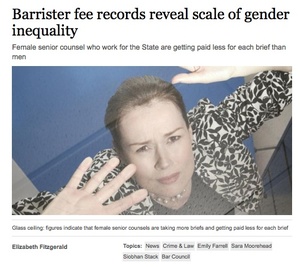
The Irish Times today reports on a fairly  dramatic, in fairness disparity between male and female barristers’ fees for State work.

We asked Legal Coffee Drinker, what’s it all about.

Broadsheet: “Legal Coffee Drinker, what’s it all about?”

Legal Coffee Drinker: “The Irish Times has obtained barrister fee payment data from the Attorney-General’s office showing an apparent disparity between male and female barristers in the divvying out of the very substantial sum expended by the State on barristers’ fees. On an average per-brief basis, female barristers earn substantially less, only 86% (Junior Counsel) and 88% (senior counsel) of the payment per brief given to male barristers.”

Broadsheet: “So why are women earning less per brief?”

LCD: “The first possibility is that they are being paid less than men for the same type of work and the second is that they are getting less complicated and lower-paying work than their male colleagues.”

Broadsheet: “That doesn’t sound fair at all.”

LCD: [pause] “It may or may not be unfair. For example, let’s take the first scenario – that women barristers are being paid less than men for the same type of work. Barristers are normally requested to give a fee quote in advance – in other words – where there are no set fee scales, they put forward their own fee. Could the explanation be that women are simply quoting more moderately than their male colleagues? And is moderate quoting a bad thing in this context?
Moving on to the second possibility, that male barristers are getting more complicated work, we again need to ascertain the reason for this. One matter in particular needs to be considered in relation to the disparity in fees and that is gradation of experience. For instance, the data cited shows that the number of female senior counsel instructed has almost doubled (9% to 15%) in the past ten years; the number of female senior counsel generally has also increased during that period. It may or may not be the case that the more complex and lengthy briefs are going to male Senior Counsels not because they are male but because of their more lengthy experience as Senior, either in respect of State work or generally.
It also takes time for cases to be heard. A substantial part of fees in relation to a case are still paid only after the case is heard. As such, increased fees arising from increased instructions may not necessarily show up in data for a number of years after the instruction. A relevant consideration would be whether or not the briefs looked at by way of comparison were completed briefs or relate to cases which are still ongoing.”

Broadsheet: “Would you say…”

LCD: [Interrupting] “One further explanation – which could apply to both Senior and Junior fee disparity – is that certain areas of law might involve higher fees than others, depending on the nature of the State work involved. A higher concentration of women seniors in an area of law with relatively low per-brief fees could be an explanation for the average per-brief disparity.”

Broadsheet: “What information would we need to know if there is actually discrimination [as between Junior and Senior Counsels]?”

LCD:
“Ideally, you would take each area of State work individually, identify the percentages of male-female seniors/juniors being instructed in respect of such work, and the extent to which these percentages have changed over the previous four years – I say four years to take into account both the delay in receiving fees for cases and also in instructing on the most complex cases. If it is an area in which there has been a significant increase in the percentage of females receiving instructions over the past four years, perhaps keep it under review and look at it again in a couple of years to see if the discrepancy has resolved itself.”
If, on the other hand, it isn’t an area where there has been a recent increase in the number of women instructed, well then this bears more detailed examination to rule out discrimination, subject to the qualification that a non-lawyer may regard a gender disparity in lawyers’ fees as one of overpayment rather than underpayment!”

Broadsheet: “Controversial….Anything else?”

LCD: “Firstly, the Irish Times says it is hard to get a gender breakdown of entrants to the profession. But the electronic list of barristers on the law library website  gives each barrister’s name, year of call to the Outer and (if appropriate) the Inner (Senior Counsel) Bar, and – in many cases – accompanying photo. It should be fairly easy, from this to work the gender breakdown of entrants to the Outer or Inner Bar in any given year. [Drains coffee].
Secondly, the data discussed in the Irish Times article was obtained from the Attorney-General’s office via a Freedom of Information request made under the Freedom of Information Act 1997. Anyone, by making a similar request, can get the same information, and analyse it themselves. The Freedom of Information facility is a great way to find out more about the workings of the State and every citizen should be aware of it. Read more about it here.”

Broadsheet: Thanks Legal Coffee Drinker. You made that understandable and reasonably ‘brief’!

LCD: “Right. Bye.”

Barrister fee records reveal scale of gender inequality (Elizabeth Fitzgerald, Irish Times)

village

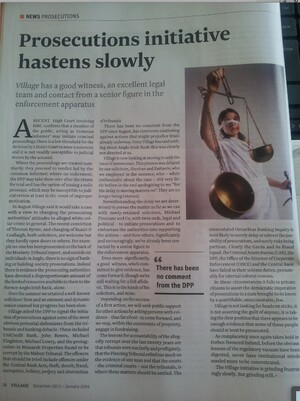
[From the current issue of Village magazine]

Village magazine’s struggle for accountability in a world gone unnaccountable continues at a somewhat frustrating pace.

We asked Legal Coffee Drinker what it’s all about.

Broadsheet: “Legal Coffee Drinker, what’s it all about?”

Legal Coffee Drinker: “The right of private prosecution is a common law right which traditionally gave a private individual the right to initiate a criminal prosecution and continue that prosecution up to a certain stage in the criminal process, at which point the Director of Public Prosecutions (DPP for short) could decide whether or not to continue.”

Broadsheet: “Up to what stage, exactly?”

LCD: “Well, traditionally, indictable offences (offences capable of being tried by jury, which are really the only ones anyone is interested in for the purposes of white-collar prosecution) were subject to an initial preliminary examination in the District Court for the purpose of deciding whether or not there was an adequate case to return for trial. The private prosecutor got to continue the prosecution up to the very end of the preliminary examination process – giving them the chance to put evidence forward as part of this preliminary examination which might pressure the DPP into continuing with the prosecution.”
As stated by the Supreme Court (O’Dalaigh CJ) in State (Ennis) v Farrell [1966] “[a] private prosecutor who had adduced sufficient evidence to effect a return for trial might, as a general rule, rest assured that the Attorney General would thereafter carry the case to trial before judge and jury”.

Broadsheet: “So what happened if the DPP didn’t agree that the case should proceed? Could the judge send it through nonetheless?”

LCD: “No. However the private prosecutor could, in such circumstances, apply to the High Court to compel the DPP to move the case forward, by way of an application for judicial review of the DPP’s decision. To succeed it would have to be shown that one or more of the grounds for judicial review was present: that the DPP was acting unreasonably (the standard of proof here is very high), had ignored relevant considerations or had taken into account irrelevant considerations; had failed to act in accordance with fair procedures, with the evidence adduced at preliminary examination being put before the court as part of this review.”

Broadsheet: “And is this still the case?”

LCD: “No. The difficulty currently faced by private prosecutions is that the preliminary examination procedure in the case of indictable offences has been abolished by the Criminal Justice Act 1999. In Kelly v Ryan [2013], the case involving a private prosecution of IRBC officials referred to in the Village article, it was argued that this removed the right of private prosecution in the case of indictable offences, by effectively rendering such right redundant – the private prosecutor no longer had the opportunity in preliminary examination to put evidence before the court which could either pressure the DPP into continuing with the prosecution or show her decision not to prosecute was unreasonable or based on an irrelevancy.”

Broadsheet: “And did this argument succeed?”

LCD: “No. The High Court judge hearing the case, Judge Hogan, took the view that the right of private prosecution survived the coming into effect of the 1999 Act – at least in theory. He pointed out that the Supreme Court in Ennis had held that the right could only be abolished by clear language and there is no express statement in the 1999 Act regarding its abolition. Accordingly it must be taken to still subsist.”

Broadsheet: “Wonderful. Full steam ahead for private prosecutions then?”

LCD: “Not that simple [Drains coffee] Judge Hogan’s judgment – which is under appeal to the Supreme Court – accepts that the right of private prosecution still exists in theory. However in practice its significance has been reduced by the 1999 Act. The abolition of the preliminary examination procedure reduces the ability of the private prosecutor to put forward a case strong enough to publicly pressure the DPP into continuing with the case and/or make her decision not to do so judicially reviewable.”
“Judge Hogan’s decision confirms that there remains a right of private prosecution in respect of indictable offences. What still has to be determined is the value of that right in the absence of a preliminary examination process. We’re unlikely to find this out for some time since the effect of the pending Supreme Court appeal against Kelly Vs Ryan is to effectively put all private prosecutions on hold for the time being. As mentioned in a previous post, Supreme Court appeals are currently taking some time to be heard. [Drains coffee].”

Broadsheet: “It sounds like another case of ‘justice delayed is justice denied’ as the old saying has it?”

LCD: “Are we done?”

Broadsheet: “We are. Thank you Legal Coffee Drinker. Happy new year from all of us at Broadsheet.”

LCD: “Right bye.

 Previously: Village Vs State

Village magazine

90270516The Irish Times this morning reveals  a cabinet “clash” between Tanaiste Eamon Gilmore and Minister for Justice Alan Shatter over the Legal Services Regulation Bill 2011.

More specifically Part 7 of the bill, dealing with the establishment of ‘legal and multi-disciplinary partnerships’.

We asked Legal Coffee Drinker what it’s all about.

Broadsheet: “Legal Coffee Drinker, what’s it all about?”

Legal Coffee Drinker:The Legal Services Regulation Bill is Minister for Justice Alan Shatter’s attempt to change the way the legal profession operates in Ireland. Nothing wrong in that in itself, but the controversy arises from the nature of the changes proposed.”

Broadsheet: “For Karl our younger readers how does the legal profession operate now?”

LCD: “At the moment the legal profession in Ireland is divided between solicitors (who deal directly with the public on a wide variety of legal services, normally excluding court advocacy above District Court level) and barristers (who deal with advocacy and specialised opinion work, usually acting on the instructions of solicitors only, though with some facility for members of professional organisations to seek opinions on non-litigious matters through the Direct Professional Assistance Scheme. Both wings of the profession are under the control of their respective professional bodies; the Law Society in the case of Solicitors and the Bar Council in the case of Barristers.

Broadsheet: “And the changes?”

LCD: “What the Bill proposes is that both solicitors and barristers should be subject to the control of a new Legal Services Regulatory Authority, answerable to the Government and with majority lay membership and a lay chairperson. The Authority will set education and training standards, professional indemnity insurance levels and inspect and deal with complaints against legal practitioners, and keep the Minister informed of developments in relation to the provision of legal services. A new system for dealing with complaints against legal practitioners is outlined in Part 5 of the Bill and involves the initial processing of the complaint by a Complaints Committee followed by referral to a Legal Practitioners Disciplinary Tribunal, which, like the Authority, has majority lay representation and which may refer the matter to the High Court for appropriate sanction. There’s also a proposal for reform of the legal costs regime by setting up a new Legal Costs Adjudicator.”

Broadsheet: “I’d say”

LCD: “Most controversially Part 7 of the Bill contemplates the establishment of legal partnerships between solicitors, barristers and other professionals. This appears to be the part of the Bill that generated the controversy in Cabinet. The key provision here is Section 74, which removes all prohibitions on the provision by legal practitioners of legal services as a partner or employee of a multi-disciplinary practice. This effectively allows barristers to operate in partnership with other barristers, with solicitors and with other professionals, in a way which has not previously been possible.
Part 7 does not however lay down any controls on how the proposed partnerships are to operate. What it does to is to require the Legal Services Regulatory Authority to engage in a public consultation process, to be completed within 18 months of the establishment of the Authority, and to provide a report to the Minister on the manner in which legal partnerships and multi-disciplinary practices should be formed and operated, the reforms, whether administrative, legislative or to existing professional codes, that are required in order to facilitate such establishment and operation, and the implications of barristers being permitted to receive instructions directly from persons in contentious matters and the reforms, whether administrative, legislative or to existing professional codes, that would be necessary to allow this.
The Bar Council has strongly objected to the partnership provisions. Some of its objections, as set out in a speech by its Chairman [available here], are as follows:-

– Most other jurisdictions have refused to accept similar barrister partnership provisions (though it is noted some have not ruled out accepting such structures);

– The establishment of partnerships will make it very difficult for younger barristers to get work and in this way make the legal profession more rather than less exclusive;

– It will also make legal advice more exclusive – the best practitioners will conglomerate together, acting for the most financially lucrative clients, making it difficult for those who cannot afford to pay them or are not well-connected enough to obtain their services. At present barristers – even those most in demand – act for a wide variety of solicitors, both large and small, and a wide variety of clients.

Broadsheet: “What’s your personal view?”

LCD: “Well, it’s difficult for me to be entirely objective on this point [refills coffee] But I’d suggest that the starting point, in looking at any proposed change to the legal profession, is how that change will impact on society generally rather than the profession specifically (although change to the profession, making it more rather than less exclusive, can itself have a trickle-down effect on society)….

Broadsheet:
“Please continue…”

LCD: “The first question anyone examining the Bill should be asking themselves is whether, whether or not the changes proposed are going to benefit the ordinary punter availing of legal services in the future.
If yes, the second thing they should be asking is whether or not the changes are the most effective way of achieving this benefit or whether or it could equally be achieved by less expensive/less radical means. My own opinion, for what it’s worth, is that the most effective way to carry out any legal reform is by a KISS (Keep It Simple, Stupid); effecting no more change than is absolutely necessary to achieve the desired result and that in the most cost-effective manner possible.
It goes without saying that any proposed change should be clearly and comprehensively defined in the legislation which proposes it, because without this information it’s not possible for legislators – or the public at large – to make a judgment either on benefit or proportionality of change.”
Applying this to the legal partnership provisions of the Bill – and leaving aside the potential harms warned about by the Bar Council – on which Broadsheet readers can make up their own minds – it is not clear what actual benefit a legal partnership facility will have for the public generally.”
Secondly (and this is part of what makes it difficult to identify benefit), the nature of the partnership system proposed (e.g. the controls on it, and how it will be regulated), is completely undefined in the Bill. It’s lazy (some might say deliberately lazy) drafting, and – although I don’t know his specific objections – I can well understand how the Tanaiste might be getting heated about this part of the Bill.”

Broadsheet: “He’s always angry though…”

LCD: “…But it’s not just the Tanaiste who should be getting upset. Legal access, and how it operates, is a matter of concern for the citizen generally, and an important aspect of democracy. This Bill is too important for any part of it to be a legislative blank cheque. There needs to be firming up on the nature and regulation of the partnerships contemplated by Part 7 before any informed legislative vote on this point can take place. [drains cup] Hopefully the Bill will be amended to deal with this, so that the benefits or otherwise of the contemplated legal partnership system can be properly assessed. If this doesn’t happen, and the Bill is passed without clarification, the new legal partnerships will, potentially, be entirely unregulated – ironic given that the selling point of the legislation which produced them was to more tightly regulate the legal profession!”

Broadsheet: ” A lot to think about there. Thanks legal Coffee Drinker. And have a Happy Xmas.”

Legal Coffee Drinker: “Right. Bye”

Gilmore and Shatter clash over proposed legal Bill(Stephen Collins, Irish Times)

(Graham Hughes/Photocall Ireland)

susu22-1050x508

A pro-life University College Dublin student is to take legal action so he can formally leave UCD Students’ Union.

The union say this is not possible.

We asked Legal Coffee Drinker, what’s it all about?

Broadsheet: “Legal Coffee Drinker, what’s it all about?”

Legal Coffe Drinker: “Well, it relates to Article 3.1 of the Rules of UCD Students’ Union which provides that all persons registered as students within the university shall be members. The question which has arisen is whether or not it is open for a student to leave the union, given the terms of this provision. UCD Students’ Union, relying on the wording of Article 3.1, says no: once a student, always a union member, it says.
However, as someone (could it have been Know It All Law Student?) pointed out in the comments section of this post yesterday, there’s a right of dissociation in the Irish Constitution which is recognised by the Irish courts, the dogs in the street and indeed the rats under the floor of the Sutherland Legal Theatre.
“What this means is that no one can be forced to join a trade union against their will, or penalised for not joining one. Although it doesn’t seem to have come up in a case to date (perhaps because it’s so blindingly obvious?) it would follow from the above that an existing UCD Student Union member is free to leave if they so wish.”

Broadsheet: “Is the right to dissociate expressly stated in the Irish Constitution.”

Legal Coffee drinker: “No, but it’s been held by the Supreme Court to be an implicit corollary of the right to associate which is expressly stated in Article 40 of the Constitution.
There’s a trilogy of cases.The first one is National Union of Railwaymen v Sullivan [1947] IR 77, in which a provision preventing workers from joining any union other than the prescribed one was held to be unconstitutional, on the basis that it deprived the citizen of a free choice of the persons with whom he chose to associate. According to the Court: “[b]oth logically and practically, to deprive a person of the choice of the persons with whom he will associate, is not a control of the exercise of the right of association, but a denial of the right altogether.
“Subsequently, in Educational Company v Fitzpatrick [1961] IR 345, the Court held that employers could not force their employees to join a trade union, stating that ‘under the Constitution a citizen is free to join or not to join an association or union as he pleases. Further, that he cannot be deprived of the right to join or not to join such association or union as he pleases… and that is tantamount to saying that he may not be compelled to join any association or union against his will’.
The final case in the trilogy is Meskell v CIE [1973] IR 121, in which an employee who lost his job as a result of not being a member of a union was entitled to damages against his employer for abuse of his constitutional right.”

Broadsheet: “So the provision in the UCD Students Union Rules violates the Constitution?”

Legal Coffee Drinker: “Yes. In two ways. Firstly, by automatically making all students members. Secondly, by not providing any way to leave if they so wish. In fact, you could argue it’s even more objectionable than the cases above, because it doesn’t just penalise people for not being members of a union, it actually forces them to be, and stay, members.”

Broadsheet: “And is the Constitution enforceable against bodies like the SU which aren’t the State?”

Legal Coffee Drinker: Constitutional rights are primarily enforceable against the State and State bodies. But in certain circumstances they may be invoked against private bodies too. The right of association (and dissociation) is an example of this. In both Fitzpatrick and Meskell it was accepted that this right could be enforced by individuals against private persons (in that case, employers) who sought to curtail it. To quote from the Supreme Court in Meskell:-
‘[I]f the Oireachtas cannot validly seek to compel a person to forego a constitutional right, can such a power be effectively exercised by some lesser body or an individual employer? To exercise what may be loosely called a common law right… as a method of compelling a person to abandon a constitutional right, or as a penalty for his not doing so, must necessarily be regarded as an abuse of the common law right because it is an infringement, and an abuse, of the Constitution which is superior to the common law and which must prevail if there is a conflict between the two’.
“In other words constitutional rights must prevail over any common law rights that the Union may claim arising from the terms of its constitution, including Article 3.1. For the Union to rely on Article 3.1 of its Rules to preclude students from leaving is classic abuse of common law rights within the meaning of the quote from Meskell above, and cannot be used to restrict freedom of dissociation.”

Broadsheet: “So will the student win his case?”

Legal Coffee Drinker: “It appears so. The principle is very simple. People can’t be forced to join or continue to be members of unions against their will. The case law on freedom of dissociation has been round for a long time, too. [drains coffee wearily} I’m surprised no one thought of it when drafting the UCD Student Union Rules in question.”

Broadsheet: “Thanks Legal Coffee Drinker.”

Legal Coffee Drinker: “Sure, whatever.”

Previously: Freedom To Disassociate

Pic CollegeTribune.ie