
Tag Archives: Letter to Irish Times

screen-shot-2016-10-18-at-10-24-51

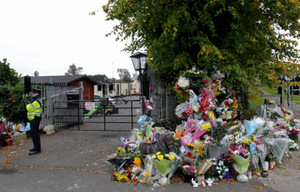
Flowers outside the unofficial halting site in Glenamuck Road in Carrickmines, Dublin,  where a fire killed 10 members of the same Traveller family, one of whom was pregnant

Thomas Erbsloh sent the following letter to The Irish Times – for the letters page – before the weekend of October 8/9 – ahead of the anniversary of the Carrickmines fire on October 10.

It has yet to be published.

Thomas wrote:

This time last year, the issue of Traveller accommodation briefly hit the media headlines, following the tragic fire in Carrickmines, killing ten members of the Traveller community. While there was an outpouring of sympathy across the country in the immediate aftermath of the tragedy, what has happened since, in terms of providing safe Traveller accommodation to ensure such a tragedy will never happen again?

Since the late 1990s, each local authority has its own, statutory Local Traveller Accommodation Consultative Committee (LTACC), which includes Traveller representatives. Following Carrickmines, the Department directed an almost immediate fire and safety review of Traveller accommodation.

Local authorities provided reports to the Department over the next couple of months, and subsequently most local authorities set up steering committees to address issues identified, with the LTACC becoming the steering group for this in many cases.

So far, so good?

In many cases, the fire and safety reports are being withheld from the Traveller representatives on the LTACC – so one is to be a member of this important steering group, without having access to the one crucial report that informs the work of this steering committee. Hmmm?

Instead one has to hope and rely that [Irish Times journalist] Kitty Holland will access the relevant information under FOI, and one might find out this important information by reading The Irish Times. While this is hardly the core issue in the delivery of safe accommodation, it exposes, once more, the tokenism in the framework structures.

The Traveller Accommodation Strategy, in place since the late-1990s, has failed in delivering Traveller accommodation. It has failed because it is strong on intent, but poor on implementation, and completely lacking any system of sanctions.

If you are in the way of the expansion of Apple Computers in Cork, you will be re-accommodated in brand new accommodation (funded out of a miraculous fund, outside of the national budget for Traveller accommodation, at a cost of € 5million, according to Cork City Council), but if you survived the tragedy in Carrickmines … well, that`s an entirely different story.

Ireland, 2016 – one year from the Carrickmines tragedy; their friends and relatives will mourn the ten dead. Not only were their deaths avoidable, their deaths were also in vain : nothing has changed and the merry system of windowdressing continues. Ireland, 2016 – one hundred years from cherishing the children of the nation equally.

Thomas Erbsloh

Anyone?

Previously: ‘They Couldn’t Get To The Water’

Mark Stedman/Rollingnews

TFMR

Human Rights Ireland – a blog run by academics, mostly lawyers, interested in human rights – have claimed a letter that appeared in the Irish Times’ print edition last Thursday (June 13) did not appear online.

The letter concerned  Health Minister Dr James Reilly’s insistence that the Protection of Life During Pregnancy Bill could not include legislation to allow for women, carrying foetuses with fatal abnormalities, to have terminations in Ireland.

The 43 academics who signed the letter maintain Dr Reilly could and should have included the legislation.

Dear Editor,

We understand that the Minister for Health has been advised that it is not possible to include terminations for fatal foetal abnormality in the Protection of Life During Pregnancy Bill, 2013. With respect, our initial response is to disagree. It is possible to interpret Article 40 3 3 so that the ‘unborn’ that is protected therein does not include those foetuses with fatal abnormalities. The Irish courts have not considered this legal issue and there is no binding precedent excluding such an interpretation.

Moreover, the Legislature has the power, and the duty, to legislate under the Constitution. When Justice (Niall) McCarthy criticised the Legislature for failing to regulate the terms of Article 40 3 3 in the X case in 1992, he was speaking of a duty that existed prior to that case. The interpretation and regulation of Article 40 3 3 is not limited to the circumstances which arose in X. That case showed how the general principle, of vindicating unborn life with due regard to the equal right to life of the mother, justified a termination in the particular circumstances of suicide risk. A different set of factual circumstances, such as those of fatal foetal abnormality, could also legally justify a termination of pregnancy given that these ‘unborns’ will not live once born. Therefore, it is within the Legislature’s power to act on this possibility and regulate for these circumstances.

The State used this legal argument to defend itself against the unsuccessful claim of Deirdre Conroy in the European Court of Human Rights, as she explained in The Irish Times on 31 May 2013. The High Court declined the opportunity to address this argument in D v HSE. The Court ruled instead that D, who was pregnant with an anencephalic foetus, could travel for a termination of pregnancy. The women of Termination for Medical Reasons, including Ruth Bowie and Arlette Lyons, have spoken publicly of being unable to access the healthcare they wanted in Ireland when their pregnancies were found to be unviable. In these circumstances, the Legislature has a moral as well as a legal duty to act now and include abortion for fatal foetal abnormalities within the Bill.
We urge the Minister to publish his legal advice on this issue so that it can be assessed and discussed. We ask the Minister to reconsider his position and to minimise the suffering of those women and couples who wish to end their unviable pregnancies at home.

Sincerely,

Signatories here


Anyone?

Previously: So Why ARE Women With Non-Viable Pregnancies Being Forced To Travel To the UK?

Letter to the Irish Times on Abortion Legislation and Fatal Foetal Abnormalities (Human Rights Ireland)

UPDATE:

Linehan