This morning.
The Seanad.
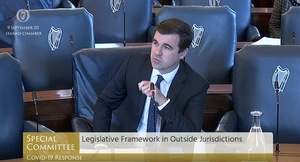
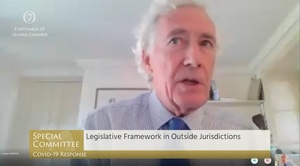
At the Special Committee Covid-19 Response, Labour TD Duncan Smith (top) had the following exchange with lockdown critic and retired UK Supreme Court judge Lord Jonathon Sumption (above).
Duncan Smith: “Lord Sumption, you’re on record as having admitted to not obeying Covid regulations when they began to reach a “level of absurdity” in your words. So, what was your threshold for what became an absurd regulation to which that you would no longer comply?”
Lord Sumption: “What I was referring to was the fact that the lockdown, the lockdown had originally been justified on the grounds that it was necessary in order to enable the intensive care capacity of the National Health Service (NHS) to catch up. And, although I disagreed with that, I thought that at least that was a serious justification which was a perfectly defensible position.
“The position was reached by the end of April, early May, when the NHS confirmed the intensive care capacity had caught up. And nonetheless, the Government, at a very critical moment decided that it would continue with the regulations. Although, on the Government’s own epidemiological, it seems very difficult to identify any legitimate purpose to it.
“It seems to me that there comes a point when the moral force of the law disappears and at that point had been reached by then. Of course, anybody who decides not to comply with the law has got to be prepared to take the consequences. But you cannot have… the reality is that coercion only works if a sufficient number of people accept the moral force of what the (UK) government is doing. And we have reached the stage in the United Kingdom where the level of acceptance, what the government is doing, is at a fairly low level.”
Smith: “Do you have a concern…but do you have a concern that when people of power or influence or privilege, of however you want to put it, decide at a certain point in their own heads that they’re not going to obey lockdown laws or regulations, that the impact that that’s going to have? And, in particular, are you concerned that whatever valid questions there are, and there are a lot in relation to the legislative framework on which the response to Covid-19 is based, that they can be subverted by elements in society that are not, have no interest in democracy, the far-right elements, conspiratorial elements, anti-health elements?
“Do you have any concern that actions such as yours and actions of others are lost and are then corrupted by those forces?”
Sumption: “Of course I do. However, I think that one has to remember that sometimes you make a decision for perfectly responsible and morally defensible grounds which other people, who are a lot less careful about [inaudible], will take advantage of. I don’t think that it is a sufficient reason for keeping silent about what I personally and what other people regard as a moral constitutional outrage.
“Sometimes you have to put up with the fact that a lot of unpleasant people might agree with you in the interests of truth and [inaudible].”
Smith: “You know, that’s your opinion in terms of being a holder of the truth there. I would disagree because we’re talking about a lockdown as something that is to be feared. And no one wants to go into lockdown. But I remember lockdown, a lot of people remember lockdown here. And it was a perfectly understandable response to a crisis that was scaring the life out of people all over the world. And a lot of people felt safe during that lockdown and it did serve to reduce the numbers.
“Now, we can’t live in lockdown forever and the challenge now for Ireland and the UK and everywhere else is to get back to some form of normality across all levels whilst living with this virus. So do you think that discussing lockdown in those fearful terms and talking about, you know, democracy being threatened and the rise of despots, do you think that’s a proportional narrative to the reality of what’s going on politically in our region or throughout the world?”
Sumption: “Yes I do. I think that the way in which we govern ourselves is a great deal more important than the way in which we react to any particular crisis because that will live with us forever whereas the way in which we respond to particular crises may be mistaken, may be misguided and the consequences will not live with us forever.
“I don’t accept your starting premise that the lockdown saves significant numbers of lives. I think that, in the long term, it will be found to have saved very few lives because [inaudible] infection rates simply rebounced afterwards. I also think that in areas like dementia, mental health and delayed diagnosis of treatments of cancer, that deaths occasioned by the lockdown may, in the end, not fall far short of the deaths occasioned by the disease.
“So my answer to your question is, in part, that I think that history will look back on this as a monument of collective hysteria and governmental folly.
“Now that’s a view that many people would reject. I take it that you would reject it. But it is a view that others hold and that I hold.”
Smith: “It is a view that I would reject. But thank you for your contribution this morning.”
Previously: Lord of Misrule




