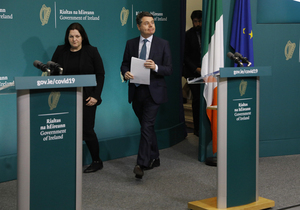



From top: Grafton Street, Dublin partially re-opens yesterday; Michael Taft
Ireland may well find it more difficult to restore the jobs lost during the emergency lockdown than most other high-income countries. This is due to our over-reliance on sectors that are and will be the worst affected; not only because of the pandemic emergency but because of pre-crisis trends.
First up is the hospitality sector. Its reliance on foreign tourists and the impact of social distancing means it will restart slowly and may take over a year to recover. With permanent changes in consumer behaviour, there is a good chance it will never be restored to levels that existed prior to the crisis.
We can estimate the damage to the Irish economy relative to our EU peer group by looking at the importance of hospitality in employment.

Market employment primarily refers to private sector activity. Irish hospitality employment makes up 13 percent of total market employment, nearly twice as much as our EU peer-group average.
Of course, there’s a good reason for a high level of hospitality employment. For many foreign tourists, Ireland is a more appealing destination than Finland.
However, Austria has an even higher level of tourism but doesn’t rely as much on hospitality employment as Ireland, while France has tourism levels close to Irish ones (measured as tourists per capita) but with much lower jobs reliance in hospitality.
Whatever the reasons, the challenge of employment – or replacement employment – for a sector that will be hit hard over the medium term will be considerable.
We see a similar pattern with retail employment – another low-paid sector.

Again, Ireland leads the table although the gap with other countries is not as pronounced as with hospitality employment. The retail sector faces particular challenges beyond overcoming the lockdown legacy. Even before the crisis the sector was coming under pressure from online sales and automation.
Like hospitality, retail – especially non-food retail – is exposed to discretionary spending, so falls in disposable income will have a disproportionate impact. Factor in commercial rents in major urban areas, and we have a sector under pressure on a number of fronts.
It should be noted that not only are these sectors low-paid, they are also heavily gendered. Nearly 40 percent of women working in the market economy work in hospitality and distributive sectors. If these sectors take a hit over the medium term, it will be women who suffer disproportionately.
One doesn’t have to be an expert in labour market economics to see the potential problems this will throw up.
If, for instance, hospitality is slow to resume normal business and there is a permanent loss of jobs (there were 170,000 employed in the sector prior to the crash), then the competition for what jobs become available will be intense. We could see wages and working conditions being squeezed in a race-to-the-bottom.
This is all the more possible given the lack of sectoral or firm-level collective bargaining which could act as a bulwark against any degrading of working conditions (it’s noteworthy that the Tourism Recovery Taskforce has no employee representation).
Many will call for supply-side strategies to tackle this employment shortfall; that is, retrain and upskill workers previously employed in hard-hit sectors. That certainly would help. However, there are two problems with this.
First, Ireland doesn’t devote a lot of resources to active labour market policies. Many other countries spend more on labour activation than Ireland. Belgium, Denmark, Austria, France and the Netherlands all devote more than 2 percent of GDP on activation programmes (which include education, training and other supports). Ireland spends closer to 1.5 percent (in GNI*). That may not seem like much of a difference but it represents more than €500 million.
Second, supply-side strategies assume there will be no demand-side problems. Simply put, we can retrain, reskill and re-educate but if there are no alternative jobs to fill, unemployment will remain high while competition for what jobs are available will intensity.
There is no simple answer here. The Irish domestic enterprise base has been dogged by stagnating productivity, and while continued foreign investment is welcome (and needed) it is unlikely to fill the gap of a sluggish recovery in low-paid sectors – if only because of a sizeable skill mismatch.
The starting point is to recognise the over-reliance on low-paid, low-value added sectors for employment.
We need to refocus our productive economy on higher value-added activity and high-road employment. And we need to consider what we do if private domestic capital is not up to this task.
We either accept the need for substantial public capital intervention (in the form of public enterprise and other public-led business models). Or we resign ourselves to endemic and ongoing unemployment.
Michael Taft is a researcher for SIPTU and author of the political economy blog, Notes on the Front. His column appears here every Tuesday.