

Tag Archives: Mooney on Tuesday

Top from left: the first deputy First Minister of Northern Ireland, Seamus Mallon; former Taoiseach Bertie Ahern; Senator George Mitchell; and Gerry Adams, at an event to mark the 20th anniversary of the Good Friday Agreement, at Queen’s University, Belfast last month; Derek Mooney

In a week when a referendum campaign that has managed to divide some of us comes, mercifully, to an end; it is worth recalling that this week, in fact this day, marks the twentieth anniversary of a referendum that briefly united us across this island.

Twenty years ago today, almost 2.5 million people across this island went to the polls to vote on accepting the Good Friday Agreement. Just over 2.1 million of them said Yes to the Agreement while 360,000 voted against.

The results, North and South, endorsed what the parties had agreed at Stormont Buildings and saw Northern Ireland set to see a return of devolution based on partnership government.

Heady days. But anyone who thought that having such a sizeable public endorsement and mandate for the Good Friday Agreement was going to ensure its smooth and speedy implementation was soon to be sorely disappointed.

Even though 71.1% of Northern Irish voters who turned out to vote (the turnout was a healthy 81.1%) voted Yes and that this 71.1% still represented about 58% of all voters in Northern Ireland, the establishment of the institutions, particularly the Executive and the Assembly was painfully slow and pitiably erratic.

The Executive was more often suspended than it was sustained in the early years… just as it is now. How little has changed.

Actually, that last part is not that true. Though it is easy to be cynical and say that Northern Ireland politics is still as bitter and divided as it was prior to 1998, that is a simplistic analysis. In reality, things have changed and politics has improved.

Gone are the days when the only times that politicians from either side of the divide in the North could meet to discuss their differences was in private and out of sight of their own colleagues, lest they be accused of selling out or being a Lundy (Robert Lundy is now reviled as the Governor of Derry who sold out to the Catholic James II and betrayed the Williamites during the 1688 siege of the city).

The DUP who were opponents of the Good Friday and opposed it from without – one might say besieged it – are now on the inside and although the DUP are not now in the Executive, they have provided three DUP First Ministers to serve alongside a Sinn Féin Deputy First Minister, the late Martin McGuinness.

Where once the declined to be seen together, DUP and Sinn Féin MPs and MLAs now appear regularly in TV and Radio studios to engage directly and debate, if debate is, at times, the right word.

Yes, there are many issues still to be resolved such as parity of esteem and respect for cultural identity and difference, but progress has been real, though persistently faltering.

But, falteringly is how politics works in divided communities. It takes years for trust to build and for politicians to foster the personal relationships, across the political divides, needed to make the institutions work.

Many important issues that seemed difficult two decades ago and completely intractable and beyond resolution only a decade before that, have been tackled. These include  decommissioning, reform of policing and changes to the criminal justice system.

Perhaps they were a form of political low hanging fruit. The more ripened and mature issues that were so clearly and obviously difficult that both sides had been preparing themselves to deal with them.

While the outstanding issues that prevent a return of the Executive and Assembly remains may seem trivial alongside something like decommissioning, they are still totemic and run to the heart of the Good Friday Agreement. What is missing in the political impetus – an impetus that must again come jointly from London and Dublin.

Nationalists and Republicans feel that the lack of official recognition of the Irish Language suggests that they do not belong. Unionists fear that nationalists are attempting to hollow out their Britishness and see the Irish language as a wedge.

But aren’t these two sides of the same coin? Isn’t the resolution of one the resolution of the other?

Meanwhile the two sides, by which I mean the DUP and Sinn Féin claim a mandate for their own intransigence, based on recent Assembly and Westminster results, yet ignore the fact that these mandates came from falsely accusing the other side of being the intransigent one and demanding the mandate to face down the other.

It is what Seamus Mallon has called “…the hypocrisies which are unbelievable and the untruths which are believable.” As he said at the recent QUB anniversary of the signing of the Good Friday Agreement:

“Politics has been debased and diminished by these two political silos which have almost Balkanised the Northern Ireland that I live in… It is the future we should be looking at.”

Maybe it is comments such as this that compels Sinn Féin to oppose Mallon being granted the Freedom of Drogheda?

Throughout his political career Mallon has been forthright in condemning the Provos and their apologists. But he has also been just as vehement in opposing all violence, from whatever its source. Just as he continues to be as fierce in standing with all victims and demanding that those responsible for creating the victims be held to account.

Mallon’s current work with TARP – The Truth and Reconciliation Platform – alongside Stephen Travers, Eugene Reavey, Alan McBride and others, makes him a suitable candidate for the Freedom of Drogheda, let alone his achievements as an SDLP MLA, MP, Deputy Leader, Senator or Deputy First Minister.

The horrible reality is that Sinn Féin’s opposition the Mallon being granted the honour is part of a much wider and darker attempt to rewrite recent political history and airbrush out all those whose acknowledgement expose its dark and murky past.

There will be another example of it later this year when the Provos attempt to claim that their campaign of terror against the two communities was born out of the Civil Rights movement – the very antithesis of what the Provos campaign was about.

Much has changed and improved in the twenty years since we voted together for a new start in the North. It is right to celebrate and commemorate that, once we realise that there is still a good deal of work to be done that includes addressed what TARP’s Stephen Travers has called:

“The pain that continues to cripple society in the North will eventually totally disable it if it is not addressed very soon. The real urgency, and the first priority, is not reconciliation; it is the acknowledgment, by both sides, that terrible things were done in their name.”

Derek Mooney is a communications and public affairs consultant. He previously served as a Ministerial Adviser to the Fianna Fáil-led government 2004 – 2010. His column appears here every Tuesday Follow Derek on Twitter: @dsmooney

From top: Pro-life campaigner Maria Steen and Solidarity–People Before Profit TD Brid Smith on last night’s Claire Byrne Live; Derek Mooney

On the morning after the night before’s hyped-up 8thRef Claire Byrne debate: committed Yes campaigners are insisting that the Yes side won it while staunch No activists are declaring with equal ferocity that their side prevailed.

In my own view, neither side significantly moved the dial among undecided voters with the real loser in the whole sorry mess being public sector broadcasting.

This was not the fault of the presenter/moderator Claire Byrne or any of the lead speakers for the Yes or No sides, but of the folk in RTÉ who decided that having daytime TV style confrontation in front of a cheering crowd was the best way to discuss a fraught, complex and emotionally charged issue.

What was needed was a calm, respectful and reflective discussion, in its place we got a he said/she said wall of noise. It needed Jeremy Vine, we got Jeremy Kyle.

All that was missing to make the Jerry Springer Show effect complete were lurid chyrons running across the bottom of the screen screaming the titles of upcoming shows: I get turned on by number 1s, but not number 2s or Spoiler Alert: they’re topping the poll.

OK, I exaggerate, though the Brid Smith versus Maria Steen encounter, complete with audience boos and hisses, did make me wonder if Steve Wilkos and a team of black t-shirted security staff were waiting just off camera.

So, what was the problem with the format? It was the audience. Not any one individual or even a group of individuals, but rather the constant and incessant cheering and clapping for speakers on their side and the hectoring of those on the other.

No doubt, each side will claim that the other one went further in heckling or shouting down the other, but that doesn’t matter.

The question is why the debate was formatted and structured in such a way as to allow them to do it. Actually, if I was really bad minded, I might even wonder if is was structured in such a way as to encourage it?

Think back to any of the US presidential debates of the last decade or so. In each of them, the moderator has opened proceedings by setting out the debate rules, as decided by the US agency that arranges the debates: The Commission on Presidential Debates.

The host then explains that the audience must remain absolutely silent for the duration of the debate, with the exception of welcoming both candidates out on to the stage, so that people at home can focus on what the candidates are saying.

Opening the second presidential debate of the 2012 campaign between President Obama and Mitt Romney, the moderator CNN’s Candy Crowley, announced:

“The audience here in the hall has agreed to be polite and attentive — no cheering or booing or outbursts of any sort.”

The format of this debate was what American broadcasters call a town hall. There ordinary voters ask their questions of the candidates directly, but that audience is made up of uncommitted voters chosen by independent pollsters.

Much of last night’s audience were chosen by the two campaigns. Both of whom seemed more interested in getting as many loud and vocal people there as possible.

I know that I am at risk of sounding po-faced, or even hypocritical. I have not been averse, in the past, of doing a bit of fairly boisterous heckling at political discussions – not all of them involving other parties.

Like many politicos of my vintage this also included a few stints in the audience of the grand old dame of Irish TV political debates Questions and Answers.

There I would attempt my faltering impression of an innocent member of the public. It was unconvincing. Indeed, the only thing worse was my dire impression of an electable politician, but we live and learn.

I know that political shows can be boring or tedious and need a bit of showbiz and spectacle from time to time. I realise that listening to a procession of TDs and Senators drone on can be a ratings killer. But going the opposite way is not the answer.

The secret is knowing when the time is right and how far to go. Last night was an example of getting the mix wrong – and it is not the first time.

We saw the same format deployed to equally unsatisfactory effect almost seven years ago in the 2011 presidential election debates – though that night had the added frisson of dodgy tweets.

Surely the only lesson they learned in the intervening time cannot just be: don’t read out the Tweets?

While we do not need to go as far as setting up a dedicated quango dealing with debates, be they presidential, Dáil or referendum along the lines of U.S. Commission on Presidential Debates, the decision on formats should not rest with the broadcasters alone.

There should be a role for an independent electoral commission, charged with overseeing our electoral process.To be fair, this government is looking at setting up such a commission.

The 2016 Programme for Government states:

A) Establishing an Electoral Commission

We believe that Ireland needs an independent electoral commission, as a matter of priority.

The new commission should examine the voter registration process and in particular the possibility of the PPS system being used to automatically add people to the electoral register once they reach voting age.

It should also look at ways to increase participation in our political process through voter education and turnout.

The new commission could also:

Assume the role of Registrar of political parties

Regulate political funding and election expenditure

Oversee the Referendum Commission, which would be a sub-section of the commission

The newly established Electoral Commission would be independent of Government and directly accountable to the Oireachtas.

As with many things the promise is there, it’s the action that is missing. The last time the electoral commission issue was raised with Taoiseach in the Dáil appears to have been back in October 2017.

Back then he said:

“There is no timeframe for it. It is very much a long-term project.”

Given that this government’s remaining time in office can be best measured in months, not years, we see that 2011 and 2016’s “priority” is today’s: “Meh, we may get around to it.”

To be fair, in the hierarchy of this Government’s broken promises this one does come a fair bit down the list, but that does not excuse its lethargy.

With a little bit of political will and Dáil time the legislation could be processed speedily. A nascent Electoral Commission could be in place for a presidential election later this year.

Much of the preparatory work has already been done. The various reports, consultation and scoping documents are already there. I understand that the Department of Environment has been preparing a Regulatory Impact Analysis for a draft Bill.

The aims and intentions of James Lawless’s Online Advertising And Transperancy Bill could be rolled into it too, so that electoral fairness is not depending on the largesse of the IT giants.

So, what’s the delay? Must we wait for Russian interference to finally act?

Derek Mooney is a communications and public affairs consultant. He previously served as a Ministerial Adviser to the Fianna Fáil-led government 2004 – 2010. His column appears here every Tuesday Follow Derek on Twitter: @dsmooney

Watch Claire Byrne Live here

Top pics: RTÉ

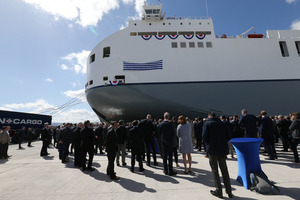
From top: the MV Celine at Dublin Port last Friday; Derek Mooney

Up to last Friday it was difficult to find a good visual representation for Brexit in Ireland. Yes, there were maps showing the six counties in one colour and the 26 in another, but apart from those or some grainy photos of border posts and black coated customs men standing behind old tin signs emblazoned “Stad”, there were few clear, defining symbols for Brexit in an Irish context.

That all changed last Friday.

The change came in the form of a ship. But not just any ship. This one, christened the MV Celine by the Taoiseach and assorted other lesser celebrities, is the world’s largest short sea, roll-on roll-off cargo vessel. It will directly connect Ireland to the European continent via Rotterdam and Zeebrugge, by-passing the UK entirely.

As images go, it is an impressive one. But the image-makers real triumph lay in finding an appropriate nickname for the newly named ship.

While “Celine” may be the official name that adorns the ship’s champagne drenched hull, the spinners on the quayside were intent that the media – and by extension we – call it by their chosen soubriquet: “the Brexit Buster”.

What a coupling, a damned big ship with an on-message nickname. It is a neat piece of messaging, conveying the impression that Ireland is ready and prepared for the worst that Brexit can throw at us.

The MV Celine’s statistics are striking. At 234m in length, the Celine is, in terms of capacity, twice the size of any other ferry currently operating out of Dublin Port. It can hold 580 standard truck trailers along 8km of parking lanes.

But size isn’t everything.

The real significance of the MV Celine is that it points to our post Brexit trading future. A future where Ireland’s EU27 imports and exports no longer must go via the UK and suffer the hassle, time delay and cost of having to going through not one, but two, sets of customs and border patrols as they enter and then exit the UK.

This is important as around 80% of Irish road freight, destined for the rest of the EU, goes across the UK. This is what some call our land bridge to EU, though it is hardly much of a land bridge when you must take a ferry at each end.

If you want a sense of the scale and extent of the delay and inconvenience we will may face in the worst post Brexit scenarios, then consider this simple fact: goods going through Dover from outside the EU take 15 times longer to process compared to those coming from within the EU (45 minutes from outside versus 3 minutes from inside).

Can you imagine the accumulated tail backs there will be at British ports? Now, multiply all those delays by two as Irish goods going to or from the EU across the UK will have to face those potential delays twice: once as they enter the UK and once as they leave it.

In the absence of some alternative direct routes, the UK’s national customs computer system will be handling both the inward declarations of Irish exports to the UK and the transit of Irish goods travelling through the UK and on to mainland Europe.

But, the UK’s national customs computer system is due to be replaced, with the new Customs Declaration Service (CDS) system due to launch in January 2019, two months before the UK brexits. As if that were not worrying enough, a UK National Audit Office 2017 review of the UK customs computer system’s readiness for Brexit found that

“…there is still a significant amount of work to complete, and there is a risk that HMRC (Her Majesty’s Revenue and Customs) will not have the full functionality and scope of CDS in place by March 2019…”

So, assuming the British government does what it currently says it will and exits both the Customs Union and the Single Market as well as the EU, then it is essential that Ireland to look for better routes to send our good to and from the rest of Europe.

These routes are vital for us as an island nation as seaborne freight accounts for 84% of Ireland’s trade in terms of volume and 62% in terms of its value. It is also highly focused on one location with 46% of all seaborne trade (by volume) passing through Dublin Port.

But, impressive as the MV Celine may be, one ship is not going to be the solution to our problems. Neither will two or three such vessels.

The real value and importance of the MV Celine right now is not the number of trucks she can carry every 38 hours to Belgium or Holland, but rather in the policy course she sets.

Should we now be looking at developing new direct shipping routes with mainland Europe, particularly with France, Belgium and the Netherlands?

But that question begets another one, are we right to assume that all these new routes should have Dublin port as their Irish hub? Should we not now be seriously evaluating our infrastructure capacity and looking to develop other Irish ports to serve these new shipping routes?

Some 60% of the trade at Dublin Port involves the UK – would it not make more sense, especially as they are investing in new customs and border facilities at the port, to make Dublin the key point of entry for our UK only good traffic, along with Drogheda and some other ports along the eastern seaboard?

Might this be a way of freeing up some extremely valuable land in and around Dublin Port for much needed high-density development in the centre of the city?

Might Brexit planning provide an opportunity for dusting off the PD’s 2006 New Quarter proposal, though this time with a more sensible and scaled down version that does not see the whole of Dublin Port shut down and shipped Northwards.

We should be considering expanding Rosslare and/or developing a new purpose-built port along the South East or Southern coasts to serve the new fast EU shipping routes.

One of the potential attraction of Rosslare, as Irish Rail was keen to tell the Seanad Special Select Committee on Brexit, is that Irish Rail is the port authority for Rosslare-Europort and so investment plans could be put in place that do not impact on the debt levels of Irish semi-state-owned ports.

Not only that but including Irish ports in the trans-European transport policy (TEN-T) could mean EU infrastructural funding for the “necessary modifications to Irish ports”.

Modification is an understatement. Increased direct shipping volumes with mainland Europe would require major infrastructural investment to provide modern facilities that provide for the speedy and high-tech loading of these faster roll-on/roll off vessels.

Perhaps the image of the ship is all the government wants just for now and so it sees its job as done, for now. Hopefully this is not the case, though it often seems to be this government’s modus operandi.

Hopefully there are contingency plans sitting on a desk somewhere while Ministers and officials wait to see if Theresa May eventually opts, when all other avenues are hopefully closed off, to take the avenue of keeping the UK in either “a” or “the” Customs Union and “a” or “the” Single Market.

If she doesn’t, then we will have very little time to act. So, now is a good time to start the feasibility planning and commence talking to a variety of international experts who know how to build, equip and run these modern ports.

Maybe that way we can turn the floating impression that Ireland is ready and prepared for Brexit into a more anchored reality.

Derek Mooney is a communications and public affairs consultant. He previously served as a Ministerial Adviser to the Fianna Fáil-led government 2004 – 2010. His column appears here every Tuesday Follow Derek on Twitter: @dsmooney

Rollingnews

From top: Isreali Defence Forces at the Qalandiya Crossing, a passageway for Palestinian labourers from the Ramallah area to cross into Jerusalem; Derek Mooney

The story of the kerfuffle caused by the Lord Mayor of Dublin’s trip to the West Bank reminded me of how my own ill-fated trip there, back in 2004.

That visit ended in me sitting in my boxers in a security room in Ben Gurion Airport. A fate fortunately not visited on our city’s first citizen.

I had been visiting Israel and the West Bank along with three colleagues. We were part of a group from Glencree that was organising study visits to Ireland by Israeli and Palestinian politicians to meet key players in the Irish peace process, both North and South.

Our purpose was to catch up with some of those who had been on the last visit and prepare for the next one. Our four-day trip, had been planned in conjunction with our Department of Foreign affairs and had the support of the Israeli Embassy in Dublin.

It included meetings with Israeli politicians and officials in Tel Aviv and Jerusalem and an overnight stay for two of us in Ramallah in the West Bank, where we would meet politicians and officials from the Palestinian side.

The President of the Palestinian Authority, Yasser Arafat, had died a few weeks earlier. So, when the two of us reached Ramallah, which is just a short drive from Jerusalem, the speaker of the Palestinian Legislative Council was now the acting President, and his deputy, a very charming GP who had trained in Dublin, was the Acting Speaker.

The acting speaker could not have been more welcoming, both in his office – where he talked fondly of his time as a medical student in Dublin – and on the floor of the Council chamber where he formally welcomed us to Ramallah and wished our project well.

This was all shown on Palestinian TV later that night – a channel that is watched assiduously by Israeli military intelligence.

He then brought us to visit Chairman Arafat’s tomb, where I was asked to lay a wreath (which I still swear to this day, I had to pay for on the spot). Another event that made it on to the Ramallah 6.01 News.

The following day we returned to Jerusalem via the dreadful Kalandia/Qalandiya crossing where ordinary West Bank Palestinians queue for hours to go through this highly militarised and barbed wire strewn checkpoint to get into Israel.

Before we returned to our hotel in old East Jerusalem we had a quick detour back to Tel Aviv for a last-minute meeting with the Deputy Chief of Staff of the Israeli Defence Forces, Amos Gilead – a meeting which his office had requested, as he wanted to talk with us about the Northern Ireland peace process.

Early the following morning two of us headed for home, leaving our colleagues to stay another night and finish off the itinerary. One of them borrowed my travel adaptor.

The hotel had ordered a taxi to take us to Ben Gurion airport. As you would expect Israeli airport security is tight, very tight. You are advised to arrive at least three or four hours ahead of your flight to allow time for all the checks. We were about four hours early.

As we queued up to leave in our suitcases, I heard an official call my name. I went with him, handed in my suitcase, watched it go through the scanner and then, rather than proceeding through the rest of the lengthy security screening channel with the rest of the passengers, including my colleague, I was invited to join the official in an interview room. Not a good omen.

There two army officers were waiting to have a chat with me. They took my passport, my mobile phone and my laptop bag and put them to one side. I could see pictures of me in Ramallah in the folder in front of them.

They then proceeded to ask me about the purpose of my trip. I produced my letters of introduction from the Israeli ambassador, explained why we were there and indicated generally what we had been doing. The questioning continued for about 40 minutes. The two officers then left the room.

When they returned they said they wanted to search me. I was told to remove my belt, shoes, trousers and jacket, these all were taken away. I was then asked to unbutton my shirt. “Would you not buy me a few drinks and dinner first?” was the question that popped into my mind – but luckily it stopped there and never made it to my mouth.

They next turned their attention to my mobile phone and laptop. Through habit I had turned my mobile off as I was queing up. They asked for my pin number. I refused.

They then tried to turn on my laptop. I had not switched it off properly the night before and so the battery was flat. They found the charger but saw that it came with big UK/Ireland three pin plug. Israeli sockets are like US ones, though with V shaped slots.

They asked for the adaptor. I explained that I had given it to one of my colleagues. How could they charge my laptop to see what was on it, they asked?

Seeing that we were in an airport, I suggested that one of them pop down to the travel shop and buy one. They were not amused. I then explained that even if they could get the laptop recharged that I had no intention of giving them the password.

I then reminded them that my visit had been organised in conjunction with the Israeli foreign ministry and that I the night before I had been meeting with their boss, Amos Gilead at the Israeli Defence department. They were unfazed.

After a few more pointless questions and even more pointless answers, they left me alone in the interview room for another hour or so.

About 20 minutes before my flight was due to depart, I was handed back my phone and laptop, given my boarding pass and the rest of my clothes and then rushed through the terminal and escorted on to the flight. I was the last one to board.

Luckily, I was allowed to make my own way to my seat, though arriving in a state of semi undress did mean that the elderly woman seated next to me avoided all eye contact for the whole of the flight.

I mention this as I have a business contact who once ended up being marched up to his seat in handcuffs.

His ‘crime’ was doing a quick overnight trip to speak at a conference in Tel Aviv and not being able to tell airport security afterwards the name of the hotel where he stayed – he hadn’t booked it and all business hotel rooms look alike – or explain why the sum total of his luggage consisted of old socks and briefs tucked into his laptop case.

So, apart from now being an amusing anecdote, is there a serious point to all of this? Yes, there are two.

The first, is that the Israeli authorities treat their friends and allies every bit as badly as they treat their foes. This goes for Israelis as much as it goes for outsiders.

Which brings me to the second and more important point. While we are right to be highly critical of the Israeli government, especially Netanyahu’s hawkishness, we should not forget that there are many moderate and progressive Israelis who still believe in the two-state solution and who recognise that, just as in Northern Ireland, there are no sustainable security solutions to a political problem.

I am appalled by how successive Israeli governments have moved from the policies of Yitzhak Rabin and Shimon Peres, but I do not see how Ireland adopting the BDS strategy of boycott, divestment and sanctions, as urged by some in Dublin City Council, does anything except play into the hands of the hawks.

Instead of urging sanctions we should insisting that the Government act on its commitment on page 144 of the Partnership Programme for Government:

‘…to recognise the State of Palestine as part of a lasting settlement of the conflict’

In December 2014 the Dáil agreed a motion to ‘officially recognise the State of Palestine on the basis of the 1967 borders with East Jerusalem as the capital…’

Another Dáil Motion tabled on 22 June 2016 and signed by most members of the opposition, called for the government to finally act on these commitments and do what eight other EU  Member States have done and recognise Palestine.

It is long past time that we did it.

Derek Mooney is a communications and public affairs consultant. He previously served as a Ministerial Adviser to the Fianna Fáil-led government 2004 – 2010. His column appears here every Tuesday Follow Derek on Twitter: @dsmooney

Pics: Haretz


From top: John  Hume, Bertie Ahern and Gerry Adams following the IRA ceasfire in 1997; Derek Mooney

By the time you get to read this I will be in Belfast attending one of several special events to mark 20 years of the Good Friday Agreement.

One of those, at Queen’s University entitled: Building Peace, and organised by the Senator George J. Mitchell Institute for Global Peace, Security and Justice at QUB, is described as:

“…the only one of its kind to gather together so many of the key influencers on the Good Friday Agreement to mark its 20-year anniversary.”

It is not an idle boast.

The former US Special Envoy for Northern Ireland, and recent star of RTÉ One’s Ray Darcy Show, will be joined by former US President Bill Clinton, former British Prime Minister Tony Blair, former Taoiseach Bertie Ahern, as well as many other key players including: Seamus Mallon, Gerry Adams, Jonathan Powell, David Trimble and Peter Robinson.

It is a stellar and fascinating line up of those both in front of and behind the scenes. It is an opportunity to recall the huge efforts of the leaders who drove the process and to at last pay tribute to those countless men and women behind the scenes who did so much of the heavy lifting, including the many dedicated civil servants on both sides who worked so diligently to get the process across the line.

We rightly recall the huge endorsement the Agreement received both North and South of the border: 71% in the North and 95% in the South, but it is also important to reflect on just how close to failure this process came, right up to the final hours and days.

This is something we should bear in mind as we bemoan the failure of this generation of political leaders, particularly those in the DUP and Sinn Féin to either sustain and re-establish the institutions that were handed to them via that 1998 sovereign decision of the people, North and South.

Sadly, declining health means that the event will be without the principal designer and imaginer of the architecture and form of the Good Friday Agreement: John Hume.

In a blogpost yesterday, RTÉ’s Northern Editor, Tommie Gorman put it succinctly:

More than any other individual – living or dead – John Hume managed to put a stop to the awful killing. The Good Friday Agreement is testimony to the genius of his imagination, the wizardry of his words and the generosity of his spirit.

If anything, Gorman’s words are an understatement.

The three-stranded structure of the Good Friday Agreement, that recognised the three distinct, yet interconnected, strands of relationships between (1) the two communities in the North, (2) the two parts of this Island – North/South and (3) our two islands – East/West, was a key element of Hume’s analysis and provides the framework around which the agreement is built.

Hume recognised, as others had done before him in conflicts across the globe, that all conflict is about difference, whether that difference is race, religion or nationality.

As he said in his December 1998 Nobel Lecture:

“The European visionaries decided that difference is not a threat, difference is natural. Difference is of the essence of humanity. Difference is an accident of birth and it should therefore never be the source of hatred or conflict. The answer to difference is to respect it. Therein lies a most fundamental principle of peace – respect for diversity.

The peoples of Europe then created institutions which respected their diversity… but allowed them to work together in their common and substantial economic interest.

They spilt their sweat and not their blood and by doing so broke down the barriers of distrust of centuries and the new Europe has evolved and is still evolving, based on agreement and respect for difference.”

The European visionaries Hume refers to here are the founding fathers of the European Union, men such as Robert Schuman, Jean Monnet, Konrad Adenauer, Paul-Henri Spaak and – though it might upset the Tories and their DUP cronies – Winston Churchill.

These men had learned that the only way to get diverse, even polarised, communities to stop focusing on their differences and identities was to shift that focus to their common interests.

That is what Hume strove to do and, in that work, he had many partners, though not all as willing or even as nuanced in their thinking.

There is a reason why Hume took so much of his inspiration from the story of post war Europe. While his slogans and rhetoric come from the American Civil Rights movement and the charismatic leadership of Dr Martin Luther King Jr, the structures and institutional frameworks he favoured were distinctly European.

Hume was a great believer in Europe and the EU and saw in it and in Ireland and the UK’s joint membership of the EU, a way to gradually dismantle the border.

As the member states of the EU slowly came together to work in closer cooperation and partnership and to form a single market and a customs union, the borders between those members states started to come down and that included Ireland and the UK.

He also saw, as did both governments, that joint membership of the EU (originally the EEC) since 1973 helped the two governments develop and improve day-to-day working relations, as ministers and officials from both interacted in Brussels in pursuit of common interests.

Personal and political relationships grew, not least those between John Major and Albert Reynolds, as they served together on the EU’s ECOFIN council of Finance Ministers. T

he development of that relationship led directly to the Downing Street Declaration, which in turn paved the way for the Good Friday Agreement.

Anyone who tells you that the EU is not central to the Good Friday Agreement clearly does not know what they are talking about, especially those who repeatedly assert that the words: ‘Europe’ and the ‘European Union’ do not appear in the Agreement. They do, several times.

This juvenile effort to use Brexit to run a coach and four through both the spirit and the letter of the Agreement is their response to the way that Britain’s Article 50 Brexit negotiations have floundered. The Agreement has done more to stymie the talks than almost any other issue, even money.

But once again the Brexiteers miss the beauty of the basic architecture of the agreement. As Bertie Ahern, Colum Eastwood and countless others have pointed out recently, the
Agreement is still relevant today as we struggle to cope with the fall out of Brexit.

The three-strand approach that underpins the Agreement can also be a template for how the North (and the South) can avoid some of the harder consequences of Brexit.

This is what has informed Micheál Martin’s call for Northern Ireland to become a Special Economic Zone (NISEZ), a call he first made in early 2017 and has repeated several times since.

Some months ago, I helped put together a discussion paper, with a colleague, on how it might operate, based on how it has worked successfully elsewhere. An example, to use Hume-speak, of how you focus on common interests not different identities – the antithesis of how the UK is pursuing Brexit.

It is right this week that we take time to commemorate the achievements of 1998. Sadly, we cannot celebrate it as we might wish as the institutions are not up and running now and it has not always delivered on its potential but, we can still remind ourselves what is possible from all sides and almost all parties, when we focus on common interests and have the vision to look just a bit beyond the next electoral cycle.

While it is tempting to wish we could have another Hume or Mallon today, it is not necessary. The strength of their vision and the skill of them and others from Sinn Féin, the UUP, Alliance, the Women’s Coalition and all the other smaller parties, remain available to us via the architecture of the Good Friday Agreement.

So, let’s enjoy the commemorations this week and when they end, let us return to making what we have just commemorated, work.

Derek Mooney is a communications and public affairs consultant. He previously served as a Ministerial Adviser to the Fianna Fáil-led government 2004 – 2010. His column appears here every Tuesday Follow Derek on Twitter: @dsmooney

Eamonn Farrell/Rollingnews

From top: The Cover of Fine Gael MEP discussion paper on Ireland’s defence/security policies; Derek Mooney

As I am out of the country for a few days I missed last night’s RTÉ One Claire Byrne Live discussion on Irish Defence policy.

Based on the social media commentary it seems the talk was as much, if not more, about neutrality, or the myriad different interpretations of neutrality, than it was about policy.

Regrettably, most attempts to try to have a sensible discussion on national security and the threats that face us flounder on tired, ill-informed and hyper charged arguments on neutrality.

Neutrality is not unimportant, but arguing continually over its definition and who is more neutral than who means we miss the core issue – how do we develop and maintain the capability to protect ourselves and to contribute to increasing global security?

So, let us get the definitions out of the way. Ireland is militarily neutral. This means more than simply not being part of a military alliance.

It means that we decide for ourselves how much we spend on defence, what strength defence force we want and how we deploy them.

It also means that we support multilateralism, via the United Nations. It has long been Ireland’s position that one of most tangible contributions we can make to global peace and stability is to deploy our troops on Chapter 6 and 7 multilateral peace enforcement operations, mandated by the United Nations.

It is why we sent approx 1,600 troops per year to do precisely that in the decade leading up to 2009.

Whether a mission has been NATO led, EU led or whatever, has not been an issue, once it has been mandated by the United Nations – a sensible position for a small nation that believes in international law.

Now back to policy: this latest attempt to start a debate appears to have been provoked by the short discussion document entitled: Ireland and the EU: Defending our common European home from Fine Gael’s group of MEPs.

Provoked being the key word. The document so outraged the good folk in Sinn Féin that one of their number was moved to thunder on about how the FG MEPs were set “…to tear up Ireland’s military neutrality and expose[s] their extremist and dangerous far-right position on European security”.

While the Fine Gael four do indeed urge us (wrongly in my view) to “redefine the concept of Irish neutrality” and to “Amend Ireland’s Triple Lock system”, it is a gross over reaction wrong to call their document extremist or far-right.

In my opinion; its biggest problem is that it is light-weight.

It’s not there aren’t some other decent ideas in the document, there are, but a paper, even a discussion paper, making 10 recommendations “for a progressive future Irish security and defence policy” should stretch to a bit more than just seven A4 pages of text in a 16-page pamphlet?

National Defence and security are big issues. There is a serious debate to be had, so if you are going to kick start one then offer something more closely argued and researched than a poor reheating of bits of Gay Mitchell’s 2003 Beyond Neutrality policy document.

Though, to be fair, this time Fine Gael does manage not to call our military neutrality a “sham” or dismiss the triple-lock as an “abdication of national sovereignty”

Still, fifteen years later and no one in Fine Gael can make a better case against the Triple-Lock than citing a lone 2003 EU peacekeeping mission to FYR Macedonia?

If this is the only reason Fine Gael can come up with to get rid of the Triple-Lock, then advocates, like me, of the Triple-Lock have no case to answer.

Even Fine Gael’s discussion of the origins of the Triple Lock misses the point.

Read the FG paper and you would think it dates to the 1990s.

Wrong. The Triple Lock mechanism itself goes back to the 1954 and 1960 Defence Acts. It essentially states that a Triple Lock of UN mandate, government and Dáil approval is required to send contingent of more than 12 armed troops overseas.

It is worth noting here that Fine Gael frets that we would not be able to assist in a humanitarian crisis or natural disaster, but misses the point that the UN mandate part only applies when sending armed contingents of more than 12, there is no restriction on unarmed contingents assisting with natural disasters.

Though they do not make it this time, the other charge levied against the Triple Lock is that it is slow.

Yet in 2007/8 when Ireland took part in and commanded the EUFor mission in Chad we were among the first on the ground and were waiting for other non-triple lock countries to catch up.

It was during the preparations for this EU led mission that I had the pleasure of hearing the then UK Defence Secretary Dr John Reid sum up (using the words of George Robertson) the approach of so many interminable EU ministerial gatherings, saying:

“Everything that needs to be said has been said, but it hasn’t yet been said by everybody.”

This slight segue allows me to a chance to acknowledge some of the MEPs’ more positive suggestions before I return to my other major complaint.

The MEPs rightly focus on the need to establish a “cohesive National Cyber Security Strategy”.

This is an issue that Fianna Fáil’s James Lawless TD. raised yesterday when he urged the government to prioritise the National Cyber Security Centre following reports that the Russian intelligence services are taking an unhealthy interest in the Irish technology and scientific sectors.

The MEPs also call for the creation of a both a Central Intelligence Unit and a National Security Council. These are two proposals that should have been considered years back, but as with many things in Defence, they have not been a priority for almost a decade now.

Which neatly brings me back to where this document collapses in on itself.

While the Fine Gael MEPs deserve credit for bringing defence to the fore, albeit via a flimsy vehicle, their calls for increase defence spending on capabilities, research and personnel, they ignore the fact that it has been their own party leaders, who have both served as Defence Minister as well as Taoiseach since 2016, who have not just failed to act, they have looked the other way.

Since 2011 one single Minister of State has effectively run the show – and although he is a well-intentioned guy who is happy to travel overseas as to visit troops and take the salute at reviews, he has never had the political clout to make defence an issue at the cabinet table.

I am not laying all the blame for all the cuts at Fine Gael’s door. I was there when we cut the Defence Force strength from 10,500 to 9,500 on foot of the Bórd Snip Nua report in 2008/09. But that was intended as a temporary measure.

Yet, a decade later, the Government struggles to even keep it at 9,500. At the same time, the numbers serving on overseas operations has over halved, with a hefty consequent effect on soldiers pay, and that’s on top of other unaddressed issues from the Lansdowne Road Agreement.

The major progress made in modernising and improving the Defence Forces in terms of training, equipment and conditions on foot of the 2000 Defence White Paper, the first of its kind, has been all but lost.

We need now to commit to getting back to where we were in 2006/7 in terms of equipment, pay and capabilities.

A major step in that direction would be to appoint a Defence Minister at Cabinet level, for whom the role is not part time and mandate them to bring Óglaigh na hÉireann back up to 10,500. They will find that there will be no shortage of suitable and willing recruits ready and waiting to join.

Derek Mooney is a communications and public affairs consultant. He previously served as a Ministerial Adviser to the Fianna Fáil-led government 2004 – 2010. His column appears here every Tuesday Follow Derek on Twitter: @dsmooney

Earlier: Luke Flanagan on PESCO

From top: Sherlock Holmes and Dr Watson in ‘The Adventure of the Copper Beeches’; Derek Mooney

Though Sherlock Holmes is a fictional character… almost as fictional as the Strategic Communication Unit’s Taoiseach Leo, but let’s not go there this week… his creator used Holmes to bring the skill of calm, logical reasoning to a wider audience.

Conan Doyle crafted intricately complex scenarios and then allowed his hero the time required to think and analyse the situation logically. He called it Holmes’s iron rule:

When you have eliminated all which is impossible, then whatever remains, however improbable, must be the truth.”

If only someone inside the British government could just stop and think, applying Holmes iron rule to the current Brexit conundrum, particularly as it relates to the border running across our island.

So, this week I want to apply the Holmes iron rule to how Brexit affects the Irish/Irish border and show why the U.K. is: 1). on the wrong course and 2) ignoring a far less painful option.

Option One: Ireland rejoins the UK. OK, I am leading-off with an absolute non-starter, yet there are, bizarrely, those on the other island who think one way to avoid a hard border is for us to see the error of our ways and return meekly to the current United Kingdom of Great Britain and parts of Northern Ireland.

These people are wondrously ignorant of modern Irish history, but then again there are former Northern Ireland Secretaries of State who are happy to tear up the Good Friday Agreement to save their imagined Brexit. So, for the avoidance of doubt, let me borrow some words from the late Mrs Thatcher that they can understand: this option is out, out, out.

Option Two: Irexit. This one is just as ludicrous as Option One, but with the dubious bobus of having some Irish advocates. You may have seen them a few weeks back, moistening the seats of the RDS as they listened to Nigel Farage and the only stopped clock never to be right even once a day: Anthony Coughlan, amongst others.

The harsh reality for these folks is that there is no backing for Irexit. The latest Eurobarometer poll, published just over a week ago, reported that 66% of us believe Ireland is better off inside the EU and that our attachment to the EU is at its highest level in 15 years.

Why would we give up our attractiveness as a base for foreign direct investment looking to access the European market?

Outside the EU the only major market access we could offer would be to the UK market – but why invest in Ireland to gain UK market access when you can invest in the UK directly and cut your cross-channel transport costs? Oh, now I see why Farage is pushing the idea, though why he would have Irish backers is still a mystery.

Option Three: UK quits the Customs Union and Single Market: If the UK is outside both the Customs Union and the Single Market then the border that separates the six north-eastern counties from the rest of this island will become an external frontier between the EU and a third country, the UK.

That is a fact. Don’t take my word for it, read what Dr Katy Hayward and Dr David Phinnemore of Queen’s University, Belfast have said:

Let us be under no illusion: with the UK outside the single market and a custom union, there will be an unavoidable increase in border controls.

The people who backed the Good Friday Agreement in 1998 – North and South –voted to replace the “border” that divided us with a cross border approach that brought communities together.

That Good Friday Agreement is more than just a hard-won political agreement, it is an international treaty between two sovereign governments.

The cross border approach it enshrined is incompatible with the sort of border and customs arrangements which Mr May mentioned last week, a reheat of paras 46 – 54 in the UK’s August 2017 NI position paper. It was a non-runner then and as Fintan O’Toole reminds us today, it’s a dud now.

Option Four: A Canada/USA style border: This option arose just yesterday when Mrs May was asked for an example of a border between two countries that were not in a customs union. She replied:

“There are many examples of different arrangements for customs around the rest of the world and indeed we are looking at those, including for example the border between the United States and Canada”

This on the day that President Trump was announcing tariffs on steel and aluminium imports from other countries, including Canada. Eh, no thanks.

Having crossed that border twice, a few years back, in a car from Seattle to Vancouver, queuing in traffic for about five hours not including the time spent out of the car at the huge customs post filling in forms, I can vouch that this one is a non-runner.

Option Five: No Brexit. I added this one as a counter balance to the previous four Irish centric, impossible options. The British people have voted to leave the EU and there is no hard data to suggest that the result of a rerun referendum would dramatically reverse that decision.
And before anyone points out that we have re-run EU referenda here, let me remind them that those first round turnouts were low, not a factor in the Brexit vote as I outlined here before.

The elimination of Option Five brings us to the one and only remaining option, no matter how improbable it may seem now. That is for the UK to leave the institutions of the EU, to quit the EU Council, Commission, Parliament etc., but to remain in the Customs Union and Single Market.

This, effectively, would see the UK return to the old EEC era – the common market. It is the solution that my friend, and former UK Europe Minister, Dr Dennis MacShane has been advocating from the moment of the Brexit vote. As Anna Soubry and Chuka Umunna have said, there is a cross party majority in the House of Commons to back staying in both.

It also has the added cachet of according with the outlook of the already mentioned Mrs Thatcher, a fact lost on the likes of Jacob Rees-Mogg who forget that Mrs T was a big supporter of the Single Market.

After almost two years of chasing Brexit fantasies the Brexiteers need to face up to the logic of their own position and stop pursuing the impossible.

They also need to start coming up with real, possible alternatives, so let me end by offering the bare bones of a proposal for Mrs May and the DUP.

Though I am a firm believer in a United Ireland and a strong advocate for more all island approaches, I can understand why Mrs May and the DUP baulked when they saw the the EU’s draft legal agreement proposing a backstop “common regulatory area”.

I don’t accept their objections to the draft text which, after all only turns in legalese what the EU27 and UK already agreed last December, but I can still understand how they might feel that it undermines the “constitutional integrity” of the United Kingdom.

So, I suggest that they look to Hong Kong for some inspiration. If it is possible to have one country, two systems, then it is not also possible to have two different economic regimes in one country?

Rather than moaning at Barnier, London should be looking to actively exercise its “constitutional integrity” and itself make Northern Ireland a “special economic zone” within the UK.

Make it a “special economic zone” which is linked via the “common regulatory area” to Ireland and hence to the EU.

A “special economic zone” which secures the important trade flows from Northern Ireland to Ireland (and vice versa): Northern Ireland to Great Britain and, of course, Northern Ireland to the EU.

This leaves the Irish/Irish border frictionless and invisible, as it is now, with the UK operating its own e-checks at crossing points to Great Britain, but not imposing tariffs on goods incoming from Northern Ireland.

It is not nearly as effective and workable a solution as remaining in the Customs union and Single Market, but no matter how improbable it may seem, it is a lot less impossible than options one to five above and it is entirely within their own hands.

Elementary, huh?

Derek Mooney is a communications and public affairs consultant. He previously served as a Ministerial Adviser to the Fianna Fáil-led government 2004 – 2010. His column appears here every Tuesday morning. Follow Derek on Twitter: @dsmooney
Illustration: Sidney Paget

From top: paid for pages in the irish Times; Derek Mooney

In November 1962, in what would become known as the “last press conference”, a tired and agitated Richard Nixon spoke with journalists gathered at his hotel as the results of the Governor of California election became clear. Nixon had lost.

It was his second major political defeat in as many years having narrowly lost the 1960 presidential election to John F Kennedy.

The defeat in his home State was about to end his political career. A political career that already had been mired in controversy and a difficult relationship with the press.

He finished his comments with the following plea:

I believe in reading what my opponents say and I hope that what I have said today will at least make television, radio, the press, first recognize the great responsibility they have to report all the news and, second, recognize that they have a right and a responsibility, if they’re against a candidate, give him the shaft, but also recognize if they give him the shaft, put one lonely reporter on the campaign who will report what the candidate says now and then.

It is the plaintiff cry of almost every politician of the modern era – give me all the stick you want, but please make sure that somewhere, somehow my unfiltered and unmediated comments can get through to the public.

It is not an unfair request.

Elected politicians should have their statements and speeches reported fairly. Voters are entitled to hear what the people they elect to high office say reported accurately and without prejudice. They are also entitled to hear alternative viewpoints reported fairly. It is about balance. In a democracy you need to hear both sides.

But the Nixon who pleaded for fairness in 1962 is also the Nixon whose flunkies and henchmen were, seven years later, drawing up “enemies” lists, sanctioning break-ins at the homes and offices of opponents and banning the Washington Post from the White House.

Nixon demonstrated that there can be a slippery slope from asking that your message be fairly heard to deploying all the levers at your command to drown-out all critical analysis.
The slide is by no means inevitable, but it is a risk that even less Nixonian political leaders can face, especially when they close their eyes and ears to the warnings.

Last November the Government’s press secretary was telling journalists that the Government’s new “Strategic Communications Unit” would be staffed by up to five people when it becomes fully operational.

Last week, An Taoiseach informed Micheál Martin and other party leaders en passant during a supplementary reply to a parliamentary question that there are now 15 people working in the unit. Fifteen. Three times the number originally suggested.

When this was put to An Taoiseach and leader of Fine Gael on the day he sought comfort in citing a Fianna Fáil-led government including a budget for strategic communications in the 2007 National Development Plan.

It is also the line that Fine Gael backbencher Noel Rock, a sort of millennial Bernard Durkan, was pushing yesterday as he tried, very non-strategically, to draw attention away from reports that provincial papers were pressured to make government advertorials look like normal news stories.

Yes, many major projects, both public and private, do have a strategic communications element. It is sensible to want to publicise that particular initiative and communicate information about it effectively. In most cases this involves a key element of modern strategic communications, a two-way interaction.

But that is not what we have here. The Taoiseach’s Strategic Communications Unit is far more preoccupied with campaign marketing than it is with public information. Its communications are anything but two-way. They are decidedly one way and that one way is from the top down – from a beneficent team of FG ministers to grateful public. There is nothing especially modern about that. It is decidedly old fashioned and mid-20th century.

It pushes a very particular image of not just the government as a concept, but of this specific government – and some key players in it – as a unique and marketable brand.

Indeed, one of the many tender contracts that the Strategic Communications Unit have awarded is for branding, the contract for the “Development of Government identity system for roll out across Government Departments” going to the people behind the Irish Water logo, a matter that Broadsheet discussed before.

One presumes this “identity system” is not a form of Public Services Card that every government department is compelled to carry anytime it wants to make a claim or renew its driving licence, but rather a rebranding system that creates a consistent identity for government departments and agencies á la UK model.

If it is just about a government logo, though I thought the 14th century Brian Ború Harp was not just the official State logo, but the government logo too, then it may be something worth exploring.

But the other contracts for “media strategy planning and buying services” and the provision of “marketing pitch specialist services” suggest that the focus is more political. These are phrases more familiar to those preparing party political election campaigns rather than cross government information projects.

But, as we have seen time and again with the Strategic Comms Unit the focus is not on all of Government with all its many departments and agencies.

It is not on all of Government, in the Art 28 constitutional definition of the 7 – 15 members who form the Cabinet.

It is not even on all the Fine Gael ministers who sit in Cabinet.

Rather, it is on a subset of those ministers: a coterie that can be marketed and sold as a fresh, young Government, newly arrived and freshly minted in 2017.

It is a cadre that includes the Taoiseach, Tánaiste and the Ministers for Finance and Environment as regular cast members with the Ministers for Health and Social Protection playing occasional walk-on parts, as required.

As last week’s Dáil exchanges highlighted, the 15-man cheerleading machine… sorry… Strategic Communications Unit is the one big initiative the Taoiseach has taken since assuming office it now dwarves, in terms of staffing and resources, other units in the Taoiseach’s department, notably the social policy division.

Yesterday and today’s revelations regarding the placing of advertorials in provincial papers that were not to be marked as sponsored should make for interesting Dáil exchanges this week.

So will answers to questions on who is getting paid outside to produce all this material and when will the Dáil be shown the plans and progress reports on all these projects, which are all paid for with public money?

Who knows, if the public discussion continues in this vein, maybe we won’t have the Strategic Communications Unit to kick around any more?

Derek Mooney is a communications and public affairs consultant. He previously served as a Ministerial Adviser to the Fianna Fáil-led government 2004 – 2010. His column appears here every Tuesday morning. Follow Derek on Twitter: @dsmooney

Rollingnews


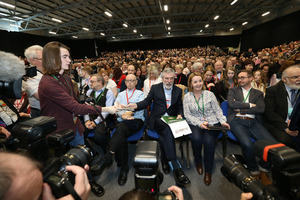
From top: Incoming Sinn Féin President Mary Lou McDonald and outgoing Sinn Féin president Gerry Adams at a Special Sinn Féin Ard Fheis in the RDS Main Hall last weekend’ Derek Mooney

I sit down to write this week’s column having just watched Prof Mary Beard’s excellent documentary portrait of Julius Caesar on BBC1. If I had hoped that watching it might give me some inspiration for today’s effort, I was wrong.

This is not the good professor’s fault. Her contention that Caesar’s legacy has echoes in the actions and words of today’s great political leaders has considerable validity – just not so much when you try to apply it to the career of Gerry Adams.

As I argued here last November Adams is not moving off the Sinn Féin stage, he is merely slipping behind the curtain. Have no doubt that his control, and that of the Army Council, has not been loosened that much.

Rather than looking to Mary Beard’s Julius Caesar, the character I should be looking to is Antony Jay and Jonathan Lynn’s fictional creation: “Yes Minister’s” Rt. Hon. Jim Hacker, MP. Specifically, the Hacker of the first episode of Series Three, entitled “Equal Opportunities”. There Hacker agrees to give an interview to Kathy, a young kid from his constituency writing an article for her school magazine.

Asked to set out his personal achievements, Hacker gives Kathy a run down of his political CV, listing all the posts and high offices he has held. No, she replies, that is not what she means. What she wants is a list of those personal achievements that have made life better for others. He can think of nothing. He is stumped.

Just as stumped as Sinn Féin’s phalanx of myth makers over the past few weeks as they prepared for last Saturday’s ceremonial changing of the guard.

Asked to list what Sinn Féin had achieved during Adams 34 years, the answer came in the form of numbers: 4 MEPs, 7 Senators, 7 MPs, 23 TDs, 27 MLAs, 261 Cllrs.

To be fair, having this number of public representatives is not an achievement to be dismissed lightly but, like Kathy, punters tend to judge political parties not by what they have done that benefits the party, but what they have done that benefits society.

Their record is what Sinn Féin has gained for itself. It is numbers. Even then, the accomplishment is inflated as it does not account for the waves of resignations including the Senator who quit the party ate last year and then quit the Seanad or the dozen and a half Cllrs who quit since the last Locals.

Ask the average Fianna Fáil-er what their party has achieved and they will list things like the Irish Constitution, free travel, free first and second level education, the Good Friday Agreement, joining the EU(EEC) etc.

Put the same question to a Fine Gael-er and they may cite the declaration of the Republic, the Anglo-Irish Agreement, abolishing illegitimacy, while a Labour party member might point to equality legislation, anti-poverty programmes, marriage equality etc.

A political party is defined by how it has changed the lives of others. How it lived up to its raison d’etre. In those terms Adams and Sinn Fein’s record is a one of abject and complete failure. It did not advance political progress in the North, it has been a brake on it. The Provos campaign of violence set back the cause of Unity.

Even in government in the North its record is threadbare. Though it will pain Sinn Féin-ers to hear this, particularly those on this side of the border, the harsh reality is that the DUP ran rings around Sinn Féin in government.

Not that I expect them to take my word for it. Just read Gerry Adams’s own analysis from his January 7, 2017 speech at the Felons’ Club in Belfast.

There he listed all the areas where the DUP had outflanked them:

…there have been other significant issues of contention, including the decision to renege on the Programme for Government commitment on the Long Kesh site; the DUP’s resistance to the legacy and truth recovery mechanisms of the Stormont House agreement; the Red Sky scandal and the Project Eagle debacle.

Remember that this is barely two months after Martin McGuinness and Arlene Foster were jointly championing their achievements on Nov 21, 2016, saying

“This is what delivery looks like. No gimmicks. No grandstanding. Just Ministers getting on with the work”.

In six and a half weeks they went from a collegiate we are working so closely together to a huffy you just cannot work with these people. All in six and a half weeks, not allowing time off for Christmas and New Year.

Try as they may to claim it, the Sinn Féin tail has never wagged the DUP dog.
When it comes to working within a partnership government Sinn Féin could do with taking a leaf out of the PDs, Labour, Greens or Independents book on making government work.

When I suggest they take a leaf out of their books, I mean just a leaf and not – as Sinn Féin has been doing for the past few months – taking another party’s story of achievements and rewriting it as theirs.

As Adams prepared to step back we saw the myth makers attempt to co-opt the record of the civil rights movement and the legacy of John Hume and other genuine peace makers like Seamus Mallon, Dr Joe Hendron, Ivan Cooper, people who stood up to the Provos, and claim it as their own.

When it comes to political cynicism, no one, is as cynical as the Sinn Féin myth makers. They are shameless. But this shamelessness has a purpose. Their rewriting of history and their “everyone else is a sell-out, except us” narrative is there to mask their real vulnerability.

If calling them out on their paramilitary associations, addressing their murky past or their equivocation on political norms were enough, then Sinn Féin would still be in single digits in terms of support here in the South.

But they are not. Reminding people of their frightful history is not really working. This is not because the public do not care about it, but rather because people do not judge parties, or brands, in the same way that they judge individuals. While character does matter, the public thinks more in terms of capability.

This is the point that political parties have missed. Sinn Féin’s vulnerability lies not so much in its lack of character but in its political incapability.

The self-styled party of equality and the plain man and woman is anything but.

For Sinn Féin, Sinn Féin comes first. The Sinn Féin/Adams project was never about Unity, equality or justice, they are just the slogans. The “project” is just about Sinn Féin pre-eminence.

The primacy of the party is what matters, not its professed primary purpose. It was the case with Adams at the helm and it will remain so with McDonald and O’Neill.

Derek Mooney is a communications and public affairs consultant. He previously served as a Ministerial Adviser to the Fianna Fáil-led government 2004 – 2010. His column appears here every Tuesday morning. Follow Derek on Twitter: @dsmooney
Rollingnews

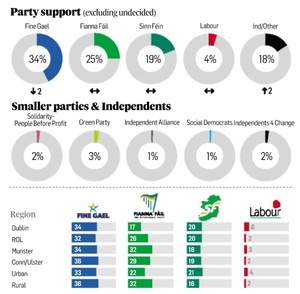
From top: Irish Times/Ipsos MRBI poll of January 25; Derek Mooney

The last few political opinion polls from the Sunday Business Post, the Irish Times, The Irish Daily Mail and the Sunday Times have all painted a similar picture of the current state of play among the main political groupings.

While they may quibble over the hard numbers, they agree on the relative positions. They show Fine Gael in prime position, enjoying a comfortable lead of 6% or more over Fianna Fáil who, in turn, enjoys a similar, if slightly wider, lead over Sinn Féin.

Without doubt it is good personal news for Varadkar, and happy news for a party that only twelve months ago was still coming to terms with the 2016 fall in its fortunes.

What a difference a year can make? An important lesson for any political leader in these still uncertain times.

But, before the government friendly pundits crack open the Champagne and start the celebrations for the next Fine Gael election victory, let us take a few moments to consider why it is still far too early for Leo, Paschal or Regina to count their chickens.

The first point I would make, is not a new one. I have said here many times before that newspapers and media outlets do not conduct their political polls in the way that political parties conduct theirs.

The main political parties do not test their own levels of support with mass quantitative polls, but rather with a series of constituency polls. These offer a more accurate picture of the real levels of voter intention.

They are their holy grails and are guarded almost as jealously and religiously as the fictitious Brothers of the Cruciform Sword tried to guard theirs. Only a few people at the top know the numbers and they don’t share them with anyone, especially not the candidates concerned.

So these numbers do not leak out, but even a simple exercise based on data already in the public domain demonstrates that even the best Fine Gael poll numbers in the capital city might not convert into much.

According to the latest Irish Times MRBI-Ipsos poll from January 25th, the level of Fine Gael support in Dublin has grown to twice that of Fianna Fáil: 34% versus 17%. In 2016 Fine Gael won 14 seats compared to Fianna Fáil’s 6 – and Sinn Fein’s 7.

This included one Fine Gael seat that was uncontested, due to the automatic return of the Ceann Comhairle, giving Fine Gael three out of four in Dún Laoghaire.

So, even before the first election poster is hung, Fine Gael is set to lose at least one seat in Dublin.

Another one, in Dublin North West, is knife-edge with Fianna Fáil’s Paul McAuliffe now having an advantage thanks to boundary changes and Fine Gael unlikely to benefit so much from Labour transfers next time.

So, where are Fine Gael’s possible gains in Dublin? Dublin Fingal and Dublin Bay North are contenders, but neither are certain. The Taoiseach will be under big pressure to pull in a running mate in Dublin West, but that will be a tall order.

Dublin South West is also an FG target, but the person they hope to unseat is fellow Cabinet Minister Katherine Zappone, which is an as you were for the government.

On the Fianna Fáil side, the prospects for gains look far better. It has more pathways to closing the gap with Fine Gael, due mainly to its low 2016 base.

For Fianna Fail, 17% across the Capital is an improvement on the 14% it got back in 2016. That 17% is a city wide average, and varies considerably area to area.

Even a marginal vote rise would see it win a seat in Dun Laoghaire, with either former TD and Minister, Mary Hanafin or young local Cllr and former Mayor, Cormac Devlin. It puts Cllr Paul McAuliffe, already mentioned, strongly in contention in Dublin North West to unseat a Fine Gael TD, while assuring Senator Catherine Ardagh of a seat in Dublin South Central where she narrowly missed out by just 35 votes last time.

Though Fine Gael will be eyeing up Dublin Fingal for a potential second seat, so too will Fianna Fáil who were 3.5% ahead of them there in 2016. Meanwhile, an increase in voter share and favourable boundary changes puts Mary Fitzpatrick in contention in Dublin Central.

The point here is that the figures in a national poll can vary hugely in constituency polls when you bring local factors and individual candidate’s support into play.

Extra votes in some Dublin constituencies will drive up Fine Gael’s national share but will not put another bum on a Dáil seat – and that is what counts on the day after polling.

But there is a second, more telling point. It is unwise to try to forecast a result from a period when one party is on maneuvers and the other one is on a sabbatical.

Where Fine Gael used the slow news period from New year to mid-January to get its message out and have its key players making all manner of policy pronouncements, Fianna Fáil has been doing its trappiest monk routine: practising taciturn reserve. It has been schtum.

Apart from Micheál Martin’s own speech on Repeal the Eighth two weeks’ back, can you recall any major policy statement from them in recent weeks, if not months?

Even allowing for the efforts of their €5million Strategic Good News Unit, Fine Gael has had the field to itself for most of the time since Frances Fitzgerald saga. Is this because Fianna Fáil has decided that this strategically suits its purposes, or is it just laziness?

It could be that that Fianna Fáil strategists are operating a form of reverse political rope-a-dope, refusing to expend its limited resources in sham battles with Fine Gael now, when it feels that the election is still a while away and the battle lines have yet to be formally drawn?

It could also be that Fianna Fáil simply decided to collectively take a month off and recharge its batteries – or, perhaps it a little of both. Either way, though Leo and his team would like the impression to go abroad that his path to victory is strewn with rose petals and the bodies of his political foes, there are way too many imponderables yet for anyone to make any serious predictions.

He could well be right. He could be on course for a famous third win in a row for Fine Gael that will propel his personal political career on to new international heights in the EU, WTO or wherever, or he could end up being, as I have argued here in the past, Ireland’s Gordon Brown, looking back at this period of time and thinking, why didn’t I just call the election then.

Either is possible.

Derek Mooney is a communications and public affairs consultant. He previously served as a Ministerial Adviser to the Fianna Fáil-led government 2004 – 2010. His column appears here every Tuesday morning. Follow Derek on Twitter: @dsmooney
Graphs via Irish Times