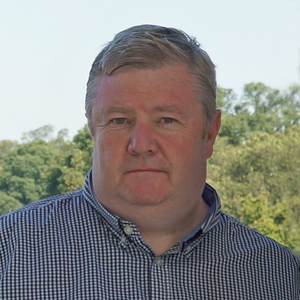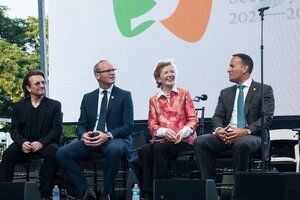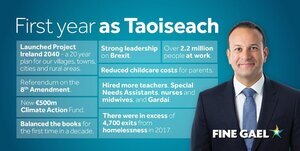



From top: Taoiseach Leo Varadkar announcing Denis Naughten’s resignation as Minister for Communications in the Dáil last week; Derek Mooney
This time last week things were not looking bad for the Taoiseach.
He was getting ready to see his Finance Minister deliver this government’s third budget. He could look forward to it keeping his TDs and support base fairly happy.
He knew it was not a great budget, some would say boring. He also knew that it was not what he would have delivered if he hadn’t to depend on those pesky Fianna Fáil-ers but, even so, he probably felt that he could look forward to good coverage in the media – and we all know how important a positive body-politic image is to the Fine Gael leader.
The Budget was just the start. There was a lot more for Leo to look forward to in what should have been a strong week for him and his party.
It was a week that should have taken the Taoiseach from passing Budget2019, through to increasing pressure on Fianna Fáil to deliver a Summer 2020 extension to Confidence and Supply and then to basking in the pleasure of seeing Mr Justice Peter Charleton’s tribunal of inquiry report clear his former Tánaiste of knowing of any attempt to discredit Sgt Maurice McCabe at the O’Higgins Commission.
That’s how the week should have gone, but it didn’t.
Welcome to politics and to the power of Harold Macmillan’s “events” (When asked what brings down a government, British Prime Minister, Harold Macmillan is supposed to have replied, ‘Events, dear boy, events’, though the story is probably apocryphal).
So, fast forward to today and instead entering the Dáil as the true master of the House after a weekend of positive headlines telling of his political prowess, Varadkar will have to slink in and hope to dispel the notion that his government is weakening and in decline.
It’s a task not made any easier by having to both defend Fine Gael junior minister, Pat Breen, and then ask the Dáil to (re)appoint of independent TD, Seán Canny, as minister of state, to secure his vote for the coming weeks and months.
It cannot be how the Taoiseach thought he would be starting this political week.
Over the past two weeks Varadkar has lost the guaranteed backing of one Fine Gael TD, Peter Fitzpatrick and now two independent TDs, Clare’s Dr Michael Harty, who voted against the budget, and former Communications Minister Denis Naughten.
Hardly achievement for a government elected almost three years with an overwhelming minority.
Two weeks ago, in the wake of the Fitzpatrick defection, I asked, albeit rhetorically,
“If long(ish) serving members of the Leo Varadkar’s own parliamentary party are having public misgivings about this government’s future, then why would Varadkar seriously expect the main opposition party to rush to commit to extend its Confidence and Supply (C&S) agreement for another year, once the Budget speech is done?”
Two more TDs down and the question is even more relevant.
The Taoiseach has known from the moment he took the leadership of his party that he needed to be ready for what would happen once the third budget of Fine Gael’s three-budget deal with Fianna Fáil was passed.
Indeed, he needed to be more than just ready for it, he needed to be the one to shape and determine it. Most of his parliamentary colleagues presumed that he had worked all this out before he went for the leadership.
It is entirely possible, if not likely, that he had – but what he appears to have neglected is the reality that no battleplan survives the first engagement.
Having the ability to adapt and correct a plan mid-skirmish is a more important political skill than being able to dream one up in the first place. His handling of the relatively minor events of the second half of last week suggests, once again, that this is not a skill that the Taoiseach possesses.
Even before the mini-drama of Denis Naughten’s resignation and the news that Minister Pat Breen had similar questions to answer, Micheál Martin managed to throw Varadkar’s short term timeline off course.
He did this by taking the initiative and eschewing the passive role that Fine Gael assumed he would adopt.
But Martin did more than throw the timeline off, he did something else which Varadkar did not expect. Martin opted to discard the political leverage that the current situation gives him and offered Fine Gael a non-conditional arrangement up to early 2019.
This would enable the government to focus on Brexit between now and December/January. It would also allow the Dáil to pass the Finance and Social Welfare Bills that enact the Budget and progress the abortion legislation consequent on the referendum.
In one move Martin may have managed to put national interests ahead of party partisan interests and still get some kudos for himself and his party into the bargain.
I have been saying here for months that there is no good reason whatsoever to continue the Confidence and Supply arrangement. This government has run its course.
While both main parties can take some pride in fact that the arrangement has brought stability and delivered three budgets, as promised, the reality is that this weakening administration is still failing to address the twin crises in housing and health.
Whatever Ministers Murphy and Harris may think, or hope, the market is not going to sort out either – especially when that market may be faced with the calamity of a no-deal Brexit from the end of March 2019 onwards.
As bad as we know a hard deal Brexit would be, with customs and regulatory checks it would at least have the benefit of a legal and logistical framework. A no deal Brexit where the UK crashes out with no agreement and no transition period would devastating.
The last few bits of service that this government can do the country over the coming 3 – 4 months is to continue to defend Irish interests at the Brexit discussions, in the hope that there can be a withdrawal agreement with the backstop (or better) and a two-year (minimum) transition.
Once that is done, the government’s final act should be an orderly and calm progress to a February election.
Derek Mooney is a communications and public affairs consultant. He previously served as a Ministerial Adviser to the Fianna Fáil-led government 2004 – 2010. His column appears here every Tuesday Follow Derek on Twitter: @dsmooney