

Tag Archives: Prime Time

PrimeTime

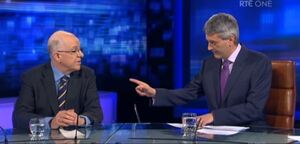
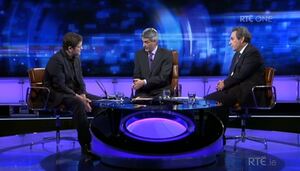
Last night, Dearbhail McDonald, associate and legal editor at the Irish Independent; Tom Lyons, senior business correspondent at the Irish Times,  and Tom O’Malley, a senior lectuter in law from the National University of Ireland Galway, appeared on RTÉ’s Prime Time to discuss the fall out of yesterday’s sentencing of Willie McAteer and Pat Whelan.

The two former Anglo Irish Bank executives were convicted of making loans to illegally prop up the bank’s share price. Yesterday, Judge Martin Nolan ruled that neither man should be jailed but said they may be forced to carry out community service.

In reference to the Financial Regulator’s office, Judge Nolan said:

“It would be most unjust to jail these two men when I feel that a State agency had led the two men into error and illegality.”

During the panel’s discussion, they briefly mentioned the role of ‘others’ in the Maple Ten deal, and at one point specifically the Department of Finance.

David McCullagh: “Tom Lyons, he [Judge Martin Nolan] really was scathing, in his judgement, about the Financial Regulator [Patrick Neary]. Why did he take such a hard line?”

Tom Lyons: “Well, I think he saw that the Financial Regulator [Patrick Neary] was heavily involved in this deal from at least March 2008, and possibly earlier. And he said that, you know, given all of the evidence that, you know, it really appeared that the Financial Regulator was giving a green light to this deal. And he said that, you know, that he thought that the Regulator really was on top of things and it should have been the one to step in and block it. But, for some reason, it didn’t.”

McCullagh: “And, presumably, if the Regulator was aware, we heard in evidence, the Department of Finance was also aware, but the department didn’t seem to get the same amount of attention in the judgement.”

Lyons: “Well the Department of Finance was aware in general terms, of the issue, you know, in terms of this is an issue that could destablise Irish banking. But it wasn’t its job to get into the nitty gritty of what was the ins and outs of how they were actually dealing with it. So I mean the Department of Finance only featured for 22 minutes in a 48-day trial. So clearly the focus, all the time, was on what did the Regulator know, or not know and when exactly did it know it.”

Later

McCullagh: “We had a difference in what the jury was allowed to consider when it was reaching a verdict and what the judge was allowed to consider when he was deciding sentencing in terms of the legal advice, in terms of the Financial Regulator, for a lay audience, can you explain what the difference is there? What the thinking there is?”

Tom O’Malley: “Well, it’s quite a common situation because the jury is already deciding whether the person is guilty or not guilty of the offences actually charged. And, obviously, they have to be, they have to confine their attention to the legal definition of the offence to begin with, and also to the facts of the case. So, in those circumstances, they are confined if you like, their verdict is simply one of guilty, not guilty or we cannot agree. When it comes to a sentence, on the other hand, a different set of circumstances, it’s a much different kind of exercise. The people have now been found guilty, it’s up to the judge to decide, if you like precisely, how guilty they are, to try to measure their guilt, having regard to the level of personal responsibility that they had and to the entirety of the circumstances of the case. And therefore it is, it is not at all uncommon that factors that are totally irrelevant for the purposes of deciding if a person is guilty of innocent then become relevant for the purposes, if you like, of measuring the precise level of culpability that the person has. And, in this case, obviously, there were two difficulties, in a sense, facing the judge, or, well two challenges, if you like. One was that he was dealing with a set of offences that had never been apparently prosecuted before, so he didn’t have any precedents as to the appropriate sentence or what the appropriate principles might be. But, secondly, and much more importantly, he was dealing with two people who were not, as often happens in criminal activities, acting entirely alone. Instead of that, they were part of a much bigger operation, they were part of a fairly large cast of actors, not even lead actors arguably and, therefore, he had to look at their level of responsibility in light of the, if you like, the network within which they were operating.”

McCullagh: “And, by being so scathing of the Regulator in his judgement, do you think he set any precedence here?”

O’Malley: “Well, I’m not sure. I suppose one point I would make about that is that, when you look at the Regulator, one of the other questions you have to ask is, or one of the other things you have to do is to go a bit further back along the food chain and ask the question who created and who tolerated the system of light-touch regulation that the Regulator appears to have been implementing. But, on the other hand, I don’t think there was any unfairness in what he had to say about the Regulator. Opinions might vary on this. But, on the other hand, when you consider the evidence that the Regulator himself gave in the course of the trial, it wasn’t as if a person was being condemned without actually being heard. The Regulator was heard in the course of the trial. He gave evidence, he was cross-examined at length and quite vigorously. And therefore, I personally, although I wasn’t present at any of the trial, don’t think that there was any unfairness done in terms of the conclusions that the judge drew in relation to the fact that the Regulator, and perhaps others, should have been far more vigilant in terms of what was happening. And they should have been far more alert of the possibility that serious breaches of the law were actually taking place.”

Later

McCullagh: “Tom Lyons, the Central Bank this evening issued a statement, in the wake of the judgement, and they said that they had ‘substantially strengthened Ireland’s capacity and financial regulation and supervision’. And they’re ‘confident the shortcomings identified by the court would not reoccur today’. Would you share that confidence?”

Lyons: “Well I think there’s definitely been changes at the top and they’ve put very credible people in place, in terms of the Financial Regulator and the Central Bank at the top. But, down below that, I mean they’re still pretty much the same people and we’re seeing, we’re coming across the same names that were there during the boom when all this sort of stuff was going on. And it is a fact that, you know, there’s been nobody sanctioned and nobody sacked from the Financial Regulator or the Central Bank. They’ve all been allowed retire and certainly in the case of Patrick Neary, who featured so heavily in this trial, I mean he retired with €630,000 pay-off and he’s on a pension today of €143,000, so I mean if that’s sanction?”

Watch back in full here

Previously: “I Imagine There Will Be An Appeal”

Kevin Cardiff: The Smartest Guy In The Room

PTTanglo

Professor of European Criminal Justice Finbarr McCauley, of University College Dublin, appeared on RTÉ’s Prime Time last night to speak about the Anglo trial.

He and presenter David McCullagh were joined by Orla O’Donnell, legal correspondent for RTÉ, Ian Kehoe, assistant editor of the Sunday Business Post, and Gregory Connor, Professor of Economics, Finance and Accounting at NUI Maynooth.

During their discussion they talked about how, during the Anglo trial, a lot of time was spent discussing the matter of legal advice that Anglo had received from Matheson Ormbsby Prentice in relation to the Maple 10 deal and how the law firm advised them the deal was on the level.

But the prosecution successfully contended that legal advice does not make an illegal act legal. And after about 20 days of argument on the matter Judge Martin Nolan ruled that the jury had to ignore the issue of legal advice.

Professor McCauley took issue with this move and even suggested an appeal may be made on foot of it.

Orla O’Donnell: The legal advice was very important to the defence because they wanted to show that these three men had done everything they could to ensure that this deal was legal and, in fact, there was a lot of talk about legal advice for the first, I think, 19 or 20 days of the trial. And yet, after that time, there was some legal argument, the prosecution said that legal advice – good, bad or indifferent – couldn’t make something that was illegal legal and the judge ruled that yes, that ignorance of the law is no defence, so they were told it could never be mentioned again.”

David McCullough: “So all that evidence that the jury had heard was, in effect, wiped out from…their deliberations.”

O’Donnell: “That’s right, irrelevant.”

David McCullough: “Finbar McCauley, some people looking at this, literally, are going to think, ‘Well, if the Financial Regulator said that it didn’t have a problem with this, and this is an arm of the State, then why were these men being prosecuted?’.

Finbarr McCauley: “Well, that’s a very good point – the point that Orla’s made there about the judge’s ruling, in the course of which he effectively excluded that evidence – I think that, with all due respects to the judge, and they have to make all these line calls in very difficult situations – but I would have thought that that’s a mistake. It seemed the prosecution argument seemed to be that this was effectively mistake of of law, in fact they used the famous Latin maximum, ‘Ignorantia Juris’, was bandied about – meaning, ‘Mistake Of Law Is Never A Defence. But, I think if you scrutinise what the defence were saying – they weren’t actually alleging that they didn’t know that Section 60 existed, or that they didn’t know what the sub-sections said. Their argument was that, under the advice that they had received from their own lawyers that they thought the behaviour they were purporting to do, came within the relevant provision. That’s not a mistake of law, with all due respects to their learned counsel, that’s a mistake of fact. Let me give you an example, if I go through a ceremony of marriage, during an already subsisting marriage to my current and beautiful wife, and I go to court, and I’m facing a charge of bigamy, and I say, ‘Oh, I didn’t know that bigamy was an offence in this country, so may I be excused?’ – I would be told – ignorance of the law is no excuse and that would be quite a proper thing for the court to say. But, if i said, ‘I’m sorry, I didn’t, I thought my divorce papers had come through’ – but in fact I was mistaken about that fact, that would not be a mistake of law – that would be a mistake of fact – I’m mistake of the factual situation pertaining to me. In my judgement for what it’s worth, I think that is what the defence were saying. And I think, therefore that the trial judge’s decision to exclude that evidence effectively converted this offence, the Section 60 offence, into one of strict liability. It precluded consideration of the mental state, the mental element, which, as you know is a fundamental issue in the law.”

O’Donnell: “That’s, one of the issues is that the defence were asking the judge to read a defence into the legislation, a defence of due diligence. And I think in English legislation there is some kind of defence of good faith but the judge said that he couldn’t do that, that he could only deal with the law as it was, it wasn’t up to a Circuit Court judge to make law. So he said it wasn’t in the legislation.”

Gregory Connor: “I think from the perspective…”

McCauley: “If I could just finish on that point, sorry Gregory.”

Connor: “Yes, sure.”

McCauley: “I would imagine that there will be an appeal, I mean I can’t say for certain but I imagine that there will be an appeal on that very point.”

Watch back in full here

Related: Much of Anglo trial taken up with legal argument (RTÉ)

191793381
[The Midlands Regional Hospital, Portlaoise, Co Laois]

The RTÉ Investigations Unit uncovers details surrounding the death of a Fifth Baby relating to Portlaoise Hospital. Prime Time,  9.35pm on RTÉ One.

Meanwhile, staying in tomorrow?

WilsonTV3

Garda whistleblower John Wilson (above) gives his first interview since the resignation of Garda Commissioner Martin Callinan to Ryan Tubridy on The Late Late Show, RTÉ One at 9:35pm.

Thanks Laura Fitzgerald and Karen Fitzpatrick

NoonanPT

Finance Minister Michael Noonan went on RTÉ’s Prime Time last night following former Garda Commissioner Martin Callinan’s resignation yesterday morning and the lunchtime announcement by Taoiseach Enda Kenny that he has set up a commission of investigation to look at the widespread recording of phone calls at Garda stations across Ireland over approximately 30 years, up until November 2013.

It’s understood that 2,500 tapes of conversations exist.

Minster Noonan – who was  justice minister from December 14, 1982 to February 14, 1986 – appeared with the caveat that he would have a one-to-one interview and that he wouldn’t have to discuss matters with any oppposition members..

Host Miriam O’Callaghan was keen to get a timeline of events from Minister Noonan, to essentially find out who knew what and when in relation to these recordings.

She was especially determined to find out what Justice Minister Alan Shatter knew and when he knew it. This is largely because of what has been reported so far, specifically:

– Enda Kenny told the Dáil that he first he heard about the issue of garda station recordings was when the Attorney General Máire Whelan told him late on Sunday afternoon around 6pm.

– On Monday night, a senior civil servant was sent to have a chat with Martin Callinan – who was under pressure from Labour and Fine Gael’s Leo Varadkar to withdraw his ‘disgusting’ remark about Garda whistleblowers Sgt Maurice McCabe and John Wilson – to talk about the Government’s unease about ‘recent events’.  Callinan was also informed of the Government’s plan to hold an investigation into the garda station recordings.
– On Tuesday, Alan Shatter learned about the garda station recordings for the first time.

However.

RTÉ News reported last night that a letter was sent by Callinan to the Department of Justice on March 10 – five days before Minister Shatter left for Mexico as part of his St Patrick’s Day jaunt – outlining the matter about the garda station recordings, while the Attorney General was made aware of the matter as far back as November 2013 and had been involved in a working group in order to deal with the issues, in consultation with Martin Callinan.

And.

GSOC reported on these issues in June 2013, when it investigated a Garda assault case involving Anthony Holness. The GSOC report said the Garda Commissioner ‘may wish to re-evaluate his practice regarding the recording of such calls and the consents required if it is to be permissible to use such recordings in evidence’.

RTÉ’s Katie Hannon of Prime Time said t she was told Minister Shatter didn’t see that GSOC report and that there was no legal obligation for the GSOC report to be brought to Minister Shatter’s attention.

With that in mind, here’s a transcript of Minister Noonan’s one-to-one interview with Miriam O’Callaghan.

Miriam O’Callaghan: “Minister, first of all, this is a very strange affair, before we go into the substantive problem of obviously recorded phonecalls in Garda stations, it’s important to work out who knew what and when. So if we deal with that issue today, of the recording of the phonecalls in garda stations. People are wondering why it was announced today because that information was in the public domain ever since the court case back in November. As you know, the Holness case and then the GSOC report in June. So, how was it today that it was so important? It was announced and that people only became aware of it in your Government?”

Michael Noonan: “Well, obviously, we don’t know all the facts and that’s why a Commission of Inquiry is being set up and that’s why the gardaí, under the new commissioner and the Department of Justice have been instructed to provide full reports and I can’t give you full answers but I can tell you what I think may have happened.”

O’Callaghan: “I don’t want to cut across you so soon but I’m not asking what actually happened in the gardaí, I’m asking you now about the Cabinet and who knew what and when.”

Noonan: “That’s what I want to address. First of all, the Garda Ombudsman made a report in June of last year and he recommended that because the practice of recording had come to light in Waterford Garda Station, in a particular case that the Commissioner might re-evaluate the practice. This was a very tentative, you know, pitch by the Ombudsman’s office.”

O’Callaghan: “Well it was a direct quote actually, they said ‘Commissioner [Callinan] may wish to re-evaluate his practice regarding the recording of such calls’.

Noonan: “Yeah, he may wish to re-evaluate…

O’Callaghan: “Based on a court criticising that behaviour.”

Noonan: “What I’m saying is that, nothing hangs on it, but it was a tentative enough way of putting a recommendation. Now I don’t know whether the Commissioner re-evaluated or not but, coincidentally, the practice was ended in November [2013], so I presume there was a re-evaluation at some level in the guards.”

O’Callaghan: “But how come Minister Shatter or the Department of Justice was not aware of the GSOC report?”Continue reading →

Mukulla

PTMaurice

On Prime Time last night RTÉ’s David McCullagh held a debate with Fine Gael TD Charlie Flanagan and Fianna Fáil TD Niall Collins in light of Taoiseach Enda Kenny’s announcement yesterday that he has appointed Sean Guerin, SC, to look into Sgt Maurice McCabe’s dossier which alleges Garda mishandling of a number of serious crimes.

They also discussed the so-called directive that Garda Commissioner Martin Callinan sent to former Garda John Wilson and Sgt Maurice McCabe separately on December 14, 2012. The ‘directive’ was delivered verbally to the two gardaí. Mr Wilson said last night that the superintendent that gave him the message told Mr Wilson that he was under instructions from Commissioner Callinan not to furnish Mr Wilson with a written copy of the directive.

Commissioner Callinan maintains this directive called on both men to co-operate with the penalty points inquiry, led by Assistant Commissioner John O’Mahoney.

But Sgt McCabe released a statement on Monday night saying the Commissioner’s claims were ‘gravely misleading and false’ while last night Mr Wilson said he believed the directive was the equivalent of a ‘gagging order’.

Sgt McCabe taped the conversation during which his directive was delivered, while in the case of Mr Wilson, he took notes. Mr Wilson’s notes – in so far as the message that was read out to him – match what was read out to Sgt McCabe, in Sgt McCabe’s transcript.

The directive was issued just a few days after Mr Wilson was found printing off records from the PULSE system in Cavan and days after several high-profile people were named in the Dáil as having had penalty points quashed.

On this specific matter, RTE’s David McCullagh took issue with Charlie Flanagan.

David McCullagh: “I want to ask you a question. Gerry Adams made the point in the Dáil during those exchanges that the Taoiseach was given that dossier less than a week ago and now we have an independent barrister appointed to look into it to see if there’s anything to investigate there, as you say, the Taoiseach has moved fast. Alan Shatter was given this two years ago.”

Charlie Flanagan: “There are two charges levelled on a continuous basis by Niall Collins and Fianna Fáil against Alan Shatter and they are as follows. Firstly, that he was given documentation two years ago, which he sat on. Not true. We will see tomorrow and we’ve already evidence that Alan Shatter acted on documentation that was before him: some of these issues and allegations have already been the subject of an examination by the GSOC office. In fact, in fact…”

McCullagh: “Then why has Mr Guerin been appointed?”

Flanagan: “In fact, David, in some cases, in some cases, charges have been brought, due process has taken place in the courts, and people have been convicted, that’s exactly as it should be through the criminal law. The second charge against Alan Shatter is that in some way he misled the Dáil by saying that Sgt McCabe, a central figure, did not cooperate with the investigation. I say, having read the documentation now published and having regard to what Sgt McCabe, an honourable man, said last night, I believe there are failures on both sides. I find it inexplicable that an investigation could take place at the behest of the gardaí, under Assistant Commissioner O’Mahoney without Sgt McCabe, a central figure being involved. How is it? How is it the investigation took place?..”

McCullagh: “Well that’s a very good question.”

Talk over each other

McCullagh: “How is it that Alan Shatter didn’t seem in the least bit concerned about it?”

Flanagan: “No, I believe that this, that this issue is, has been the subject of a review of papers in Alan Shatter’s office over the last and I believe we’ll know this tomorrow. The second issue is, as far as Sgt McCabe is concerned, there are reports that he was asked on more than one occasion…”

McCullagh: “What reports?”

Flanagan: “..that his issues would be…letters from the Department of Justice directly to him and the content of the transcript of the tape last night.”

McCullagh: “Hold on, hold on, hold on, hold on, hold on. Hold on, hold on, hold on, hold on.”

Flanagan: “It seems to me inexplicable that Sgt McCabe didn’t know that there was an investigation under way.”

McCullagh: “Hold on. The thing last night is quite clear. What he was told: ‘The Commissioner is now directing you to stop accessing PULSE and he disputes whether he was doing that and, anyway..’And if you have any concerns they can be brought to the attention of the Assistant Commissioner’. How is that a direction?”

Flanagan: “Yes, well, I find it inexplicable that Sgt McCabe wasn’t aware of the fact that an investigation was taking place.”

McCullagh: “But the Commissioner and the Minister said that he was directed to cooperate with the inquiry, now is that a direction?”

Flanagan: “Well, I believe that there is more to the story than we’ve seen and I look forward to the minister making that statement tomorrow in the Dáil.”

McCullagh: “The Commissioner said that on that date…”

Flanagan: “And standing over what the minister has said, under Dáil privilege.”

McCullagh: “The Commissioner said that on that date that Sgt McCabe was directed to cooperate with the inquiry and quite clearly if that, if that transcription is correct, he quite clearly wasn’t.”

Flanagan: “Listen the fact of the matter here is that Sgt McCabe knew that an investigation of some form was taking place because he was given more information than was actually contained in the transcript.”

McCullagh: “And did he have the Assistant Commissioner’s phone number in his, in his iPhone.”

Flanagan: “Listen, I’m not in a position to answer as to whether Sgt McCabe had people’s phone numbers on his person. What I am saying, David, and you know this is a complex and serious issue, what I’m saying is there were failures on both sides. How an investigation could take place over a period of months, the central figure wasn’t involved and happened to ring up wondering what the story was when the whole thing was finished.”

McCullagh: “What was Minister Shatter’s failure then? Well, Niall Collins is the one who..”

Niall Collins: “No you just said there’s failures on both sides, Charlie, I mean you’re being entirely inconsistent here.”

Talk over each other.

Collins: “Is it good enough that the Minister for Justice will come in to Dáil Éireann under privilege and seek to completely discredit the character of Maurice McCabe.”

Flanagan: “No I don’t accept that will happen.”

Collins: “You have testified on numerous occasions that Maurice McCabe is very credible so has Pat Rabbitte, so has members of the PAC [Public Accounts Committee]. Anybody that has met Maurice McCabe is happy that he is credible in terms of what he is saying. Yet the minister choose to come into the Dáil and seek to assassinate his character.”

Talk over each other.

McCullagh: “Let Charlie answer that.”

Flanagan: “I think that is the kind of hyperbole that is actually damaging to the process.”

McCullagh: “Well hold on a second.”

Talk over each other.

Flanagan: “What Minister Shatter said under Dáil privilege was that it was his view that Sgt McCabe did not cooperate with the investigation.”

McCullagh: “But how could he cooperate when he wasn’t asked?”

Flanagan: “Well, you know, that’s a moot question and it’s not perfectly clear that he wasn’t asked. And I looked at the evidence of the Garda Commissioner and the evidence of the Department of Justice as far as that’s concerned.”

McCullagh: “Ok, well just in relation to the revelation last night, you know, you, some people say that’s a direction – I don’t see how anybody who understands the use of the English language could think that was a direction but anyway that’s beside the point. Why was it delivered verbally and not in written form? Why, if he did disobey a direction, was he not disciplined for it, and why on earth did the Assistant Commissioner not pick up the phone and ring him?”

Flanagan: “These are questions that are better put to the Garda Commissioner and the Assistant Commissioner. I would have thought that the Assistant Commissioner might have made a call to him over the course of weeks before the investigation got under way and in fact when the investigation was under way, having regard for the fact that Sgt McCabe was at all times a central figure.”

Watch back in full here.

Transcript of conversation between Maurice McCabe and Mark Curran (Irish Examiner)

Related: GSOC Saga: Uncovering truth amidst confusion (Mick Clifford, Irish Examiner)

ShatterGSOC

Mooneyy

Hmmm.

Last night Justice Minister Alan Shatter’s appeared on Prime Time in relation to the alleged bugging of the Garda Síochána Ombudsman Commission.

During his appearance, presenter Claire Byrne asked Mr Shatter about the different versions of events told by him in the Dáil on Tuesday, compared with that of the GSOC chairman Simon O’Brien, told at an oireachtas committee meeting on Wednesday, and indeed what GSOC commissioner Kieran Fitzgerald said on Prime Time on Tuesday.

Mr Shatter put it down to general confusion while also insisting what he said in the Dáil was exactly what GSOC told him.

Claire Byrne: “Just to clear what you said in the Dáil was based exactly on what Simon O’Brien told you during your meeting on Monday. So did he have a different story then? When he went to the committee. I mean, let’s admit it, he gave an incredibly different account of what had happened?”

Alan Shatter: “I’m very conscious that Mr O’Brien and the other members of GSOC were at a committee meeting for up to four hours and a series of questions were put to them. And I think, in the course of that event, there were different answers given, with regard to particular issues and these, some of what was said during the course of that seemed to me to be a little confused or contradictory.”

Byrne: “So you were surprised by at least some of what was said during that committee hearing by the chairman of GSOC?”

Shatter: “At no stage during his oral briefing of me, in the context of a written brief, or indeed the press release that GSOC issued, was it stated that he or members of GSOC believed they were under surveillance. What was stated was that, in the context of a security sweep that had been undertaken, vulnerabilities, or potential threats or abnormalities had been identified. And I acted, I acted on foot of that.”

Byrne: “Ok. But this is very important. Do you believe that you were given information that led you to mislead the Dáil?”

Shatter: “No, I was given information that I brought to the Dáil…”

Byrne: “But it was wrong, it was contradicted afterwards..”

Shatter:…”the brief…well no, it was, the brief that I received from GSOC, which was very important, I forwarded this evening to Joint Oireachtas Petitions Committee, before whom the GSOC members were yesterday [Wednesday]. I’ve been asked to present at the committee next Wednesday, I’m very happy to do so. I do think that it’s important that there’s absolute clarity in regard to these issues.”

Byrne: “So you weren’t told the full story?”

Shatter: “No I was told a, the story…”

Byrne: “A story but not the whole story.”

Shatter: “I was told the story that I told the Dáil and I do think there’s now some confusion arising from the four hours of hearings that took place.”

Later

Byrne: “Quite aside from the hearings, Kieran Fitzgerald was in here, the Garda Ombudsman Commissioner the other night and he said that the first security sweep was done because there was a credible threat they believed, now that wasn’t what you said in the Dáil? You said it was routine.”

Shatter: “Kieran Fitzgerald, I think I recollect correctly, said that he agreed with my account in the Dáil..”

Byrne: “But he did say there was a credible threat.”

Shatter: “I repeat: my objective, and my only objective, was to tell the Dáil the truth of what I knew about these matters. What I knew about these matters was based on the briefing I got from the chairman of GSOC and also from the written submission that they made to me. It was absolutely clear and the written submission they furnished sets it out. They referenced the importance of confidentiality and security and that because, for some considerable time, going all the way back to 2007 apparently, there hadn’t been a general security sweep, they determined what should be undertaken. No threat was ever identified to me as stimulating the need for that sweep.”

Watch Alan Shatter’s interview in full here

Previously: Contradictions In Terms

John Mooney

UPDATE: Read the briefing note given from GSOC to Alan Shatter here

ShatterDail

Justice Minister Alan Shatter spoke in the Dáil yesterday evening about the reported bugging of the Garda Síochána Ombudsman Commission’s offices during a 5.30pm debate on the matter, saying:

“It is important to say at the outset that the Garda Síochána Ombudsman Commission has informed me that, after an investigation, they concluded that no definitive evidence of unauthorised technical or electronic surveillance of their offices was found. Moreover, they have informed me that their databases have not been compromised. In other words, it has not been established that the offices of the Ombudsman Commission were subject to surveillance. Some public comment has proceeded on the basis that it is an established fact that the offices of the Commission were bugged when clearly it is not.”
…
“The issue in question arose following a security sweep, in September 2013, of GSOC’s offices in Dublin. I am informed that there was no specific concern which caused GSOC to organise the security sweep, which was carried out by a security firm based in Britain. It was a routine sweep of a nature which had occurred previously. I do not think anyone could argue that it is unreasonable for a body which, of its nature, holds sensitive information to take measures to ensure the security of its communications.”
…
“I am advised by GSOC that the sweep identified what they refer to as two technical anomalies which raised a concern of a surveillance threat to GSOC. I should emphasise that my understanding is that what was at issue were potential threats or vulnerabilities, not evidence that surveillance had, in fact, taken place. A subsequent sweep identified a third potential issue. There was no suggestion that there was any risk of unauthorised access to the GSOC databases and the documentation on them.”

Kennybug

Taoiseach Enda Kenny, above, also addressed the Dáil, saying:

“So, if you’re asking me ‘was the office bugged, what I’m saying to you, in the words of GSOC that they found, following the investigation, no evidence of sophisticated evidence of unauthorised technical or electronic surveillance of their offices found, I think that’s pretty clear.”

RTE9

RTÉ’s political correspondent David Davin-Power on the 9pm news last night, speaking to Eileen Dunne, from Leinster House.

Eileen Dunne: “David, the focus of this story seems to be changing all the time, where are we tonight?”

David Davin Power: “That’s right Eileen, the focus of this controversy has weaved about a bit but I think tonight it’s settled on the Garda Ombudsman Commission and its handling of events. The original newspaper story that sparked this controversy was pretty accurate in its detail, in that it mentioned wi-fi networks, conference phonecalls and so on but it also went on to cite unnamed sources, saying that there was ‘government-level technology involved’. Well, obviously, there doesn’t appear to have been and that raises the question of who leaked the information and, to borrow a phrase from a couple of years ago, who sexed up this particular dossier? And then there’s the question of not telling the minister, understandable perhaps at the time but scarcely credible now that the whole controversy seems to have been nothing more than something of a bottle of smoke. And then, finally, there’s last night’s statement, which infuriated ministers, aswell as the Garda Commissioner, in mentioning the gardaí specifically. Now the Ombudsman chairman [Simon O’Brien] wanted, in his comments, just to put the gardaí out of the frame completely, saying they weren’t involved in anyway but it had the effect of providing ammunition to people who have always been sceptical and suspicion, suspicious of the Ombudsman Commission. So, plenty of questions, serious questions for the chairman of the Ombudsman Commission to ponder, along with his colleagues. They appear before a Dáil committee tomorrow. They’d want to put in a pretty credible performance and present a united front, if the whole process of rebuilding trust and credibility is to have any chance of success.”

Fitzgerald

Garda Ombudsman Commissioner Kieran Fitzgerald then went on Prime Time with Miriam O’Callaghan, following the news, last night.

Miriam O’Callaghan: “So, Kieran Fitzgerald, the minister today seems pretty clear, there’s no evidence at all that you were bugged. So were you bugged?”

Kieran Fitzgerald: “Miriam, it would be very, very good if we were able to say definitively yes, or definitively no. Unfortunately, the reality of modern surveillance and intrusive surveillance mechanisms, is that it’s very often an inconclusive result. So what we got were credible threats to our own security, we hired consultants, experts, international experts to consider those for us, examine those and test them. At the conclusion of their testing and their sweeps, their security sweeps, they were able to tell us that certain things did not look likely and other things, they could not be definitively sure.”

O’Callaghan: “What were the credible threats?”

Fitzgerald: “The credible threats were three-fold. One was a piece of equipment which was connecting to an external network, a wi-fi device. Now it should have been activated by a password, in actual fact it was activated, seemingly, without the need for a password and transmitting. It did not compromise our data, it did not connect with out internal security. But, having found it, we certainly needed to take it very, very seriously. That was one. The second was more worrying, it was a conference call telephone, a conference call facility that we use, not infrequently,  and that was tested, and the test showed up what we called, in our first report, an anomaly, but it showed up something that gave them cause for concern and their judgement was that the strange behaviour of this device, in response to their test, was such that, it could have been coincidental, it could be accidental, it could be explained away but they rated in their report the possibility of it being coincidental as close to zero.”

O’Callaghan: “And the third one?”

Fitzgerald: “And the third one was a sophisticated piece of equipment that does sweeps of buildings, from an external, it doesn’t have to be in a building, just in the vicinity and that can, if you like, attack mobile phones and mobile devices.”

O’Callaghan: “It sounds like, still, like your statement last night from GSOC which more or less confirms what you’re saying now: you still believe that there could have been bugging of your building and your equipment. And that is not what the minister is saying today.”

Fitzgerald: “Well, we’ve no disagreement at all with the minister and we…”

O’Callaghan: “Well you clearly have…because he came out today saying there was none.”

Fitzgerald: “Well, what the minster actually said was that he had received a thorough briefing from us yesterday and further again today, with his officials and what he said was that we said that there was no definitive evidence of…”

O’Callaghan: “He said actually, just to quote him, he said that what was identified was ‘potential threats and vulnerabilities but there was no evidence that any surveillance had, in fact, taken place’.”

Fitzgerald: “There is no evidence to sugge-to confirm that surveillance has taken place. The minister is absolutely right and we have no, as a result of our briefing to him, we have no disagreement on that topic.”

O’Callaghan: “But on the balance of probability, Kieran Fitzgerald, do you believe you were bugged?”

Fitzgerald: “It is very difficult to say, I mean…”

O’Callaghan: “But what do you believe?”

Fitzgerald: “Well, hold on, Miriam, it would be lovely to be able to say we could be certain one way or another. What we are faced with, at the conclusion of this, is that we could more or less dismiss some of these threats and if you like, on a balance of probabilities, on others, we just do not know. What we have learned though, are the threats to our building and ensure that they no longer exist.”

O’Callaghan: “OK but on one of the anomalies you just mentioned, you said the likelihood, you know, that it’s an innocent thing was remote to zero, the possibility?”

Fitzgerald: “Well that’s what was reported to us, exactly.”

O’Callaghan: “So you can’t still believe, or say to me tonight that that would make you believe that there was some form of surveillance.”

Fitzgerald: “Well we cannot definitively, as the minister said and as I’m saying now,  we cannot definitively say that we were bugged, certainly we cannot say that.”

Later

O’Callaghan: “But was it routine, Kieran Fitzgerald? To go to a British firm? To do it in the middle of the night, to do it at weekends, or did something make you do it?”

Fitzgerald: “Can I just say, there aren’t an awful lot of people engaged in this work so the pool of people…”

O’Callaghan: “Ok. But was there something that sparked you to do this?”

Fitzgerald: “If you recall, throughout 2012, we were involved in some serious investigations and we…”

O’Callaghan: “The Kieran Boylan case?”

Fitzgerald: “And we submitted a special report to the Oireachtas, something we very rarely do, something we do only in grave and exceptional circumstances. We were obviously in a state of heightened awareness of our security at that point. And some things appeared in the public discourse that gave us rise to concern, nothing terribly specific but things that worried us and we thought this is a good time to do this.”

Watch back in full here

PTwhole

John Mooney, of the Sunday Times, and Mark Kelly, of the Irish Council for Civil Liberties, joined David McCullagh on RTÉ’s Prime Time last night to talk about Mr Mooney’s story concerning the bugging of the Garda Síochana Ombudsman Commission building.

Their appearance followed the release of a statement by GSOC which stated there was “no evidence of Garda misconduct”  and which also confirmed the existence of “three technical and electronic anomalies”. It also followed the release of a statement by Garda Commissioner Martin Callinan in which he demanded to know why gardaí were “suspected of complicity” by GSOC.

Mr Mooney explained that, while the GSOC statement didn’t detail the ‘anomalies’, he claimed they were in fact: a phone in a conference room was being monitored, a Wi-Fi device was accessed but deleted all data accessed/potentially collected once it realised it was detected, and a shadow Wi-Fi was set up around the GSOC building which “piggybacked” on GSOC’s own Wi-Fi system which allowed for further monitoring.

Mr Mooney said some of the monitoring was traced back to a British IP address which, he said, was “clever” because it prohibited GSOC from pursuing an inquiry into the UK, as such a move would be beyond its remit.

Then Mark Kelly talked about a potential paper trail if the surveillance was legal before Mr Mooney said he knows certain events prompted the surveillance sweep.

Mark Kelly: “There has yet to be an unequivocal statement that there has been no surveillance of GSOC by An Garda because there is a legal power in the [Criminal Justice Surveillance] Act, from 2009 for Special Branch, a section of the Defence Forces, called G2,  and also for Revenue Commissioners to lawfully engage in surveillance, but that leaves a paper trail. I think a starting point in answering the central question which is: who bugged GSOC? It’s not about who  reported to the Minister [for Justice, Alan Shatter] and when. It’s not about what did GSOC know that they haven’t told us, it’s about who bugged GSOC? And a central part of getting to the truth about that, I think is what people want to hear is eliminating people who are innocent. So, if it is the case that the guards have had no involvement whatsoever, in terms of the existing legal framework, let that clearly be said.”

David McCullagh: “Ok, and for a legal surveillance operation, you need to go to a judge and you need to get approval and all that sort of thing so, as you say, there would be a paper trail, there would be records of all of that and it should be roughly straightforward then to issue a statement?”

Kelly: “It should and I’m quite surprised that hasn’t happened yet been done. Perhaps the minister will do it tomorrow. But then, there’s a second element to a possible investigation. If this surveillance is not being carried out lawfully, and we’ve no reason to think it has been carried out lawfully,  or a reason is there for it to be carried out lawfully, has it been carried out unlawfully? But by agents of the state who have access to the appropriate technology…”

McCullagh: “So we’re talking about rogue elements, the possibility of rogue elements?”

Kelly: “The possibility of rogue elements.”

Later

Mooney: “I think it’s just very important as well to ask why did they [GSOC] do this? What  made them feel that they were under surveillance and someone was monitoring them? Simon O’Brien, the GSOC chairman, made a reference to RTÉ tonight that this was a general search: I don’t believe that. In fact, I know that there was certain events [that] prompted this particular security sweep. And that is the omission in this [the GSOC] statement that really, urgently needs to be clarified.”

Watch in full here


Headshot-Smiling

[Brian Finnegan, editor of GCN]

Would you feel entirely safe holding your same-sex partner’s hand on the street in Ireland?

Jane Casey writes:

GCN/TheOutmost.com’s editor Brian Finnegan, will be discussing homophobia in Ireland on RTE’s Prime Time tonight. He will appear on a panel alongside Labour’s Ivana Bacik, The Iona Institute’s David Quinn and blogger Paddy Manning.We are collecting results for Brian to bring to the debate on RTÉ this evening {below)

Vote here

Gay Community News