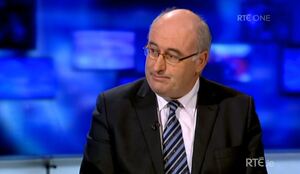
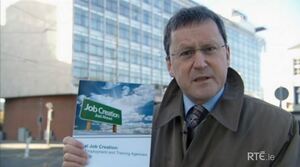
Last night Environment Minister Phil Hogan appeared on RTÉ One’s Prime Time to talk about the Irish Water controversy.
Everything is fine, he assured presenter David McCullagh…
Phil Hogan: “There is a perception being created that this particular money is just being spent on just accountancy and solicitors’ reports, that is not the case and I think that Mr Tierney at the committee today laid that out very well, in terms of the essential infrastructure that’s required to set up a public utility company for water from scratch.”
David McCullagh: “Yeah, sure but what, I mean, TDs, backbench government TDs, TDs, like Barry Cowen [in studio], Fianna Fáil, and others in Opposition TDs, ask a simple, straightforward question ‘how much is being spent on consultancy in Irish Water?’ No answer comes back from the Government.”
Phil Hogan: “Well, what I do, is I don’t micro manage what’s happening in Irish Water. And I don’t, we as Government set down the policy position and the overall amount of money that has to be spent, to set up this particular public utility company. And deputies have an opportunity to bring in Irish Water before the committee on a regular basis, or as often as they wish. And I don’t believe that I, as Minister, or certainly Irish Water, are in any way, other than expecting the highest transparency.”
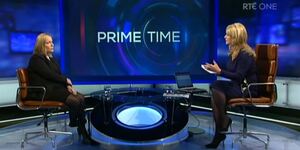
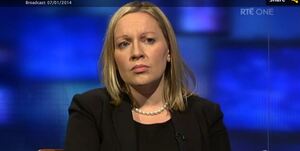
Lucinda Creighton joined Claire Byrne on RTÉ’s Prime Time on Tuesday night ahead of the Reform Alliance’s conference in the RDS on Saturday, January 25.
And took some views from the audience….
Claire Byrne: “Lucinda, what is [The Reform Alliance]?”
Lucinda Creighton: “It’s…It’s a vehicle and a way for us, I suppose, to work together in the Dáil and Seanad to put forward ideas, where we have agreements and common position, we obviously don’t have that on everything. We meet once or twice a week. We go through the Seanad and Dáil agenda and we co-ordinate, we co-table motions, or amendments to legislation, things like that.”
Byrne: “Why do you need to call that something other than Fine Gael when, when…”
Creighton: “Because we’re in Fine Gael.”
Byrne: “But you’re members of the Fine Gael party?”
Creighton: “Some of us, Claire. Not all.”
Byrne: “But you made that very clear today. Why can’t you do that within the Fine Gael party as such?”
Creighton: “Well because, it’s been made clear to us we’re not wanted in the Fine Gael party.”
Byrne: “So why are you still in the Fine Gael party?”
Creighton: “Well, for me, I suppose I’ve been a member of Fine Gael since I was 18 years old, so there’s a certain attachment, needless to say I’ve worked very hard, both as a grassroots supporter, as a canvasser behind the scenes and, in more recent times, as a public representative. So it’s difficult, it’s not an ideal situation, I suppose from that nostalgic point of view, but I’ve a job to do, I’m an elected TD and I want to find ways to highlight issues that matter to Irish people.”
Byrne: “Do you reckon though that Fine Gael will kick you out now, for doing this, for setting up this conference, for registering with the Standards In Public Office organisation? Because if you start funding for the Reform Alliance, you could be taking fundraising away from Fine Gael?”
Creighton: “Well, there are a few questions in that. I mean, firstly, I think it would be bizarre if any political party didn’t welcome political debate. I mean I’ve hosted meetings in my constituency on every topic under the sun, from health to education to political reform in the past.”
Byrne: “That’s different though to taking their money, when it comes to fundraising?”
Creighton: “Well, hang on a second, the only people that are taking money at the moment in my name and in the name of my colleagues is actually the Fine Gael party.”
Bryne: “Yeah, but you’ve registered with the Reform Alliance, which allows you then to raise funds..”
Creighton: “Yeah, but it’s an important point cause a lot of people aren’t aware of the fact that, every year, the Fine Gael party receives, is now in receipt of about €300,000 in the name of TDs who have hand, act or part in the workings of the Fine Gael parliamentary party. And it is an important point because I think it should be given back to the Exchequer.”
Byrne: “You’re going to be raising funds now for the Reform Alliance. Fine Gael are also trying to raise funds all the time, everybody knows that, that’s what political parties do, so there is a very obvious conflict there.”
Creighton: “I don’t think there’s any conflict. I’m an elected member of the Oireachtas, my colleagues are also elected members of the Oireachtas, we have political engagement that we want to carry out. We want to organise events, we want to have meetings, we want to engage with the public and, you know, let’s remember what this is about. It’s not about political parties, it’s not about Fine Gael, Fianna Fáil, or anybody else. Politics is supposed to be about serving people. And, we have a situation where, in a recent referendum, 60% of the Irish voting public didn’t show up to vote. In the last general election, approximately 40% of people didn’t show up to vote. So we have a problem in terms of actually interesting, getting people interested and connected with politics. Political parties are often to be seen as very exclusive, to be a closed shop and the activities of political parties are often seen as something that does not appeal to and is not welcoming of the public, the actual people that are affected by political decisions. And what we’re trying to do, is give those people a chance to actually feed into the political system and that’s what we’re doing, by organising our meeting.”
Byrne: “Perhaps, dipping your toe in the water, to see what level of interest there is in another political party, is that a part of it as well?”
Creighton: “Well, no it’s not. I mean I don’t know what the future holds and I think there’s lots of speculation about the potential and possibilities of new political parties in the future. But that’s not the purpose of holding these meetings. We set off all along…”
Byrne: “But you wouldn’t rule it out either, just to be clear. You’re not going to say tonight the Reform Alliance will never become a political party.”
Creighton: “Well, I mean, if you had asked me a year ago, would I have been excluded from the Fine Gael parliamentary party for voting for something, according to what we said we would do, before the last election, I would have said no. So I’ve learned that, you know, there are no certainties in politics but…”
Byrne: “The Independent TD Finian McGrath issued a statement today, warning people about the Reform Alliance, saying look ‘this is just a bunch of disillusioned Fine Gaelers who, you know, share the Fine Gael philosophy around economics but not on social policy’. Is that a fair assessment, do you think?”
Creighton: “I, I mean, I think it’s clear that our political background we’ve come from, the Fine Gael party, I don’t think that there’s any crime in that. I don’t know, well I’ve some idea of what Finian’s own political background is. I think it’s bizarre that any democrat in this State, particularly one who holds public office would warn about a movement, to try and engage people in political discourse and to ensure that we actually do politics better. So I don’t know what Finian is fearful of, I don’t know what my other colleagues in the Oireachtas are fearful of. I think we should all embrace greater engagement and greater discussion of politics. We desperately need political reform. I know you’re about to have a discussion [later in the programme] about the future and the post-bail out period. You know it’s a very, I think it’s a very interesting discussion to have because Ireland has changed, people’s incomes have dropped dramatically. A lot of people have lost their jobs. A lot of people have been forced to emigrate as we know. Yet politics in this country hasn’t changed at all. We haven’t reformed the political system. That’s something that my party committed to do before the last election, it hasn’t done in Government and it’s one thing that I’m personally very disappointed about.”
Byrne: “OK.”
Creighton: “And it’s something I was disappointed about as a minister, and I’m still disappointed as somebody who’s now outside of the parliamentary party.”
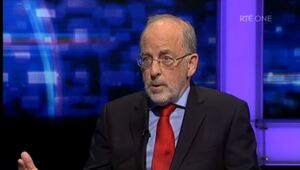
Joining Miriam O’Callaghan to discuss the influence of Pope Francis on the Catholic Church last night were Bishop of Kildare and Leighlin Denis Nulty, Breda O’Brien of the Iona Institute, UCD Professor of Modern History Diarmaid Ferriter and Gina Menzies, theologian and member of We Are Church.
Miriam O’Callaghan: “Let me ask you about “Cultural Catholics” so because it’s interesting, are they Catholics within your meaning of the word – the fact that if they only go to mass at Christmas, or if you know they use contraception, as many people do in Ireland, if they live in sin, they say they have partners – are they…..?”
Bishop Denis Nulty: “Of course they are Catholic – there’s no doubt about it, they may not be as committed as I myself may like them to be, but they are Catholics.”
MO’C: “Are they welcome to have sacraments within the Church?”
Bishop Nulty: “They are welcome to… the Church is an open door, and welcomes all people – sacraments are a slightly different area….because of issues… some people may not be (able) to go to sacraments – but that teaching is clear enough. The Church welcomes everyone with an open door.”
MO’C: “Simple question, I suppose Fintan O’Toole addressed it there as well – if you had a gay couple living in your area, and you knew that they were living together – would they be allowed to take the sacraments in your church?”
Bishop Nulty: “A gay couple, and I knew they were living together? I woud be encouraging them not to – I would be saying it’s the same way that a couple who are remarried outside of the church, outside of the sacrament, I’d be encouraging them not to, but to still to come to church.”
MO’C: “But would you give a gay couple Communion – I suppose a simple question?”
Bishop Nulty: “…I wouldn’t, but I think you’re {interrupted}…narrowing something.. …which Pope Francis says…you shouldn’t”
Diarmaid Ferriter: That doesn’t sound like an open door, does it?
Gina Menzies: “Well, actually that’s quite contradictory – in a way what Pope Francis is saying in his interview in his exhortation, he actually changes the language, he changes the context, he talks about an inclusive church. And one of the most significant things he said which was truly radical is that the Eucharist is not a reward for those who sort of follow the rules – that the Eucharist is a nourishment for the journey of faith, which is an insight that has come by theologically almost thirty years ago. And it’s interesting that we now have a Pope who has acknowledged that inclusivity as the way of the gospel.”
[Later]
Ciaran Ó Mathúna: “I represent a group called Gay Catholic Voice Ireland and we set ourselves up to represent gay and lesbian people who have felt not welcomed and who have felt excluded and we want to be a positive voice because there are lots of gay people in parishes participating and want to participate in their faith and want to give expression to their faith something that is very important – but yet again tonight we’ve heard we’re not really welcome. And all these nice words – like I mean, we welcomed Pope Francis’ interview that he gave from Brazil when he used the word ‘gay’, instead of ‘homosexual’, and he was the first Pope to do that – and we welcomed this tone and this openess and you know, it’s a nice challenge to other church leaders and organisations to be more inclusive – and yet you know we are told that, yes you are loved and you’re made in the image and likeness of God and you’re welcome and you’re part of our church and you’re welcome with open doors with equality – but we don’t experience equality, we don’t experience those open doors – and yet, week after week, we want to be part of our parish, and yet members have been told they can no longer read at mass, they can no longer be in the choir, they can no longer be a minister for the Eucharist – because they are gay.”
Frosted highlights and ‘Hips Don’t Lie’ by Shakira?
Bring it on.
Prime Time’s Robert Short is going to look at property prices in Dublin which have risen by 12% in the last year, while outside the capital have risen 2.5%.
He’s also going to look at the disparity between prices in south Dublin versus north Dublin.
Ahead of tonight’s show on RTE 1 at 9.35pm, he writes:
“I turned up at a recent viewing of a standard, three bed semi in Booterstown in south county Dublin. It’s been on the market for three weeks with a price tag of €550,000. And in property-speak, it would ‘benefit from modernisation’. According to the estate agent, there are already three bidders and the bidding is up to €535,000.”
“There were about a dozen parties at the viewing. All had stories of being outbid. There was a certain nervousness about what seemed to be happening in the south county Dublin property market; a sense that bargains from a depressed market were fast slipping away.”
“Is south county Dublin caught in a 2006 time warp? Well not really, if you consider the outer constellation of craziness that was 2006. Prices are still half, or just under half of what they were then.”
“Here’s what the statistics say: The annual increase in Dublin property prices in the year to September was just over 12%, according to the CSO. Prices in the rest of Ireland are still falling, albeit at a slower rate of 2.5%. It’s clear that prices in Dublin have taken off and left the rest of the country behind.”
“And within Dublin, it’s even more striking that asking prices in south county Dublin were up 12.7% while in North County Dublin they were up just 1.4%. According to the Daft.ie House Price Report, the average asking price in the north of the county was €210,765 while the average asking price in the south of the county was €370,650. It’s a remarkable disparity.”
“TCD economist Ronan Lyons, who analyses the Daft.ie data believes the spike in prices is a once-off phenomenon. He thinks it’s principally based on the pent up demand from a generation which through luck or circumstance did not purchase during the boom. They’re forming their own households now, starting families.”
“They are also getting squeezed in the rental market, which has gone up an average 8% in the capital.”
“And there’s not a sufficient supply of houses in the areas in which they want to live. Negative equity has restricted the supply of family-sized homes to estate sales and, to a lesser extent, bank sales.”
Governor of the Central Bank, Patrick Honohan appeared on Prime Time last night to talk to presenter David McCullagh about Ireland’s exit from the bailout without a credit line.
In a wide-ranging interview Mr Honohan also gave his thoughts on the chances of Irish taxpayers’ money from the bailout being recouped, growth in Europe and mortgage debt write-offs and house repossessions being a reality in Ireland.
He also explains why Irish taxpayers may not yet be finished pouring money into the banks.
David McCullagh: “Patrick Honohan, the Government is launching the ship of the state into potentially chopping waters without the benefit of a life-jacket. Did you agree with your colleagues in the ECB [European Central Bank] when they said it would have been prudent to take out the insurance policy?”
Patrick Honohan: “There are risks and there are ways of protecting against risks. I actually favour the clean exit, though a case can be made for the other approach. I don’t think it’s as important a decision as people maybe are inclined to make it out to be. We’ve come to the end of an important stage in the restabilisation of the Irish economy and, going ahead now, there are a lot of other things that help us move forward, apart from just a precautionary credit line for another year.”
McCullagh: “Well the Government is making quite a big deal about the fact that we’re going without the precautionary credit line, that we don’t need it, that we can launch, that we can make that clean exit. Were you consulted on that, in advance of the decision the Minister for Finance made? He mentioned a big long list of people he consulted?”
Honohan: “For sure. I volunteered my advice to him but I actually gave a sort of very balanced, between two options. In no way, was it like that last time if you like, three years ago, I wasn’t saying, this is definitely the way to go on one way or the other. I felt the Government could choose between the options here and I waited to see what they would say. They opted for a clean exit and actually I would have done the same for Ireland.”
McCullagh: “And what’s the, I can understand the political argument for going for a clean exit. But what’s the economic argument for doing so?”
Honohan: “You know you’re dealing, from now on, we’re dealing with markets, convincing markets that we, Ireland, are a creditworthy and a credible counterpart. This is a statement of intent, that the Government intends to continue on the path of discipline in its approach, and action to support economic recovery. Economic growth, fiscal discipline, those are the two things that keep our finances on an even keel and by going in this way, I think it helps convince the markets. That’s one of numerous arguments that can be made on both sides.”
McCullagh: “OK, but it’s interesting that you mention fiscal discipline because I was reading an article you wrote in the Irish Times I think, back in September, talking about John Maynard Keynes and austerity and all the rest of it, but you were making the point that what needed to be done was to stick the course, to keep to the programme and all the rest of it and that seemed to be advising the Government to stick with the €3.1billion adjustment in the Budget. The Fiscal Advisory Council gave exactly the same advice and the Government ignored it. So, now that the stabilisers are being taken off the bicycle, how can the bond markets be certain that the Government will actually do what it’s supposed to do, in their view?”
Honohan: “I think it’s within the margin of error. We heard the IMF saying, ah sure, the €2.5m will be enough – I paraphrase what they said. I would have gone for a little extra, basically in order to get the adjustment over with, faster because there’s still a certain amount of fiscal adjustment, in another year or so, of things to do, the sooner that’s over, the sooner the confidence, the domestic confidence can recover and the sooner we’ll get more spending and more growth.”
McCullagh: “Ok, now, the other leg of the Government’s strategy is, of course, to get the, try to get retrospective recapitalisation of the banks to try and pull back some of the billions that were poured into the Irish banks by the Irish taxpayer. Now, there seems to be certain amount of resistance, to put it mildly from the Germans, other people are saying this is never going to happen. Aren’t we in a bit of a difficult position now cause on the one hand, we’re saying everything is fine, we can go back to the markets, we can pay our own way and, on the other hand, we’re saying to Brussels and particularly to Berlin, ‘please sir can we have some more’?”
Honohan: “There’s no doubt that our debt levels are very high. The difficulty we have arrived at is partly due to the huge amounts of money that was poured into the banks. That I think now, however, is a political argument that has to take place among the governments of Europe. It’s not really to do with financial stability at this moment. It’s a political argument which, of course, the Central Bank will provide all the technical support and help that we can to win that argument over time.”
McCullagh: “And is it possible to win it?”
Honohan: “Well I don’t see it happening very soon.”
McCullagh: “And what are your colleagues on the ECB board saying to you, about all of this? I mean, presumably it’s a matter for discussion?”
Honohan: “Not really. Because the, arrangements between governments on who’s going to pay for what, they are matters for governments. Central bankers are dealing with monetary policy, stability, not distribution between different governments. So, actually, when I go to the ECB governing council we never have a discussion about ‘Is Ireland going to exit the programme? Is Ireland going to..’ That’s not the topic that. Of course the ECB staff are part of the Troika but not at the level of the Governing Council.”
McCullagh: “Ok, so we’re back in the markets, everything is fine, until everything isn’t fine and there’s some kind of external shock and there is clearly danger of that. What are you most worried about?”
Honohan: “Well, what am I…I’m always worried, I’m always scanning the horizon for risks, so I don’t think I would like to renumerate them in order to accelerate their arrival. There are a number of risks that one can see out on the horizon. And a number of things which we’re monitoring very closely. So, you take your choice now, I’m sure you have a list of your own that you would like me to comment on.”
McCullagh: “Well start with growth in the Eurozone?”
Honohan: “Growth in the Euozone, it’s not so much of a risk as a constant negative, the fact that growth is so much below potential in the Eurozone. And this is the matter of concern right across, I mean there’s no dispute about this. And there’s six quarters of recession have been followed by two quarters of very low growth so that is a weak environment in which to sustain and build the Irish recovery. We don’t depend entirely on the Eurozone for our trading partners, not at all, so we are getting growth from the USA, from China so Europe is not the only environment but, it’s a negative.”
McCullagh: “But for people at home, watching this, and you know worried about, obviously negative equity, they’re worried about unemployment, they’re worried about emigration and they’re wondering how long is it going to take before things are actually going to start getting better, for them. Not for the national accounts so much? For them. When are they going to see the growth as it lifts us all out of the mess?”Continue reading →
(Johanna Westeson, top, from the Center for Reproductive Rights and Cora Sherlock of the Pro-Life campaign, above)
Today, the campaign group Terminations for Medical Reasons will take their petitions alleging human rights violations to the UN Human Rights Committee in relation to pregnant women diagnosed with fatal foetal abnormalities who have to travel outside of Ireland for terminations.
Last night James Burke, from the TFMR, and Clíona Johnson, from One More Day, appeared on RTÉ’s Prime Time. last night
They both told of their respective decisions when James’ wife Amanda and Clíona found out they were expecting a child with a fatal foetal abnormality. James and Amanda’s daughter had Edward’s Syndrome while Clíona’s son had anencephaly.
Amanda travelled to Liverpool for a termination. Clíona went full term here in Ireland and gave birth to her son before he died.
RTÉ presenter David McCullagh then invited Johanna Westeson, from the Center for Reproductive Rights, which has its headquarters in New York and is helping the TFMR with theirs petition, to speak. Ms Westeson was followed by Cora Sherlock, from the Pro-Life Campaign.
Ms Westeson, top, said Clíona had very important things to say. She also said nobody from the Center for Reproductive Rights or TFMR would tell a pregnant woman with a fatal foetal abnormality to have a termination. But she said any woman in Ireland must be given the option to have such a termination in this country, instead of having to “run off to another country like a fugitive”.
Ms Sherlock said:
“I think that every family has the right to meet their baby and I think what we’re seeing in this debate is the ongoing failure of this government to put those kind of facilities in place. As James said, we need to have separate facilities so that women who find out that their babies are terminally ill can go an meet other women in that position and get the kind of support. We need to look around the world, and see what’s happening in other countries, like in the US for example. I would encourage your viewers to go on to YouTube after this programme and look at a programme called 99 Balloons. It talks about Eliott Mooney who only lived for 99 days but it shows a kind of connection, as Clíona was talking about between mother and baby, that can, you know, create over that time. And also the fact that he went on to inspire his parents. When Eliott finally died, his parents were inspired to do a lot of work with disabled babies, in the aftermath.”
She then continued:
“Can I just make one other point, David. I’m quite concerned to see the Center for Reproductive Rights getting involved in this debate because what the viewers at home may not know is that they are very involved in campaigning for abortion rights throughout the world. So, you know, this is something that we are dealing with, in this country. We need to have a proper debate about how we’re going to address the situation and how we’re going to give support for families. And I just think it’s not really appropriate for an internationally-funded group to come in and get involved in that event.“
Hmm.
You may recall how last December, the Sunday Business Post reported:
“The American Pro-Life Action League has said Irish pro-life groups are set for a significant financial boost as a result of fundraising campaigns across the US. The national director of the American Pro-Life Action League has said that Irish pro-life groups are set for a significant financial boost as a result of fundraising campaigns across the United States. Joseph Scheidler told The Sunday Business Post that members of the league, which has been active since the 1980s, would also be travelling to Ireland to take part in anti-abortion protests here. He said the donations involved could amount to several hundred thousands of dollars, and that a significant amount of the money raised would go to Youth Defence.”
“The deterioration in the position of under 25s in our labour force has been particularly severe. The numbers of them with jobs has fallen by 60% since the start of this recession. That is worse than any other category by far. And this document from the OECD in September says the reason the Government has cut their dole payments is to save money and to make parents more responsible for supporting their unemployed children now up to the age of 26. Which is all well and good, if the parents have money. But in thousands and thousands of cases that is not the case. And having little, or no money, puts you at a very big disadvantage when it comes to searching for jobs.”
RTÉ’s George Lee on Prime Time last night responding to the recent Budget decision to extend the lower dole rate of €100 dole rate to new entrants aged under 25 from next January.
They will get a reduced rate of €144 while those aged 26 will receive the full jobseekers’ allowance of €188.
Miriam O’Callaghan then spoke to Labour TD John Lyons; Moira Murphy, from the We’re Not Leaving campaign; Professor Alan Barrett, of the ESRI and Cllr Hugh Lewis, from People Before Profit.
During the debate, Ms O’Callaghan put it to Prof Barrett, above, that the dole cut was brought in as an incentive to make young people find work.
She asked him: “Will it work? If there’s no jobs out there, will it work?”
Prof Barrett replied: “No, probably not.”
He explained:
“The youth unemployment crisis, we can call it that, but it’s still just the economic crisis. Ok? It is still fundamentally the problem that we don’t have enough jobs to go around and like that, ultimately what we need to do is get the economy starting to move and when that happens the hope will be that jobs start to come around and that young people will be in a position to get those jobs. What happens, having said that, is I think one of the great, great fears and worries that we have is that we know the longer people are out of work, the more difficult it is for them to get back into work. So we have at the moment, we have this current problem of youth unemployment but where we’re really worried about it is that, even if things turn around, it doesn’t necessarily mean that people are going to get, that they’re going to plug back in seamlessly. And what we also know is that even if people get jobs one of the worst things about sort of entering the labour market at the time of a recession is that it can actually affect you for the rest of your career. It’s the scarring effect. It’s not necessarily the case that you’re going to jump back to where you otherwise would have been. You can now spend the entire of your life behind where you otherwise would have been and this is why we worry about youth unemployment. I mean there’s middle-aged unemployment, there’s elderly unemployment but there’s a specific worry about youth unemployment because it can affect people essentially for the rest of their lives.”
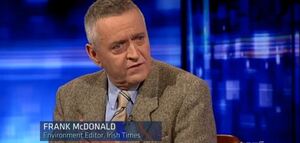
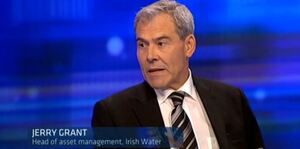
( Frank McDonald, Environment Editor of the Irish Times, top, and Jerry Grant, of Irish Water, above)
Irish Water, which was established in March of this year, will take over the responsibility for providing water and waste water treatment from 34 local authorities on a phased basis, starting next January, over the next five years.
After that, Irish Water will be responsible for all water services and all capital and investment decisions regarding Ireland’s water infrastructure.
Last night Jerry Grant, head of asset management at Irish Water, and Frank McDonald, Environment Editor with The Irish Times, appeared with host Robert Shortt on Prime Time to talk about the future of Irish Water, in the context of the current water shortages being experienced in Dublin, Kildare and Wicklow.
Frank McDonald: “It has to be remembered that water, OK, we think of Ireland as having loads of loads of water. It falls out of the sky every day nearly. But the truth of the matter is that that’s just raw water. The water has to be treated. We also have to deal with sewage and treat that as well. So, you know, all of that will require money and a huge new revenue stream will be the water rates that we’re going to have to start paying, I think from next year onwards. And I think it’s very ironic that just at the point at which water rates are finally being introduced which, in my view, are completely justified, the responsibility for water is being whipped off the local authorities and transferred to a new semi-State company, in a further move to centralise and already highly-centralised…”
Robert Shortt: “Why is that not a good idea, given that the record or local authorities in managing water assets is, at best, patchy?”
McDonald: “Well, I think that you have to look at it in context. I mean Jerry referred to the history of underinvestment. There has been a history of underinvestment. And there’s a whole lot of plans that exist, that haven’t actually been implemented because there wasn’t the money to pay for them. And I think that obviously, one of the major things that Irish Water is going to have to fastrack now which is basically the plan that has been kicking around now for the last eight years or so, which is to take water from the River Shannon and bring it to Dublin. Now, that sounds like a smash and grab raid by the capital on another part of rural Ireland. But in fact it isn’t really because what would happen is the water would be siphoned out of the Shannon, taken to a reservoir in the Midlands and then from there transferred to Dublin to the treatment plant.”
Shortt: “That’s a big project and we’ll get to that in a minute but if I could just go back to the restaurateur in Tanya Sillems’ report. There’s been a lot of talk about compensation for water users who experience a problem in their supply. Does Irish Water have any worked out policy, when you’ll be running as a commercial company, what will you say to business owners when, for whatever reason in the future, the water supply isn’t there. And, indeed, the homeowners who are going to be paying water charges?”
Jerry Grant: “Well first of all, of course we’re acutely responsible, conscious of the consumers of water. And, again, in the criticality of water to everyday life and to all kinds of activities that was eminently clear..”
Shortt: “Will you give them compensation if the water is not delivered?”
Grant: “First of all, for us, the important thing is a secure revenue stream. The regulator, the CER, will have a very strict regime of supervision of us and we’ll certainly make sure that we meet certain service standards and will certainly take money from us if we don’t meet those standards. In the first instance…”
Shortt: “So, is that a ‘yes’ then?”
Grant: “It’s a matter for the regulator ultimately as to how that protection to the consumer is catered for. But the really important point is that we have a secure, sustainable and adequate revenue stream, to leverage the investment we need. The major scheme for Dublin has been talked about but we have much more than that.”
Shortt: “So where is the money going to come from?”
Grant: “Well, clearly, as I said we have to establish our revenue stream. I would refer to some of the comments Frank made in relation to the local authorities and to make the point, that it is clear that it is not possible to finance all the things that need to be done on an authority by authority basis. We must have a national asset management approach…”
Shortt: “Sorry, what does that mean? Does that mean you’re going to borrow money?
Grant: “Well it does, yes.”
Shortt: “Because presumably you’re not going to get all the investment you need from the water rates that are coming in on the water charges.”
Grant: “No. We have a significant deficit to make up. We have to understand the risks and clearly there are risks, there are unacceptable levels of risk of failure in both water supply and waste water. We have to understand those. We have to stretch the revenues that will be available to us, to do the most we can, across the country so that everybody has an equal chance, of having an acceptable water supply and waste water. But yes we will have to borrow money and we can only do that credibly when we have a, first of all, an organisation that is seen to be in control of the service, that’s seen to know what it’s about and has a secure revenue base on which to leverage that borrowing.”
Shortt: “Frank McDonald, is that the advantage of Irish Water? That you have this big organisation that has, you know, some punching power, that it can borrow in ways that the local authorities couldn’t? Would you accept that there’s a good idea from that point of view?”
McDonald: “I think that’s fundamentally the reason why it’s being set up, is to provide an organisation into which money can be funnelled, through public private partnership schemes and other stuff like that. I mean for example that idea of taking water from the Shannon to Dublin is clearly a big PPP project possibility and that’s the most likely way it will be procured. So it would be procured, in effect, at no expense to the State, to the Exchequer. It will be procured on the basis of private sector investment but with the control over the asset being maintained by the semi-State company Irish Water.”
Later
Shortt: “Those glossy TV ads, how much did they cost?”
Grant: “I have no idea but they’re part of the project of converting the consumers of water in Ireland to customers. I think we have a very real difficulty in…”
Shortt: “I think will people be very, very keenly aware that they’re going to be paying water charges next year, they might get a little bit irate seeing these ads for water on a night when they can’t even make a cup of tea.”
Grant: “I think it is an incredibly important message we have to deliver that Irish Water is on the pitch to serve the people of Ireland and to deliver for them, now and into the future. We expect, in our recovery in the Irish economy, we know for experience when recovery comes, demand for water will grow, we must be able to meet that. And we have the raw water resources to do that.”
Shortt: “Finally, very briefly Frank, are you convinced? Will Irish Water work?”
McDonald: “I think it may work. But I think that if people are going to be paying water charges for their water they will want to be supplied with water. And they won’t be prepared to accept any excuse for not supplying it.”
Former Cork hurler Conor Cusack, from Cloyne, spoke to Miriam O’Callaghan last night on RTÉ One’s Prime Time. His appearance came after he wrote an article detailing his battle with depression and how he almost tried to take his own life. He posted the article, entitled ‘Depression is a friend, not my enemy‘, on his blog on Monday.
Miriam O’Callaghan: “Conor, you’re very welcome.”
Conor Cusack: “Miriam, thanks very much for having me here. It’s great to be up here. I suppose, look, I’m not here to paint a picture of myself as being an angel. I’ve a lot of friends down in Cloyne and Cork and they’ll tell you, I’m the furthest thing from being an angel that you can find. I’m not here to bash medication, or bash psychiatry. They have their place within the treatment of depression and there’s a lot of people who get a lot of benefit out of it. But I suppose I’m here to tell my story and I think it’s a story that resonates with an awful lot of people in the country. If it can be a bit of help, a bit of comfort, a bit of hope to some few people and if it can perhaps break the taboo and maybe lessen the stigma that’s attached with it? Well then I’m very glad to tell this story.”
O’Callaghan: “Let’s go back, Conor. When did you first experience depression? When did you know you were suffering from depression?”
Cusack: “Well, look, I suppose I was probably around 15 or 16 when I first started experiencing panic attacks and for anyone who’s experienced panic attacks, it’s an horrific experience. You’re convinced your world is ending, pains in your chest, can’t catch your breadth, you’re convinced you’re going to die. And that was the start of my problems, really, you know. Now, it just progressed along, bit by bit. It wasn’t something that was sudden. Gradually, I started to lose interest in my friends, started to lose interest in school that I loved, started to lose interest in hurling and the worst of all, I started to lose interest in people. I always loved people and loved being in their company but it was a gradual, bit-by-bit thing. And I suppose, I was in work one morning, in [inaudible] down in Midleton, and finally, the image that I had been keeping up along, I didn’t have the strength any more, to keep up that image. And finally I cracked. And, you know sometimes they say that something has to crack for the light to allow in, well that morning I cracked. And I lay down in the corner inside in the building, started balling my eyes out. One of my fellow workers came over, poor man didn’t know what to do, he was looking foolish with me and I said ‘look will you just take me home’. GP came and prescribed a few relaxing tablets and stuff. Went to hospital the following week, had a battery of tests done, had every test imaginable and at the end of it all, a doctor came to my bed at the end of it, and said ‘look, we think you’re suffering from depression’. It was the first time that I’d heard the word and that was the first time that I would have realised that I had something like that wrong with me.”
O’Callaghan: “And, for anyone who hasn’t read the blog, I mean you basically retreated to your bedroom, didn’t you? I mean it was so bad, you almost stayed in your bedroom a lot and hardly ever came out?”
Cusack: “Lived in my bedroom, Miriam, lived in my bedroom. For five months, the metre-by-metre window in front of me, that was my link to the outside world, you know? And there was probably 10mm of glass separating me from there but I was a million miles away from that. That was the real world out there. This was a living hell in here for me. I saw the summer pass, I saw the autumn pass, I saw the winter pass through that window. There was only one person, well two people, my mother and my aunt Marie that I’d allow in to that room, just to bring me food. And, on the Thursday morning, when I’d used to go to see the psychiatrist, that was the only time I’d leave the house. I didn’t want to speak to anyone, I didn’t want to talk to anyone. That room was my sanctuary away from the world. But, in reality, it was a living hell.”
O’Callaghan: “You came to your lowest moment, didn’t you? Tell the story about the day your mother didn’t go to mass.”
Cusack: “Well, I suppose, previous to that, I’d been to a lot of different doctors and psychiatrists and I was on 18 tablets a day at this stage, you know, and I wasn’t getting better. I was sent to another psychiatrist in a place in Cork City, it’s called St. Anne’s and St. Anne’s would probably have, it would be a place that would be associated with a lot of people with mental difficulties. And I went in to see the doctor and the first thing he said to me was ‘oh, your brother is the famous Cork goalkeeper’. And he proceeded to talk for the next ten minutes about hurling. I had zero interest in hurling at that time and my esteem and whatever was on the floor at that stage and here was this guy and he talking to me about hurling and not talking to me about me. And at the end of it all, he suggested this electric shock therapy to me. And intrinsically I don’t know why but something inside of me always told me that medication and something like that was not the path that I needed to follow. And I remember coming out of the hospital and I was utterly distraught. Because this was like my final hope, that I thought that this was the guy that was going to finally help me. And, instead, he was suggesting something that was alien to me. And I…”
O’Callaghan: “Though it could work for other people..”
Cusack: “It could work, exactly, yeah, absolutely..”
O’Callaghan: “But keep going.”
Cusack: “Absolutely, as I say, this is my story, you know, and everyone has their own. But..So I came home and I remember I was utterly distraught and, you know, I decided one night I couldn’t…the desire for death outweighed my desire for living. And I decided I was going to kill myself. And an incredible thing happened. A peace that I hadn’t experienced in years came over my body. It was like as if my body realised no longer is it going to have to suffer this horrific physical and mental pain that I had been going through for the last number of years, no longer was I going to have to suffer these panic attacks, waking up, soaked in sweat every night. And I got a night’s sleep that I hadn’t had in years. And I was very calm about it. There was no anxiety. I knew my dad and my brothers, Victor and Dónal Óg, would be going to a match that Saturday evening and I knew my mam and my sister would be going to mass. And so I had the rope in my room, I was quite calm about it, very matter of fact, I was going to get into my car, drive to my location that I had arranged and hang myself. And for some reason, I don’t know why, but my mother never went to mass. And, ultimately, it was the decision on her part that saved my life.”
O’Callaghan: “It’s amazing, actually.”
Cusack: “Yeah.”
O’Callaghan: “But after that, you transformed yourself. You got better. Your story is a happy story at the end, Conor. Explain that path to recovery for you. How that came about?”
Cusack: “Well, look, I worked for Darina Allen since I was eight years of age, I worked there for eight or nine years in her gardens and in her kitchen and, you know, Darina is an incredible woman, she never forgets anybody who’s ever worked for her. Still to this day she’ll send in if there’s something happened to the family, a death or something, a table full of food would come into the house. And my aunt Marie has worked with Darina for years. And Darina asked one day ‘How’s Conor doing? Is he in school or what is he doing?’ And my aunt told her, you know, that I was in a bad way. So Darina suggested a person that she knew, that she felt could have been of benefit to me. And, now I’d been to loads of, loads of doctors at this stage. I’d given up all hope. But my mother pleaded with me, just to go one more time. And, that was the decision on my part, that ultimately saved my life. I went to see this clinical psychologist and from the moment I met him, I don’t know what it was but from the moment I met him I knew ‘This was it. I’m going to get better with this person. He is the man that I’ve been seeking all along’. And it was an incredible thing. I remember coming home with my mother, driving home, with my mother in the car that evening, and I was crying but it was tears of joy, it was absolute tears of joy because I knew this was the thing that I’d been waiting for all along. And it was an incredible moment in my life. And it was the moment that transformed the whole lot for me, you know?”
O’Callaghan: “And you’re well now. And I know the reason, you said to me earlier, you wrote the blog and what you want mostly to say tonight is to give hope to other people, don’t you Conor?”
Cusack: “Absolutely, Miriam. Look there’s people at the moment out there that are going through depression or anxiety and they’re getting treatment and I just want to say to them, I want to encourage them to stay on the path. It’s not an easy, it’s not an easy journey, it’s very difficult and I salute their courage for doing that. And the rewards at the end of it are great. There’s another group of people out there that are living with and helping, supporting friends and loved-ones that are ill with depression or anxiety, or whatever, I know the powerlessness that they feel, looking at their loved-ones and that it’s not like a cut in your leg that you can fix or anything. It’s a difficult place for them. But the person themselves might not say it but, inside in them, they very much appreciate your support and your comfort. I remember mother saying to me one time: ‘I will patiently wait til eternity and beyond for my son to get better’, so keep giving your love and support.
To those people out there that are living a life of silent misery, and are afraid to take that step, you’re not alone, there’s a load of people in your same situation. You know, there’s a certain comfort and safety in remaining hidden but it’s a terrible tragedy if you can’t be found. And, you know, there’s an incredible amount of help and support out there for those people. It’s an act of courage and strength, not weakness, to admit that you’re struggling. It’s an act of courage to say that I need help but you need to take the first step, you need to take the first step, and I plead with those people to please take that first step. And, finally, to those people out there tonight, Miriam, that are perhaps contemplating suicide. I know the terrible torture and pain that you’re going through, I know the horrific thing that your day-to-day living and existence is, I know that you think that this world and your family and friends and community will be a better place without you in it.But I guarantee you it won’t, it’s not. The destruction and the pain that’s left in families with someone that’s committed suicide is incredible and the distress they’re going through now is nothing compared to what it would be, without you in the world. As human beings, you know, we’re a once-off phenomenon in this universe. Of all the billions of people that have ever lived or all the billions of people that are going to come after us, there’ll never again be another Miriam O’Callaghan, there’ll never again be another Conor Cusack. We’re totally unique and the world needs us, the world needs all the people that we have in our communities. So, you know, I promise those people that are in that terrible place, there’s a place within them, it’s a place of peace, it’s a place of joy, it’s a place of love, it’s a place of hope and it’s waiting for them to rediscover it. It’s waiting for them to rediscover it. And it’s within their grasp, it’s within their grasp. They’ve all the skills and all the abilities to be able to get there. And the thing about it Miriam is these people, they’ll emerge stronger people. They’ll emerge people that are living their life from the inside out, independent of other people’s opinions, they’re living their life fully and freely. They’re gonna not be frightened of this world any more, they’re going to be embraced by it. They’re going to look at challenges and difficulties and take them all on. And somewhere along the way, I’ll get to meet those souls, souls on the road less travelled, and I’ll look forward to that. Embrace the journey, start the journey.”
O’Callaghan: “Conor, thank you so much for coming in tonight.”