Tag Archives: Richard Bruton

Screen Shot 2016-07-25 at 10.38.17

Minister for Education Richard Bruton

Um.

Minister for Education Richard Bruton spoke to Gavin Jennings on RTÉ’s Morning Ireland this morning about the new fitness-to-teach mechanism which will allow parents and students make formal complaints about teachers for the first time.

After discussing the new initiative, Mr Jennings turned his attention to the legal letters that were sent, on behalf of Department of Education and Sate, to people who were abused as national school children and who have been taking legal cases against the department and the State.

The letters warned the abuse survivors to abandon their legal cases or potentially face significant costs.

Gavin Jennings: “Your department sent out letters last week to people who were abused by teachers in national schools, as children, again. Advising them that they face significant costs if they’re not successful in their legal cases, against your department. You’re being accused of intimidating victims: not the first time the State has been accused in this manner.”

Richard Bruton: “Well I think, you know, I’m very conscious of the people here, many of whom have suffered terrible abuse at the hands of individuals and there is, in some cases, a responsibility on the State and I think what we’re trying to do is help those people in a humane way. We have, as a department, as you know, spent ove a billion over the redress provisions and we’ve made ex-gratis payments in other cases where people have suffered very serious abuse and it has been known in advance, so what we’re trying to do is make sure that people are treated in a humane way…”

Jennings: “You’re fighting them.”

Bruton: “Of course respecting the law and the obligations of courts to ensure that, you know, this State is also…”

Jennings: “You’re fighting to protect the State and the department first, putting them above the interests of victims, yes?”

Bruton: “No, by no means, I mean I think we have introduced very substantial payments to people who have been victims of abuse. We have fully respected the European Court of Human Rights’ finding. We have paid compensation and we are offering ex-gratia payments to other people…”

Jennings: “Ex-gratia means without admission of liability is that right?”

Bruton: “Without admission of liability. But I’m determined to make sure that, you know, I will review all of this process. Those letters went out from the State Claims Agency, not directly from my department but I will review these processes to make sure that, in our dealing with individuals, that we treat them in the proper and the humane way that they ought to be treated. While at the same time respecting the role of courts and the law.”

Jennings: “Richard Bruton, thank you. That’s the Minister for Education…”

Listen back to the interview in full here

Rollingnews

CmrmcmIWYAAYKRW

Education Minister Richard Bruton speaking on RTÉ Radio One at lunchtime

Audrey Carville, on RTÉ’s News At One, interviewed Minister for Education Richard Bruton earlier today.

The interview followed an earlier report by Conor McMorrow which included exchanges between Independents 4 Change TD Clare Daly and Taoiseach Enda Kenny in the Dáil this morning, ahead of tomorrow’s vote on Independents 4 Change TD Mick Wallace’s bill on fatal foetal abnormalities.

During her speech, Ms Daly said:

“You hide behind the advice of the Attorney General, advice we haven’t seen, advice which is substantially at variance with the advice of other Attorney Generals and disputed by a whole array of legal experts. Taoiseach, my question to you is: who do you think you are? That you believe that you can allow the continued violation of human rights. The constitution can never be used to deal with this. If you haven’t go the leadership or the guts to do it yourself, will you stop using your position to block the courts or the people from dealing with this.”

During the interview…

Audrey Carville: “Just, following on there from those exchanges [between Ms Daly and Mr Kenny], Clare Daly says your government, and others, have been repeatedly told by the UN and others that you’re violating women’s human rights. Is that acceptable to you?”

Richard Bruton: “No, it’s certainly not. I think the situation though is three times attempts have been made to change the Constitution in this area and three times they failed. Now they’re on different issues but it clearly shows that constitutional change needs careful preparation and that’s what the Citizens’ Assembly is designed to do. Now in the context of Deputy Wallace’s bill, the medical advise has been absolutely stark, that this bill would be of no value to mothers or to doctors who would be faced with the sort of difficult situation that Clare Daly described. The Attorney General’s view is also clear, that this bill conflicts with the constitution. So we are driven back to the situation that if we want change, we have to create an environment where the people can reflect on the change that’s needed and make a decision in due course in a referendum, that’s the only way which you can change a constitution which provides a protection, at present, for the unborn with due regard to the life of the mother.”

Carville: “Indeed, so why not just call the referendum? Everything else is a delaying tactic.”

Bruton: “That’s not the case. I mean, as I say, efforts have been made in the past to change the constitution and have failed and I think that experience that we have seen for example, in dealing with this issue when we were simply trying to legislate, as you know, for the Life in Pregnancy Bill in the last session, that the work of having a Citizens’ Assembly reflect or hearings, to reflect on the content and what changes were about was really important to getting the degree of support that was possible. This is really complicated when you go to the people. And people will have to be able to see when they are faced with a vote, what it is they’re voting on, what are the implications of the changes that are being proposed to them. And that will take careful teasing out. There are many cases that will have to be teased out. Fatal foetal abnormality and other situations like rape and incest where very difficult circumstances are consulted…”

Listen back in full here

Meanwhile…
Screen Shot 2016-07-06 at 14.07.23

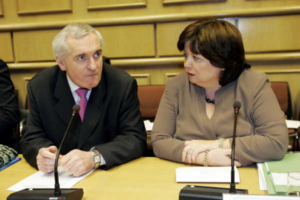
Former Taoiseach Bertie Ahern and former Tanaiste Mary Harney

In the Irish Times on September 11, 1999…

The newspaper’s then chief political correspondent Denis Coghlan wrote:

Publication of a Government Green Paper on abortion has reopened divisive debate and raised the prospect of serious friction between Fianna Fáil and the Progressive Democrats. In 1992 Albert Reynolds sought to roll back the Supreme Court judgment in the X case and dared Dessie O’Malley to risk a general election on the issue. This time, Bertie Ahern seems willing to face down Mary Harney.

Of course, we don’t know precisely what the Taoiseach has in mind. And he is unlikely to tell us in the short term. But the pre-election commitment he gave to the Irish Catholic in 1997 appears to lean towards a restriction of the X case judgment or a legislative restatement of the prohibition on abortion.

But nothing is static in politics, and the commitment given by the Fianna Fail leader in opposition could crumble in the face of internal and external pressures. The only certainty at this stage is that Mr Ahern and his backbenchers are the main comfort-providers to the anti-abortion lobby and are anxious to retain its support.

The Progressive Democrats are doing what they did in 1992: reluctantly going along with a process they do not relish.

On the first occasion, the collapse of the coalition government allowed Mr O’Malley to advocate legislation to deal with the implications of the X case, rather than the constitutional referendum put forward by Mr Reynolds. And there is no indication that party policy has changed under the Tanaiste.

Reaching a consensus on this issue within Cabinet appears as remote as the possibility of Brian Lenihan and his all-party Committee of the Constitution producing an agreed set of recommendations.

For the main Opposition parties are still firmly entrenched in the positions they took up in 1997, when Mr Ahern resurrected abortion as an election issue.

Yesterday Alan Shatter of Fine Gael dutifully reiterated the position adopted by John Bruton when he was Taoiseach. The party was opposed to a referendum, he said, because no constitutional wording could fully and properly address this difficult area.

And they were concerned that any legislation would have the opposite effect to that intended, when applied in practice or interpreted by the courts.

Rather than embark on another referendum, Mr Shatter said, the Government should expand counselling services for women in crisis pregnancies and reform the adoption laws and services so that adoption would be seen as a preferred alternative to abortion.

Ruairi Quinn took a similar line. The way to reduce the number ofabortions among Irish women was to reduce the number of crisis pregnancies through education on sexuality, personal responsibility and access to contraception.

As for the deliberations of the all-party Committee on the Constitution, Mr Quinn felt it was unlikely to come to a different conclusion from that reached by the Expert Committee on the Constitution in 1995.

That approach would require giving legislative effect to the Supreme Court judgment in the X case, and was the position favoured by the Labour Party.

The Government sub-committee that produced the Green Paper – Brian Cowen, Mary O’Rourke, John O’Donoghue, Michael McDowell and Liz O’Donnell – took the five recommendations of the expert committee and expanded them to seven.

Four of the recommendations were common: the insertion of an absolute ban on abortion in the Constitution; to legislate for the X case; to restrict the terms of the X case’ and to return to the pre-1983 position.

The fifth recommendation from the expert committee suggested amending Article 40.3.3 so as to legalise abortion in constitutionally defined circumstances.

This was reworked into two options by the Government sub-committee: amend the Constitution so as to restrict application of the X case, and retain the “status quo” with a legislative restatement of the prohibition on abortion.

Finally, the sub-committee suggested that abortion might be permitted on grounds beyond those specified in the X case.

The last referendum on abortion, in 1992, clarified one issue. A solid 35 per cent of the electorate opposed giving women the right to travel and information on abortion.

It was that constituency Mr Ahern courted as Fianna Fail’s new leader in 1995 when he allowed his backbenchers off the leash to oppose Michael Noonan’s legislation giving effect to the electorate’s decisions to permit travel and abortion information.

Having established his anti-abortion credentials, Mr Ahern went on to cultivate that constituency by establishing an expert group on abortion within Fianna Fail.

Two years later he promised a referendum and legislation in the run-up to the general election of 1997.

At the time, his announcement went down like a lead balloon with the Progressive Democrats.

More than two years after those promises were made, the public is no wiser about what precisely the Taoiseach has in mind.

An early notion about utilising Article 27 of the Constitution has been dropped. The status of a commitment to draft the heads of legislation that would be put to the people – as happened in the divorce referendum – is unclear.

The Taoiseach now appears to be taking cover behind the Oireachtas committee and collective Cabinet responsibility.

It is a delicate stage in the exercise. The next step will involve open-ended consideration by the all-party committee on the Constitution. If a miracle happens and agreement is reached there on a way forward, the matter will come back to the Government. There could then be further consultations, a White Paper and a referendum/legislation.

It should come as no surprise that in spite of pressure from the Independent TDs, Mildred Fox and Harry Blaney, few Ministers expect a referendum to be held in the lifetime of this Government.

But anti-abortion groups are determined to pressurise the Government and Fianna Fail backbenchers into completing the process by next summer.

They have a mountain to climb. Resistance to an outright constitutional ban on abortion is widespread within the political system. Mr Ahern may be anxious to retain their support in advance of the next general election.

But he may be neither willing nor able to deliver their demands.

Plus ça change.

Previously: ‘The People Decided To Keep That Reference In The Constitution’

Earlier: ‘It Sure As Hell Is Not Politics As Normal’

Pic: Richard Bruton

Screen Shot 2016-04-27 at 08.55.07

Fine Gael Minister for Jobs Richard Bruton

RTÉ reports:

Speaking on RTÉ’s Morning Ireland, Mr Bruton said in the event that charges continue in the future then those who were in default will have their bill pursued.

If water charges are to be scrapped in the future, then people who have already paid their bills will have to get their money back, he said.

It is proposed that Irish Water will be retained while the funding model for water will be examined by an independent commission and then an Oireachtas committee before a Dáil vote takes place on its recommendations.

Proposal to suspend water charges for at least nine months (RTE)

Screen Shot 2015-07-09 at 12.44.43

Indeed.

During Leader’s Questions on Tuesday, led by Richard Bruton, top, Mr Bruton insisted several times – in an exchange with Fianna Fáil leader Mícheál Martin – that there is a member of the Comptroller and Auditor General office ’embedded’ in NAMA.

Micheál Martin: “I am sure the Minister, Deputy Bruton, will agree at this stage there has been enormous concern about the sale of NAMA’s Northern Ireland loan book to Cerberus Capital Management. This was raised in the Dáil last week by Deputy Mick Wallace, who raised serious concerns and made serious allegations. We know BBC Northern Ireland has carried out an extensive investigation in a programme yet to be aired, but some of its people have already spoken about it. Many statements have been publicly made by key stakeholders involved, and various leading politicians have denied any involvement whatsoever. I am minded of the remarks made by the Minister, Deputy Michael Noonan, to the Joint Oireachtas Committee on Finance, Public Expenditure and Reform in April 2014. He asked the agency to conduct a review with a view to accelerating the sale of its loan book and bundling properties together. He stated: “I have asked [NAMA] if they have any suggestions on how we could work that and would it be possible to use it as a brake on the market.” By this, he was asking what would be the consequences at the end of 2015 of taking the residual NAMA book and doing what IBRC did to its residual book in selling it off in a six-month period. One might now argue that one of the consequences was the kind of deal done with Project Eagle, where the entire Northern Ireland property portfolio of NAMA was put into one bundle and sold at a loss of around €200 million to NAMA and a discount of approximately 72%. We now know that, essentially, £7 million ended up in an Isle of Man bank account. That is not contested. We know the money was in an account controlled by a former managing partner of Belfast law firm Tughans, which acted indirectly for Cerberus, the US investment firm that bought the loan book. We know Pimco, another large US firm, withdrew from a tender process for the same loan book, citing concerns about an unsolicited approach from a number of individuals.”

Ceann Comhairle: “A question, please.”

Martin: “It notified NAMA about the unsolicited attention and, as part of its due diligence process, pulled out because of concerns that it had. NAMA has confirmed that Pimco’s compliance staff discovered that its proposed fee arrangement with US law firm Brown Rudnick also included the payment of fees to Tughans and a former external member of NAMA’s Northern Ireland advisory committee. This is in the public domain and I am not naming any names. Tughans has now stated that a former partner diverted the professional fees into an account without the knowledge of other partners. Suffice it to say that this is very serious and profound stuff that goes to the very heart of whether a proper deal was done on behalf of the taxpayer. I acknowledge that we have had many different commissions of investigation established but, given the gravity of what has been alleged and what we already know publicly or NAMA has confirmed, a commission of investigation is urgently required to investigate this entire episode involving the sale of the Northern Ireland loan book to the company concerned. Has the Government made a decision to set up such a commission of investigation?”

Richard Bruton: “I thank the Deputy for his question. First, it is important to say that NAMA has a very clear public mandate to deliver best value and in that role it is very actively overseen by the Oireachtas. There is an embedded member of the Comptroller and Auditor General’s office working with NAMA, it conducts regular audits and representatives come to the Committee of Public Accounts on a quarterly basis with information. I understand NAMA representatives will be before the Committee of Public Accounts this Thursday, and there will be an opportunity for members of that important committee of the House to question those representatives on the way NAMA manages its affairs.”

“The issues raised and which are a cause of public concern regarding the destination of a fee are an entirely different matter. It is important to understand the way in which NAMA dealt with this. When it heard there was interest in the loan book, NAMA insisted there would be a competitive process and one of the companies involved, as the Deputy knows, was Pimco. It indicated that its compliance staff had uncovered a proposed fee arrangement and when this came to the attention of NAMA, it decided that if Pimco did not withdraw from the sale, NAMA could not permit it to remain in the sales process. On foot of that, Pimco withdrew from the sale. NAMA also sought assurances, I understand, in respect of the successful bidder in this project that there was no such arrangement in place. It received such assurances.”

“NAMA has discharged its business in a very thorough way. The issues raised by the Deputy in respect of the decisions made by the NAMA board on whether to sell loans individually or in a bundle are a legitimate matter for questioning at the Committee of Public Accounts. The representative of the Comptroller and Auditor General would have been across that decision at all stages and would have been involved with the auditing of the decision as it was made. This information on how the business was conducted is available to the Comptroller and Auditor General and it would be available to the Committee of Public Accounts. NAMA’s representatives will be before the committee on Thursday.”

Martin: “That is not a satisfactory answer in any shape or form. This is not about a routine appearance before the Committee of Public Accounts and it is not the subject of a routine audit. The timeline is very important. The fee arrangement mentioned by the Minister necessitated the withdrawal of Pimco was brought to the attention of NAMA by Pimco, by the way. No auditor or anybody else discovered that. Representatives of Pimco went to NAMA and indicated that its compliance personnel were very concerned about the unsolicited approaches, the nature of those approaches and the fee arrangements. Within a month, NAMA sold the package to another major investment company, Cerberus, apparently with a similar fee arrangement process in place and with the diversion of up to £7 million into an Isle of Man bank account.”

“It is glaringly obvious that this demands a very serious, independent and objective inquiry, with compellability, into the specifics of this issue. Very serious allegations have been made about what transpired and there are many unanswered questions. This is entirely unsatisfactory. This concerns the largest property sale ever on the island of Ireland, with 850 properties being bundled together and many intermediaries involved. A person was allegedly operating in a discrete office within the Tughans building and people who served on the Northern Ireland advisory committee of NAMA were involved with this issue. That is very serious and I do not buy the line that NAMA just accepted assurances, with that being the end of the matter. It is not the end of the matter. Just as with previous occasions, the Government has been slow to come to the mark on issues like this. I put it to the Minister that the Government must review its response to the issue and establish a commission of investigation to get to the truth.”

Bruton: “It is important to point out to the Deputy that the fee arrangement to which he refers did not involve NAMA in any way.”

Martin: “I did not say it did. Nobody is saying that.”

Bruton: “These fee arrangements were on the side of the buyer and not the seller of the loans. NAMA was not involved in any way and no payment was made by NAMA in any respect of these fees. That was not the case.”

Martin: “Do not look to answer questions that were not asked.”

Bruton: “The issue of how NAMA conducted its business is very clear. That has been overseen and supervised by the Committee of Public Accounts and the Comptroller and Auditor General has somebody embedded in NAMA. NAMA’s board is appointed by the Oireachtas to get best value and to have this level of Oireachtas oversight. We have a unique level of Oireachtas oversight with respect to this body and the opportunities are there for Members to raise issues at the Committee of Public Accounts, where they have the support of the Comptroller and Auditor General, an expert in forensic accounting advice who is the auditor to NAMA and who will have gone through these issues. Thursday’s meeting offers an opportunity to deal with the NAMA involvement. There are clearly other issues regarding fees paid on the other side of the trade and they are of public concern. I understand the Northern Ireland Assembly is investigating those, as is the Law Society, with respect to the solicitor involved. There are investigations of those matters under way.”

Hmmm.

Anyone?

Transcript via Oireachtas.ie

Earlier: ‘What Did They Get The €5m For?’

9034351390343448

[Minister for jobs Richard Bruton, abpve and Bausch & Lomb, Waterford]

If entirely predictable.

Independent TD for Waterford John Halligan said it is “deeply disturbing” that Minister for Jobs Richard Bruton knew jobs were on the line for a number of months and did not bring it to the attention of the Dáil.
Mr Halligan said that given Waterford has been one of the worst-hit areas in the country for job losses since 2008, Mr Bruton needed to bring information he had about potential redundancies and pay cuts to the attention of local politicians.

Bausch + Lomb to cut 200 jobs in Waterford with 900 more at risk (RTE)

(Sam Boal/Photocall Ireland)


More as he gets it.

brutoncoveneyWe’re sorry that good-looking people like us made you throw up and feel bad about yourself …

FG Ministers Richard Bruton and Simon Coveney walk-off  at an “Oireachtas Charity Fashion Show last night.


The number of people at work in the April-June period fell by nearly 14,000, the biggest three-month fall in a year, according to the Central Statistics Office. The figures appear to dash hopes that employment growth is at hand.

They show there were 1,783,400 people employed on a seasonally adjusted basis in the second quarter, meaning there are 357,000 fewer people at work since employment peaked in 2007.

Minister for Jobs Richard Bruton last night acknowledged the continued fallout from the collapse of the “bubble economy”, but said “the sectors on which we will build the future economy are now showing signs of growth”.

That’s good, because, by all accounts, increasing jobless figures just dashed hopes of growth.

Previously: Messi

Increasing jobless figures dash hopes of growth (Dan O’Brien, Irish Times)

(MarkStedman/Photocall Ireland)

Minister for Jobs, Enterprise and Innovation, Richard Bruton TD, at the IDA Ireland announcement today in the Alexander Hotel, Dublin, of the creation of 300 jobs in Galway in the games industry in Ireland.

Meanwhile: Bruton’s Investment In UK Property Wiped Out (Irish Times)