Tag Archives: Siteserv

CEUgOftUkAE10NZ-1

Via Stephen Donnelly TD

Update:

Hmmm.

Screen Shot 2015-04-30 at 12.26.39

Screen Shot 2015-04-30 at 12.27.06

Labour TD Alex White, top, and Sinn Féin’s Peadar Tóibín during Leaders’ Questions this morning

Labour TD and Minister for Communications, Energy and Natural Resources Alex White took Leaders’ Questions this morning.

During it, Sinn Féin’s Peadar Tóibín raised the issue of Siteserv.

Peadar Tóibín: “Are members of the Cabinet aware of any individual who was a shareholder of Siteserv who would have had access to IBRC information, around the sale of Siteserv, and who would have information around Irish Water’s Siteserv tender [for water meter installation].”

Minister Alex White  “It’s a classic tactic of Sinn Féin to level, to level allegations, which have no grounds, which he presents no grounds for, masquerading as a question, masquerading as a question, that is a classic tactic of the party. There is absolutely no basis. Now the answer, the answer to the question, the answer to the question.
I’m a member of the Cabinet, I certainly am not aware and I can only answer for myself but I just, I, I, I believe that the manner in which the deputy poses questions, a little like the way his party’s colleagues, including [Sinn Féin] Deputy [Mary Lou] McDonald operate in this house, make allegations without any foundation, leave them on the record and make no effort whatsoever to ensure that there’s any kind of a reasonable basis for what’s being said. And that means a leas ceann comhairle, that means a leas ceann comhairle, that the deputy’s [inaudible] cannot be taken seriously in relation to anything they say, anything they say whatsoever.”

Yikes.

Yesterday: Playing Dukes And Drakes

Meanwhile…

Independent TD Stephen Donnelly writes:

Every day, TDs submit something called ‘Topical Issues’. Four are picked for discussion in the Chamber. This week, due to the Government’s Party Political Broadcast, aka the Spring Economic Statement, topical issues were tabled for today only.

So Catherine Murphy TD and I tabled one on the potential conflict of interest involved in having KPMG investigate a sales process (SiteServ) which KPMG was involved in running, in a dead bank that KPMG was the auditor of. Oh yes.It wasn’t selected. But here are two of the four that were:

1. The status of the integration of the former Newbridge Credit Union into Permanent TSB.
2. Proposals to route construction traffic through Donabate town centre for the construction of the National Forensic Mental Hospital.

Both important issues for those involved, to be sure…but really I forget sometimes just how low the bar is set in Ireland….

Stephen Donnelly TD (Facebook)

Thanks Nevan Riley

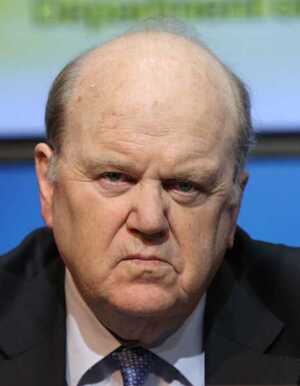
90378385Minister for Finance Michael Noonan yesterday in government buildings

This morning.

Minister for Finance Michael Noonan went on RTÉ Radio One’s Today with Sean O’Rourke to discuss yesterday’s Spring Statement and the ongoing Siteserv crisis with the host in rare form (in fairness).

You could hear a pin drop.

As the minister chose to whisper.

Sean O’Rourke:
“On the, em, Siteserv sale, Minister, you have, the inquiry announced there last week, just reviewing, eh, that and other transactions by IBRC, Mr Wallace, the liquidator who’s in charge of that and then he’s going to be overseen by [retired judge] Iarlaith O’Neill, do you regret now that you weren’t more forthcoming in the Dail when you were asked questions about that, that transaction and issue?”

Michael Noonan: “No, I was very forthcoming. The issues coming out now in the interviews done by Alan Dukes {former IBRC chairman]  and Mr [Mike] Aynsley [former IBRC CEO] and so on, they’re giving their side of the story, I have a whole run of Dáil questions again this week and I’ll be answering them and giving full information. I gave the information to the Dáil. But no one expects in a Dáil reply to get the information they get under Freedom of Information and Catherine Murphy, doing a very good job, went on to the Freedom of information route and she got the background.”

O’Rourke: “But [Independent TD] Catherine Murphy had to ask, she was on question 19 to you before it ever emerged that you had concerns, and very serious concerns, about the way IBRC was doing business, and not just about Siteserv.”

Noonan: “First of all, it was all back in 2012. The issue was the accountability of IBRC to the Minister for Finance and to the Department of Finance. The Minister and the officials were in exactly the same space. We had a whole series of concerns which we dealt with with the Board of IBRC, we resolved the situation to our satisfaction by putting an Assistant Secretary in there, there is no evidence whatsoever that any misappropriate action took place in any of their transactions but because it has become such an issue of public concern it’s timely now that…”

O’Rourke: “But you could have defused all that ages ago, Minister, by being a little more up-front about the concerns that were there, instead of which as [political correspondent] Brian Dowling put it last Sunday on the [RTÉ Radio] This Week programme, anybody reading your replies would say, well, nothing to see here, there’s nothing that gives any indication that the Minister was concerned about the way business was done and those answers were really designed to conceal more than they revealed.”

Noonan: “No, no, no, that is not correct. The information that was requested was given. I have no grounds now, and I don’t think anybody else has any evidence, that anything untoward happened. I got assurance from the Board through their chairman that what they did was in the best interests of the Irish taxpayers and I accepted that insurance because the responsibility, the legal responsibility, of the Board was to do what they did and I was barred from getting involved in any commercial decision of the Board and I accepted it and we will see now whether my judgment was right or not when it is reviewed, but the review isn’t because evidence has come out the review is because there has been a public furore and its in the public interest that…”

O’Rourke: “Let’s just get a little flavour of it, two very brief clips, one’s from you and the other’s from Alan Dukes when you announced the thing last week, here’s just what you said, I think, in Limerick in Friday…”

[plays recording]

Noonan: “One, is just to establish were there were any malpractices or any criminal offence and secondly would what happened in these transactions be considered to be sound business practice.”

Dukes: “And that makes me extremely angry, that even though the Minister says that he doesn’t expect to find anything like that, the very fact that there’s any mention of criminality or malpractice to my mind is absolutely outrageous.”

O’Rourke: “He’s hoppin’ mad.

Noonan: “Of course he is, he is, very annoyed. But all the allegations made under privilege in the Dail were effectively allegations that fraud had occurred. Now how could I possibly have a review conducted that didn’t deal with that issue. Fraud is a criminal offence.

O’Rourke: “In other words it was quite calculated, it wasn’t a slip of the tongue on your part or anything like that when you said fraud, criminality.”

Noonan: “Yeah, when you go back, I don’t think anything happened like that but if you go back on the record in the Dail the allegations were, effectively were, that there were criminal transactions fraud is a criminal offence, I mean, what would you be saying to me this morning if I prevented the review from examining whether fraud occurred or not? Like, that is a ridiculous position.”

O’Rourke: “For Alan Dukes to take, yes.

Noonan: “Well I think he probably misunderstood what I was doing or else he hadn’t been tuned in to what were the allegations made in the Dáil, but one of the problems in all these things where there’s allegations of scandal is that all allegations are run under privilege as if they were true and then truth has to be proved.”

O’Rourke: “But you didn’t, I don’t think you made it quite clear when you were making the announcement last Friday that it was because of things said in the Dáil that you used those words fraud or criminality.”

Noonan: “I did, I did a very long interview with [RTE journalist] Sean Whelan and I think I referenced the fact that it had gone to the point where there were allegations made and they had to be answered.”

O’Rourke: “What about Alan Dukes’ suggestion that your secretary general in the department John Moran wanted to have a kind of arrangement whereby not only would he be appointed would he join the board of IBRC but himself and Alan Dukes would effectively ready up decisions that would be pushed through the Board and in a way that Alan Dukes certainly felt was inappropriate.”

Noonan: “I don’t know what the basis for the second charge is but on the first charge it was quite common in the past to have departmental officials on the boards of organisations like IBRC. Brian Lenihan, when he set up the Board, because you know there were an awful lot of allegations of political interference in Anglo, he excluded departmental representatives and he also put an arrangement in place that the political side and the departmental side would have no influence over transactions, anything commercial was excluded so that made the accountability difficult but my difficulty with IBRC was an issue of governance and they were independent in carrying out their functions but I had a function to hold them accountable, they did not give me full value for my role and I had to fight in the public interest to make sure I had it their examples in the literature and information that has been revealed first of all the Government brought in a pay policy that bankers couldn’t be paid in excess of €500,000, they tried to ignore that and they tried to hire people at higher salaries, we wanted the cost of IBRC to reduced and instead of that they kept hiring people against government policy, so there were a lot of issues, but they were issues about their independence and my responsibility to hold them accountable.”

O’Rourke: “I know that he main explanation and justification for shutting them down for liquidating them was because of things to do with promissory notes but was that tense relationship and your dissatisfaction and lack of trust in them, to what extent did it influence that government decision?

Noonan: “No it didn’t. The sequence of events was that, you know, coming into the late spring and summer things came to a head and I had that meeting the minutes of which were released with Alan Dukes and Mr Ainsley and after that we made a decision that John Moran would meet Mr Aynsley [IBRC CEO] and the result of that meeting was an agreement that an Assistant Secretary would be put in. As well as that…”

O’Rourke: “And that didn’t work out too well either.”

Noonan: “As well as that we had a new relationship framework as they call it, you know, a new contract governing the relationship between the Department and IBRC and that gave us oversight of transactions in excess of 100 million and then by September I was negotiating in Europe on the promissory note and it was clear to me by September that whatever the solution ended up at in its detail it would involve the liquidation of the Bank…”

O’Rourke: “And is there any suggestion on your part or suspicion that the Siteserv sale was hurried through to get done and dusted before the new regime whereby they would have to report to you in more detail would arrive because it was only a matter of days, a couple of weeks…”

Noonan: “No, I have no evidence and I don’t think anybody else has of any wrongdoing, there was a series of unsupported allegations and we have to have a review…”

O’Rourke: “I suppose, as [former Labour Minister for Communications] Pat Rabbitte put it in his column in The Sunday Business Post last Sunday, no matter how effective the rebuttal, any story that has a rotten bank losing taxpayers’ money the country’s most prominent businessman shareholders of a bust company extracting a pay off and a minister accountable to the Dáil will outpace the economic statistics any day.”

Noonan: “Yes, all that is probably true but the people who were running IBRC at Board level they had no involvement in Anglo, I mean the whole board in Anglo had stood down this was a new board put in by [then Minister for Finance] Brian Lenihan and there were a lot of eminent people of high repute who were on that Board and I would classify Alan Dukes who was on the Board first and then appointed Chairman by Brian Lenihan as a a person of high repute as well and I have no evidence that they did anything.”

O’Rourke: “A former colleague of both of you, [Newstalk Breakfast presenter and former Fine Gael Minister] Ivan Yates, has suggested that if you were minister at the start when that Board was being assembled you’d never have appointed Alan Dukes chairman, whatever about keeping him there.”

Noonan: “No we have a cordial relationship which we’ve kept up over the years.”

O’Rourke: “That’s what [Progressive Democrats founder] Des O’Malley used to say about Charlie Haughey.”

Noonan: “Now, now, it’s not like that, we don’t see one another very often but when we see one another we’re friendly.”

O’Rourke: “And are you satisfied that this matter can be investigated and put out there in the public domain, all kinds of reassurance provided, how quickly, I think the 30th August was mentioned…”

Noonan: “Yeah, yeah, the end of August the end of August but I see this as the first phase possibly. It may, you know, when we get the report this may end the matter but I’m going to put the Report to the appropriate Dáil Committees and if there’s something that has to go farther we’ll go farther.”

O’Rourke: “But to go back to where we started, Minister, you weren’t upfront about the concerns you had, you talked earlier about data sharing with the Dail…”

Noonan: “I was upfront, I was upfront.”

O’Rourke: “Really? And how come we had to wait for the FOIs then at all, why shouldn’t you have given all the information that was in the FOIs, why not give that to the Dail?”

Noonan: “Because why do we have FOIs only to get background information?”

O’Rourke: “But it’s, it shouldn’t really be a game of cat and mouse, it’s not today or yesterday that the late Judge [Liam] Hamilton said if Dáil answers or Dail questions were properly answered there’d be no Beef Tribunal.”

Noonan: “It’s not a game of cat and mouse but there are procedures there which TDs can get information…”

O’Rourke: “But is there not a mindset there and maybe in your case it goes back to your days as Minister for Justice, tell them nothing.”

Noonan: “Ah now, you’re really scraping the bottom of the barrel there when you’re talking like that, I mean RTÉ isn’t great at disclosure you’re sitting on reports for 12 months that you haven’t published, I mean reports about the future of RTÉ*, so get off the stage, get off the stage now.”

O’Rourke: “Attack is the best form of defence there Minister, I’m just wondering why should a public representative elected by the Irish people not get the same information in reply to a Dail question as is there in the files anyway, why put them through the business of FOI?”

Noonan: “Because the files are often background information there was nothing in the files that added to the sum of the knowledge, the files were about a disagreement between us and it was the Department exercising its governance and when the proper procedure was invoked, Freedom of Information, all of the information was given out.”

O’Rourke: “Wasn’t that a bit clumsy now?”

Noonan: “I don’t think it’s clumsy at all, it’s very effective and it has proved to be effective.”

O’Rourke: “And you don’t see a case for put it out there, if a TD asks the question give them the answer, give them the answer?”

Noonan: “Well you see, I don’t think it’s feasible to say if somebody mentions IBRC that I give, you know, out chestloads of information on IBRC just because it’s mentioned.”

O’Rourke: “We’re talking about exams later and you’re a former teacher, answer the question you’re asked, is that essentially what you’re saying?”

Noonan: “What I’m saying is that there are two ways, well, there are several ways that deputies can get information and one of them is by Dáil question and the other is by Freedom of Information and Catherine Murphy followed the correct procedure, she invoked both options and she got the information.”

O’Rourke: “Would the moral of the story then from a TD’s point of view be, forget about the Dáil question, go straight for Freedom of Information?”

Noonan: “No, no. They’re different I mean you get very precise accurate information on the Dail question, if you’re looking for background then it’s Freedom of Information.”

O’Rourke: “OK Minister, thank you very much for coming in. Michael Noonan, the Minister for Finance.”

Listen back here

* anyone?

Meanwhile…

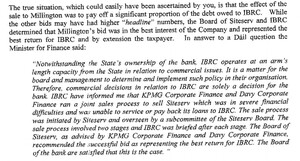
Notwithstanding the State’s ownership of the bank, IBRC operates at an arm’s length capacity from the State in relation to commercial issues. It is a matter for the board and management to determine and implement such policy in their organisation. Therefore, commercial decisions in relation to IBRC are solely a decision for the bank. IBRC have informed me that KPMG Corporate Finance and Davy Corporate Finance ran a joint sales process to sell Siteserv which was in severe financial difficulties and was unable to service or pay back its loans to IBRC. The sale process was initiated by Siteserv and overseen by a subcommittee of the Siteserv Board. The sale process involved two stages and IBRC was briefed after each stage. The Board of Siteserv, as advised by KPMG Corporate Finance and Davy Corporate Finance, recommended the successful bid as representing the best return forIBRC. The Board of the bank are satisfied that this is the case.

Michael Noonan’s reply to Pearse Doherty on April 18, 2012


Notwithstanding the State’s ownership of the bank at the time, Irish Bank Resolution Corporation operated at an arm’s length capacity from the State in relation to commercial issues. It was a matter for the board and management to determine and implement such policy in their organisation. Therefore, commercial decisions in relation to IBRC were solely a decision for the bank. I am aware that KPMG Corporate Finance and Davy Corporate Finance ran a joint sales process to sell Siteserv which was in severe financial difficulties and was unable to service or pay back its loans to IBRC. The sale process was initiated by Siteserv and overseen by a subcommittee of the Siteserv Board. The sale process involved two stages and IBRC was briefed after each stage. The Board of Siteserv, as advised by KPMG Corporate Finance and Davy Corporate Finance, recommended the successful bid as representing the best return for IBRC. I am advised that the Board of the bank at that time were satisfied that this was the case.

Michael Noonan’s reply to Catherine Murphy on December 16, 2014

Right so.

Also…
letter

Michael Noonan’s words used to scary effect in bowel-loosening letter from [REDACTED]’s legal team to Karl’s den the ‘sheet, January 2014.

Good times.

(Sasko Lazarov/Photocall Ireland)

catherinemurphyIndependent TD for Kildare North Catherine Murphy

“The Minister, Deputy [Michael]Noonan, stated that what happened must never happen again and that the Government could not get back the €34 billion put into Anglo Irish Bank, but the Government did not ask for it.

It is criminal that people are still paying for it. It is as if we took on the mortgage of the big house up the road, subsequently restructured it and were singing the restructuring’s praises because we no longer had to pay as much as we believed we would.

This is the spin, but we are still paying every penny of it as well as the interest. In response to a parliamentary question, the Minister told me: “The schedule for extinguishing the balance will be €500 million in 2015, 2016, 2017 and 2018.” On 23 December, the first €500 million was borrowed and burned. He continued: “That will rise to €1 billion in 2019, 2020, 2021, 2022 and 2023. It will double again to €2 billion” per year from 2024 onwards until it is paid, which looks to be in 2034.

I am coming to a point about the relationship between this and that awful night when we turned the IOU into a sovereign bond. We have no way of knowing what the relationship was between IBRC and the Department of Finance on that night. In the Chamber, the Minister talked in glowing terms about IBRC’s board and chief executive and IBRC was only being wound down so quickly for one reason.

However, we were not told what the relationship was. This issue needs to be addressed in the House. Why was there a sudden urgency to liquidate IBRC? Was there even a relationship? Not even the senior management knew. Remember how Mr. Alan Dukes was told that afternoon; we saw it on Twitter.

The question of the relationship is important. Many issues like that arise. According to Mr. John Moran’s diary, he met Mr. Mike Aynsley on 1 and 2 August, but there are no notes from that high level meeting. How could it be that two days of meetings were held between the most senior people in the Department of Finance and IBRC and not even one note was kept?

“Turning again to the big guys as opposed to the small guys, Mr Denis O’Brien owed IBRC millions of euro. If he had a spare €45 million lying around, why was he not asked to use it to pay down his borrowings instead of using it to purchase a company that we have been told was a bit of a basket case? Why would the bank allow someone in such debt to use €45 million to expose himself further or did he know that Siteserv would quickly turn into something profitable?”

“The inquiry by KPMG relates to this debate. If we are to have hope for the future, we need to do things differently in terms of governance. We cannot ask the same people who were part of a deal to review that deal. It will not wash.

The public knows this. I took great offence when the Taoiseach yesterday spoke about the accuracy of some of my questions and how they were written. It was beneath him and his office. He should correct that statement. There was nothing wrong with the questions I posed. What was wrong was that I was not getting answers. They had to be pulled out like hens’ teeth. This is unacceptable.”

I am concerned by section 31(2)(b) of the Freedom of Information Act 2014. Under it, where a member of the Judiciary is involved in a review or inquiry, freedom of information requests are out of bounds. It is important that this issue is not just pushed off into the future and buried until 31 August, right bang in the middle of the silly season.”

I am very hopeful about this country. The claim has been made on many occasions from the Government benches that those of us on this side of the House show no evidence of having hope. In fact, we do have hope, but we may well have a different vision for the type of Ireland we want to create.

This is an opportunity to acknowledge that we should not dismiss things that are positive. Indeed, both of the Ministers, Deputies Richard Bruton and Simon Coveney, who are in the Chamber have been very much at the heart of driving some of the positive improvement we have seen. It is only fair that we acknowledge that. However, we should not be codding ourselves about any of the issues or tolerating spin; our discussions must be real. The Government would do well to remember that the public is wide awake and engaged with all of this.”

Catherine Murphy TD in the Dáil yesterday

Transcript via Oireachtas.ie

Pic: RTÉ

Screen Shot 2015-04-28 at 12.07.57Denis O’Brien

“The consideration for Siteserv Holding Ltd’s acquisition of the Siteserv assets and business from Milliington was €45.4m. This was financed with shareholders’ equity of €12m and loan finance from AIB.

“In the period from June 2012 to April 2013, SHL drew down €32.4m from the bank in loan and overdraft finance and repaid €3m. So effectively O’Brien and his fellow shareholders got control of Siteserv using just €12m of their own cash.”

How Has Siteserv Fared Since Denis O’Brien Took It Over? (Business Plus)

Meanwhile…

“If Michael Noonan is serious about reviewing loan transactions where significant writedowns have occurred, then there should be a similar review of a reasonable sampling of transactions at Nama – as well as AIB, for that matter.”

Mike Aynsley, former CEO of IBRC

Mike Aynsley interview exclusive: “I’m disappointed and outraged” (Tom Lyons, Sunday Business Post)

Yesterday: Timeline To A Killing

90378185-1

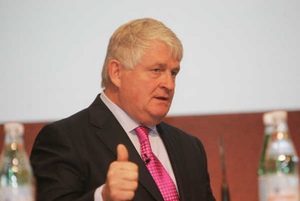
From top: Siteserv’s head office in West Dublin; Denis O’Brien

As the Siteserv share register is made public this afternoon.

Everything you wanted to know about Siteserv.

In a handy tl;dr form!

From its inception in 2004 to it’s takeover in 2011 by [REDACTED] right up to the first water meter protests in 2014.

Grab a tay.

Connect the dots!

Marvel at the number of 1980s UCD graduates.

Kick household objects.

2004: Siteserv is founded by Brian Harvey with financial support from Niall McFadden, of Boundary Capital, and private investors. McFadden worked previously at investment bank Morgan Stanley, for Larry Goodman and for oil company Tedcastles before setting up Boundary

November 2004: Siteserv acquires Rent-A-Fence.

June 2006: Siteserv acquires Donohue Scaffolding, which was founded by John Donohue.

October 31, 2006: The London Stock Exchange Aggregated Regulatory News Service reports that Brian Harvey is Siteserv’s CEO; Hugh Cooney is non-executive chairman; Bernard McGlade is Group Financial Controller, and Martin Cole is non-executive director. The report comes ahead of Siteserv being launched on the Dublin and London stock exchanges in November 2006. It also reports that Mr Donohoe is a member of the Siteserv board. Harvey is reported to have a 27.5 per cent of the business while the other directors also have a stake in Siteserv.


November 6, 2006:
It’s reported that Siteserv recruited shareholders through Niall McFadden and Declan Cassidy’s Boundary Capital – which has a 24% stake in Siteserv. In 2012 the Sunday Times mentions in an article that Mr McFadden is friendly with businessman Denis O’Brien. There are other reports in November 2006 that say the other listed shareholders include Davycrest Nominees Limited, with 24%, and Harvest Financial Services Limited with 19.6%.

November 15, 2006: Siteserv PLC raises almost €10.5million from its flotation on Dublin’s IEX market and the Alternative Investment Market (AIM) in London. Its share price jumped 36 per cent from 0.55c to close its first day of trading at 0.75c. The company’s market capitalisation was approximately €51 million. Davy acts as nominated adviser, IEX adviser and broker to Siteserv.

November 16, 2006:
In an article on Siteserv, it’s reported that: “Harvey and McFadden’s relationship dates back to their college years in UCD in the late 1980s, where now 40-year-old Harvey studied politics and economics before cutting his professional teeth with a stint in public relations firm Drury Communications.”

December 1, 2006: Siteserv announces the acquisition of Holgate Fencing (Ireland) in a cash and shares deal worth up to €19million – its first acquisition as a listed company. Holgate is described as a leading supplier and installer of motorway/road crash barriers and environmental acoustic barriers to the Irish market.

December 6, 2006: Goodbody Stockbrokers names Siteserv as one of three small stocks which it predicts will be leading contenders to deliver value in 2007.

December 22, 2006: Siteserv buys formwork and scaffolding provider Easy Access, which was established in 1992, for €20million. It’s reported the purchase will be funded through Siteserv’s existing resources and additional borrowings of around €15m. It’s reported that Patrick Jordan, founder and managing director of Easy Access, and his management team, will remain with the company after the acquisition. Jordan is also reported to have been made a director of Siteserv. It’s reported that Jordan has entered into a three-year contract with Siteserv with a gross salary of €200,000, plus a director’s fee of €25,000 per annum from Siteserv.

January 5, 2007: Siteserv leads the Dublin market with shares in the scaffolding and fencing firm soaring almost 18pc in early deals.

January 12, 2007:
Kevin Gallen joins the board of Siteserv and is appointed chief financial officer and company secretary. Mr Gallen is reported to have previously been finance director and company secretary at Unidare plc. He also worked for the Bacardi Corporation, based in Amsterdam, where he held the position of Assistant European Controller. Prior to joining Bacardi, he worked in audit roles in PricewaterhouseCoopers in Dublin and in Amsterdam. He is a chartered accountant and holds a B. Comm. from University College Dublin.

January 22, 2007: Siteserv posts interim pre-tax profits that rose more than 500% to €2.55million for the six months to October, 31, 2006. It said its revenues grew more than 600% to €16.28million.

March 9, 2007: London Stock Exchange Aggregated Regulatory News Service reports that Bernard McGlade is resigning as a director of the company with effect from March 8, 2007.

March 19, 2007: AIX reports that Siteserv’s chairman Hugh Cooney “raised his stake in the company to 222,953 shares or 0.22 pct of share capital after buying 80,000 shares at 1.04 eur each and 5,000 shares at 1.00 eur each, on March 16 in two separate transactions.” It added: “The company also said executive director Martin Cole bought 30,000 shares at 1.04 eur each and 20,000 shares at 1.06 eur each on the same day, raising his stake to 0.33 pct of the company’s share capital.”

April 21, 2007: It’s reported that Boundary Capital plans to float on junior stock markets in Dublin and London in the coming weeks, and that three of Boundary’s directors – Mr McFadden, commercial chief Declan Cassidy and Martin Cole – will contribute €25 million to acquire equity in the new company. It’s reported that Davy has been chosen as the stockbroker to the flotation.

April 21, 2007: It’s reported that Boundary Capital has agreed to purchase Buy & Sell magazine.

July 16, 2007: Siteserv posts pre-tax profits of €5.3million for the year ended April 30, 2007, up from €600,000 in 2006.

August 6, 2007: It’s reported that the board of Siteserv has agree to accept Kevin Gallen’s resignation as CFO and Company Secretary with immediate effect. Martin Cole, currently a non-executive director, assume the role of CFO and Company Secretary until a new CFO is appointed.

August 12, 2007: Siteserv’s share price drops back down to the flotation price of 0.58. It’s reported this is due to nervousness surrounding the construction sector.

September 6, 2007: Siteserv buys Sierra Communications, a provider of services to the power, telecommunications and civil engineering markets in Ireland, for €46million. Its customers include NTL, ESB and Sky. Deal involves €41.4 in cash and €4.6 in shares. The London Stock Exchange Aggregated Regulatory News Service reports that the beneficiaries of the Sierra sale are Sierra founder Desmond Whyte, and Sierra’s four executive directors, managing director Kevin Hoctor; operations director, Elliott Whyte; field operations director, T.J. Malone; and finance director Steven Quinlan, all of whom are reported to be remaining with the company following the sale while Des Whyte will remain as a consultant to Sierra. The Irish Times reports that the five men will become Siteserv shareholders.

Continue reading →

siteserv
2

Ah here.

Siteserv again.

Bewildered student writes:

Going through Siteserv’s market results (as you do) for year-ending April 30, 2011. It states that Siteserv secured a water meter contract in Dublin in 2010. I have seen no reference to this anywhere else…although I do seem to recall John Tierney was Dublin City Manager at the time.
Since the national water meter contract was only awarded to Siteserv’s subsidiary GMC Sierra in July 2013 I was wondering if someone could help shed a little light on this for me?

Anyone?

Market Results – Siteserv 2010/2011

000a7aee-642Hugh-Cooney

Walter Hobbs (top) and Siteserv non-executive director Robert Dix and chairman Hugh Cooney at Siterserv’s EGM in Davy House, Dawson Street, Dublin on April 5 2012

This morning, Mark Paul, in the Irish Times, reports on Finance Minister Michael Noonan’s announcement that KPMG is to carry out a review of the sale of Siteserv to Denis O’Brien’s Millington.

Kieran Wallace and Eamon Richardson of KPMG, the IBRC liquidators, will carry out the review.

From his piece Mr Paul writes that this may be deemed controversial because the Siteserv sale was overseen by Davy and…KPMG.

In effect, the special liquidators from KPMG will review the probity and commercial reasoning behind a transaction that was approved in 2012 by KPMG, albeit by a different department of the accounting firm and by different executives.

Still, this issue of a perceived conflict of interest is likely to be one of the first sticks grasped by the Opposition to beat the Government.

Indeed.

But there’s more.

It also seems likely that there may be further unease given that non-executive director at Siteserv Robert Dix, and chairman of Siteserv Hugh Cooney also have connections with KPMG.

Both Mr Dix and Mr Cooney were vocal in support of the Millington bid at the shareholders’ EGM in April 2012 when Siteserv officially voted to accept the Millington offer, despite reports of higher bids.

According to Mr Dix’s LinkedIn profile, he was a partner in KPMG from 1998 until 2008. It states:

“Initially worked in Audit. Set up Transaction Services in KPMG Ireland in 1999 and ran the division until retirement in 2008 providing mergers and acquisition advice to clients.”

As for Mr Cooney, according to Bloomberg, he’s a consultant and company director at KPMG.

Meanwhile Walter Hobbs, IBRC’s  independent expert, who appeared on RTÉ’s Prime Time last night to defend the Siteserv sale, was himself a director at KPMG.

Good times.

Further to this, readers may wish to recall an article in the Sunday Independent by Tom Lyons about the shareholders’ EGM back in April 2012.

From the article, Mr Lyons wrote:

“The public, the media and the four non-corporate shareholders who showed up now wanted to know if Siteserv had been sold for the best price?

Gripping the podium firmly, Hugh Cooney, the chairman of Siteserv, set out the case for the defence.

Mr Cooney admitted that Anchorage had outbid Mr O’Brien.

But, he said: “This revised higher bid was very carefully considered and was not excluded from the process.” Mr Cooney said conditions attached to this bid, which he did not detail, were less attractive than Mr O’Brien’s proposition — and so it was turned down. Altrad’s bid of €60m, he said, had only recently been received and Siteserv’s board and advisors had turned it down too as it was only “indicative” and had various conditions.

Mr Cooney then addressed the media and its reporting of Mr O’Brien, who beside being a billionaire was also an existing borrower from IBRC.

“Mr O’Brien’s offer represented the best offer in terms of price and conditions,” he said, “We were in no way influenced positively or negatively by the identity of the purchaser.”

“Robert Dix, a KPMG veteran and Siteserv’s senior independent director, who oversaw the sale, defended the company. “We identified a very large number of companies . . . the opinion of the investment committee, our advisors, the board, and confirmed by IBRC, [Mr O’Brien’s] was the best bid,” he said.

Mr Neilson [Ray Neilson of Altrad who claimed to have been shut out of the process and who bought a few shares just to speak at the meeting] was no mood to give up. “We said we would double what was going to the shareholders today and the remainder would go back to the banks,” he insisted. “We would give the banks another €11.5m, the shareholders another €3.5m. We wanted to double shareholder value and give the rest back to the people of Ireland.”

Mr Cooney again pointed to the uncertainty around Altrad’s offer price. “I am an experienced director and take my responsibilities seriously,” he said, “I am very happy to stand over the process.”

“Mr Neilson dismissed claims by Siteserv there was only a “slim” chance that Altrad would stick with its higher bid. “The reality is that with the level of synergies we’d have with Siteserv, €60m would have been a very low bid for it,” Mr Neilson said.

“That was our opening bid. If they’d allowed an open fight as we would see it, where they’d allowed in people with synergy, then I think it could have gone for well in excess of €60m.”

Then it was on to the media briefing by Mr Cooney, Mr Dix and Mr Harvey. Mr Dix was on the defence again from questions from five newspapers and RTE.

“We always knew this transaction would be open to full scrutiny because our lender was being asked to write off a considerable amount of money,” he said. The best deal, he said, had been achieved.

Pressed by the Sunday Independent on how hard the bidders were squeezed to get the maximum price, Mr Dix said: “We had a number of rounds. At the end of them we asked them to put their best foot forward. Eventually, you have to have a final round. Denis O’Brien put the best foot forward.

“Because of leaks to the papers the business came under pressure from its creditors because there were questions around the financial viability of the business,” he explained. “We had to quickly get a transaction done at the best price.”

Mr Harvey is a big shareholder in Siteserv, who will share in some of the €5m in cash being given back to shareholders. The Sunday Independent asked him whether he had significant personal borrowings from IBRC.

“I don’t think it is relevant to anything like this,” Mr Harvey said. “I think that’s unfair,” Mr Cooney said. “We have evaluated all the offers and made a decision. The question you have just asked is inappropriate. You are challenging the robustness of our process.”

Mr Dix said he was aware of “noise” from under-bidders, who he admitted were “unhappy”. The Financial Times asked him why he had not taken the higher Anchorage bid.

“What does more mean?” Mr Dix said. “There are headline prices. All bids were subject to due diligence, subject to deductions for this type of debt, that type of tax. The price in a sense is meaningless. . . the net figure from [Mr O’Brien] was higher.”

Mr Cooney said Siteserv was under pressure to complete the deal swiftly at the end. “Because of the media speculation, credit insurers were threatening to withdraw cover, which was putting further pressure on the company … speed was of the essence,” he said.

Mr Cooney said he believed Siteserv could have lost contracts if the process had been allowed to drag out longer by allowing Altrad another eight weeks to put a bid together.

The Financial Times said this would not have been an issue if Altrad had been brought into the process sooner. “I just can’t understand why two really good advisers, Davy and KPMG, didn’t identify this company. Did they screw up?” it asked. Mr Dix denied this.

The Sunday Independent asked had Siteserv’s advisers run enough bidding rounds to shake out the highest bid. “I am not going to get into the detail,” Mr Dix said. “Each offer was fully researched and developed at every stage. . . It wasn’t rushed through, it took six months.”

Mr Dix said Denis O’Brien’s reputation in the fallout of the Moriarty tribunal report was irrelevant and he said it would have no impact on Siteserv bidding for Irish government contracts.

“I have no concern,” Mr Dix said. “Denis O’Brien is a very successful businessman. Those tribunals are something different. They have nothing to do with me or Siteserv. The EU Commission said in the case of Padraig Flynn [the former European Commissioner who was pursued by the Mahon tribunal] it was nothing to do with him. I think it is something separate from commerce, quite honestly.”

As the briefing ended, Mr Dix gave his final thoughts on a bizarre and fractious end to Siteserv’s days on the Irish Stock Exchange.

“We honestly believe it was run in a fair and transparent way and the outcome was the best for IBRC and all other stakeholders,” he said.

After three firm handshakes, Mr Harvey, Mr Cooney, and Mr Dix ended the briefing.

But where was the taxpayer and IBRC’s man, Mr Hobbs, who couldn’t make it because of a prior engagement?

The Sunday Independent tracked him down on his mobile after IBRC and Siteserv could not immediately reach him.

“There was a lot of different considerations, not just price,” Mr Hobbs said. “We are very happy with the outcome. In these situations everything is carefully considered,” he said.

Tom Lyons: A done deal, but were taxpayers the losers? (Sunday Independent, April 8, 2012)

Pic: Irish Independent

Opposition lashes out at plan for SiteServ review (BreakingNews)

Meanwhile…

90377686Catherine Murphy outside Leinster House this morning.

Update:

GOS writes:

Paper based.
No ability to ask questions or hear from people excluded from process.
To be carried out by KPMG employees – which firm incidently audits a number of Denis O’Brien companies (INM, Communicorp, Beacon). That’ll get to the bottom of it all right.

Earlier:

Ms Murphy tweeted another batch of FOI documents [including one literally unreadably blurry] that appear to further test Michael Noonan’s belief that Siteserv was the best deal for the state.


proxy-2proxy-1
2

proxy

Earlier: Who Are Those Guys?

Previously: Redactulous