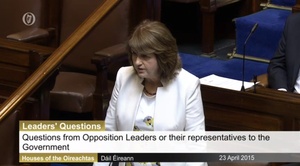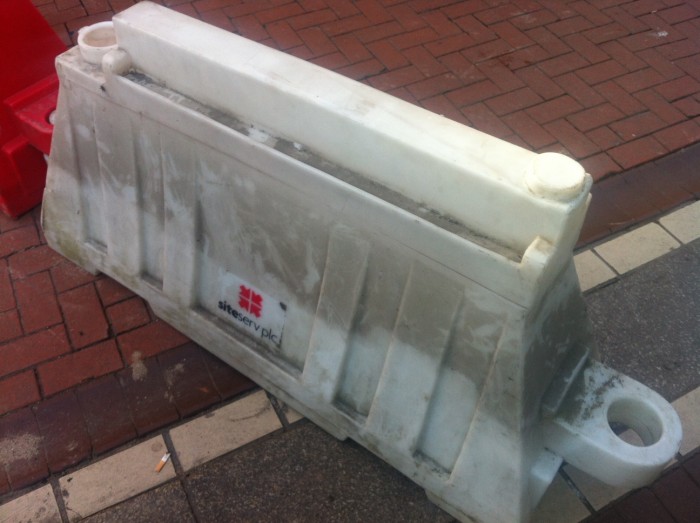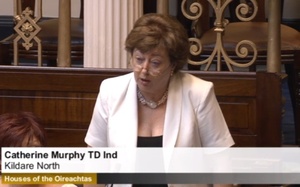
 Catherine Muprhy (top) and Sean Corkery, CEO of Siteserv (above)
Bless.
Further to growing concern regarding the purchase of the company responsible for the installation of water meters in Ireland.
Sean Corkery, CEO of Siteserv, the business bought by Denis O’Brien from IRBC with a €100 million write off that was subsequently awarded the meter contract, went on Morning Ireland to help clear up some outstanding matters to presenter Gavin Jennings.
Grab a hot tay.
Gavin Jennings: “If you’ve had a water meter installed outside your home in Dublin or the Midlands South East or the North West it’s likely that it was done by a company called GMC Sierra, it’s a subsidiary of Siteserv, a company which was bought three years ago by a company owned by businessman Denis O’Brien called Millington.
At the time it owned, owed rather, €150 million to IBRC, Anglo-Irish Bank. And when it was bought, for €50million , the other €100 million Euro of debt was written off, in other words the State, or the taxpayer, took the hit. Now, the Minister for Finance says his Department looked into the deal, and IBRC’s role in it, and that its officials, to quote, were made aware of certain aspects which raised concerns with some of the quality of some of the decisions, that the same law firm, Arthur Cox, acted for both buyer and seller, and that Siteserv shareholders were paid, but, that he was assured by IBRC that the deal was managed to get the best result for the country. Michael Noonan was responding to Dail questions from Independent TD Catherine Murphy, whom we talked to earlier. The Chief Executive of Siteserv, Sean Corkery, is on the phone now. Sean, good morning to you.”
Sean Corkery: “Good morning Gavin. Thank you for having me on. I’m pleased to clarify any misunderstandings on this.”
Jennings: “You issued a statement yesterday in response to [North Kildare TD] Catherine Murphy’s response to Michael Noonan. Again, you defended the deal as being best practice and above board. If it was above board, how come when the Department of Finance, when they came looking, found certain aspects which raised concerns with the quality of some of the decisions made?”
Corkery: “Well first, you know, it was the Minister who looked into it, he said it was above board, done best for the taxpayer, what he said yesterday in his statement was that, I’m getting, I’m getting a little bit fed up of the constant questioning from Catherine Murphy in the sense that it’s the same question, I think she knows what the answer is in that it is that everything was completely above board and I’m trying to run a company I’m the CEO of that company, when statements are made that are untrue they affect, you know, customers, suppliers and employees. So what was said yesterday was that the Minister looked into it, there was one or two issues that he raised, one was around the same legal company and I think the other was around the payment to the shareholders, and he said that having checked it out everything was above board. I should say further that, listening here this morning, the payment made to the shareholders were of course the shareholders of Siteserv plc.”
Jennings: “Yes.”
Corkery: “And nothing to do with the purchasing entity, which is Millington, which is a company which is owned by Denis O’Brien.”
Jennings: “Okay, can I ask you about some of those concerns which were raised. Why was the same law firm used by both the seller and the buyer and how is that not a conflict of interest?”
Corkery: “Well, I don’t know exactly why, but I’ve come across it myself a number of times where two companies that have nothing to do with one another could be using the same legal company, they end up one purchasing the other or having some kind of a relationship and legal firms are quite familiar with dealing with that and they have, you know, a different professional dealing with the two different companies and obviously there are very clear guidelines and Chinese walls as the Minister mentioned yesterday. It wouldn’t be unusual…”
Jennings: “But can you explain to me, I don’t understand and I’m sure a lot of our listeners don’t understand, what are Chinese walls in these situations…”
Corkery: “Chinese walls are, you know, the legal firm, absolutely committing on a professional basis that information doesn’t pass between the professional dealing with one company and the professional dealing with the other, irrespective of the fact that they might be employed by the same legal firm. I think something like that makes a headline and for somebody listening in this morning they might say, oh that’s unusual, maybe there’s something to that, I would say if you check out a lot of corporate legal firms it’s quite, usual but in any case I mean, we weren’t there at the time, we were the company who came in to purchase the company, we had our legal firm they were, they had theirs it turns out it was the same legal firm, but the point there I wanna make is that this company, it was doing very badly, it ran up a huge debt based on accumulated losses and the IBRC discounted the company and put it up for sale, a lot of people looked at it, everybody was, you know, offered the same price and the same discount and the entrepreneur Denis O’Brien came along and took the risk on it, and it was a risk, I came in from multinational companies and I can tell you…”
Jennings: “ESAT, you came in from ESAT, isn’t that right?”
Corkery: “no, I came in from Dell I spent 13 years with Dell and 13 years with Apple.”
Jennings: “You were involved with ESAT before, that is that right?”
Corkery: “I was, I was but what I can tell you is, when I came in, Siteserv was in bad shape, whoever bought that company…”
Jennings: “Okay, okay, can I ask you about the second concern that was raised, the payment of shareholders, if it was such a good deal, why did shareholders need to be convinced ,and need to be paid to be convinced?”
Corkery: “Well, it’s specifically, that, that, the IBRC acted, the State sold the company but, I’d imagine those shareholders had invested a lot of money over a number of years ,they probably never got close to anything of that money back and they were probably given some value because the company had some value namely €50 million value and they as shareholders shared in that value that would be a typical truncation where shareholder….”
Jennings: “But taxpayers, and I know it’s not your responsibility, they’ll be wondering why if there was money in the pot to pay shareholders why wasn’t that used as part of the debt writedown.”
Corkery: “Again, you know, I can’t exactly answer that but I mean the best thing to do was to try to convince the shareholders to sell the company otherwise you know we’d have lost, no, the taxpayer would have lost, another €50 million, the taxpayer would have lost 1600 jobs which would have cost the taxpayer, and to sell that on to some entrepreneur who’s willing to take the risk, invest in the company, we’ve invested over 50 million in the last 2 years, committed to invest another 100 million over the next three years, and you know we’ve doubled the employment we had when we bought the company two years ago that has to be good for the tax payer, so net net this was a proper deal, a good deal and the taxpayer came out the right side of it in my view. In the meantime I’m trying to…”
Jennings: “As you point out, Siteserv…”
Corkery: “In the meantime I’m trying to run the company so it’s difficult when these questions keep coming up and we get back to the same answer because…”
Jennings: “Yes, but they are legitimate questions and we’re very grateful to you for coming on for answering them. If it was best practice why were the underbidders so unhappy?”
Corkery: “Well as was said yesterday the so-called underbidder never made an official bid for the company, it came in very late in the process, and the Siteserv plc board, which were brought together to make a decision on who they should sell the company to, felt they came in late in the process but more importantly they put a number of conditions. You must remember Siteserv was sold as a company to the Denis O’Brien company with no conditions, in other words we didn’t even get the opportunity to do a due diligence, this was €50 million take it or leave it, take it off the parking lot. Another company came in late in the process and put in a number of conditions including a 6 week due diligence process and that obviously was a huge risk…”
Jennings: “One of those companies said that the reason why they came in late was because when they enquired whether the company was up for sale they were repeatedly told it wasn’t.”
Corkery: “I don’t know anything about that. I mean it’s easy to come in after the event But there wasn’t too many people, two and a half years ago in the sale of Siteserv, and the sale generally of the engineering business in Ireland, willing to take a company with no conditions for €50 million that had lost €100 million of accumulated losses over the past two years.”
Jennings: “As you pointed out, Siteserv is doing very well now, more employees, bigger revenues, bigger profits and a big debt gone and a big contract to put in water meters. How did that happen given that the contract was awarded before GMC Sierra was ever legally formed?”
Corkery: “No, yeah well that would generally be pretty standard, we made a joint venture with GMC and Sierra company, we tendered for that process and you know, if you’re successful you set up a joint venture, if you’re not successful then you don’t legally set up the joint venture, again that’s something that gets the headlines but technically, you know, there’s nothing to it you don’t go through the process of setting up a joint venture prior to getting a project like that because the joint venture is specific to the contract, in other words we saw GMC as being experts in the water area and that’s why we did a joint venture with them…”
Jennings: “Sean Corkery, CEO of Siteserv, thank you very much for speaking to us this morning.”
Listen here
Last night: Siteserv for Sore Eyes
Denis O’Brien, Fine Gael And The Water Meter Deal