Tag Archives: Social Welfare

Ombudsman Peter Tyndall launching his annual report for 2016 in Dublin this morning

This morning.

Ombudsman Peter Tyndall launched his annual report for 2016.

In it, he deals with the matter of complaints to his office from people in receipt of social welfare payments who’ve been notified that they were overpaid and that they owe the Department of Social Protection money.

In his report, Mr Tyndall writes:

During 2015 and 2016, I noticed an increase in the number of complaints to my Office from people who had been, or who were currently, in receipt of social welfare payments and who had received notice from the Department of Social Protection that they had been overpaid. The Department was demanding repayment from them.

The periods during which the overpayments accrued ranged from relatively recently to over 20 years ago. The amounts also ranged from €1,000 to over €100,000.

An examination of these complaints raised significant concerns so I decided to initiate a systemic examination of the Department’s processes in raising and collecting overpayment debts from claimants.

My Office examined local overpayment files held in two Dublin Intreo Offices. In October 2016, I sent a report of our findings to the Department for its consideration and response.

During 2016, my Office examined other individual complaints received from overpaid social welfare claimants. A total of 55 overpayment complaints have been examined. 25 have been finalised and closed. Of those closed, I upheld 15 (60%) and the overpayments were written off by the Department.

In one case study, Mr Tyndall explains how one woman, who was told she owed the Department of Social Protection €19,900, ended up receiving a €700 refund from the department.

Mr Tyndall writes:

A woman complained to the Ombudsman after she wrote to the local office of the Department of Social Protection and failed to receive a response. The woman had received correspondence from her local office saying that an overpayment of €19,900 had been made to her. The woman was unaware of how this debt arose and had written to the Department for an explanation.

The Ombudsman contacted the Department’s local office and asked it to respond to the woman’s correspondence. While responding to the Ombudsman the Department also reviewed the woman’s social welfare payments. It discovered that her application had not been processed correctly. The woman’s income had been recalculated a number of times resulting in different outcomes, while in considering her husband’s income the Department had failed to take account of an illness that reduced his income.

Following the review, Department discovered that not only had there been no overpayment but that the woman was entitled to a refund of approximately €700.

Read the report in full here

Earlier: How Many?

Rollingnews

3000722_f78da293

A look at the social welfare system in Ireland, from the eyes of Roos Demol, a Belgian writer/blogger resident in the country for eighteen years, as posted in Migrants in Ireland, her blog dedicated to stories of the Irish immigration experience.

The last thing I ever wanted to do was to become dependent on social welfare. But things happen. I had to quit my job a few months ago because I needed to be with my daughter who had several health problems, so money was already scarce, then my estranged husband decided to cut the maintenance in half and I was left penniless.

As any mother would do, I got into protection mode and did everything possible to get some kind of income. While looking for jobs, I also signed on for social welfare in the hope it would keep me going.

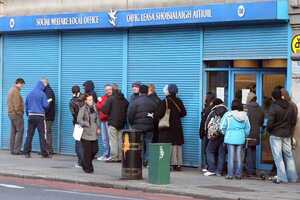
Ireland has an extremely outdated signing-on system., the endless paperwork, the old fashioned standing in line, the grumpy people in the social welfare office, it was all very unpleasant to experience, but I took it on and went through it, because I had no choice.

Nothing, however had prepared me for the meeting with the social welfare inspector.

Of course, I do understand why an inspection could be necessary, especially since I noticed that in the social welfare office and the community office every document you produce is considered to be fake, and everything you say is considered a lie, even my birth certificate was looked at with suspicion. ( I had to point out to the lady in the SWO that ‘September’ in Dutch means ‘September’ in English. I keep forgetting that Anglophones find understanding other languages very difficult).

I went to the appointment with the inspector as instructed on a Monday at 12. I was a bit taken aback by the office doors that each had a lock and an entry code. What was going on?

The man, blond with little piercing blue eyes, let me into his office, as always I smiled and said hello. He didn’t smile back.

He took my file and looked through it, then he said ‘So are you going back home?’ I looked puzzled. He repeated ‘why don’t you go back home to your family?’. I then realised that by ‘home’ he meant Belgium.

I looked at him in disbelief. I said ‘I’ve been living here for 18 years, my children are Irish, why on earth would I go back to Belgium?’

Then he said ‘So I guess you’re not then’. ‘Because you are going to get money off the state here’ he shouted out loud with a menacing look on his face.

I was bewildered, from then on I knew this was not just a talk about what happened and about the steps I should take, etc. this was an interrogation. I had to keep telling myself I was in Ireland, land of the thousand welcomes. I have borne children here, I have paid taxes, I pay taxes every time I buy something, I pay road tax, I delivered very intelligent and talented children to this country, I organised charity events for Action Breast Cancer , I am a cultural ambassador for the Irish In Europe Association, promoting Irish businesses in Brussels, I did workshops with teenagers from disadvantaged backgrounds, I fundraised money for the local school, brought choirs to small churches in the country side and many more things. but here was a guy telling me I am taking money off the state and telling me I should go ‘home’.

That meeting lasted around an hour. I was treated like a criminal all the way through, everything I said was either ridiculed or sneered at.

I could only think of one thing. What if I was black? What has this guy been saying to other people?

I did not sleep that night, I was completely traumatised. I made a complaint, we’ll see what happens.

I thought about the movies I saw, the books I read about the Magdalen sisters and the industrial schools, Angela’s Ashes and the way poor people were treated in the old days. It was always just fiction, but now I had experienced it myself, it is still happening.

I used to work in the employment office in Brussels, I met people like me, I also worked in prison for six years as a nurse. Never in my entire life have I treated anyone with such disrespect. I am totally disgusted.

I am in bad luck and working hard to get out of it. I am not taking social welfare because in the end I am not yet reaching the (very low) threshold for job seekers allowance, and the thought of ever having to see this man again, makes me sick. I think I’d rather go ‘home’ indeed.

Migrants in Ireland

90286109

Daire writes:

Over the last three working days I’ve received three items of post. One was from my apartment insurer (who I’m 90% certain won’t actually insure me as the setup of the apartment is a fire hazard), a letter I’ve apparently ‘requested’ from Irish Water asking me for my details to sign up.

And then I got this letter from the dole who dutifully told me that I owe them €22.30. This isn’t up for debate – according to their rules, the Department of Welfare’s incredibly just and virtuous rules, I do owe them this money.

However before I get my rant on, let’s look at this keeping in mind Enda’s promise to rescue all those souls who’ve fallen overboard in the past eight years or so.

He wants them all to have jobs by 2018 according to his St Patrick’s Day message. From my experience, I worked in the tax year of 2011, emigrated the same year and came back in October 2013. I received Dole within a record time of 10 days or so.

I started work in February 2014 until November 2014. I went to the dole office and was told I was not due anything because they wanted proof of my cohabiting, self-employed partner’s income (which was hard as it was her first year doing it).

After initial shock at being due nothing (when in doubt always lie to the Welfare, they should’ve taught me in school) having worked almost the entire year, they said my only option was to show them my partner’s receipts and bank statements.

They accumulated it to a yearly average and I was given the princely sum of €66 a week.

Needless to say this was pittance for rent, high season for ESB bill, food, house insurance, and internet. Since my partner works in the arts and the companies she worked for were awaiting grants from The Arts Council who have to wait for the money to be dripfed to them from Enda’s teat, she was constantly owed money but had none or not enough to even pay the rent.

So debts were incurred, family who were estranged for obvious reasons were contacted out of the blue and squeezed. Not the worst or even close to it for a lot of people but I suppose my point lies with those coming back to all those lovely jobs by 2018.

To those coming back by then (a lot of whom were on the dole before they left and not having worked in a while), make sure you’ve a nice bounty with you to feather your nest with, or your family has weathered the storm – coz the welfare employees are only the messengers. If you’ve a complaint/valid point to make about the system prepare to be ignored.

(Photocall Ireland)

00144302(Joan Burton at the Global irish Economic Forum in Dublin Castle last month)

Mark Malone writes:

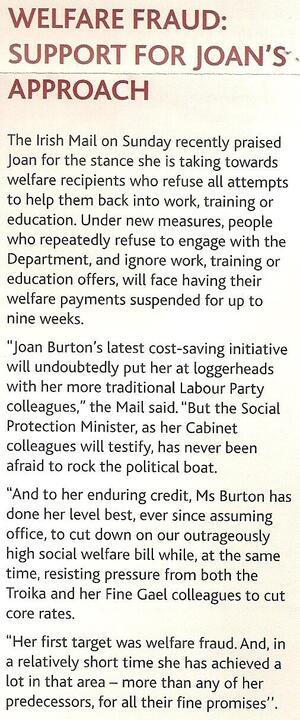
Its hard to know were to begin. A Labour minister announced yesterday that sections of the police force are to be drafted in to set up road blocks and stop workers in cars outside industrial estates.

When I first heard this mentioned on my Facebook and Twitter feeds I assumed it was some kind of left knee jerk interpretation. (I’m prone to them myself) Then I thought it might be FG spin from either within Burton’s department or the Dept of Finance to politically damage Burton. This was before I realised she said this herself on air, though ‘clarifying’ later in the day that she was referring to industrial estates rather than housing estates. Should we be eternally grateful that a Labour minister in only sending cops to harrass the labouring classes at our places of work, rather than at our homes? This is a deeply authoritarian step for any government to take, and as such it is a risk for Labour in further antagonizing ordinary working class people . Though given that Labour is hemorrhaging support, it seems that the party will face a similar fate to other centrist minor coalition partners right across Europe over the last ten years.

This political policing begs some serious questions too. How exactly is a cop stopping cars of people coming out or heading into a days work going to be able to tell if people are signing on the dole while working. Under what legislation can a police force be entitled to demand your personal information on the presumptive basis that all workers coming out of a workplace might be doing the double.

On what information are they using to pick those to stop. Are they going to stop every car, thereby creating long tail backs for workers in and out of work? I cant help thinking of how the RUC used to stop people coming and going to local GAA matches, creating massive tailbacks, often delaying kick off times. Simple harassment of a population to suits the states aim. What’s the difference here?

Are people who work in industrial estates going to have to do what people in the north used to? Head off half an hour early to build in time being held in a traffic queue by the cops? How long does the Labour/FG government think people will put up with this shit?


Joan Burton and the Political Policing of Labour (Soundmigration)