

Tag Archives: taft on tuesday

From top: Minister for Finance and Public Expenditure and Reform Paschal Donohoe launches Budget 2018 last November.; Michael Taft

Following an exchange of graphs on Twitter with Seamus Coffey (@seamuscoffey), chair of the Irish Advisory Fiscal Council, I did some looking around Eurostat’s Structural Earnings Survey database. This dataset focuses on employee earnings.

We can not only compare Irish wages to other EU countries, we can look into the ratio of high wages to low wages. The news isn’t particularly good. The following focuses on the business economy which can be used as a proxy for the private sector.

The SES comes out every four years so the data lags a bit but is still relevant.

Unlike the average wage, the median wage measures the mid-way point at which 50 percent earn above and 50 percent earn below (if we were to measure average the pattern would be pretty much the same).

We find that Ireland is well down table, above France and the UK. To reach the mean average of the other countries, the Irish median wage would have to increase by 8.6 percent, or nearly €3,200.

But not all employees rank towards the bottom.

The median wage in the first decile (the lowest 10 percent income earners) falls even further behind the mean average: the median wage would need a 22 percent increase to reach the average. However, in the 9th decile (the second highest income group), the Irish median wage is actually above the average (3 percent).

So not only is the Irish private sector median wage low, it is skewered against the lower-paid.
This results in a highly unequal situation, though not the most unequal among our EU peer group.

In terms of the ratio between the 9th and 1st decile, Ireland ranks 3rd from the bottom– ahead of the UK and Germany which comes in at the bottom (this should caution us about the alleged strong economic performance of Germany – it is built on precarious mini-jobs which now employs one-in-five employees).

Another concern is the rise in inequality.

In Ireland inequality jumped during the property boom period and has remained high since, significantly above the mean average of our peer group. The other EU countries remained on the whole relatively stable but this includes considerable increases in inequality in Germany and Netherlands.

The one downside to this data is that it doesn’t include employees’ full wage; in particular, the social wage.

This is the portion of a workers’ wage that the employer pays into the Social Insurance or similar fund.

From this fund, people can access free healthcare and enhanced pay-related in-work benefits (maternity benefit, illness benefit, etc.); that is, except in Ireland where the social wage is weak which results in low in-work benefits while forcing Irish workers to pay for goods and services on the private market which, in other countries, would be provided free or at below-market rates (e.g. GP care, prescription medicine, etc.).

Before we turn to tax and redistribution to reduce inequality let’s first consider policies at the workplace level since that is where inequality starts in the market economy.

A big instrument in fighting inequality is workers’ ability to bargain collectively with their employers. I have discussed this in some detail so I won’t go into details here.

But here’s this from the International Monetary Fund: which found that union membership and collective bargaining reduce economy-wide inequalities:

‘We find evidence that the erosion of labor market institutions is associated with the rise of income inequality . . . notably at the top of the income distribution . . . the decline in unionization is related to the rise of top income shares and less redistribution, while the erosion of minimum wages is correlated with considerable increases in overall inequality.’

A quick look at the CSO’s analysis of the distributional impact of public sector wages (which are collectively bargained) and private sector wages (which are largely not) shows the former has a more egalitarian wage structure with much smaller gap between the top and bottom income scales.

And the great thing about a collective bargaining strategy to tackle market inequality is that it doesn’t have a financial cost, unlike social protection programmes such as Family Income Supplement which effectively subsidises low wages.

We should be concerned about wage inequality, the inefficiencies it brings to the market economy and the corrosive effect it has on social cohesion.

And we should translate that concern into giving men and women more power in the workplace. In this way, every workplace can start making a contribution to reducing inequality.

Michael Taft is a researcher for SIPTU and author of the political economy blog, Notes on the Front. His column appears here every Tuesday

From top: Minister for Housing Eoghan Murphy and Taoiseach and Fine Gael leader Leo Varadkar at the launch of social housing units last November; Michael Taft

The National Homeless and Housing Coalition is holding a demonstration on Saturday, April 7 over the housing crisis. It has the support of dozens of organisations spanning civil society groups, trade unions and political parties.

To highlight the urgency of this issue and the importance of the march, I have expanded on some ‘quick facts’ published in Home Truths – a special newspaper being distributed nationally in advance of the march by supporters of the coalition.

1. Homelessness Rising

Homelessness has seen a steady rise since 2015, more than doubling. The last year saw an increase of over 1,900; this compares to an annual average increase of about 1,650 in the previous two years. Of the 9,100 homeless, nearly 3,300 are children.

These numbers only refer to people in emergency accommodation. The Housing Agency’s Summary of Social Housing Assessments 2017 shows nearly 20,500 households living with family or friends. And this doesn’t include people in the same circumstance but not on the housing list.

2. People on the Social Housing Waiting List

There are over 85,800 households on the social housing waiting list – nearly 200,000 adults and children. That’s a bad enough. But a look at some of the sub-categories illustrates the dismal realities of this fact:

Nearly 40 percent have been waiting for five years or more

Over 7,000 have a household member with a disability or exceptional medical condition

Nearly 18,800 are actually in employment

And there are 6,600 aged 60 years and over

3. Upward Pressure on Homelessness

Over 72,000 households are in residential mortgage arrears. Over two-thirds have been in arrears for 90 days or more. In addition, over 20 percent of employees are officially categorised as ‘low-paid’, while 13 percent at work live in deprived conditions. Evictions and inability to afford rent are now driving forces behind homelessness.

4. The Rise and Rise of Rents

According to Daft.ie, rents have increased by over 60 percent in the last five years. During this same period inflation rose by less than 1 percent. Rents are increasing by over 10 percent a year. Wages are only increasing by 2.5 percent. Every year, rents are moving further out of reach of low and average income groups.

Given that these are Daft.ie figures, they are asking rents. But this shows that new apartments coming on to the market are not going to make a contribution to reducing the level of rents or increasing the stock of affordable rental accommodation. And market analysts are projecting a 20 percent rise over the next two years. Excessive rent increases will be with us for a while.

5. Dublin Rents far Exceed Other EU Capitals

When compared to other EU capitals, Dublin is at the top of the rent league (only London is more expensive than Dublin). If you were renting in the city centres of Berlin, Amsterdam, Vienna or Brussels, you’d be paying €8,400 less per year to your landlord.

This shows the difference between managing market rents and, in the case of Ireland, not managing them.

(Note: the above data is taken from Numbeo, a user-generated site. This is not as accurate as a properly produced statistical survey. However, the National Competitiveness Council has started using this site, stating that ‘the scope and depth of the data gives this approach some merit’.)

6. Subsidies to the Private Rental Sector

In the last 12 years, the state has handed over €6.4 billion to private landlords and the private rental sector. Under current targets, the Government will be spending nearly a €1 billion a year by 2022. Question: is it more financially and socially efficient for the state to build and rent housing through a public agency (local authorities, public company, etc.), or to rent housing from the private sector?

7. Rising House Prices

The average new house price nationally is €330,000. In Dublin it is nearly €420,000.

House prices have yet to return to the stratospheric pre-crash levels. However, since house prices troughed in late 2012 / early 2013 (the above graph includes both new and second-hand), national prices have risen 69 percent in five years while Dublin prices rose by 76 percent. In the last year, prices have risen by 12 percent.

There are several contributors to prices: availability and price of land (and impact of land hoarding); availability and cost of credit; wages and incomes; desirability and viability of alternative housing tenures – in particular, rental accommodation.Supply of housing is only one factor in price and, at times, not the main or relevant factor as Mel Reynolds and Dr. Lorcan Sirr have pointed out.

8. Home Ownership Increasingly Out of Reach

In Dublin, a couple buying their first home will have to pay, on average, a deposit of over €40,000 and have a combined income of over €100,000. Currently, the average wage for workers is €38,000. For average-income employees, it is difficult to see how they can afford to buy a house in Dublin.

9. High Cost of Credit

It has been well-established that Irish mortgage interest rates are higher than in other EU countries. So, in addition to increasingly high house prices, were average income earners able to get to the purchase stage, they would find themselves paying high monthly mortgage costs.
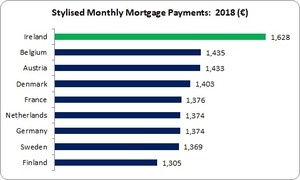
Let’s do a stylised comparison with other EU countries – a €275,000 mortgage for 20 years at fixed rates.

Like rents, Irish monthly mortgage payments are higher than in other countries. There will be differences depending on length of mortgage and the mix of variable and fixed rates, but this stylised comparison is likely to hold across the range of option – especially as Irish interest rates are 3.7 percent while in many of the other countries they are below 2 percent.

We are still paying for the banking crisis.

10. Land Costs and Developers’ Margins Driving High Property Costs

There’s a housing cooperative in Ballymun – the Ó Cualann Cohousing Alliance – which is building houses for sale at prices that can come in well below (30 percent or more) market rates. How can they do this? First, the land is provided at heavily subsidised prices from the Dublin City Council – so land costs are reduced.

Secondly, they don’t have a developers’ margin (though the private companies that build the houses do so at profit). That’s the difference.

The Journal.ie’s Fact Check came up with a similar finding when asking whether it would be cheaper for the state to build houses.

What is driving high property prices?

The cost of land (which is being inflated given land-hoarding and the lack of market management) and developers’ profits.

The cost of land and developers’ margins can account for a third of the price of a home in Dublin.

Those are just a few reasons to march on April 7. But actually, there are hundreds of thousands of reasons to march – the vast number of people in housing need. These are the stake-holders in this march. Indeed, they are the only stakeholders.

I will be marching with them on April 7. Hopefully, you will too.

Michael Taft is a researcher for SIPTU and author of the political economy blog, Notes on the Front. His column appears here every Tuesday

The ‘Housing is a Human Right’ march will be held on Saturday, April 7th at 1pm assembling at 1pm at the Garden of Remembrance, Parnell Square, Dublin 1.

From top: Housing Minister Eoghan Murphy; Michael Taft

The Department of Public Expenditure and Reform has produced a useful analysis of spending on housing; in particular, the rent subsidy schemes.

When we put this next to the targets in Rebuilding Housing – the Government’s housing strategy – we can see how endemic subsidies to the private rental sector are. This poses challenges to policy-makers and activists in overcoming the housing crisis.

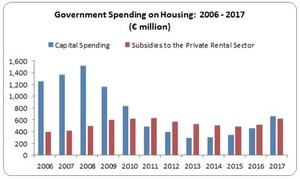
The Department report charts expenditure on private rental subsidies and capital spending on housing which actually creates additional accommodation.

The chart shows a substantial fall in capital spending – from €1.5 billion in 2008 to €295 million in 2013, rising again to €695 million last year.

Subsidies to the private sector have also seen a rise since 2006, though slightly depressed following the crash.

In the years 2011 to 2016, private sector subsidies outstripped capital spending, though this situation was reversed last year. Between 2006 and 2017:

Capital spending totalled €9.1 billion

Private sector subsidies totalled €6.4 billion

This €6.4 billion is comprised of spending on four schemes: Housing Assistance Payment (HAP), Rent Supplement (RS), Rental Accommodation Scheme (RAS), and the Social Housing Current Expenditure Programme (SHCEP).

HAP has only been recently introduced and is intended to both replace long-term rent supplement programmes and allow recipients to work full-time. But it is already becoming a major spending item – rising from nil in 2012 to €158 million last year.

If we use a crude calculation – of dividing annual expenditure in 2016 by the number of households in receipt of subsidies – we find that the average spend per household is €5,600 with variations within the schemes.

The Department refers to the Housing Agency’s Value for Money analysis conducted in 2011. The Agency concluded that traditional social housing (local authority) fared poorly compared to the SHCEP and the RAS schemes.

In other words, the state received better value for money by effectively leasing from the private sector than by building and possessing its own housing stock.

However, this report is heavily caveated. The Housing Agency admits that the data is limited and the year that they used – 2008 – may not reflect more current trends. It called for a new study to be conducted. The Department echoed this request, claiming that times (and costs) had moved on.

Really moved on; the Housing Agency’s study used 2008 as their base year. The problem is that rents have risen dramatically, and so have state subsidies to the private sector. A couple of examples from the Department’s paper:

HAP expenditure (the Housing Agency didn’t assess HAP since it was introduced after their study) rose from €2,675 per recipient in 2015 to €3,500 the following year, a rise of nearly a third.

Rent Supplement rates increased by 16 percent in the two-year period from 2014 to 2016 in Dublin; in Cork and Kilkenny the rise was 11 and 13 percent respectively.

Any new study would have to factor this in but, further, it should also take into account not only quality but the macro-economic effect of expenditure on market-led rents (opportunity costs) and future capacity.

And capacity is a key question. Rebuilding Ireland puts a lot of store in the private rented sector’s ability to absorb an increasing number of state-subsidised tenancies.

The reliance on private sector subsidies will continue, although it will tail off somewhat as the building and acquisition programme increases.

But in this four-year period the Government expects to create 67,000 new tenancies in the private sector.

A real question is whether this is feasible – is there capacity in the private sector to provide this number?

A related – and important – question is to what extent this will squeeze supply for tenants who are not eligible for state schemes?

This reliance on the private sector is not confined to rental and leasing. State acquisitions for the social housing supply merely transfer tenure from the private to the public sector. They do not actually create additional housing. In this four-year period the state is targeting only 28,000 new builds.

Let’s face it – we have dug ourselves into a deep hole and even with the best will and policies, it will take a long time to get out. All the more reason that we should have the latest data and the most comprehensive analysis to ensure that policy achieves the optimal outcomes.

Subsidies to the private sector will be with us for a long time. Already, 15 percent of households are in state-supported housing. Therefore, it is necessary that we have the right policies to ensure quality and security for tenants, affordability for the state and no downsides for others looking for rental accommodation.

The question that needs urgent debating, buttressed by quality evidence, is whether the reliance on the currently designed subsidies to the private rented sector passes those tests.

A better route might be to escape the idea of social housing as ‘for the poor’ as distinct to a private rental sector for everyone else; especially as the private rental sector is already heavily subsidised.

We should seriously look at the Nevin Economic Research Institute’s cost-rental model which breaks down this distinction and offers up rental accommodation for all tenants regardless of income or employment status.

Ultimately, there would be no ‘public’ vs ‘private’. There would be a single rental market – providing quality accommodation at affordable rents.

That would be the best value-for-money outcome.

Michael Taft is an economic analyst and author of the political economy blog, Notes on the Front.

From top; cycle courier in Dublin; Michael Taft

Precarious working is rising, pervading a number sectors: hospitality, retail, construction, financial, education (including childcare) and health. A major difficulty, though, is that there is no official or agreed definition.

There is no one set of measurements that captures precariousness.

We sometimes use short-hand data such as under-employment –people working part-time but looking for more hours or a full-time job. Or those on uncertain working hour contracts. These are aspects of precarious working but do not tell the full story.

To overcome this, the EU Commission’s Precarious Employment in Europe uses the concept of ‘at-risk of precariousness’. They first identify the risks:

Low-pay and in-work poverty

Lack of certainty over hours worked

Lack of access to social security / insurance benefits such as unemployment or illness benefit

Lack of employment rights such as holiday pay

Lack of right to collective bargaining

Lack of career progression, career development, in-work training

Stress and negative health impacts

This list covers a number of precarious situations based on income, workplace rights, social security, career and health-related issues. The EU Commission then ranks various employment contracts by their potential risk.


Standard open-ended contracts – whether full-time or part-time – are not without risk of precariousness but they are at the lower end. The highest at-risk contracts are, unsurprisingly, temporary agency work, posted work, zero-hour contracts and black market work.

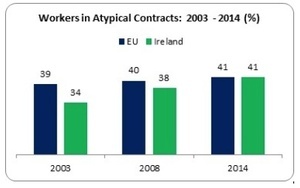
All work that is ‘atypical’ (that is, not full-time standard contracts) is subject to levels of unacceptable risk. And atypical work is growing.

Four in every 10 workers are in medium to high risk categories. Of course, this doesn’t mean that all ‘atypical’ workers are at risk. High-income, professional self-employed and many fixed-term contract workers would not be subject to risk. Nonetheless, if we are to find precariousness, we’ll find it in atypical work.

Obviously no single measurement can encompass all this and provide a bottom line number. We can, though, measure some aspects of precariousness.

Part-Time Involuntary employment: Those who are involuntarily employed part-time (when they would rather be employed full-time or with more hours) stood at 23.7 percent of all part-time workers in 2009. This rose to over 40 percent by 2012 as would be expected during a recession. Since then it has fallen back 31.5 percent but still remains above pre-crash levels.

Temporary Agency Workers: A small category, it has increased during the recession and afterwards. In 2009 only 0.7 percent of workers were employed in this category. By 2016 this has nearly doubled to 1.3 percent with a continuous upward trend.

Temporary or Fixed-Term Contracts: In 2009, 8.8 percent of employees were on fixed-term contracts. This rose to over 10 percent during the recession but has fallen back to 8.2 percent.
These measurements show a mixed-bag. And some high-risk categories are not measurable such as bogus self-employment.

ESRI’s Elish Kelly and Alan Barrett, writing in the Economic and Social Review, studied the trend in atypical contracts and expressed concern at the:

‘ . . . apparent persistence of the increased likelihood of atypical work in the recovery, albeit to a weakening degree. Before drawing any strong conclusions, we should note that the timeframe we are using is short and so we certainly cannot conclude that Ireland is in a new phase where atypical work is more likely. Nevertheless, the results raise the possibility that economic recovery will not, of itself, lead to more full-time and permanent jobs.’

Whether we will fall back to pre-crash norms or enter into a new phase of increasing atypical contracts is still not settled.

If measuring precariousness is difficult, resolving it is even more so and not amenable to a magic bullet.

The problems faced by low-hour contract workers are different from temporary agency workers are different from bogus self-employed.

Each situation requires specific tools and, as the Irish Human Rights and Equality Commission shows, the resolution can be quite complex with potential for perverse consequences (in this case, the Government’s legislation on ‘if-and-when’ contracts and banded hours).

A Floor of Social Rights

So how can we establish a framework that can tackle precariousness while acknowledging the complexity of the different solutions?

A EU Commission study came up with a provocative proposal: a Social Rights Floor. This would take all the social rights currently enjoyed by those on open-ended contracts and assess the degree to which those rights are applicable to those on atypical contracts.

This would include many of the risks outlined above by the EU Commission (social security, workplace rights, etc.).The fight against precariousness shouldn’t be reduced to legislation over employment contracts.

There are two other key ingredients:

Sectoral collective bargaining: each sector has particular issues which could be addressed by employers and employees collectively to ensure the remedy is robust and universally applicable. This not intended to replace a legislative floor but the fact is that banded hours negotiated collectively in the retail sector are more secure than what the Government is proposing. And if one were to look at the legislative protection for atypical workers in Denmark, you might think it quite weak. However, precariousness is tackled through sectoral collective bargaining and the result is much stronger protection.

Fiscal policy: I have written in the past about the idea of transforming personal tax credits into a partial Basic Income or Participation Income. This would only benefit workers whose income is below the income tax threshold. It wouldn’t be a handsome amount at first (approximately €300 per month) but it would establish an income floor that could be raised in the future.

Floors for Social Rights and income will become ever more a necessity in the future. The oncoming automation, AI and robot revolution could generate even more workers on atypical contracts.

The challenge will be to ensure that, regardless of your employment contract, you will enjoy the full range of Social Rights, that you will have an income floor, that you will have access to training and re-skilling (through enhanced labour market interventions) and, so, greater career progression.

In other words, you will be protected from precariousness.

Michael Taft is an economic analyst and author of the political economy blog, Notes on the Front.

From top:Taoiseach Leo Varadkar with Minister for Children and Youth Affairs Dr Katherine Zappone; Last Sunday’s Sunday Independent; Michael Taft

The Sunday Independent devoted three pages to the escalating cost of childcare. This was based on a Departmental document made available to the paper, along with a new Eurostat study and an analysis of childcare affordability from Ciaran Nugent of the Nevin Economic Research Institute. It tells the same story that I canvassed late last year – that rising childcare fees are cancelling out a substantial portion of the new €20 per week subsidy.

I don’t intend to go over the arguments first made in this post written when the new scheme was announced. However, I will restate the main point: as long as childcare services are run on a stand-alone basis – whereby each provider must raise enough money (primarily from parents) to meet their costs – affordability will be elusive.

Any attempts to subsidise the service will lead to fees inflation as services seek to increase investment with the additional payment – as is happening now.

Here I’d like to outline an alternative programme of affordable and quality childcare, working from where we are now. Ideally, childcare services should be a public sector activity as it is in other countries where municipal services play a lead role. However, public sector intervention is not likely in the short-term. We need to work with the 3,700 services currently providing early years’ service.

Each service would be invited to participate in a national network operated by a dedicated public agency. This agency would oversee the quality of each service and provide general operational guidelines, allowing for flexibility so that services can match local needs.

The key incentive to participate in this network is that the agency – funded through the Department of Children and Youth Services – would directly pay employees’ wages and social insurance costs. This could dramatically reduce fees.

According to the detailed 2007 Deloitte study of childcare costs (a bit out of date but the proportion of costs should remain the same), employee compensation makes up 67 percent of childcare expenditure. This shouldn’t be surprising – caring for children is very labour-intensive. If the public agency takes over this cost, this would reduce childcare fees by two thirds.

On average, childcare fees would fall from an average of €179 per week to €58 per week, saving parents €525 per month.

That savings would be a real benefit to families’ living standards, increase women’s participation in the workforce and boost consumer spending in other non-childcare businesses: win, win, win.

Taking over employee compensation would remove the main upward pressure on childcare fees. Services need to pay higher wages to reduce staff turnover (which is approximately 30 percent resulting in high recruitment and training costs) and attract higher-skilled people.

Workers in the sector would be able to negotiate collectively with the agency – covering not only their wages, but their working conditions (full-time contracts, up-skilling, pensions, etc.).

In other words, we could start to professionalise the sector.

The cost would not be as much as might be imagined. Using the recent Pobal survey of the Early Child Services sector we find there are 23,000 employees in the sector, half of which are full-time. If we assume 20,000 full-time equivalents (this is probably on the high side but let’s try to find the highest possible cost) at the average hourly pay of €11.93 the cost to the new public agency would be €484 million. If we immediately increased pay by 20 percent across the board, the cost would rise to €580 million.

Though this is just a back-of-an-excel-sheet estimate, the gross cost would replace a significant amount of current expenditure which, in 2016, amounted to approximately €225 million for the full Early Childhood Care and Education programme. The net cost, therefore, would be less. This would still leave Ireland well down the table in public spending compared to other EU countries.

Is childcare affordability affordable?

Even if we were to take €580 million as the final cost, we could easily fund this out of the current fiscal space.

The Government projects it will have €10 billion available over the next three years, of which €3.3 billion is earmarked for tax reductions.

The proposed cost would make up less than 18 percent of the proposed tax cuts. Wouldn’t this be a better use of limited resources?

There are a number of issues that would still need to be teased out:

1) Would for-profit services be admitted to this network (granting as a subsidy to private profits)

2) Would there be provision for capita payments – similar to primary schools

3) Would the public agency or local authorities be enabled to provide childcare services directly in areas of low supply

These and other issues would need to be addressed but locating these within a public sector-led national network makes it easier to deal with affordability, quality, supply and access.
We have the need, we have the resources. But the first – and main – decision we need to make is political.

Michael Taft is an economic analyst and author of the political economy blog, Notes on the Front.

Rollingnews

From top: AIB and Permanent tsb remain in state hands;; Michael Taft

It is curious how little debate there has been regarding Ireland’s banking system (apart from being scandalised by continuous scandals).

The bank guarantee was brought in practically overnight while the Dáil debate over the nationalisation of Anglo-Irish took only six hours.

On the other side of the crisis there has been little debate over the privatisation of AIB and Permanent TSB. It seems that, when it comes to banking, we proceed by reflex.

Well, it’s not too late to start that debate. And it’s not too late to champion the cause of public banking. What are the advantages of public banking?

First, while operating in a competitive commercially environment, it is not bound by short-term shareholder value. This frees the bank to engage in longer-term lending with patient capital.

Second, it can be rooted more locally with a mandate to lend into the productive economy – businesses and households; steering away from property and financial products.

Third, through decentralisation it can engage in relationship-based lending based on knowledge of local markets and individual borrowers (advantaging SMEs), compared to transactional-based lending with its centralised and near-algorithmic approach.

Fourth, public banks can be more amenable to political scrutiny and public accountability. A case in point is the current debate over the sale of mortgages to vulture funds.

Fifth and most importantly, would be its governance. The New Economics Foundation has proposed a trustee-based model to transform RBS into a local public bank. It would look like this…

The Board of Trustees – made up of employee, public appointees, and business and consumer representatives -would be responsible for overall policy while the Management Board would be charged with day-to-day implementation of that policy.

There are other potential positives:

A public bank could be regionally based focussing on activities in the province they serve (e.g. Munster, Connaught). However, even within the province the banks could be branded in a way to show their commitment to the local areas (e.g. Bank of Kerry, Bank of Offaly, etc.).

The Central Bank has acknowledged continuing problems with ‘banking culture’ and if this 18th century pamphlet – Observations on, and a Short History of Irish Banks and Bankers – highlighted by Diarmaid Ferriter is anything to go by this is a long-term, probably endemic issue.

‘ . . . the abuse of the public confidence by bankers . . . the fatal calamities which have befallen this kingdom by the abuses of private banking . . . is there an evil, which can arise from the monopoly of money, which they have not produced? And how partial the little good which the community has reaped from them . . . the public can never rely upon the fidelity of bankers under the present regulations’.

Regulation can go far, but only so far. A public bank can provide competition with private banks on many grounds; in particular, ‘culture’, emphasising customer relations and service.

A re-investment in regions and communities could be undertaken by opening up branches – but doing so in imaginative ways. These branches could be one-stop shops housing post-offices, credit unions, MABS advisory centres, etc. This could be combined with community out-reach programmes such as local financial-education initiatives.

To provide for democratic input, customers could elect their consumer representatives on the Board of Trustees through postal ballots. With public banking there is any number of initiatives and practices that could be considered to democratise this space.

Some would point out that we have had two banks under public ownership for years and nothing on this scale has emerged. That is true but the state, while ‘owning’ the banks, never acted like an owner.

The state acted more like a concierge, opening the door and tipping their cap to any investor who happened to wander in. T

he day after these banks were brought into public ownership, the state plotted to get rid of them. We had public ownership but not public banking.

As to whether AIB or Permanent tsb should be the public bank of choice needs to be discussed. AIB might be a better fit given its size and reach throughout the country.

Or it may be decided that a smaller option – with the ability to grow – would be preferable; thus Permanent tsb. There are pluses and minuses with both; for instance, both banks have high levels of non-performing loans, but Permanent tsb’s profile is higher.

In both cases, consideration would have to be given to buying back the shares sold to private investors. This would be an upfront cost but one that could be paid for by removing the banks’ ability to carry forward losses and write them off their tax bills. This is another dubious cash subsidy to banks which are directly responsible for their own losses.

There is one more objection: if either bank remains in public hands, how would we recoup the bank bail-out subsidies which, in the case of AIB, is considerable (approximately €10 billion is still outstanding)? There are two responses:

First, one may recoup the full-cost of the bail-out but there may be a bigger long-term price; namely, that selling the bank back to the same class of investors imbued with a short-termist perspective, the wider economic benefits would be lower than a public bank. That we cannot immediately monetise that difference doesn’t mean it wouldn’t have a real, negative impact.

Second, the public bank would still be required to pay back the bail-out subsidies but over a longer-term, with the repayment constituting a type of ‘bail-out dividend’.

None of this is straight-forward nor open to easy answers. That is why we need a full and detailed debate. Let’s have the Oireachtas hearings, let’s examine models that work in Europe and the US. If there is an argument that privatising the two banks can still meet the goals of a public bank, let’s give it consideration.

The Left should not be silent on this or let the issue pass by default. If we’re talking about an economics of recovery, public banking could be a crucial element in that.

But most of all, let’s have the debate. For once the two public-owned banks are privatised, it will be even more difficult to argue the case for, never mind introduce, public banking.

Michael Taft is an economic analyst and author of the political economy blog, Notes on the Front.

Rollingnews

From top: Taoiseach Leo Varadkar and Fianna Fáil leader Michael Martin; Michael Taft

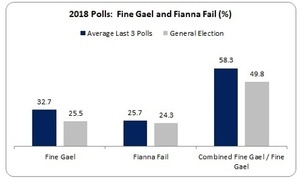
The two conservative parties – particularly, Fine Gael – are increasing their grip on Irish politics. Three polls in January – Red C, Ipsos MRBI and Behaviour & Attitudes – show a resurgent Fine Gael led by an increasingly popular Taoiseach.

While Fianna Fail is struggling to build on its 2016 result, Fine Gael is racing ahead. Combined, the two conservative parties are approaching 60 percent and this doesn’t count the Independent Alliance and the conservative (gene-pool) independents.

In Dr. Adrian Kavanagh’s vote-to-seats model, Fine Gael’s performance is even stronger. While this is only a model, Dr. Kavanagh projects that the three polls could result in Fine Gael winning up to 70 seats, or 44 percent of Dail seats.

At this level, Fine Gael is knocking on the door of single-party government, even if they have to rely on outside independent votes.

Again, in Dr. Kavanagh’s model, the two parties combined could dominate the next Dail, with a combined 117 seats, or 74 percent.

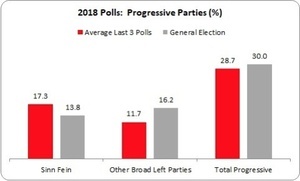
For progressives, the story is one of stagnation at best.

While Sinn Féin sees an increase (with a possible future boost by its new leader, Mary Lou McDonald), this is cancelled out by the decline of other progressive parties, leaving the combined vote slightly below the 2016 election result which, for progressives, was itself a disappointment.

Unfortunately, Dr. Kavanagh doesn’t have the full seat projections for all these parties. Sinn Fein sees, on average, an increase of three seats while the other parties will be lucky to hold on to what they have.

So why is Irish conservatism doing so well, while progressives are treading water? One reason is that Fine Gael has been able to sell a twin-message of ‘change’ and ‘stability’ with a bit of ‘radical centre’ thrown into the mix. Is this just vacuous branding?

Over the last three years there are 155,000 more people at work – an increase of 10 percent. Unemployment has fallen from nearly 12 percent to just over 6 percent – a decline of over 100,000 people on the dole.

Someone on the average wage will have received an increase in take-home pay of over €1,700 annually in pay increases and tax cuts (on average).

Deprivation rates are falling, severe arrears are falling, public sector pay is being restored: after the roller-coaster of crash, recession and austerity things are settling down for many people.

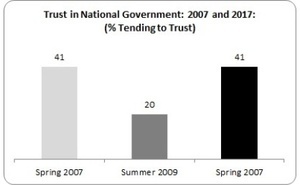
This can be seen from Eurobarometer’s poll surveying people’s trust in their national government.

Prior to the crash, a substantial proportion of the population ‘tended to trust’ the Government – 41 percent. Shortly after the crash this figure dropped to 20 percent.

Now, however, trust is returning to pre-crash levels. It is reasonable to assume this is related to people’s perception of the economy and their own financial and social circumstances.

But another reason screams out: there is no alternative. Progressives don’t currently constitute an alternative capable of governing or significantly influencing the debate.

It would be interesting to poll public perceptions of the Left’s economic policy.

I suspect that, beyond taxing the rich, redistributing income and spending more on public services, people would struggle. Not surprisingly – the broad Left lacks a common economic narrative even as it makes sensible demands.

And for many progressives, this is compounded by a vocabulary rooted in anti-austerity protest that is increasingly disconnected to growing numbers in this period of recovery.

This is all the more frustrating given the evidence of people’s re-emerging progressive instincts, whether that is evidenced by support for public services and capital investment rather than tax cuts, concerns over both economic and political inequality, frustrations over the conduct of banks (tracker-mortgages) and low-road employers. Just as the winds are starting to blow in our favour we have no sail to put up.

How do we start addressing this?

We, first, need to construct an ‘economics of recovery’ rooted in the world of work that can directly connect to people’s workplace experience.

People want a voice in the workplace –about wages and working conditions; people want social security – when they become ill, or are starting a family, retire, in need of housing or healthcare, or are between jobs; and people want income certainty and an end to precarious working hours and intermittent pay.

These are three strong starting points for an ascendant progressive politics, connecting to the Taoiseach’s ‘early risers’ or, in more old fashioned language, the working class.

Secondly, we need to develop a politics of common sense, a way of formulating and presenting issues that capture the debate. This common sense can emerge out of a sense of decency (shouldn’t wages at least guarantee that people don’t live in poverty – hence, a Living Wage); out of what’s fair (people’s health care shouldn’t be dependent on income – hence, free healthcare); or out of logic (doesn’t it make sense to rent or sell homes at cost – hence, cost-rental and cost-purchase).

Of course, we have to show how common-sense policies can be delivered. Not only are there economic constraints, and institutional and cultural inertia; there are powerful interests who can portray such policies as utopian or simplistic, in order to maintain their economic status.

Third, we need a practice of cooperation to make all this work. This requires maximum progressive cooperation; not only between broad left parties, but with civil society organisations and the trade union movement (what Conor McCabe has described as a ‘commonwealth of civil society and trade unions working in tandem with a progressive political sphere’).

If the broad Left is to provide leadership in the debate, it must start in its own backyard. And, quite simply, leaders bring people together, unite, and give everyone a stake in the endeavour.

Apart from the Coalition to Repeal the 8th Amendment – the lead example of cooperative work – there is the National Homeless and Housing Coalition; a body composed of all the broad Left parties, a number of trade unions and – most critically – civil society groups who work in the areas of housing need.

They have developed a common sense programme to address the housing crisis and are planning a major demonstration on April 7th in Dublin.

This is a crucial development – not just because it aims to keep the housing crisis high up the agenda – but because, through it, progressives can establish themselves as the principle alternative to current Government policies. In effect, Fianna Fail has opted out of the housing debate since it still clings to the old, and discredited, policies of developer-led tax breaks.

This process of cooperation and a common programme, becoming the principle alternative to the Government – this is why the march on April 7th is so important. If it is a success then this kind of cooperation of the commonwealth can start to become a habit – the first step to becoming a major political and social force.

There are no short-cuts; there is no recipe to take down from the shelf. An economics of recovery, a common-sense politics, the practice of cooperation – this doesn’t guarantee success. But one thing is clear – if we continue the way we are, we shouldn’t expect history to bail us out.

Change is certain, yes; but progress is not.

Michael Taft is economic analyst and author of the political economy blog, Notes on the Front.

From top: 3d rendering of humanoid robots working with headsets and monitors; Michael Taft

Will the age of automation, AI (artificial intelligence), and robots produce a utopian or dystopian future; or, which is more likely, a bit of both.

This discussion will continue for a long time. However, we must start debating how we will deal with these inevitable changes even if we can’t accurately predict their future impact. And do so without falling into the twin-traps of over optimism and apocalyptic pessimism.

An example of the latter was this study that produced a mini-panic – suggesting that nearly 50 percent of all US employment was at risk of automation (that was the headline panic; the report’s details are more nuanced). Nonetheless:

…Our model predicts that most workers in transportation and logistics occupations, together with the bulk of office and administrative support workers, and labour in production occupations, are at risk.

More surprisingly, we find that a substantial share of employment in service occupations, where most US job growth has occurred over the past decades, are highly susceptible to computerisation.

This was quickly countered by a McKinsey Report which stated that only 5 percent of employment would be lost. The difference lay in how they measured the impact – will it fully replace a workers’ job, or most of it, or part of it?

The difference between fully or partially replacing a particular job is crucial to understanding the impact.

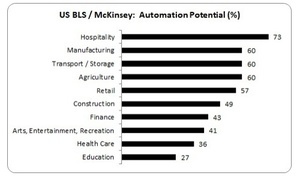
The McKinsey Report produced a useful projection based on assessing the automation potential in particular sectors.

The sectors with the highest automation potential, according to McKinsey, are hospitality, manufacturing, transportation, agriculture and retail. Those with the lowest are education, health, information and management.

According to this summary:

‘Almost every occupation that McKinsey looked at had some aspect that could be automated. Even 25% of tasks inside of a CEO job, the analysis found, could be automated. But very few jobs could be entirely automated. McKinsey’s conclusion was not that machines will take all of these jobs, but rather, “more occupations will change than will be automated away.”

So our jobs may not be fully eliminated, but they may be significantly changed.

Some proposals have been put forward to deal with the oncoming Robot invasion. A Robot tax has been mooted, with revenue going to a fund to be distributed to households. Yanis Varoufakis suggests that such a tax wouldn’t be workable. In any event, is it a good idea to tax an investment that can result in greater efficiency and higher productivity?

Others have proposed a Basic Income. There may be a number of good arguments for Basic Income (and there are) but dealing with technological change is not one of them. This could result in fewer people at work having to fund more people not in formal work, with less demand contributing to economic growth.

Still others put great store by education and re-skilling. This is something we should be doing in any event. But this assumes that there will be a growth in employment arising from automation. If there isn’t, what are we training people for – except to increase competition for employment which could drive down wages?

These observations aren’t the last word, merely the first. There are many who would argue that radical technological change is nothing new, that we have lived through these periods before.

They further argue that the reduction in costs will lead to a higher volume of demand for other goods and services, and that the increased productivity will increase net wages. There is much that is potentially true here. The problem is we can’t predict a future that is coming so fast at us.

Here are three proposals that could also help inform the debate.

First, reduce working hours. I have discussed this here. We should be considering this regardless of automation. This is a work/life balance issue which can be negotiated along with wages. If there are fewer hours needed to work due to robots increasing productivity, why not share that benefit out – especially in those sectors most exposed to automation.

Second, future public policy should raise the proportion of employment in health and education – areas where governments have considerable influence through the public sector. There is a long-time rise in such employment.

Prior to the crash, nearly one-in-five in the EU-15 were employed in the health and education sectors. In Ireland it was less but in both instances, there have been substantial increases since 1970.

We know that health employment will rise given the aging demographic. And if we want to invest in education and re-skilling, there will be a need for education employment. These two sectors are the least susceptible to automation.

Third, with the potential of jobs being lost, or downsized and down-skilled, or being transformed into precarious work practices, we should ask: where is the worker’s voice in all this?

If we let ‘market forces’ do their business, with governments trying to play catch-up and plug social holes, we could be in for a debilitating time. That is why the law should vindicate workers’ rights to collective bargaining in order to negotiate the introduction of these changes – whether reduced working hours, higher wages and/or social benefits, or re-training programmes.

Since people will be most affected, they should have equal say in how this is all done.

There are any number of strategies to be canvassed, discussed and argued over. And they all beg more questions. For instance, a policy of increasing education and health employment through the public sector would require that a greater amount of the value uplift of robots be captured by the state. Is this best done through higher corporation tax or equity in those high-tech companies receiving the inevitable public subsidies?

But at least let’s start that discussion now. The last thing we need is to leave the resolution of the problem until after the problem has collapsed the economy – just like what happened in the years leading up to the property boom crash.

Because next time the robots may not be able to put the pieces back together.

Michael Taft is economic analyst and author of the political economy blog, Notes on the Front.

Top pic: Getty

From top: the 11th floor of the Google HQ in Dublin; Michael Taft

As part of a drive to bring a little bit of democratic accountability over multi-nationals, the EU Commission is proposing that multi-national country-by-country reporting be made public.

This refers to the process by which large multi-nationals are required to report in what countries they derive their profits from and pay their taxes in.

In the future, large companies will be required to provide this information to the national tax authorities in the EU. The question the EU Commission is posing is whether this information should be made public.

Unsurprisingly, a number of interest groups are opposed to public disclosure, according to Ian Guider writing in the Sunday Business Post (paywall). In its submission to the Department of Finance, Ibec warned:

‘It is difficult to envisage how public trust could be engendered through this system (making country-by-country reporting public) or how debate could be better informed by publication of confidential information.’

This is curious reasoning. Experience suggests that public trust is ‘engendered’ through transparency; it is secrecy that undermines confidence. Second, debate is better informed with full information; it is degraded and open to manipulation in the absence of information.

Deloitte employs a more interesting reason not to make this information public. According to Guider, Deloitte claimed that:

‘ . . . revealing it (country-by-country profit and tax information) could lead to [companies] becoming targets of audits’.’

Well, this information will already be provided to tax authorities so if there is something amiss, an audit would (or should) result, even without making the information public. In any event, companies shouldn’t worry – if they are tax-compliant.

Returning to Ibec’s concerns, there is one argument that is really strange. Referring to the prospect of companies having to reveal where they are operating:

‘Companies in sectors such as pharma and medical devices where site information is highly guarded, even within company groups, would be put at a disadvantage.’

I can understand occupying military empires preferring not to reveal the location of their bases (the natives might start taking pot shots at them), but to equate company location information to state secrets is somewhat extreme. In any event, competitors and tax authorities can easily access this site information through industrial detectives.

Of course, when all arguments fail, fall back on the ‘it-will-deter-foreign-investment’. Make country-by-reporting public and Ireland will lose out on foreign investment (the corollary is that secrecy is a sustainable investment policy).

But is this unsubstantiated assertion true? Let’s look at one public country-by-country reporting process that is already in place and see what lessons can be drawn.

Since 2015 all EU banks have been required to publish country-by-country data –and this information is public. Oxfam undertook an examination of the top 20 EU banks using this public data: ‘Opening the Vaults’. They found:

The 20 biggest European banks register around one in every four euros of their profits in tax havens, an estimated total of €25 billion in 2015.

These European banks made profits of €4.9 billion in Luxembourg – more than they did in the UK, Sweden and Germany combined.

Barclays, the fifth biggest European bank, registered €557 million of its profits in Luxembourg and paid €1 million in taxes in 2015 – an effective tax rate of less than 0.2 percent.

European banks did not pay a single euro of tax on €383 million of profit made in smaller tax havens.

A number of banks are registering losses in countries where they operate. Deutsche Bank, for example, registered a loss in Germany while booking profits of €1.9 billion in tax havens.

Low levels of profit in countries that are not tax havens translate into low tax revenues for those countries. For instance, Indonesia and Monaco have a similar level of economic activity by European banks, but the banks make 10 times more profit in Monaco than they do in Indonesia. Such gaps can hardly be explained on the basis of ‘real’ economic activity.

In the Oxfam report, Ireland features prominently as a destination for potential profit-shifting (that is, profits generated in other countries but booked in Ireland to take advantage of the accommodative tax regime). This is why Oxfam refers to Ireland as a potential tax haven or, at least, a tax haven facilitator.

The questions here are: has this country-by-country information helped inform the debate? Has this publicly available information led to a withdrawal of foreign direct investment? Has this public data led to tax audits? The answers are yes, no, and hopefully.

None of these tax avoidance activities – and their interaction with Ireland – appear to be illegal. But that is the problem. If it was illegal it could be closed down. The purpose of open information is to stimulate a debate over what should be legal and what shouldn’t be. The EU Commission proposal is the first step towards starting this conversation

. The purpose of Ibec’s and Deloitte’s submission – as reported in the Sunday Business Post – is to close down that conversation.

And there is no better way to lose trust and confidence in the system than to keep vital information secret. So let’s open the books. Let’s have that debate – in Ireland, Europe and throughout the world; wherever multi-nationals operate.

Michael Taft is economic analyst and author of the political economy blog, Notes on the Front.

Rollingnews


‘Austerity dug us into a deep hole which the recovery has yet to lift us out,’ says Michael Taft (above)

There’s been a lot of commentary so far on the 10th anniversary of the Great Recession: jobs, income, consumer spending, growth. One aspect that has been over-looked, however, is public expenditure.

Following the crash public spending – investment, public services, social protection – were all cut with bank-bailouts being the very big exception. Starting in 2014, public spending started to rise but it has not returned to pre-crash levels. We are still in a public spending recession.

The following measures primary public spending per capita (i.e. excluding interest payments) factoring in inflation. Of course, nothing is simple with Ireland’s national accounts.

While public spending – excluding the once-off bank bailouts – and population data are relatively straight-forward, inflation is not. 2015 was the year of the Leprechaun, so named by economist Paul Krugman when Ireland logged a massive 26 percent increase in GDP due to methodological changes.

In 2015, economy-wide inflation was recorded as increasing by 7 percent which is not a reflection of the true situation.

So, I have done a ‘Leprechaun-adjustment’, inserting consumer inflation in 2015 which was less than 1 percent.

In 2008, public spending per capita slightly exceeded €15,500. Within five years, this was cut to €13,700, or 12 percent. Since the trough in 2013, public spending has been on the rise.

However, in 2018 it will only reach €14,000. And according to the Government’s own projections, it will still be below pre-crash levels by 2021.

On current trends, we won’t exceed pre-crash levels until 2023 – 15 years after the start of the Great Recession.

Some will argue that 2008 levels of spending were unsustainable and there is some truth in this. Back then we had gone through a decade of cutting taxes and increasing public spending, relying on revenue from a credit-fuelled property-speculation bubble. It was always going to end in tears.

However, we are still living with austerity’s hangover – repairing the social damage caused by irrational austerity measures while privileging financial creditors over the productive economy: think housing crisis, hospital waiting lists, high levels of deprivation.

Austerity dug us into a deep hole which the recovery has yet to lift us out of. And on the Government’s own projections the pace of public spending could start to ease.

Under current projections 2018 will see the biggest increase since public spending started rising, tailing off by 2021. However, these are just projections contained in Budget 2018. The Taoiseach hints that tax cuts may not proceed to the same extent as they previously hoped (in the three years 2019 to 2021 the government intends to cut taxes by €1.8 billion).

This could be a recognition that under current projections, public spending may not be able to keep up with the combination of rising inflation, the elderly cohort and expectations. If more of the fiscal space is assigned to public spending, then we could exit the public spending recession earlier.

But as of now, our public spending is below the level when we entered into the recession. And there are a number of road hazards ahead.

We may be basing even our current depressed levels of spending on a corporate tax-revenue bubble. What happens to future budgets when that balloon is untied?

Then there’s Brexit and the danger of decreased revenue and increased unemployment payments if the economy is hit.

And don’t forget the prospect of future interest rate increases (at the end of this year? in the middle of next?) and the depressing effect this will have on consumer spending as people pay more for property and less on goods and services in the productive economy.

A slow-down will no doubt elicit calls to ‘control’ spending as part of that ol’ fiscal consolidation dance that exhausted us only a few years ago.

Let’s admit it – Ireland doesn’t do macro-economic stability very well. After years of pro-cyclical fiscal policy prior to the crash (fuelling a property-bubble), followed by more pro-cyclical years following the crash (fuelling the recession), we may be looking into another roller-coaster ride – though probably, hopefully, not to the same extremes.

What party or alliance of parties will rid of us this turbulent binge-and-purge cycle while promoting economic efficiency and social prosperity?

Michael Taft is economic analyst and author of the political economy blog, Notes on the Front.

Rollingnews