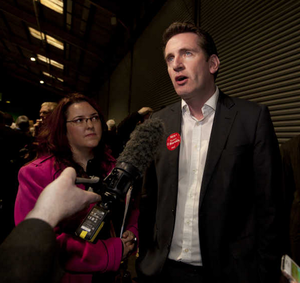



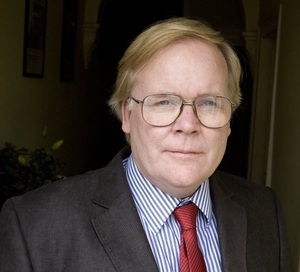
From top: Possible future coalition partners Enda Kenny and Michaél Martin; Michael Taft
We need a new conversation and a new way of doing business among progressives, just as we need these at the level of national and local policy.
We can’t expect people to change if we do not change.
Michael Taft writes:
So what’s it going to be? Coalition? Minority Government? Extended stalemate? What we do know is that support for the Government collapsed – by over half. Labour’s decline was anticipated, Fine Gael’s wasn’t – at least not in the pre-election polls.
We also witnessed Fianna Fail’s significant advance with a 40 percent increase in their first preference vote, winning an additional 25 seats.
In the new Dail Fine Gael and Fianna Fail look set to take 94 seats. In 2011 they won 95 seats. However, this is a smaller Dáil. In percentage terms, the two conservative parties won 57.2 percent of seats in the 2011 Dail; now they won 59.5 percent.
The conservative vote didn’t fall; it just swapped between the two parties. And this doesn’t count the increase in conservative and gene-pool TDs who look to increase from six to eleven seats.
Progressive parties and independents put in a credible performance. However, the breakthrough that many were hoping for (including me) didn’t come.
Sinn Féin increased their popular vote by 3.9 percentage points with the AAA-PbP increasing by 1.5 percentage points. Combined, these two parties look set to gain 13 seats – positive but about half the Fianna Fáil increase.
The Social Democrats took three percent but couldn’t increase on their outgoing total while the Greens are back in parliament with two seats. However, the number of progressive independent TDs doesn’t appear to be increasing at time of this writing.
So where next for progressives? Much will depend on the formation of government and potentially an election in the short-term. But for the medium-term here are a few suggestions.
1. Start an Honest Conversation
In policy terms, wipe the slate clean. One of the messages coming out of the election was that people didn’t believe the promises to cut taxes, increase public spending and establish fiscal stability. Rightly so. There is little fiscal space – far less than parties claimed.
The future is extremely uncertain: low Eurozone growth, interest rates, oil prices, currency movements, the stability or otherwise of the European banking system. Then there’s the question of the character of the recovery (how much real, how much statistical). And what about Ireland’s continuing and unsustainable reliance on a corporate tax regime which works at the expense of other countries. Start an honest conversation about the challenges we face over the next decade – and don’t be surprised how many people will thank us for it.
2. Talk about the Economy
Strangely, there was little talk about the economy, about how we generate wealth, income, and sustainable enterprise activity. Let’s start that conversation. We can start with the rich and detailed analysis by the Nevin Economic Research Institute’s Tom McDonnel. You can read the full report here – Cultivating Long-Run Economic Growth in the Republic of Ireland – and an abridged comment here. It doesn’t address the all issues (no single document can) but it sets out the foundation:
Investment makes up 50 percent of long-term economic growth. If you want to ‘continue’ the recovery or ‘extend’ the recovery to those who haven’t felt it yet, you start with investment – driving up growth, productivity and wealth.
Education is another key component of growth – that and growing the working age population through immigration. Limited resources should be targeting at our youngsters’, starting with pre-primary education.
An infrastructural investment bank, affordable childcare, R&D spending, reduce inequality (which is more than just cash redistribution), advanced broadband – these and other initiatives can help promote a dynamic and enterprising economy.
Let’s remember the old Keynesian adage: look after the economy and the budget will look after itself.
3. Social Security
Revolving contracts, uncertain hours, low-pay, lack of rights: we are creating more uncertainty in the workplace which is driving down living standards and social prosperity. We must prioritise employees’ issues –ICTU’s Charter for Fair Conditions at Work is another useful starting point.
Alongside workplace uncertainty is social uncertainty. What happens if I get sick, or can’t find another contract soon; how will I care for my parents’ in their old age or afford to send my child to third-level education? These and other questions occupy more and more people. We must ‘socialise’ these costs through accessible public services and a strong social protection system – protection for people at work as much as for those out of work. And, being honest with people, this will only happen with a much high ‘social wage’ (or higher employers’ social insurance). That’s how continental European countries do it.
4. A New Way of Doing Business
Why don’t progressives talk about enterprise? It’s how we generate jobs, incomes and security. If low taxes and social insurance, low wages and ‘labour flexibility’ were the key to success, we would have the best indigenous enterprise sector in Europe. Instead, we have one of the poorest sectors. We need to grow investment-minded and productive companies – through public and municipal enterprise, new models involving labour-managed companies, new hybrid forms of non-profit and for-profit companies, community cooperatives and enterprises (working with local capital), and more attractive supports for private companies tied with public equity (if the state takes the risk, it should share in the success).
Business is too important to be left to Irish business.
5. Don’t Forget, We’re Europeans
How many times did Europe come up in the general election debate? Not much. If at all. We need to talk about the alliances we will make to advance policies that will benefit all those living in Europe. And this is not just about opposing TTIP (the Transatlantic Trade and Investment Partnership) or demanding our money back from the banks, though this will be part of it. What about the proposal to end low-pay by pegging minimum wages at the low-pay threshold (60 percent of median income in each country)? Or an economic QE programme to fund an investment programme in transport, telecommunications, energy, housing and education? And, of course, ending the irrational austerity programme through a progressive adaptation of the EU fiscal rules.
And while we’re on the subject of Europe – let’s call for Ireland to sign up to the Financial Transaction Tax being introduced through enhance cooperation.
These are just a few suggestions. Others will have more and no doubt better ones. But there’s one more thing: progressives must end the sectarianism and division among the Left and Centre-Left. Cooperation, tolerance and open-mindedness are needed now more than ever.
We need a new conversation and a new way of doing business among ourselves, just as we need these at the level of national and local policy. We can’t expect people to change if we do not change.
But there’s much to be hopeful about. Fintan O’Toole made an important point yesterday, rightly saying that the majority of the Irish people are moving in a different direction from the one the Government wanted to go – a pathway public services, housing, solidarity and more equality. We have a great opportunity to work with people in moving the country in that direction.
The future is progressive – if we make it so. That will take some hard work.
Michael Taft is Research Officer with Unite the Union. His column appears here every Tuesday. He is author of the political economy blog, Unite’s Notes on the Front. Follow Michael on Twitter: @notesonthefront