
Yearly Archives: 2017

listradeListrade


Listrade writes:

One of the more interesting things about inhabiting social media or comments sections is playing behavioural psychology bingo. This act in itself is a form of cognitive bias. It suggests I consider myself above the average commentator who regularly indulges in logical fallacies and cognitive biases.

The average driver considers themselves a better driver than the average driver. Wikipedia-researched logical fallacies and cognitive biases get thrown out into online discussion as tools to diminish an opposing argument. The accuser implying they would never be so stupid as to fall into that trap.

The good news is that practically everything that annoys or angers you about people on the internet is easily summed up by one of the numerous Wikipedia articles on Psychology. The bad news is that it applies to us all equally.

Sticking to our so-called “bubbles” gives the impression that opinions appear to have become more polarised and hardened. That only the side we align with shows logic and reason. That it would be a better world if the other side would just admit they are wrong.

The biggest problem comes from the fact that the “other side” usually doesn’t exist. We’ve created it and tagged it as a reductive left or alt-right. We’ve assigned characteristics from a minority to the majority.

Polarisation of opinions has been inevitable, not because people are unreasonable or irrational, but because people are people. This dive into the “post-truth” world was always going to happen ever since the first BBS [bulletin board system]. Then came the dark days when Uncle Tupelo split up and you had to choose between Farrar or Tweedy. No middle ground, choose now.

Mathew Inman did a great strip on something called the backfire effect in the latest Oatmeal, which was a distillation of the You Are Not So Smart podcast’s three episode in-depth look at this effect. The principle is that some beliefs are so key to who we are, that no matter what the evidence put in front of us, we will reject it.

Reject it and become even more hard-lined in our belief. In short, somethings we hate being wrong about and will believe all kinds of crap in order that we can convince ourselves we aren’t wrong. The current polarisation of opinions can be put down to the backfire effect.

Way back in my early days of public policy, a new early draft of legislation landed and I was charged with finding all the problems with it. For problems, read things that the people who paid our wages wouldn’t like, i.e. things that would cost them money.

There were a lot of problems with it and not just financial ones. It was a mess. The bits that weren’t poorly written were cut and paste from archaic UK regulations (UK references left in place) There was no way it could go through as it was. Except it very nearly did.

Once the errors and necessary corrections were highlighted, rather than them getting changed, the responsible Department dug their heels in and put all their effort into pushing it through with the legislation as it was.

The only amendments accepted at the initial stage were those that would make it worse (for us at least). It was 12 months of swimming upstream against the backfire effect before we got anything changed.

There is plenty of research (much of which is gone through in the podcasts) that seems to show this effect and on a range of issues and topics.

We argue away in a vain attempt to convert and change people’s minds and it turns out it is all for nothing and only works to make them more hard-line in their belief. If anything it drives them to be more extreme in their views than lessening them. That’s how we end up with r/Donald.

However, a worse trait is that when someone finally admits they were wrong against all the psychological odds, we shame them. The Twitter user @Trumpregrets has over 250,000 followers. Its soul aim is for us smarter liberals to laugh at those who now regret voting Trump. Instead of welcoming them or working to align them to a cause, we create a twitter account for all the smart liberals to laugh at the stupid blue-collar workers.

We routinely remind politicians and celebrities of when they were wrong years ago, even though they’ve admitted their error or changed their minds based on evidence.

We say they’ve flip-flopped and post a tweet from seven years ago of them stating something different. It’s acceptable when they deny ever having held such an opinion; have at them, but when they’re admitting they were wrong, that’s different.

Against all the odds and human nature, some people accept their belief was wrong. Let them have that moment without sneering or shaming.

After far too long in public policy and my eventual epiphany, it became as physically draining working against the backfire effect in the legislature as it is trying to reason with someone on an internet comment section, except with less Youtube links.

I vowed to never be that person, to weigh up the evidence and not dismiss contrary views so quickly. I would admit when I’m wrong and not be ashamed. I’m sure that when the day comes when I am wrong, that’s exactly what I’ll do.

Three years ago Listrade asked himself “are we the baddies?” after 10 years working for a lobbying group and retired to Argentina with other ex-lobbyists and baddies. Since then he has never finished the novel he’s been working on for 20 years, but has completed Undertale in peaceful and genocide several times and is two Korok seeds short of 100% completion in Zelda.

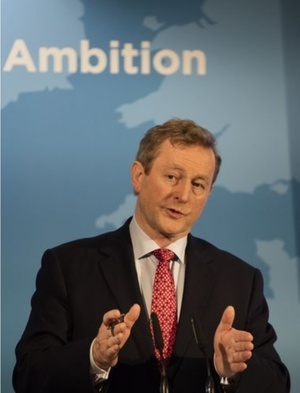
From top: Michael Bernier addressing the dáil last week; Derek Mooney

Last Thursday, the EU’s chief negotiator in the Brexit process, Michel Barnier addressed the Oireachtas. While M. Barnier’s speech was, not surprisingly, short on detail it still contained sufficient key phrases, including this one:

I want to reassure the Irish people that in these negotiations, Ireland’s interests will be the European Union’s interests. We are in these negotiations together and a united EU will be there for Ireland

to reassure most of the assembled Deputies and Senators that he (and his considerable team of technocrats and negotiators) understand and have Ireland’s interests at heart.

It was a strong performance from the well regarded and highly experienced French politician. To his credit, he not only addressed the Dáil and Seanad, he then sat through some fourteen individual responses from party and groups leaders plus independent TDs and Senators.And he did all this while perched on a seat facing the Ceann Comhairle, just in front of Brendan Howlin and Gerry Adams.

Perhaps this was some bizarre cruel and unusual trial by ordeal set by the Dáil’s committee on procedures and privileges to test his stamina and fortitude? If so, he passed it easily.

Throughout his speech Barnier referred to the importance and significance of the actual negotiations themselves, using the word “negotiate” itself, or a variation on it, about a dozen times, including this important reference towards the end of his address:

“If we put things in the right order, if we negotiate with mutual respect, without any aggression or naivety and are open to finding solutions, there is no reason our strong Europe cannot maintain a strong relationship with the UK.”

The inclusion of the word “naivety” here – along with the word “aggression” – has some significance. Over the past few weeks, and particularly since the announcement of the UK general election, it has seemed that Theresa May and her ministers have been deliberately ignoring the usual dynamics of negotiation.

Speak with anyone with experience in negotiation, be it in labour relations or conflict resolution, and they will tell you how easily things can go wrong when the basic rules and principles are ignored.

They are not that complicated. Negotiations are general seen as either a positive or a zero-sum game and you adjust your approach, as appropriate, to get the result you want.

This requires a lot of preparation – including preparation around two key negotiating process dynamics.

The first of these is “attitudinal structuring” or, in other words, putting yourself in the other person’s shoes. It involves getting the other party to start to see things from your point of view, and to begin to change their own attitudes accordingly.

The second one is, “expectation management”. That involves getting your own people prepared for likely outcomes and not running the risk of seeing delivery of any negotiation outcome fail because you over promised and then under-delivered.

On none of these three areas have the UK made any realistic moves. Rather they have insisted on badly playing their already lousy hand of self-dealt cards.

The preparation has been minimal with the boss of the top civil servants trade union bemoaning the fact that May’s government has under invested in the civil service with many senior civil servants are already working six and seven day weeks trying to prepare for Brexit negotiation.

Apart from some the occasional soothing noise from the UK’s Brexit Secretary, David Davis, there has been virtually no attempt to “structure the attitude” of the EU towards the UK in a favourable direction. The traffic has been all in the other direction with senior ministers on May’s cabinet hurling insults and accusations across the channel as if they were rehearsing for a black and white episode of Dad’s Army.

What we have seen from the British Prime Minister and her team is a war on two front, not a preparation for a serious negotiation. The first front, is the one across the English Channel (and the Irish Sea) as they see themselves fighting a verbal war for liberation from a despotic and evil EU empire.

The second is the home front, but this front set along the land border with Scotland and the sea one with Northern Ireland, not downtown Walmington-on-Sea.

Where once May spoke of listening to the Brexit concerns and worries of the constituent nations of the United Kingdom of Great Britain and certain parts of Northern Ireland, she now studiously ignores them. It is worth noting that she spent more time electioneering at the Balmoral Show in Belfast last Friday than she had on the ground attempting to get the institutions up and running.

The net result of the hostilities on these two battlefronts is that she has raised expectations as to what she can achieve from Brexit to such a pitch that it cannot be delivered.

Indeed, the stakes are being raised on the other side of the negotiations. As I write this I see that President Macron has announced the appointment of Edouard Philippe as his Prime Minister.

Not only is Philippe a member of the centre right Les Republicains party, a signal of Macron’s outreach to them, he is also – as Mayor of Le Havre – an avowed critic of the Le Touquet Agreement – this could see all those refugee camps move from Calais to Dover and beyond.

While Theresa May has been politically astute in calling the election now and avoiding a more fraught campaign in the immediate aftermath of whatever eventually emerges from the Article 50 negotiations, she has over hyped the rhetoric and overheated the expectations from Brexit.

She has also considerably increased the chances of the UK leaving the EU without a deal. It is why Barnier warns of the perils of “naivety” and “aggression” in negotiations and why it was particularly important for him to do so in the parliament chamber of the EU member state poised to pay the heaviest price for such British folly.

About the only positive thing you can say for this early election is that it may mean that Boris Johnson won’t be Foreign Secretary after June 9th and an actual fully formed and sentient adult may be put in charge of the Foreign Office.
Derek Mooney is a communications and public affairs consultant. He previously served as a Ministerial Adviser to the Fianna Fáil-led government 2004 – 2010. Follow Derek on Twitter: @dsmooney

Fine Gael TD and Minister for Social Protection Leo Varadkar

This morning.

On Today with Seán O’Rourke.

Further to the Minister for Social Protection Leo Varadkar’s Welfare Cheats Cheat Us All campaign…

Cllr Gavin Mendel-Gleason, of the Workers’ Party, in Dublin North West, and Paddy Smyth, Dublin City Fine Gael councillor for Rathgar-Rathmines, spoke to Mr O’Rourke about Mr Varadkar’s campaign.

Former inspector with the Department of Social Protection Bernadette Gorman later joined the conversation by phone.

Ms Gorman accused Mr Varadkar of launching the welfare cheat campaign as a means to improve his chances of becoming the next leader of Fine Gael and, by extension, Taoiseach.

She also called it a “hate campaign”.

From the interview:

Sean O’Rourke: “First of all, to you, Paddy Smyth, Fine Gael councillor for Rathgar-Rathmines. Is Leo Varadkar taking, is he taking a sledgehammer to crack a nut here?”

Paddy Smyth: “Not necessarily. The amount of welfare fraud that goes on, estimated by the department, is a sizeable sum. Hundreds of millions of euros, of taxpayers’ money, that is claimed fraudulently. Now, the most interesting thing, I think, about this campaign is the reaction from certain parties. The fact that certain parties can find a politically profitable to condone, if not rightly encourage, social welfare fraud, I think is a very worrying development for our society. As I said, hundreds of millions of euros.”

O’Rourke: “Hold on now, where is this hundreds of millions coming from now?”

Continue reading →

This morning.

Buswells Hotel, Dublin 2

The launch of Solidarity’s Equal Participation in Schools Bill – to be be debated  in the Dáil tomorrow evening – which would abolish the ‘Baptism Barrier’ and usher in a pluralistic curriculum.

A quarter of of parents baptise their children for the sole reason of beating a system that favours children born to Catholic parents. And problems exist once inside the classroom.

Ms Coppinger said:

“Currently, it’s practically impossible to truly opt-out of religion in schools; many schools have an ‘integrated curriculum’ with religion being mixed into other subjects. Religion should be on an opt-in basis, not out-out. Make the curriculum objective and pluralistic. There is a legal obligation on the Department to respect religious views when setting the National Curriculum. This means no proper sex education dealing with issues for LGBTQ.”

Above from left Megan Brady, secondary school student and  LGBTQ rights campaigner, Sarah Lennon, chair of Education Equality, Ruth Coppinger, Solidarity TD, Roopesh Panicker, a Hindu parent whose daughter was denied admission to local primary schools, Richard Boyd Barrett , People Before Profit TD.,

Leah Farrell/Rollingnews

David Wall (above) has placed eight crosses on his cycling helmet (top)

Cyclist David Wall writes:

Yesterday , the eighth cyclist was killed on Irish roads this year. Last year, 2016, 10 cyclists died in total. If this rate of carnage continues, at least 17 cyclists will die on our roads this year.

How many have to die needlessly before we finally decide to invest in decent, safe cycling facilities?

Why is it that when I decide to cycle to work, I feel like I’m taking my life in my hands? Does any other transport user feel the same?

I wear a helmet, I use lights, but I am still never sure there won’t be an incident on my way to and from work. I am one of those cyclists that obeys the rules of the road, I try to respect all other road users, I stop at lights, etc., but still I have come close to serious injury so many times – by hitting massive potholes, by being squeezed against the kerb, by having to swerve around vehicles parked in bike lanes (constantly), by being cut off by drivers turning left to dream land, or cutting across me, or flying by me, or breaking the lights.

Cycling has exploded in Dublin, and around the country. But the facilities are still archaic. The previous government supported the Dublin bike scheme, because through selling advertising, it cost almost them nothing.

They are not, however, willing to invest in the outcome of such a scheme: more cyclists on dangerous roads needing safe, separate cycling infrastructure.

According to the recent Department of Transport, Tourist and Sport (DTTaS) Transport Trends 2016 document, the number of journeys on Dublin Bikes has increased from 1.2 million in 2010 to 4.1 million in 2015.

It also states that the number of cyclists entering the city increased by 74.5% between 2010 and 2014 as it increased from 5,932 to 10,349. If you are going to increase the number of cyclists, you’d had better increase the spend on cycle infrastructure. Otherwise you are asking for carnage.

This is not, however, what is happening. According to the DTTaS Transport Trends 2016 document, of a total DDTaS transport spend of 1 billion, 464.6 million in 2015, only 21.4million was spent on sustainable transport (walking and cycling), which is roughly 1.5% of the entire budget.

But according to the same document, walking and cycling are responsible for 21.9% of all journeys in Dublin and 14.1% elsewhere. So how does that compute?

The long awaited city quay cycleway, to finally provide a safe route for cyclists along the quays, has been delayed again a couple of weeks back after coming under pressure from business lobby groups.

Now there is talk of taking cyclists off the road altogether and along a boardwalk style cantilevered cycleway, which would mean they would have to cross over footpaths twice at each junction to get onto and off the main road. This is another proposed Irish fudge that will end up serving nobody.

A pedestrian can travel safely to work on a path, a bus user in a bus lane, and a driver on one of the many many single and dual carriageway routes into the city. But the cyclist usually has a meter wide strip painted (if lucky) on the left of an existing carriage, which may sometimes be used by traffic, and other times by parked cars, making it meaningless, and dangerous.

To the politicians, us cyclists are invisible, voiceless and powerless. We are easy to ignore, even though the danger to us is patent to any road user. They can talk about the need for facilities while doing nothing, it will not affect them. We do not register with them or their electoral concerns.

On the radio we have commentators like George Hook stoking animosity against cyclists on a daily basis, complaining that we don’t obey the rules of the road, that we cause accidents, that we are the danger to others.

There is not, however, a battle of us versus them as he would like; we are all road users, and all we want is to arrive to our destinations safely like everyone else. People like him would have us taken off the road if they could. But we don’t even want to be on ‘their roads’, we want our own dedicated lanes!

These people need to realise that we are not going away. They need to be held responsible for the conflict they wish to provoke. With every accusation they make against us, implying we don’t have a right to share their roads, they make it easier for us to be ignored by politicians, councillors and functionaries.They make it easier to overlook the fact that we have to navigate treacherous routes.

We know, however, that Dublin, being flat and mild, could be a perfect city for cycling.

We know that cycling is one of the best, cheapest, healthiest, most environmentally friendly modes of transport. There is no reversing the trends, we are not going away, unless the carnage on our streets continues. Maybe they would like that.

We need to stop being invisible on the roads. It is about time that we should make ourselves unmistakable, unforgettable, and blatantly conspicuous to other road users. When they see us on our bikes, there should be no doubt about the harm that their carelessness can cause us.

Just because we opt for a particular mode of transport, we shouldn’t have to accept more risk than other road users. For too long cyclists have been politically imperceptible.

Let us wear our vulnerability on our heads. This year, and every year to come, until there are safe, segregated, cycling facilities in the city,

I will wear a cross on my helmet for every cyclist that has been killed unnecessarily that year. I invite anyone else who feels like they are entering a warzone on their daily commute to join me, so that the effect of such lack of investment will no longer go unperceived.

When I first thought about writing this, there would have been six crosses on my helmet. Now, there are eight! How many more will there be, needlessly, this year alone?

In 2017, let’s wear our vulnerability on our heads. Let’s remind other drivers of the danger we are constantly subjected to. Then, when the divisive, car commuting commentariat complain about cyclists on their roads, we won’t let them forget that it is them that are killing us, and not the other way round.

David Wall is a philosophy and architecture graduate from Dublin. David describes himself as a ‘routine cyclist’

Pic: David Wall