





More to follow.



More to follow.

Number 12: Dublin 1660 -1860: The Shaping of a City by Maurice Craig
Selected by: Stan
First Published: 1952, revised 1969, numerous reissues since, most recently a hardback special edition by the Liberties Press in 2009.
Why? “Ostensibly an architectural history of Dublin, it is in fact, a biography of the place, a city that emerges as a capricious and moody character, prone to fits of near catatonic depression and withdrawal, interspersed with periods of manic growth and energy.”
It Stays with You: “If you spend enough time with it, it teaches you to see the city as Craig did, not as a statically glorious monument to a ragged Georgian peak, but as a constantly re-written text. Though he wrote it at a time when that heritage was beginning to be appreciated, he was neither a snob or a reactionary. He understood the city as a site of struggle throughout – inside and outside the walls, north and south sides, catholic and protestant, and as a stage for a constantly changing population of immigrants.”
Legacy: “More than anything, it reminds you that the boom and bust cycle of the last few decades seems to be written into the DNA of Dublin: the ‘magnificent’ Georgian Squares were thrown up by less than scrupulous speculators who would have been perfectly at home during the Tiger years, and the time during which Dublin briefly swelled into one of Europe’s biggest cities before falling into a near 150 year decline reads like a pre-figuring echo of more recent vanities.”
Availability: Out of stock; Available at Amazon and eBay and in some library branches nationwide (list here).
Previously:
Damien Shiels
Emily O’Reilly
Graham Howard
David Flanagan
Maura ‘Soshin’ O’Halloran
Kevin C Kearns
Ed Moloney
Gene Kerrigan
Bobby Sands
George O’Brien
Eamonn Sweeney
Terence Patrick Dolan
‘Great-Irish Non-Fiction’ is a reading list of 100 books chosen by YOU and highlighted over the coming weeks. If you would like to include a favourite leave your suggestion below.






MORE to folly


MORE to folly


From top: The youth mass at Ballybrrit Racecourse, County Galway during Pope John Paul II’s visit in 1979: Ciaran Tierney
In far more innocent times, as children, we got up at the crack of dawn. I remember the excitement in the family home, as we arose and prepared for the biggest and most symbolic walk of our young lives.
I still recall the folded deck chairs, the home-made sandwiches and flasks of tea, the yellow and white flags.
At the house, the looks of envy on the faces of the younger siblings and the two grandmothers, who were not old enough or able to join the mass exodus on foot to the racecourse on the other side of the city.
We met up with the cousins, seeing the sense of adventure in their eyes, and the adults around us gave us a sense of what a huge moment this was in our shared history.
There were thousands upon thousands at the racecourse, corralled into zones at the biggest event I had ever seen. This was bigger, even, than an All-Ireland final and a ripple of excitement went through the crowd as the helicopter landed near the grandstand.
And, then, the immortal words . . .
“Young people of Ireland, I love you!”
This was Ballybrit, Galway, in 1979. It felt like a moment of triumph for Catholic Ireland and I could see its significance in the eyes of my parents as they told me how wonderful it was that Pope John Paul II had come to our town.
Our generation of children even became known as the “Pope’s children” after that day in Ballybrit but, looking back almost four decades on, it now looks like the end of an era rather than the start of something wonderful and new.
It actually seems unbelievable now that 79% of the Irish people went along to welcome Pope John Paul II to our land 39 years ago.
Up on the altar in Galway, Pope John Paul II was flanked by two Irish clerics, Bishop Eamonn Casey and Fr Michael Cleary, both of whom it would later transpire had fathered children in the years prior to that memorable day in Galway.
As many people have pointed out since, their indiscretions paled into significance in the context of so much criminal abuse which has been uncovered in recent years.
So much has changed.
It dawns on me now that my family and I walked past the Magdalene Laundry in Galway in order to make our way to Ballybrit to hear the pontiff express his love for us.
Only nobody ever talked about the young women who were incarcerated inside, washing the bed linen for the “great and the good” of our city.
As children, we never heard anything about the 10,000 women and girls who were locked up in Magdalene Laundries across Ireland from 1922 to 1996.
Yes, it’s still shocking to think that these prisons for “fallen women” remained in place until well into the 1990s.
It dawns on me now, too, that so many of my generation were being abused at the time of the last papal visit, because nobody questioned those in authority and certainly not members of the Catholic Church who had so much control over our daily lives.
In any Irish family, it was considered an honour to be an altar-boy. In 1979, if a young woman became pregnant outside marriage a priest could still arrive at the front door of the family home to whisk her away to a life of imprisonment. Such was the shame.
We did not question those in authority and we had never even heard of child abuse or peadophilia in 1979.
It dawns on me now that it would take another 35 years before we heard about the 796 ‘Tuam Babies’, dumped in unmarked graves less than an hour up the road from where the Pontiff expressed his love for all the young people of Ireland in Galway.
We were never told about the women and children who were imprisoned in that now notorious Tuam home until 1961. I guess the lives of those women didn’t matter because they were ‘guilty’ of being born outside marriage in a far more judgmental Ireland.
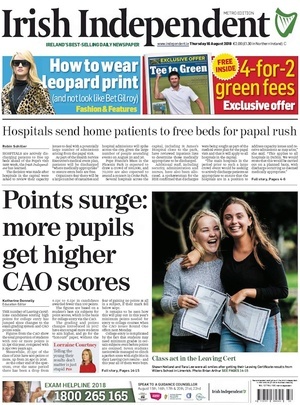
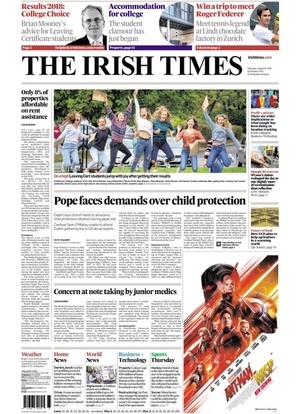
As Ireland prepares to welcome Pope Francis next week, it dawns on me now that the Church he leads has done so much harm to my people, destroyed so many lives, and that so little has been done to make amends.
Doubtless, there were children in Ballybrit that afternoon who are no longer with us, because the pain and trauma of what they endured at the hands of the Irish clergy was far too much to endure. For many, death and self-destruction was the only answer to the pain.
So many Irish families were torn apart by clerical abuse, their pain magnified by the response of church authorities who moved abusers around from one parish or part of the country to another rather than helping to find justice for the victims.
So many people were labelled as “illegitimate” or less than human, so many young mothers had children taken from them against their will, perhaps for adoption by “good Catholic families” in the United States, because unmarried mothers were too stigmatised to be allowed bring them up here in Ireland.
So many of us now see the Catholic Church as an international organisation which ignored, facilitated, and covered up the abuse of Irish children that it’s hard to imagine how enthusiastically we welcomed a former Pontiff back in 1979.
Were we really so innocent? So naive? Did people really have no idea that such terrible crimes were taking place at the time?
We now know that a comprehensive report found that the church authorities responded to clerical abuse with “denial, arrogance, and cover-up” nine years ago. In the interim, what has changed?
We now know that the Bon Secours order stonewalled or ignored the victims and families of the “Tuam Babies” when they sought the truth or some semblance of justice for their 796 loved-ones.
They are still refusing to engage with the families in 2018, a year after the research of historian Catherine Corless has been completely vindicated by the Irish Government.
We know that up to 140 Irish children were abused by just one priest in Northern Ireland, Fr Brendan Smyth, who was free to travel throughout the land (and continue to abuse) even though the most senior cleric in Ireland was aware of allegations against him.
Had action been taken, how many shattered lives might have been saved?
We have found out about so many shocking cases of abuse, cover-up, and denial involving Irish women, children, and men at the hands of members of the Roman Catholic Church that it seems we cannot be shocked any more.
It’s because of the clear litany of scandals they have endured that Irish people have changed immeasurably since 1979. In the intervening years we have legalised homosexuality, divorce, marriage equality, and abortion, despite strong opposition from a church which seemed to dominate all aspects of our lives back then.
Now people want the Catholic Church to be removed from our schools and hospitals and they want full and meaningful apologies for all the hurt caused and lives destroyed.
When Pope Francis speaks to thousands of people in the Phoenix Park in Dublin on Sunday, August 26, hundreds of others will assemble at silent vigils in places such as Tuam and Dublin.
All they want is acknowledgement of the truth and the terrible damage caused to so many innocent Irish people by the Roman Catholic Church.
As a child, I took part in the longest walk of my young life to see Pope John Paul II in 1979. Like so many others, I was innocent, joyful, and enthusiastic that the head of our global church proclaimed his love for me and all the young children of Ireland.
Almost four decades on, all that innocence has died.
I would far prefer to attend one of the protests, to stand side-by-side with the amazing victims, than celebrate the visit of the figurehead of an international organisation which has always seemed far more interested in protecting its own power than the welfare of Irish children.
The innocent victims have found their voices and Pope Francis is missing out on a powerful opportunity to atone for a terrible past if he refuses to meet them, hear their stories, and apologise.
Those of us who are of a certain age may have walked in our thousands to Dublin, Galway, Knock and Drogheda in 1979, but Ireland is a very different place right now and people are no longer willing to accept the blatant abuse of power.
Decades of abuse and cover-ups won’t be wiped out by protests, but it is so important that Pope Francis and the entire Catholic Church is reminded of the damage done.
Those who have been abused will stand together in solidarity at the Garden of Remembrance in Dublin on Sunday, August 26, and at the site of the Tuam Mother and Baby Home.
That to me will be a far more powerful ceremony than trying to regain the long lost innocence of 1979 and a ‘Catholic’ Ireland which has long since vanished.
Ciaran Tierney is a journalist, blogger, and digital storyteller, based in Galway, Ireland. Find him on Facebook here
Pope Francis And Long Lost Innocence (Ciaran Tierney)
Pics; RTE/Connacht Tribune

Number 11: The Irish in the American Civil War by Damian Shiels
Selected by: Papi
First published: October, 2012 by The History press.
Why: “A painstakingly researched labour of love. The level of detail means it is not a dry recitation of lists and rolls, but an actual look into the human aspects of being an Irishman and woman in the American civil war. The book is written, not as a civil war book, but as a chapter of Irish history that happens to be based within that conflict”
It stays with you: “Because of the staggering stories of both the heartbreak of war, but also the families left behind and futures both lost and made of almost 200,000 Irish soldiers on both sides of the war.”
Who would like this? “Any student of history, or admirer of stories of day to day people in the past – made all the more poignant due to the massive number whose stories aren’t told in the book – would be a big fan of this book.”
Availability: Still in stock; Also available in most library branches nationwide (list here).
Previously:
Emily O’Reilly
Graham Howard
David Flanagan
Maura ‘Soshin’ O’Halloran
Kevin C Kearns
Ed Moloney
Gene Kerrigan
Bobby Sands
George O’Brien
Eamonn Sweeney
Terence Patrick Dolan
‘Great-Irish Non-Fiction’ is a reading list of 100 books chosen by YOU and highlighted over the coming weeks. If you would like to include a favourite leave your suggestion below.







More to folly

Fergus Keane, of FRO Films, writes:
“As summer draws to a close, some summer relationships may need to be gently wound down. We spare you having to read a magazine’s unsightly instructions on how best to do this by offering “TEN pain-free ways to leave your lover”
Previously: How To Nail Any Irish Job Interview

Number 10: : Masterminds of the Right by Emily O’Reilly
Selected by: Barbara
First published: 1992 (Attic Press)
Why: “Masterminds of the Right investigated and exposed the shadowy world of right-wing forces that plotted the 1983 referendum on abortion and the 1992 Maastricht Protocol to deny women reproductive rights. It is a slim volume that succinctly traces the links and agendas of individuals and organisations at work behind the scenes, but close to Official Ireland, who were determined to introduce and maintain regressive and socially conservative initiatives.”
It stays with you: “Because it is almost chilling to discover the power these people and groups exercised over politicians and the judiciary, not just in the 1980s where a “national” constitutional issue was at stake but much later in 1992 for the great European initiative that was Maastricht. It is also chilling to realise the ease with which these forces moved almost invisibly to wield huge power without any accountability.”
Who would like this? “Anyone interested in the roots of the opposition to the recent referenda on marriage equality and abortion, many of who may be too young to remember the darkness of the 1983 campaign to insert the Eight Amendment into the Irish Constitution, and the shadowy world occupied by the masterminds of the Right.”
Availability: Not currently in print; available on Amazon and elsewhere online; Also available in most library branches nationwide (list here).
‘Great-Irish Non-Fiction’ is a reading list of 100 books chosen by YOU and highlighted over the coming weeks. If you would like to include a favourite leave your suggestion below.
Previously:
Graham Howard
David Flanagan
Maura ‘Soshin’ O’Halloran
Kevin C Kearns
Ed Moloney
Gene Kerrigan
Bobby Sands
George O’Brien
Eamonn Sweeney
Terence Patrick Dolan


MORE to folly