Author Archives: Bodger

The Policing Authority publishing its commissioned report on Garda breath test figures this afternoon

Readers may recall how, in March, it emerged that there were nearly one million (937,212) phantom Garda breath tests recorded by gardai between between November 2011 and October 2016.

In September, a review carried out by Assistant Commissioner Michael O’Sullivan found there were more than 1.4million (1,458,221) fake Garda breath tests recorded between 2009 and 2016.

Readers may recall that, at the time Assistant Commissioner O’Sullivan’s report was published, it was reported how the Policing Authority had hired financial auditors Crowe Horwath to conduct its own independent investigation into the matter.

This afternoon, the Policing Authority has published that report.

And they’ve found another 400,000.

In addition, the report states:

“On examination of summonses issued between 2006 and 2016, a total of 149,426 incorrectly issued summonses were identified. Several thousand convictions were imposed in relation to incorrectly issued summonses: this figure is estimated by the Garda Síochána at a maximum of 14,736, with 11,218 of these confirmed as requiring appeal to date.”

And the report found gardai they falsified the number of checkpoints that were set up…

From the report:

“From our engagement with frontline Gardaí and supervisors (sergeants) across the organisation, it was reported that some members would inflate the number of MIT checkpoints recorded on PULSE, and thereby the number of breath tests, in order to be seen to have delivered the number of checkpoints authorised for that tour of duty.

“For example, a number of Garda members in a busy urban station told us that they were frequently under significant pressure when on patrol, and at any given time might have six or seven backed up calls awaiting their response, which would be prioritised in order of seriousness.

“They explained that whilst they fully understood the value of operating MIT checkpoints from a road safety perspective, they simply couldn’t manage to perform all of those which had been authorised, and the habit had therefore developed of entering erroneous data onto PULSE – for instance, if three checkpoints were authorised and only one was carried out, two checkpoint incidents might be registered on PULSE and false data entered in respect of the checkpoint which had not been operated.”

“We were also advised that on occasions, supervisory sergeants would suggest that the numbers be inflated in order to comply with management expectations relating to MIT checkpoints being operated.

“We have also heard from serving and retired Garda members who have told us confidentially that some MIT checkpoints were authorised and recorded as having been performed, but were later found not to have taken place, whether due to the pressure to record compliance with the authorisations or (as suggested in some cases) Garda members taking advantage of the lack of frontline supervision and remaining in the patrol car or in the station rather than conducting the checkpoint.

“This tendency seems to have been particularly prevalent amongst regular uniformed Gardaí, whose operational policing duties cover a wide range of activities, and who would therefore often find themselves in a situation where the operation of MIT checkpoints on a given day would be far down their list of priorities.”

“During our visits to the 28 Garda Divisions, we asked many frontline and supervisory members about the sense of pressure to report performance in respect of MIT checkpoints. We were frequently told during these visits that there was no formal requirement in that regard, and no documentation was presented to us in respect of directives from Garda HQ or from regional or Divisional management to meet any qualified performance targets.

“Instead, the pressure was apparently more implied rather than explicitly stated, and often related to actual (as opposed to forecast) performance figures presented at Divisional or regional meetings: no Division wanted to be “bottom of the league” and there was often a degree of competition and rivalry between Divisions (i.e. if one Division showed a 5% increase in the number of MIT checkpoints operated, then a neighbouring Division would want its performance to at least match that).”

“This was interpreted by many frontline and supervisory Garda members as meaning that MIT checkpoint data needed to be maximised. By contrast, the prevailing view from Divisional Officers at Chief Superintendent level, and from other members of local management teams, was that there was never any such pressure placed upon frontline members and supervisors.

“Indeed, many senior Divisional members were of the opinion that they were happy if checkpoints didn’t take place, provided a valid reason was given.”

In addition, it found, contrary to claims made by some senior gardai that there were no performance targets, there is evidence of specific targets being set for checkpoints and breath tests.

The report found:

“…we have reviewed a selection of Divisional Policing Plans published during the period 2009 to 2016, and it would appear that in a number of these plans there are indeed specific targets relating to both MIT checkpoints and breath tests.

“In relation to the latter, it is not clear whether these are breath tests conducted at MIT checkpoints or those carried out either at the roadside or in Garda stations as a result of other operational policing activities.

“The content of the Divisional Policing Plans differs from one Division to another, and will generally depend upon local priorities and policing needs, with a link to overall national priorities and targets.

“It is certainly the case that some Garda Divisions set and published targets for the performance of MIT checkpoints and breath tests on an annual or quarterly basis, which again is at variance with some of the claims by senior officers that no such targets existed.”

Yet.

It also found:

“Our view is that it is highly unlikely that there is any connection between the inflation of MIT checkpoint data on PULSE and any personal gain which a Garda member may have wished to attain. Clearly, fabrication of MIT checkpoint data to justify a false claim for overtime payment would represent both a disciplinary and criminal matter, but we have seen no evidence to suggest that this actually happened.”

Meanwhile…

At the press conference…

Previously: A Breathtaking Timeline

Another Half A Million

Pic: Policing Authority

UPDATE:

The report can be read here
Forgotten Irish Tricksters is an occasional series where historian Sibling of Daedalus unearths the inventive Irish con men and women lost to time.

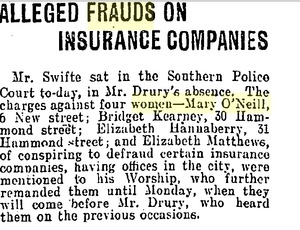
Number 3: Mary O’Neil

Sibling of Daedalus writes:

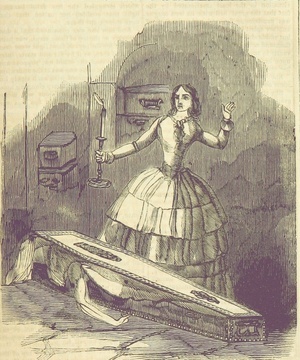
Bridget Connell, of 35 Cook Street, Dublin, was an elderly lady with only one thing of value: her life, which was insured with the British Life Assurance Company for the sum of £8.

On March 16, 1904, her niece, Mary O’Neill, with whom she shared a tenement, told Mrs Connell, who was ill in bed, that she was in financial difficulties and going out to get money, to lie very still with her eyes closed and not to be annoyed with her.

As instructed, Mrs Connell lay very still all day. She must have known there was trickery, for her niece had left her covered in a shroud and surrounded by candles, but she did not realise that the trick was on her.

The penny dropped, however, at 4 pm. that evening, when a little girl, passing down the stairs, told her that Mary was up on nearby High Street in a cab with a coal porter and a Royal Fusilier, having a merry old time.

Mrs Connell might have been 83 years old but was not slow at putting two and two together. She headed promptly to the nearest British Life Assurance office, only to find that she had been declared dead by her niece earlier that day, for the purposes of obtaining payment under the policy.

The revived corpse was still very much alive at the trial of Mary O’Neill in the Southern Police Court, Dublin, which took place later that year. Mrs O’Neill’s defence that her aunt was expected to die any time was not accepted by the court.

Bitter after having been sentenced to two months’ hard labour, she informed the court that she was sure Mrs Connell would be dead and buried before she came out. It is not clear if this happened.

What is clear, however, is that old habits die hard…

….Three years later, Mary O’Neill was again before the Southern Police Court, this time as the ringleader of the famous Dublin Mammies Insurance Scam – a complicated bit of trickery involving four middle aged women, six insurance companies and not-so-dead corpses too numerous to count.

This time, her husband, William O’Neill, whom she had described, when registering his death, ‘as fine a man as you could wish to see, and now he is gone’, who came back from the dead to give evidence against her….

illustration: ‘The Spectre of the Hall’ by JM Rymer

Previously: Forgotten Irish Tricksters 1: Mary Kate Hodges

Forgotten Irish Tricksters 2: Maureen Corrigan and Charlotte Brownlee

Merrion Square, Dublin, May 28, 1935

Gott in Himmel.

Sibling of Daedalus writes:

While researching fascism in 20th Century Ireland I came across this photo in the Dublin City library archive published in the Evening Mail in 1935…

It shows (in dark suit) Colonel J ‘Very preposterous’ Ryan, Vice-Director-General of the League of Youth (formerly The Army Comrades Association later the National Guard, then Young Ireland but always known affectionately as the Blueshirts), presenting “warrants of appointment” to officers of the ‘Southern Dublin Division’ at the back of 3, Merrion Square, Dublin 2, HQ of the ‘shirts.

More women than Leo’s cabinet.

Just saying…

FIGHT!

Dublin City Library Archive

Previously: Sibling of Daedalus on Broadsheet


They’re a little needy.

For the Bloomsday that’s in it.

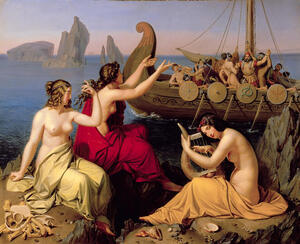
A swarm of Sirens selected by historical blogger Sibling of Daedalus.

Sibling writes:

Episode 11 of Ulyssess takes place in the Ormond Hotel where Leopold Bloom reimagines two barmaids and a lady of the night as the mermaids inducing men to their deaths in Homer’s epic, Odysseus.

To give these much-maligned, femmes fatlales their due (Siren’s Day?) behold a hand-picked collection of virtually irresistible, shore-based temptresses captured by painters through the years.

As Bloom later notess: “Beauty: it curves, curves are beauty. Shapely goddesses, Venus, Juno: curves the world admires.’

FIGHT!

From top: Henrietta Ray; Leon Auguste Adolphe Belly; William Etty; Gustav Wertheimer; Gustav Moreau; Otto Greiner; Peter von Cornelius;  JW Waterhouse; Norman Lindsay; HJ Draper and Otto Greiner.

From top: Mayo-bound German parachutist?l The Evening Herald, November 28, 1945

Or did he?

Forgotten Irish Tricksters‘ is a series by historical blogger Sibling of Daedalus exploring the absolute chancers that brought acting the maggot to an artform but are now barely remembered.

Number 2:  Maureen Corrigan and Charlotte Brownlee.

Sibling of Daedalus writes:

Throughout the Battle of the Atlantic, the bodies of dead German airmen washed up with regularity onto the rocks of the coasts of the west of Ireland.

Occasionally it was rumoured that, like the sailors of the Spanish Armada, some of them survived, hidden in remote cabins, awaiting a more formal invasion by their countrymen.

No one was entirely surprised, therefore, when, in 1944, two teenage girls, Maureen Corrigan and Charlotte Brownlee, reported the presence of foreign parachutists in the Ballina area.

But, after an apparently thorough search by army and Gardai failed to uncover any trace of foreign men, the girls were charged, convicted and sentenced to several months for wasting official time and general trickery.

According to the judge hearing the case, Corrigan and Brownlee were thoroughly bad, their actions prompted by exhibitionism, the wish for their photographs to appear in the papers, and the desire to be interviewed at length by high-ranking army officers.

However, the following year, Sergeant Michael Cavanagh, a Mayo-born soldier in the American Army, disclosed to the Evening Herald the existence of Nazi documents designating North Mayo as a leading airfield base in the event of an invasion of Ireland.

Nothing has been heard of the girls since their conviction and sentence.

High-level trickers or lowly victims of a Churchill-deValera cover-up?

YOU decide.

Previously: Forgotten Irish Tricksters: Mary Kate Hodges

Pic: Frj2

50268-1

From top: The Dame Street/College Green plaza; The Proposed Plan for Bedford Square, as shown on Roque’s Map of Dublin (1757)

Further to news of a new plaza at the at the College Green end of Dame Street, Dublin 2…

Sibling of Daedalus writes:

This is not the first time a large civic area has been planned for that locale. Back in the 18th century the Wide Streets Commissioners had plans for a similar development at the other end of Dame Street, just in front of the entrance to Dublin Castle.

The proposed square, to be known as Bedford Square, was to consist of a large plaza with a statue of George I in the centre.

The motivation behind the plan was not to provide public amenity to the citizens of Dublin but rather to provide an excuse to clear out the existing disreputable houses in the area, home of many of the city’s brothels as well as the Eagle Tavern, in-town meeting place for members of the Hellfire Club.

The scheme for the new square was abandoned after it was decided that this aim could be better achieved by replacing the proposed plaza with a stock exchange, now City Hall, which stands approximately where the square would have been.

Bedford Square stands with the Eccles Street Circus (abandoned after the decapacitation of Luke Gardiner at the Battle of New Ross in 1798) and the Kennedy Memorial Hall as one of Dublin’s proposed developments what never were.

If the choice had been made to go ahead with the idea of a large civic plaza, Dublin might have developed into a very different, more continental city, with citizens congregating in the open air rather than indoors in pubs. Or perhaps not…

Hic.

FIGHT!

Previously: Sibling of Daedalus on Broadsheet

Bedford Square map via archiseek

windsorroad

post

From top: 14, Windsor Road, Rathmines, Dublin 6: Justice catches up with Clara Whiteley

Diamonds are forever.

Even in Rathmines.

She thought.

Irish Historical blogger Sibling of Daedalus writes:

In 1917 the landlady of 14 Windsor Road, Dublin, let lodgings to a young, smartly dressed and affluent woman, whose husband was said to be in the American Navy.

From the first day of her arrival, she took a great interest in the garden of the house, and kept her own pet flowerbed below her window. The lady subsequently left, and her carefully tended chrysanthemums fell into disarray.

One day, two gentlemen called to the house, and asked the landlady for permission to dig in the flowerbed. A spade was produced, and a small box, wrapped in brown paper, containing diamonds of considerable value, found buried under four narcissii.

The lodger had been the famous jewel thief, 19 year old Clara Whiteley. otherwise known as the Girl with the Diamond Eyes.

She had, without any assistance, stolen the diamonds from from a jeweller in Great Portland Street, London, by pretending she wanted to show them to her husband, who was in another room. In fact, there was no husband, only Clara, long gone when the jeweller went looking.

Clara’s subsequent conviction and deportation to South Africa did not deter her from a life of crime. She was last heard of in 1934 when (as Cecilia Beresford) she was sentenced to 13 months’ hard labour for stealing a cigarette case.

That’ll learn her.

Tales of Old Dublin

Previously: Sibling Of Daedalus on Broadsheet

Kitchen Confidential author Anthony Bourdain on a 36-hour visit to Dublin for the Travel Channel show The Layover, taking in from top: Matt the Tresher, Pembroke Street, Dublin; Slattery’s, Grand Canal Street, Dublin, Bite Bear, South William Street, Dublin (with proprietor, hipstaurateur Joe Macken); The Gravedigger’s pub, Glasnevin and at Roma II chipper, Wexford Street, Dublin (also with Macken, second left).

The Layover: Dublin Pictures (Travel Channel)
Joe Macken’s Dublin Eateries (Travel Channel)

Thanks PT