Tag Archives: Policing Authority

This afternoon.

In Dublin Castle.

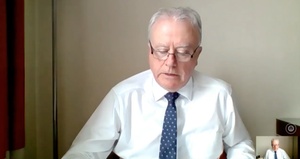
A public meeting of the Policing Authority with the acting Garda Commissioner Dónall Ó Cualáin is taking place.

As Mr Ó Cualáin is out of the country, he is appearing via video link.

According to a draft outline of the meeting’s agenda, they will discuss the Garda Inspectorate report on Child Sexual Abuse; the Youth Diversion Programme; progress on implementation of recommendations arising from a report of the Special Rapporteur on Child Protection; review of a public order incident at An Cosán; the commissioner’s monthly report to the authority and other business.

Via Policing Authority

The Policing Authority publishing its commissioned report on Garda breath test figures this afternoon

Readers may recall how, in March, it emerged that there were nearly one million (937,212) phantom Garda breath tests recorded by gardai between between November 2011 and October 2016.

In September, a review carried out by Assistant Commissioner Michael O’Sullivan found there were more than 1.4million (1,458,221) fake Garda breath tests recorded between 2009 and 2016.

Readers may recall that, at the time Assistant Commissioner O’Sullivan’s report was published, it was reported how the Policing Authority had hired financial auditors Crowe Horwath to conduct its own independent investigation into the matter.

This afternoon, the Policing Authority has published that report.

And they’ve found another 400,000.

In addition, the report states:

“On examination of summonses issued between 2006 and 2016, a total of 149,426 incorrectly issued summonses were identified. Several thousand convictions were imposed in relation to incorrectly issued summonses: this figure is estimated by the Garda Síochána at a maximum of 14,736, with 11,218 of these confirmed as requiring appeal to date.”

And the report found gardai they falsified the number of checkpoints that were set up

From the report:

“From our engagement with frontline Gardaí and supervisors (sergeants) across the organisation, it was reported that some members would inflate the number of MIT checkpoints recorded on PULSE, and thereby the number of breath tests, in order to be seen to have delivered the number of checkpoints authorised for that tour of duty.

“For example, a number of Garda members in a busy urban station told us that they were frequently under significant pressure when on patrol, and at any given time might have six or seven backed up calls awaiting their response, which would be prioritised in order of seriousness.

“They explained that whilst they fully understood the value of operating MIT checkpoints from a road safety perspective, they simply couldn’t manage to perform all of those which had been authorised, and the habit had therefore developed of entering erroneous data onto PULSE – for instance, if three checkpoints were authorised and only one was carried out, two checkpoint incidents might be registered on PULSE and false data entered in respect of the checkpoint which had not been operated.”

“We were also advised that on occasions, supervisory sergeants would suggest that the numbers be inflated in order to comply with management expectations relating to MIT checkpoints being operated.

“We have also heard from serving and retired Garda members who have told us confidentially that some MIT checkpoints were authorised and recorded as having been performed, but were later found not to have taken place, whether due to the pressure to record compliance with the authorisations or (as suggested in some cases) Garda members taking advantage of the lack of frontline supervision and remaining in the patrol car or in the station rather than conducting the checkpoint.

“This tendency seems to have been particularly prevalent amongst regular uniformed Gardaí, whose operational policing duties cover a wide range of activities, and who would therefore often find themselves in a situation where the operation of MIT checkpoints on a given day would be far down their list of priorities.”

“During our visits to the 28 Garda Divisions, we asked many frontline and supervisory members about the sense of pressure to report performance in respect of MIT checkpoints. We were frequently told during these visits that there was no formal requirement in that regard, and no documentation was presented to us in respect of directives from Garda HQ or from regional or Divisional management to meet any qualified performance targets.

“Instead, the pressure was apparently more implied rather than explicitly stated, and often related to actual (as opposed to forecast) performance figures presented at Divisional or regional meetings: no Division wanted to be “bottom of the league” and there was often a degree of competition and rivalry between Divisions (i.e. if one Division showed a 5% increase in the number of MIT checkpoints operated, then a neighbouring Division would want its performance to at least match that).”

“This was interpreted by many frontline and supervisory Garda members as meaning that MIT checkpoint data needed to be maximised. By contrast, the prevailing view from Divisional Officers at Chief Superintendent level, and from other members of local management teams, was that there was never any such pressure placed upon frontline members and supervisors.

“Indeed, many senior Divisional members were of the opinion that they were happy if checkpoints didn’t take place, provided a valid reason was given.”

In addition, it found, contrary to claims made by some senior gardai that there were no performance targets, there is evidence of specific targets being set for checkpoints and breath tests.

The report found:

“…we have reviewed a selection of Divisional Policing Plans published during the period 2009 to 2016, and it would appear that in a number of these plans there are indeed specific targets relating to both MIT checkpoints and breath tests.

“In relation to the latter, it is not clear whether these are breath tests conducted at MIT checkpoints or those carried out either at the roadside or in Garda stations as a result of other operational policing activities.

“The content of the Divisional Policing Plans differs from one Division to another, and will generally depend upon local priorities and policing needs, with a link to overall national priorities and targets.

It is certainly the case that some Garda Divisions set and published targets for the performance of MIT checkpoints and breath tests on an annual or quarterly basis, which again is at variance with some of the claims by senior officers that no such targets existed.”

Yet.

It also found:

Our view is that it is highly unlikely that there is any connection between the inflation of MIT checkpoint data on PULSE and any personal gain which a Garda member may have wished to attain. Clearly, fabrication of MIT checkpoint data to justify a false claim for overtime payment would represent both a disciplinary and criminal matter, but we have seen no evidence to suggest that this actually happened.”

Meanwhile…

At the press conference…

Previously: A Breathtaking Timeline

Another Half A Million

Pic: Policing Authority

UPDATE:

The report can be read here

Screen Shot 2017-04-27 at 10.58.01

Screen Shot 2017-04-27 at 11.05.04

Garda Commissioner Nóirín O’Sullivan will be appearing before the Policing Authority from 11am until 1pm (watch live in link above) and will be fielding questions on breath tests, fixed penalty notices, Fennelly Commission and the internal audit on the Garda College in Templemore.

Further to this…

This morning, the Irish Independent reports:

Garda management has ordered a major investigation into “irregularities” surrounding vehicle checkpoints in the Cork district, the Irish Independent has learned.

Senior Garda bosses are probing whether false checkpoints were logged on Pulse – the official Garda computer system.

Two rank-and-file gardaí are under investigation and face the prospect of disciplinary action, according to well-placed sources.

The gardaí are suspected of having set up false checkpoints while on the clock.

Two gardaí under investigation after allegedly setting up fake checkpoints while on the clock (Niall O’Connor, Ralph Riegel, Irish Independent)

screen-shot-2016-11-24-at-10-46-58

Garda Commissioner Nóirín O’Sullivan and Minister for Justice Frances Fitzgerald

This afternoon.

From 3pm to 5pm.

Garda Commissioner Nóirín O’Sullivan will appear before the Policing Authority

The Policing Authority was established on January 1 of this year to “oversee the governance, structures and performance of the Garda Síochána in the policing area“.

According to the agenda of the meeting, Ms O’Sullivan will discuss the recommendations made following the O’Higgins report – which made a series of findings about serious Garda malpractice in the Cavan-Monaghan division.

Readers will recall how, during the O’Higgins’ Commission of Investigation into Sgt Maurice McCabe’s allegations, Colm Smyth, SC, initially told Judge Kevin O’Higgins that – on behalf of Ms O’Sullivan – his instructions were to “challenge the integrity of Sgt McCabe and his motivation”.

This was claimed to be based on a meeting in Mullingar between Sgt McCabe and two gardaí.

Several months later, on the day Commissioner O’Sullivan was due to give evidence – by which time Sgt McCabe had produced a transcript of his meeting in Mullingar with two gardaí – Mr Smyth told Judge O’Higgins: “The position now is that his motive is under attack, credibility is under attack from the Commissioner. But not his integrity.”

Meanwhile, this morning – before Commissioner O’Sullivan’s appearance – the Policing Authority will discuss the matter of Garda appointments.

Readers will note how, in May, the Government approved the appointment of four assistant commissioners.

In addition, it was reported that further senior appointments were in the process of being made – even though, under pending new legislation, the Policing Authority was to take over the responsibility, from the Government, for senior Garda appointments or promotions.

At the time, Francesca Comyn, in the Sunday Business Post, reported:

Nóirín O’Sullivan’s husband, Detective Superintendent Jim McGowan, is among 18 tipped for elevation. Another name of note understood to be on the list is Superintendent Thomas Maguire – the senior officer who, back in 2012, recommended that Sergeant McCabe be the subject of a disciplinary inquiry. The probe related to a computer, seized as evidence in an investigation, which went missing in Garda custody.

Maguire later exonerated McCabe, but the inquiry he conducted was criticised by O’Higgins in his report. He was found to have withheld statements from the whistleblower and initially preferred, on a paper review, the conflicting evidence of another garda over that provided by McCabe.

In July, the Department of Justice announced that it had appointed ten people to the position of Chief Superintendent and 18 to Superintendent – before the new appointments process, under the Policing Authority was introduced.

Mr McGowan and Mr Maguire were among those promoted.

In September, Josephine Feehily, chair of the Policing Authority, told the Oireachtas Justice Committee that it was disappointed that it had not been consulted about the senior garda appointments made earlier.

Yesterday, it was reported that the responsibility for Garda appointments will move from the Government to the Policing Authority from December 31 – just as Justice Minister Frances Fitzgerald announced 11 new Garda promotions, comprising of one assistant commissioner, three chief superintendents and seven superintendents.

Watch the Policing Authority meeting live from 3pm here

Rollingnews.ie

Screen Shot 2016-08-08 at 12.54.45

Page 12 of the Policing Authority’s draft Code of Ethics

The Policing Authority must establish a Code of Ethics for the gardaí by the end of the year, having already created an initial 15-page draft code.

It’s now inviting members of the public, gardaí and civil society groups to make submissions by close of business on Friday, September 23.

It writes:

This call for preliminary views and comments is an important opportunity for interested members of the public, employees of the Garda Síochána, civil society organisations and relevant statutory bodies to offer their views on the Code.

In particular we would invite views on:

– whether there are any issues of concern not covered by the draft Code,
– whether there are any issues which should be addressed differently,
– any examples that you think should be included in the Code to demonstrate what would constitute good ethical behaviour or alternatively, examples of what would constitute a breach of the Code, and
– any other comments or feedback

FIGHT!

Submissions can be emailed to info@policingauthority.ie or posted to The Policing Authority, Fourth Floor, 90 King Street North, Dublin 7

Policing Authority

Previously: We Need To Talk About The Guards

Screen Shot 2016-06-13 at 14.34.57

https://www.youtube.com/watch?v=GqfXCZLxUuQ


Further to the O’Higgins’ Inquiry into Sgt Maurice McCabe’s allegations of malpractice…

Garda Commissioner Nóirín O’Sullivan is appearing before the Policing Authority at the King’s Inns, Dublin 7 NOW.

You may recall how, during the O’Higgins’ Commission of Investigation into Sgt McCabe’s allegations, Colm Smyth, SC, initially told Judge Kevin O’Higgins that, on behalf of Ms O’Sullivan, his instructions were to “challenge the integrity of Sgt McCabe and his motivation”.

This was based on a meeting in Mullingar between Sgt McCabe and two gardaí.

Several months later, on the day Commissioner O’Sullivan was due to give evidence – by which time Sgt McCabe had produced a transcript of his meeting in Mullingar with two gardaí – Mr Smyth told Judge O’Higgins: “The position now is that his motive is under attack, credibility is under attack from the Commissioner. But not his integrity.”

Watch Ms O’Sullivan’s appearance live in the video link above