
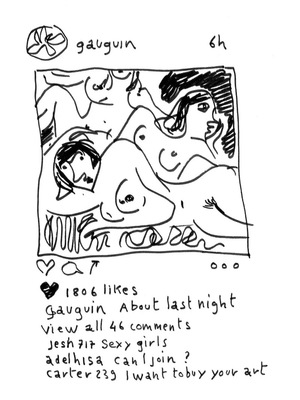


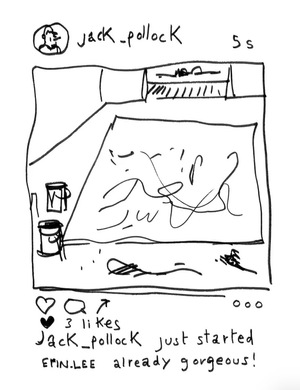
From illustrator Jean-Philippe Delhomme’s book ‘Artists’ Instagrams: The Never Seen Instagrams of the Greatest Artists’









Infectiously cuddly plushies from Giant Microbe (€6 to €35 each +P&P) – each one complete with a card filled with interesting facts about the malignant microbe in question.
Aw.
*bleeds out*
It could, though.
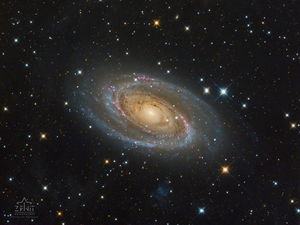
Behold the elegant swirl of Messier 81, aka NGC 3031 or Bode’s galaxy. To wit:
…this grand spiral can be found toward the northern constellation of Ursa Major, the Great Bear. The detailed telescopic view reveals M81’s bright yellow nucleus, blue spiral arms, pink starforming regions, and sweeping cosmic dust lanes. Some dust lanes actually run through the galactic disk (left of center), contrary to other prominent spiral features though. The errant dust lanes may be the lingering result of a close encounter between M81 and its smaller companion galaxy, M82. Scrutiny of variable stars in M81 has yielded one of the best determined distances for an external galaxy — 11.8 million light-years.
(Image: Paolo De Salvatore, Zenit Observatory)




Behold: the Nikola NZT – an all-electric off-roader with heavy duty shocks, Kevlar reinforced tyres and 30cm of ground clearance.
Developing 590bhp from a 125kWh battery, the NZT accelerates to 100km/h in under 4 seconds and will go 240km on a full charge. The climate controlled cabin (complete with ‘infotainment display’ and high end sound system) can be sealed with a removable hardtop.
Yours – sometime in 2021 – for about €71,000.


A pitch black, rage-filled UCLA graduation short by Connor Bland which follows a germaphobe as he struggles to live with the unsanitary habits of his housemate.




All manner of domestic items and appliances tightly wrapped in cross-stitched designs by Swiss-based artist Ulla Stina-Wikander: bringing symbolic functionality to a pastime traditionally regarded as (her words) kitsch and worthless.


The extraordinary coin craftsmanship of Russian artist Roman Butin.
Bespoke carvings and unique mechanisations made to order. Just so you know, the snapping teeth coin sold for $10,000 back in 2017.


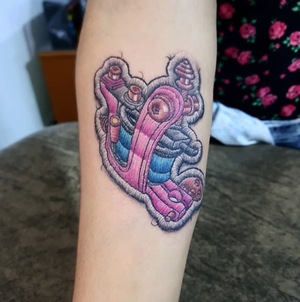


The work of Brazilian tattoo artist Duda ‘Tattoo You’ Lozano: inked-on tatts like sewn-on embroidered patches.
Or you could just sew on actual embroidered patches.
Or just leave it and don’t be at yourself.
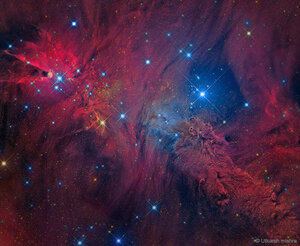
Behold: curious formations and bizarre textures visible in the vicinity of the Cone Nebula, 2,700 light years from Earth.
Well, this is how it would have been in 681BC, when – who can forget – an assassin brought the 24 year reign of Assyrian king Sennacherib to an untimely end (that’s what you get for sacking Babylon).
Anyhoo – what’s this? Some kind of interstellar dust cloud? To wit:
The unusual shapes originate from fine interstellar dust reacting in complex ways with the energetic light and hot gas being expelled by the young stars. The brightest star on the right of the featured picture is S Mon, while the region just below it has been nicknamed the Fox Fur Nebula for its color and structure. The blue glow directly surrounding S Mon results from reflection, where neighboring dust reflects light from the bright star. The red glow that encompasses the whole region results not only from dust reflection but also emission from hydrogen gas ionized by starlight. S Mon is part of a young open cluster of stars named NGC 2264, located about 2500 light years away toward the constellation of the Unicorn (Monoceros). Even though it points right at S Mon, details of the origin of the mysterious geometric Cone Nebula, visible on the far left, remain a mystery.
(Image: Chilescope; Processing & Copyright: Utkarsh Mishra)


