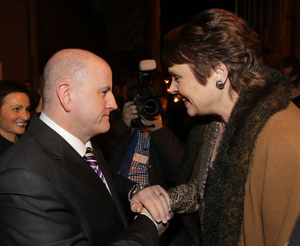



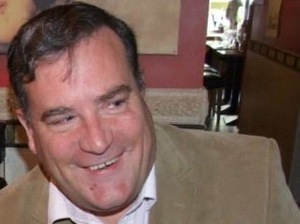
From top: Peter Casey at Dublin Castle last Saturday; Dan Boyle.
I wouldn’t say that the 342,727 voters who indicated support for Peter Casey in our presidential election are racists, but I suspect that many who have tendencies to be racist did vote for him.
There were many factors that contributed to a tenfold increase in his support over a period of one week.
One was the assumption, fuelled by opinion polls, that Michael D. Higgins would be easily elected. While always a dangerous assumption, this seemed to free many voters into making a statement; or statements, to give a collective two fingers to the political establishment.
The second factor is that like Dáil by-elections, in presidential elections most votes gravitate towards the successful candidate and then towards the most viable challenger.
My highest vote (16%) was achieved in a by election. I estimate I got at least half those votes by being seen as the most viable ‘protest’ candidate.
However the third factor is political serendipity – being at the right place at the right time saying a perceived ‘right’ thing.
Undoubtedly Peter Casey touched a nerve. In doing so he caused an extraordinarily large number of voters to change their opinions over a blink of an eye time span.
This is worrying that so many people could at the drop of a hat, express support for a candidate they did not know, and whose wider policy platform was so nebulously incoherent.
The most publicly expressed reason why the new found Casey supporters became attracted to him was because, as they said, he said things they often are afraid to say themselves.
While politicians are regularly castigated for resorting to cliche, this statement meant to be evocative of an electorate not being listened to, is among the worst of all political cliches.
When it is said that people are afraid to say things, it means they feel they are being deprived to say things that are wrong. Very wrong. What is being sought is the right to be intolerant.
For many in the electorate, or at least those who bothered to vote, Casey has been a mischievous cipher to somehow communicate the supposedly desirous state of being politically incorrect.
PC is not a legal code. It’s meant to be about positive ways in how we consider each other, how we speak about and refer to each other. It is open to exaggeration and thus likely ridicule, but it remains a better alternative to that of being nasty and ignorant towards each other.
I wouldn’t be of the school of thought that would want things not to be said. I think it is more rewarding when the distasteful gets said, once it is immediately reacted to and challenged.
While writing this I have been attending an event in Cork. Speaking there was a young traveller woman, an artist. She pointed out she was the only traveller in the room among a crowd of people, who after events of past weeks she would assume one in five of those sat there could not recognise her for who and what she was. Would that Peter Casey could speak with such assured eloquence.
There is a cozy comfort in how we form our opinions of others through generalisations, myths and common misconceptions. Instinct allows us to avoid needing to think or to have to inform ourselves.
This might seem a bit too PC for some. To such people I say FU. That might give some sense of how those we choose not to understand, or engage with, feel.
Dan Boyle is a former Green Party TD and Senator. His column appears here every Thursday. Follow Dan on Twitter: @sendboyle