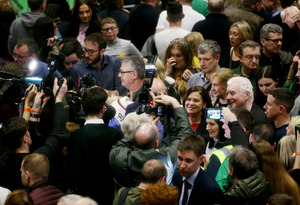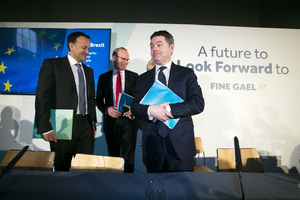



From top: Sinn Fein President Mary Lou McDonald and Deputy Party leader Michelle O Neill speaking to the media on the Plinth at Leinster House last week; Derek Mooney
Mandate, mandate, mandate. You couldn’t switch on a radio or open a webpage last week without someone talking at you about their mandate.
You had this one talking about the size and significance of their mandate and that one saying how much they respected and acknowledged other people’s, though usually just before they explained why they were going to ignore it.
Mandate has become the most abused word of the post #GE2020 era. So, what is a mandate? Well, put simply, it is just the authority given by voters to each elected TD.
Sinn Féin’s mandate is the collective total of its 37 TD’s individual mandates, just in the same way as Fianna Fáil’s is based on its 38 TDs and Aontu’s is due to its one.
No TDs mandate is inferior or superior, a point that seems lost in many of Sinn Féin’s pronouncements. It uses the word mandate as if it was a synonym for majority. It isn’t.
Over the past week we have heard SF talk about how Fine Gael and especially Fianna Fáil needs to heed Sinn Féin’s mandate as if this was a winner-takes-all where the one with the highest votes ignores all the others.
Sinn Féin may not take its seats in Westminster, but all that time hanging about the palace of first-past-the-post while avoiding the chamber, seems to have had an influence.
Yes, Sinn Féin won most votes and yes, the electoral strategy they adopted has left them one seat behind Fianna Fáil, but that does not mean Fianna Fáil TDs, to borrow a phrase I used last week, must embrace it or swear an oath to implement it.
Every TD and every party has a mandate, the issue is that no one party, or group of parties, received a clear or overwhelming mandate. There are several distinct sets of mandates that are individually clear, but collectively ambiguous and even contradictory.
What matters is which party or group of parties and others can put together a program for government that has the allegiance and support of 80 TDs.
In less fraught and complex times that was a relatively straightforward process. One side would be closer to having half of the seats. All it had to do was approach smaller parties to agree a platform and together get to the magic 50% figure, be that 72, 74, 82 seats etc.
But these are different times. The electorate gave a sign through its swing to both Sinn Féin and the Greens and its continued support of Fianna Fáil (as I outlined last week) that it wants change. The problem comes when you try to discern just how far that change should go.
It’s a confusion that exists even within Sinn Féin, though you never hear it mentioned by its spokespeople. One of the more curious of the RTE/Irish Times exit poll findings was that Sinn Féin voters were less in favour of increasing public spending than even Fine Gael’s [1].
The fact that Fianna Fáil and Fine Gael together have fewer than half the seats, removes the biggest traditional obstacle to the formation of a coalition of the left and far left, led by Sinn Féin. (Correction, it removes the second biggest traditional obstacle, the biggest being the left’s lack of votes).
Accord to yesterday’s Rec C poll, this is the preferred choice of 61% of Sinn Féin’s voters (and 45% of Soc Dems), yet Sinn Féin appears to have given up on such a prospect and is insisting that Fianna Fáil, who it said it never wanted to see back in government, must ignore the wishes of its voters and prop it up – though only 20% of Sinn Fein voters back this option.
The fact that SF and FF combined only has 75 seats means it needs a mudguard…. Sorry, I mean it needs another party. Step forward the Greens.
But why would or should the Greens be a mudguard for Sinn Féin and Fianna Fáil – or even for Fianna Fáil and FG?
While I can possibly see Green delegates seeing some merit in serving in an FF/SF government, I just cannot see them agreeing to put FG ministers back in office.
Perhaps they will conclude that the government will last for five years and their voters will forgive them in time. I am sure Dick Spring thought the same thing in 1992 when he put Albert Reynolds back as Taoiseach.
He may even have thought that again in late 1994 when he backed bringing John Bruton across the floor and making him Taoiseach, but the voters of 1997 had a different idea.
Though diminished, Fianna Fáil’s mandate on government formation has two clear elements. It told voters that it would not put Sinn Féin into government. A position it reaffirmed at its party meeting last Thursday.
It also said that it wanted change and that change for Fianna Fáil meant putting Fine Gael out of government. Though these positions were unambiguous and consistent in advance of polling day, the parliamentary party meeting seems less sure now on this point than it is on the Sinn Féin question.
Does Micheál Martin rule out the prospect of having Fine Gael ministers serve in a Fianna Fáil led coalition? Does he envisage Fine Gael offering a minority Fianna Fáil/Green/Social Democrat government the same Confidence and Supply arrangement that he offered Enda Kenny and then extended to Leo Varadkar?
Does he anticipate Fine Gael honouring such an arrangement with the same fidelity and adherence as him? I doubt we will get answers to these questions before Thursday’s first meeting of the 33rd Dáil.
What we will see is who is elected, by secret ballot, as Ceann Comhairle. While many of his colleagues would be happy to see outgoing one, Fianna Fáil’s Sean Ó Fearghaill, returned to the post, that would cost Martin a vote in the later vote on Taoiseach. At a time when every vote counts, the decision may be less about merit and more an early indicator of what way the wind is blowing.
Will Sinn Féin and Fine Gael TDs together take the opportunity to reduce Martin’s vote by one or will they think they may need that vote for a future partnership?
Will Fianna Fáil TDs abandon their colleague in a secret ballot to keep the vote for Martin?
While on the topic of Fine Gael, the most extraordinary thing about the last few days is just how little focus there has been on what is happening in Fine Gael. It has just suffered its second worst result and yet there has been little to no focus on how it responds.
Though there have been questions raised about Varadkar’s leadership from outside the Oireachtas party, from ex-Senator Paudie Coffey, former deputy leader James Reilly and former Justice Minister Alan Shatter, who tweeted a blistering attack on him yesterday, there has been an eerie silence from within the upper echelons – for now.
Varadkar’s fate as leader lay less in his own hands and more in the hands of Micheál Martin, whose own political fate is uncertain, and those of Simon Coveney and Paschal Donohoe.
Not a happy prospect, especially as only one of these has any reason to hope he stays on – and he’s not the one who is in Leo’s party.
Derek Mooney is a communications and public affairs consultant. He previously served as a Ministerial Adviser to the Fianna Fáil-led government 2004 – 2010. His column appears here every Monday.Follow Derek on Twitter: @dsmooney
[1] The Poll asked: If the Next Government Has Resources to Spare, Should More of the Money Be Used to Reduce Taxes or Should More Be Used to Increase Spending on Public Services? People who voted SF #1 went 57% in favour of public spending and 43% in favour of Tax cuts. Fine Gael voters went 59% spending 41% tax cuts, FF voters: 63% spending 37% tax cuts, Soc Dems 71%/27% and S-PBP 81%/19%