

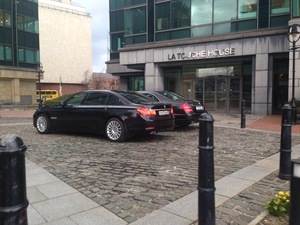
It’s the Fat Cats.
They can park anywhere they damn well like.
The pedestrian plaza, IFSC, Dublin, this evening.
Anyone?
Thanks Bruce



It’s the Fat Cats.
They can park anywhere they damn well like.
The pedestrian plaza, IFSC, Dublin, this evening.
Anyone?
Thanks Bruce

‘We Were Nor Raised For Export’
A new Sinn Féin General Election video featuring lovely drone footage of Ireland and excerpts from a speech made by Donnchadh Ó Laoghaire (top) from Carrigaline, Co Cork at the party’s Ard Fheis in 2013 on the Irish emigrant experience.
Full speech here
Thanks Oisin

Fiona Kennedy
Last month, Fiona Kennedy wrote about the barriers she faces when trying to access mental health services.
She has clinical depression and borderline personality disorder.
Today Fiona, who lives in Connemara, Co. Galway, writes:
Eight months ago, I was recommended to stop working with the private therapist I had been seeing for six years, and was put on a waiting list for dialectical behaviour therapy (DBT) at the Adult Mental Health Services of Galway University Hospital.
DBT is recognised internationally as being the most effective therapeutic intervention in managing the symptoms of a particularly debilitating mental illness known as borderline personality disorder (BPD), which I was diagnosed with two years ago.
In the last eight months, my situation has gone from barely managed damage limitation, to the point of almost complete mental breakdown. Within three months of finishing with my therapist, I was signed out of work on sick leave as I was no longer able to function effectively. I am regularly suicidal, and self-harm is part of my reality.
When I’m at my worst, however maladaptive it is, it helps me cope. My world has gotten very, very small. I drop my kids to school, I do bits and pieces around the house on the days that I can.
Sometimes I’m able to handle being around people, others I’m not. Those days are particularly tough, those are the ones where I hang on by my fingernails.
But, dragging us through all of this difficulty was the promise of eventually getting onto a treatment programme that would help me to turn it all around.
My family and I have spent the last eight months putting all our hope in DBT. Today, just weeks before the anticipated start date, I’ve been told that it’s not actually going to go ahead at all, because the hospital does not have the resources to provide the programme.
They’ve lost six out of ten therapists from the DBT team, and they have not been replaced. I don’t know where to begin to describe how I feel right now, because the words I have aren’t big enough. Angry, disappointed, let down – they don’t come close. I’m absolutely gutted.
I always had my doubts as to whether or not DBT would go ahead as I’ve been fighting with the extremely under resourced public mental health services for years, but I still can’t quite believe it has genuinely come to this.
I’ve waited eight months. I’ve been told time and again that this is the best thing for me, the only thing that really helps with bpd. To have that hope taken away at the 11th hour is unspeakably cruel.
I realise that this is not my psychiatrist’s fault, and I do genuinely believe that she has done everything in her power to make this happen for me, but right now, that does nothing to change the fact that I’m further than I’ve ever been from getting the help I need.
How is this fair?
We are weeks from an election, and yet services are falling into a worse state than ever before. The therapists who have been lost from the DBT team are not likely to be replaced.
My fear, aside from the obvious impact that not getting DBT will have on me personally, is that the whole programme will just be let slide, will fall way down the list of priorities, and will eventually be dropped.
I’m only one of countless numbers who will be impacted by this, because this goes way beyond the individual. The difficulties of living with and supporting someone struggling with a mental illness are often overlooked, but the impact is very real.
Not getting DBT doesn’t just affect me, it affects my entire family.
I wonder do the powers-that-be know the unique sense of utter hopelessness that comes with being told that your last available option is in fact no longer available?
I want to be angry right now, but I can’t summon up the energy. I’m swinging so fast between moods and emotions that I’m almost meeting myself on the way back.
One of the key features of BPD is emotional dysregulation, which means we find it very hard to maintain a stable mood and can swing from elation to the depths of depression and back again several times on any given day, never mind a day when I’ve been hit with such a phenomenal disappointment. It’s exhausting. I have a headache from crying and am having to work incredibly hard not to let myself be utterly defeated by this
Mental health services in Ireland are in a state of absolute chaos, there simply aren’t the resources available to provide the help that is so desperately needed.
How has it come to this?
How have we reached a point where people with devastating mental illnesses are being told that there is no help available?
Mental illness can kill, and worse, it does kill.
It needs to be taken every bit as seriously as physical illness, and the resources have got to be put back before more lives are lost.
Fiona is an Ambassador for See Change, a national movement that tries to improve attitudes towards people with mental health issues, and she blogs here
Previously: Access To Mental Health Services
Pic: Congregation.ie

Hot tramp he loved us so.
Liggy Stardust writes:
Still in mourinng for David Bowie I came upon this live version of the great man [singing Rebel Rebel] at The Point, Dublin in 2004. Listen to what he has to say right at the end [in Irish]. Up the Republic. Vote Sinn Dáme…
FIGHT!

Joan Collins TD and supporters outside the High Court
RTÉ reports:
Dublin District Court has dismissed the prosecutions against eight of the 11 people charged with a public order offence arising out of water protests in Dublin 8 on 20 April last year.
Outgoing independent TD, Joan Collins and ten others were charged with failing to comply with the direction of a garda to leave the vicinity of a protest on Parnell Road.
The court refused to dismiss the prosecutions in relation to two of the co-defendants who were also charged with obstructing a garda.
…Judge Aeneas McCarthy said there was conflicting evidence from gardaí as to the section of the Public Order Act under which the direction was given by the Sergeant David Lynch.
He said there was a Constitutional right to peaceful protest. He said the State had to negate that right by proving that there was a common design to engage in a protest that was not peaceful.
Court dismisses case against outgoing TD Joan Collins (RTE)
Earlier: Turning The Tide Of Irish Politics
Pic Tom Tuite

‘sup?
Anything good in the Guardian?
Harriet Sherwood writes:
Ireland’s last census, in 2011, showed a big rise in the numbers of non-Catholics. Although those identifying themselves as Catholic were still the vast majority of the 4.5m population, more than 6% – 277,000 people – described themselves as atheist, agnostic, lapsed or of “no religion”. The number was an increase of almost 50% since the previous census in 2006; the next census, due in April, is expected to show an even bigger rise.
… A few months ago, the archdiocese of Dublin commissioned research from a global consultancy firm, Towers Watson, to forecast the church’s trajectory over the next 15 years. Its findings made bleak reading for the church, which declined to speak about the report to the Guardian.
Attendances at mass are set to fall by a third between now and 2030, on top of a 20% drop between 2008 and 2014. The church can expect to recruit one new priest under the age of 40 each year. As incumbents retire or die, there is likely to be a fall of up to 70% in the number of working priests, and about three-quarters of those remaining in post will be over the age of 60. The church must consider recruiting priests from other countries and encouraging existing priests to work beyond the age of 75, the report said.
Baptisms were predicted to remain stable, but the report noted that this may be explained by “the preference given to children who are baptised when enrolling in Catholic primary schools. If this requirement is removed at any point prior to 2030, we believe there is likely to be a decline in the number of baptisms each year.”
…Jodie Neary, the mother of 18-month-old unbaptised twins Evyie and Mia, said: “The school system is the last stronghold of the Catholic church in Ireland, so it’s very important to them. I’ve never considered baptising the girls, but I know people who baptise their children just to make sure they can get into the local school. It’s very common.”
… The Guardian spoke to parents who reported children being assigned prayers for homework, given religiously-themed artwork and reading books, taught creationism on nature walks and enlisted in the construction of “prayer stations” with religious icons on school premises. “It’s hard to challenge this – you don’t want to be the parent who turns up every day to argue with the teachers,” said one.
…[Mike McKillen, 72, who teaches bio-chemistry part-time at Trinity College Dublin said:] “The church is no longer in the ascendant. And once we get a system of education that isn’t dependent on religious patronage, its influence will wane further. There is political momentum on this, and the policy makers cannot ignore it any longer.”
Faith, hope and secularity: Ireland on brink of change as church power wanes (The Guardian)
Related: Carol Hunt: And The Lesson Today

Friday February 19: Generator Live: Daithí, Katie Laffan, Cut Once, Beach@ The Generator, Smithfield, Dublin 7.
Nialler9 writes:
The first in a series of gigs run by The Generator Hostel in Smithfield of emerging Irish talent features a very good lineup of exactly that. There’s dance pop music form Daithí, alternative/indie from Beach, cheeky funk pop from Katie Laffan and electronica from Cut Once. Tickets are free you just need to register.
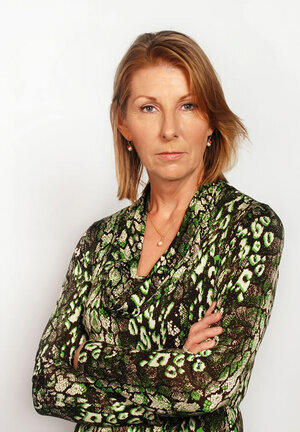

From top: RTÉ’s Áine Lawlor and Fianna Fáil leader Micheál Martin
Fine Gael Health Minister Leo Varadkar was interviewed on Morning Ireland today.
During the interview Mr Varadkar levelled criticism against Fianna Fáil leader Micheál Martin in relation to his time as Health Minister between 2000 to 2004.
Morning Ireland presenter Cathal MacCoille said Fianna Fáil was asked to come on the show, to respond to Mr Varadkar’s assertions, but the offer was turned down.
Further to this, Mr Martin spoke with Áine Lawlor on RTÉ’s News At One.
It got a bit… tetchy.
Áine Lawlor: “We’re joined now, from Galway, by the Fianna Fáil leader Micheál Martin and good afternoon to you.”
Micheál Martin: “Good afternoon you, Áine.”
Lawlor: “On the latest figures, even if the Fine Gael/Fiann Fáil coalition would be short won in getting a majority, is a grand coalition looking like the only answer?”
Martin: “Áine what figures are those?
Lawlor: “The Red C poll.”
Martin: “But you know by… first of all, by the way, I thought I was coming on to respond to Leo Varadkar this morning.”
Lawlor: “I’m not, I’ll come to that in a moment…sorry, I..”
Talk over each other
Martin: “I’ve answered these questions ad nauseam. The bottom line is…”
Lawlor: “No, just to say, Micheal Martin, just to say Micheal Martin, the reason I asked you about the poll is because I wanted to talk about the general state of the play in the campaign first before…”
Martin: “I know…”
Lawlor: “…going into accusations that have been, we can deal with that first if you’d rather?”
Martin: “No, I’ve no problem with it at all. But, just to say to you that that was the basis upon which this interview was agreed, from my perspective. I’ve no difficulty in answering your question and I’ve answered it before. I think we need to be very careful in terms of the parameters by which we’re going to judge this election and, particularly, the opinion polls. I’ve said in the past that, in the United Kingdom for example, opinion polls were out by 6.5% and the problem with that was it dictated the type of debate that was held in Britain. In other words, the British people never got to discuss what the Tories would do to their health system, or would do to their social welfare and so on. So we need to be careful in Ireland that we don’t allow the polls to dominate this debate to the exclusion of issues and the kind of country we want and Fianna Fáil have been saying, from the outset, that there’s a choice between the Irish people, that Fianna Fáil, between a Fianna Fáil-led Government that would focus on fairness, on a fair break for the self-employed and for enterprise and for decency in society as a whole as opposed to a Fine Gael-led government which will and look after the wealthiest in our society. And then it’s up to the people to decide, in relation to that choice, I think we’ve succeeded in doing that during this campaign…”
Lawlor: “Absolutely. Which is why…”
Talk over each other
Lawlor: “… which is why I am putting this question to you because you’re pre-supposing that we will be able to put a Government together. But given what the polls are indicating, at this point in time, and given what you have said and what Enda Kenny has said about who, and who you will not, go in with. The question before voters in the run-up to next Friday is whether there is any government that can be put together given what you’re all saying at the moment. So that’s why I’m asking you the question: is a grand coalition the only viable option?”
Martin: “I don’t agree with your premise and I’ve said this time and time again. I don’t agree with that premise. I think your discussion, and all of the discussion, is on the basis that the election has happened, the election has not happened. In the local elections for example, of where we can take that basis, we would have been discussing Fianna Fail coming in on third place.”
Talk over each other
Lawlor: “No the question is based, Micheal Martin, on the fact that the people of this country elect a Dáil…”
Martin: “Aine I would appreciate if you would allow me answer the question please.”
Lawlor: “Yes, but..”
Talk over each other
Lawlor: “The people of this country will elect a Dáil. That Dáil’s job is to elect a Government. If the people of this country don’t want to be Portugal, don’t want to be Spain, don’t want to be paying higher interest rates, do want to have an actual Government, I’m asking you when that Dáil is elected will you do your part in working with other politicians to put a Government together because, at the moment, a Government may not result after next Friday.”
Martin: “That’s the Fine Gael line you’re peddling in terms of Portugal. The Irish people aren’t responsible for Portugal, Italy or anybody else. We know there are international issues that are determining the global situation, not least the volatility in China and the uncertain situation there and other issues. My point is and my point, repeatedly has been, that this election hasn’t even begun. And I do not accept that the opinion polls may be correct in terms of what will actually happen. And you can go through constituency polls which give a far different perspective, by the way, of seats, than the national polls. I have said over a week ago that we will, just as we have been in the last Dail, responsible in terms of looking after this country. For example…”
Lawlor: “So you will play your part in putting a Government together after the 26th?”
Martin: “Aine, could I just make a comment to you? I listened to Leo Varadkar this morning. He didn’t have this aggressive intervening and interruption every time I’m trying to put a coherent paragraph together. And I would appreciate it if I was allowed the same space that Government ministers are repeatedly allowed on RTE programmes. I really would appreciate it.”
Lawlor: “Micheal Martin, I can only answer for the interviews I do…the reason..”
Martin: “But I just want to make the point to you that..”
Lawlor: “I appreciate that but, I also think that you’ve been rather unfair on that challenge that you’ve put down there, so let’s move on and talk about the question of Leo Varadkar and the allegations that he made against you…”
Listen back in full here
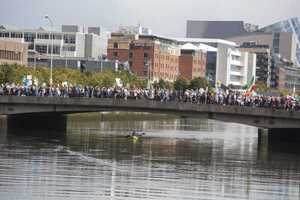
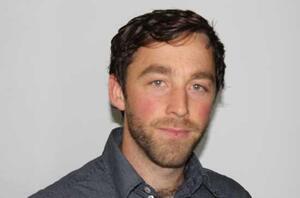
From top: Water protesters arrive in Dublin for a Right2Water rally in August, 2015; Dr Rory Hearne
The water protests and Right2Water have changed Ireland. They have helped people realise that we do not just have to accept everything that we are told, that there are alternatives.
Dr Rory Hearne writes:
Again they will come to Dublin this Saturday in their tens of thousands – from every corner of the country and from all parts of Dublin.
Another tidal wave of the ‘ordinary’ men, women and children of Ireland – taking to the streets to make their voice heard against austerity, the ‘unjust’ water charge, the unequal recovery and to have ‘a government for the people’.
It could be the biggest water protest yet.
And this one is even more significant because it takes place just a few days away from the general election. This is because the water protest movement, the largest protest movement in Ireland since the 1913 lockout, is changing the course of politics in Ireland.
The government and mainstream media have never fully understood or wanted to understand why so many people took part in the water protests and how they are changing how people think about politics.
The water protesters have become like the irritating fly that buzzes around a nice quiet room. We were supposed to be in recovery and austerity finished yet the protests just got bigger and bigger. They upset the cosy consensus. And so the government sent out Alan Kelly and the Gardai as their swat to try kill it.
But they have failed.
There will be tens of thousands of people in Dublin on Saturday saying to the entire political establishment, ‘we are the Irish people awakened from our slumber of passivity – we are saying ‘no more’, we want our country back to be run for the welfare of its people, and we are going to vote for politicians who have stood with us’.
This is a profound statement that will have a major bearing the outcome of the election because it shows that the Irish people are not just lying down as they did at the start of the crisis in 2008 and when the Troika rolled into Dublin to takeover in 2010.
Remember all the questions about why didn’t the Irish protest at the imposition of austerity, the bailout of the banks and the Troika (IMF, ECB and EU) taking over the country?
Remember when the former Minister for Finance, Brian Lenihan, said in April 2009 that other European countries were ‘amazed’ at the extent of austerity inIreland and that there would be “riots” if these were introduced in any other European country.
Remember Enda Kenny, smil the cover of Time magazine in October 2012 where he explained to the world that there had been no large-scale demonstrations in Ireland because “(Irish) people understand that you have to do difficult things to sort out our own public finances”.
They thought they had convinced the Irish people to stay quiet by getting us to blame ourselves for ‘partying to hard’ in the boom years.
They thought the election was going to be the Irish people sensibly choosing stability over chaos.
But the government never learned from their mistaken attitude to the water protests. They didn’t listen to the people then and they still aren’t listening now.
Through the water protests and the Right2Water/Right2Change movement –made up of communities, trade unions and Left political parties – the Irish people found their voice of protest. They found their dignity and decided to take a stand.
Water was the issue people could take action on. They could stop a water meter being installed outside their house in a way they couldn’t stop a cut to the local hospital or community centre.
They could protest on the street at a water protest. And through that people could express their anger at all the injustices of austerity, the bank bailouts and the debt. And while there had been smaller on-going protests such as the Ballyhea Says No against the Bondholder Bailout in Cork, against local hospital closures – the water campaign united everyone.
This is why the water campaigners are a key force that is making this election like no other in the history of the state. They are a key influencing factor in the decline in support for the establishment parties of Fine Gael, Fianna Fail and Labour and rise of the independents, Sinn Fein, Social Democrats and the AAA/PBP.
This is because the water movement, and particularly the communities who first started opposing the installation of water meters, took a stand to defend the Irish people against austerity when no one else would do it.
And their constant presence in communities and again on the streets this Saturday reminds people of this simple fact – that when the Irish people’s backs were to the wall – the establishment parties of Fine Gael, Fianna Fail, Labour and the Greens prioritised the bondholders, vulture funds, the ECB, developers and corporations – and made the ordinary joe soap pay the price.
It is interesting to compare the huge numbers of Gardai deployed to enforce the installation of water meters in the face of local community protests with the lack of policing available for communities being overrun by drug gangs.
And of course who benefits from the installation of water meters? Siteserv – the company belonging to Fine Gael’s favourite oligarch – Denis O Brien. It says it all about the government and Irish state’s priorities and who they actually represent – and it’s not ordinary people. And when it comes to voting next Friday week the people will not forget that.
The power and influence of the water movement is shown in its ability to involve people who were never involved or interested in politics or activism before.
And we know this because myself and some of my students in a module on social movements I was teaching in Maynooth last year undertook a survey of over 2000 water protestors. We found that over 55% of water protestors had never protested before (see findings of the research here).
The water movement has also successfully used new forms of media – particularly social media – to play a key role in providing a means of communication of a different analysis of issues and information that people would not have received before from the mainstream media.
This change is being translated into the election as the Right2Water/Right2Change campaigners have worked on getting people to register vote. Also through the Right2Change list of candidates they are encouraging people who never voted before out to vote (delivering 200,000 newspapers outlining this in the next week).
Just as with the Marriage referendum that motivated young people to register and vote in greater numbers than before so too the water issue and Right2Change candidates give people, particularly in disadvantaged areas with traditionally low turnout, a reason to be bothered to vote.
They see in the independents and Left parties politicians who have protested with them and who will stand up for them. That increased turnout of anti-establishment voters will have a big bearing on the election.
On top of that not only are people voting for alternatives, they are no longer giving preference transfers to the establishment parties. So after voters vote 1,2,3 for their favourite Independent, Sinn Fein, PBP-AAA, Social Democrat, they are stopping. In the past they would have filled out the whole ballot paper. Fianna Fail and Fine Gael will lose from this reduced number of transfer votes.
But the water protests have done even more to change Ireland. For years people have been talking about the decline of community and active citizenship and that people in Ireland had just stopped caring about their neighbours and society.
Now the water protests have brought people together in local community campaigns. It has moved from the water issue to people getting together to see how they can address homelessness and the housing crisis, to local hospital issues, to educating themselves about politics, to looking for community centres and space for people to meet their neighbours and see how they can improve their community.
It has brought back a sense of solidarity and cooperation with people seeing how they can work together to build a better country.
The protests and Right2Water have changed Ireland. They have helped people realise that we do not just have to accept everything that we are told, that there are alternatives.
Make sure you bring your rain coat and umbrella on Saturday. It looks like rain.
Dr Rory Hearne is a Senior Policy Analyst with TASC, the Think-Tank for Action on Social Change. His column appears here every Wednesday. Rory is an independent candidate for the Seanad NUI Colleges Panel. Follow him on Twitter: @roryhearne
Right2Water rally information here
UPDATE:
Meanwhile…
Case against me dismissed. Awaiting further news from the court. Will update later.
— Joan Collins T.D. (@JoanCollinsTD) February 17, 2016
Previously: Joan Collins TD Arrested

Of this ‘satirical’ election handout from FG GE16 candidate Kate O’Connell, Midge Fox writes:
I received this paper on Portobello bridge this morning. According to the conspicuously named “Election Times” aka campaignforkate.ie, Sinn Fein, “the party of peace and harmony” according to an unknown “Sinn Fein councillor” intend bringing us into some kind of communist utopia. Yippee!!!