
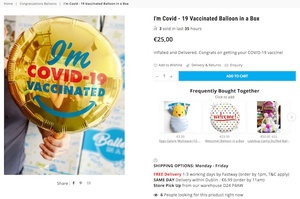
Ah here.
I’m Covid – 19 Vaccinated Balloon in a Box (BalooninaBox.ie)
Thanks Jack Jones.




From top: Nurse Joan Love with the AstraZeneca jab at the HSE Vaccination Centre in the Aviva Stadium, Dublin; Heber Rowan
There are several vaccines being used to combat the COVID 19 pandemic. Their names will be fixed in our minds for years to come, like family houses in Game of Thronesm as they fight for control of the COVID virus.
This week the Johnson & Johnson vaccine was ‘paused’ in the USA and there has been concern raised about the AstraZeneca vaccine being harmful to roughly one in a million people from blood cloths. One in a million is a risk that generally, for most other medicines, is
determined as a reasonable one, because you have to weigh up the benefits. Ultimately asking, what serves more people than does harm?
Often cited at the moment is the higher risk of blood clots from birth control medication, people decide that it’s worth more to bear that risk than not have the use of it. The same goes for the vaccines. That said, the European Centre for Disease Control (ECDC) knew that in pausing the roll out of the AstraZeneca vaccine they would assuage the fears of those with concerns about such side effects. However as we consider the speed of the roll out program and the continued damage with the lockdowns: was that worth it?
People make decisions based on weighing up of risks. We have in society, a way of keeping to our risk equilibrium. The normal level of risk you accept in your day to day life.
As an example, it’s been found that if you drive without a seatbelt, statistically you will drive slower. If you know that seatbelts will reduce harm you might drive a little faster, because you work towards your risk equilibrium. You feel a sense of what’s the risk you can take and what you can’t. It’s different for many folks, Formula 1 drivers certainly have a different sense of what type of risk is OK for them and what’s not than you or I.
The issue is how risk is felt.
Simply knowing the factors that cause risk or danger is based on our exposure to awareness of that danger. If you wear a seatbelt you will find it more straightforward to figure out what the risk is of not wearing it actually is. That’s different to a new type of medicine made in extraordinary circumstances with cutting edge science. You have to rely on the trusted sources of information or experts to determine if taking them is a risk worth having.
And that is why in my opinion, the fear associated with the AstraZeneca vaccine is over the top. People are concerned that they might be the one in a million case that receives, a potentially lethal side effects. The media has grabbed on to a story that has interest and “legs to run on”. People want to know more about it.
The science is there. The risk is there too but it’s a remote one. Significantly less so than NOT taking it.
Attempting to reconcile why there is such a concern goes further though. It can be argued that the fallout from the much discredited link between autism and vaccines by Andrew Wakefield is a cause. People fear that they will be the unlucky ones because they hear more about the negative stories than they do about the humdrum stories of lives changed and improved by vaccines. It’s not perfect but it works.
People in fear will share their stories and others will share those stories because we find it easier to understand a story than scientific data. That’s why in conversations we will often talk about the lives of others than ideas or facts. People have stories and we are attuned to find them interesting because it’s easier to relate to.
An over abundance of caution.
Now I think we’re moving forward with an abundance of caution. Too much. This is not good because when it comes to dealing with working to speed, working as fast as possible to get a removal of the social distancing restrictions in society. It slows that down. Lives will be lost and damaged from the societal harms of seemingly never-ending lockdowns.
You have to be efficient and effective to make sure that treatment strategies work, knowing while it will not work for everyone, it will get things done where it counts. Reducing harm and saving lives.
Much of the debate about vaccines is also influenced by the humility that scientists working in their fields generally have. They know that they can often be wrong, that new evidence can end decades of a working hypothesis in an instant. So this is where we are at. A medicine held back because of too much caution.
As we can see with Israel’s relative end of COVID cases, life going back to a relative normal there. That matters and vaccines matter.
The lack of common sense
This week there has been a partial reopening of Ireland with schools back to relative normality and construction work picking up where it left off months ago.
This is welcome though with a look at recent debates on the Claire Bryne live show and on the radio, you’d wonder at the adage that “common sense isn’t common”.
Sam McConkey said recently that the restrictions could go on for 3-5 years. Crazy stuff in my opinion to even conceive of that.
Small businesses up and down Ireland are crying out for a return to normality and the idea of years of further restrictions is unconscionable. Click and collect services for instance are currently banned and while some pubs sell take away drinks, they are unable to allow patrons to use their bathrooms. Surely if it is deemed safe enough to sell take away drinks, it would be safe enough to allow for the use of bathrooms?
On Monday’s edition of Claire Byrne Live on RTÉ One the issue of Portaloos was discussed as a possible solution as we enter the warmer summer months. The matter of increased costs running such outdoor facilities was brushed over with no substantial analysis of current policy when it has been found that only 0.1% of cases are transmitted outdoors.
The brush with significant danger has passed by with the vaccine roll out assisting those most at risk. It’s time for a dose of common sense and less fear of making mistakes.
Let’s end the lockdown.
Heber Rowan is a Sligo native with a passion for politics. He works in public affairs and enjoys listening to and narrating audiobooks. He can be found on Twitter and occasionally blogs on Medium.com.


From top: Albert Camus by Henri Cartier-Bresson (1944); David Langwallner
The world is now increasingly being divided between an ever-smaller, dominant, medieval plutocratic class. Between them and the excluded others. Let us call them The Unvaccinated. Only a metaphor, but an important one.
I have written hitherto about how we are descending or reverting to the 1930s in terms of austerity, the rise of fascism and the decline of rational discourse.
Perhaps the most influential text of the 1930’s is Oswald Spengler’s “The Decline of the West” (1926) and the suggestion that much of the blame for the decline of European civilisation could lie on the doorstep of Slavic and ‘degenerate races’. The prior unvaccinated and impure. The prior degenerate other.
The counterpoint of the argument was that Aryan blue blood, whether Germanic or Anglo Saxon, was the emblem of purity and that the other races corrupted the gene pool. particularly Slavic and Hassidic races. Of course, Spengler influenced Hitler and the snowball of fascism led to the extermination of those undesirable races and the nightmare of the holocaust.
Such matters were hitherto of historic concern and until recently a distant epoch but regrettably this form of Social Darwinism is back in fashion and a new corporatised Shoah of economic liquidation and segmentation, as well as the cartelisation of humanity, beckons, accentuated by Coronavirus.
It will further lead to the demonisation and exclusion of the other and rather than humanise him or her many will not interact with other races and nationalities even in the melting pot. For safety fears, as a result of hysteria or only on specific terms and for specific reasons.
Or rather, all will have to conform to survive, become part of the vaccinated and thus enjoy vaccine data retention tourism. If allowed to travel.
This epidemic will, I predict, only lead to others as the science suggests and in tandem we are facing a depression greater in scope than the 1930s as well as environmental meltdown. In an age of chaos and uncertainty, the power grab of the strongman is evident for all to see.
Intellectual ideas that gain traction are not necessarily good ideas. Social Darwinism and Malthusian ideas are back in vogue. A Gatesian world that thinks in numbers. Where economists and scientists rule.
State authorities and populations are reacting to the present crisis in an overly authoritarian way, either though the direct election of fascists or through an insidious authoritarianism pandering to scaremongering and introducing, through executive action or legislation, an authoritarian creep. The walls are closing in.
We have reverted to what the great Austrian writer Stefan Zweig (who committed suicide as an emigrant from persecution) in his book “The World of Yesterday” (1942)”, a summary of the 1930s indicated:
“I feel that Europe, in its state of degeneracy has passed its own death sentence.”
And not just Europe. There is now no haven for the migrant, the dispossessed and the unvaccinated. No shelter from the storm certainly not in Ireland.
.
Albert Camus is now crucial to our time and to the multi-cultural discourse. He was, in origin, a member of the French community in Algeria, doubly despised by the French mainland and by the Islamic majoritarian population in Algeria. He was a Pied-Noir, then, and now, a term of abuse. He had mixed race perspective as do I. and that is the crucial perspective of the outsider.
Camus, of course, was also above all else a product of the enlightenment and the French tradition of letters and reason. A product of Voltaire, with a prose style clipped and epigrammatic, much influenced by Pascal. It is a classic French prose style. Almost ridiculously tight. There is an austerity about it, but also a romantic lyricism born of his mongrel Algerian background. The twinkle was always in this lady’s man’s eyes, as is very evident in the famous picture by Cartier Bresson (at top).
In his writing on Algeria, as in his writings in “The Rebel” (1951) on extremism in the French Revolution, there is distaste for fundamentalism, secular and religious, which then and now is why he is relevant to our time as a cautionary critic of multiculturalism, but also an opponent of extremism such as authoritarian terrorism or state terrorism.
He would have no time for the compulsory imposition of vaccines which the European Court Of Human Rights (ECHR) has now implicitly sanctioned. He would see it as the destruction of freedom. A kind of corporate fascist creep.
It should be stressed in a balanced way that he advocated co-existence between the transplanted French and the native Islamic population and condemned the torture and the death penalty inflicted on the Islamic population by French authorities. Impeccable multiculturalism, but Camus saw clearly that there was going to be a bloodletting in Algeria arising from extremism and he was, of course, right then and indeed now, a new bloodletting is coming.
Those qualities of middle of the road temperance often get run over and railroaded by barbarism, whether fascist or communistic. Pleas for tolerance fall on deaf ears. But that is what is needed: the just man or woman, the legalist in fact, the moderate, the secular humanistic rationalist. The voice of courage and independence, the espousal of absolute human rights against the nonsense of relativism. The secular humanist intellect.
Edward Said, who criticised Camus, is, of course, the great intellect of anti-imperialism of recent vintage. He analyses, in his crucial texts Culture and Imperialism (1993) and Orientalism (1978), how the mission statement of an imperialist agenda is to civilise barbaric races and impose imperial subjection if necessary, by terror and barbarism.
He analyses texts such as Graham Greene’s The Quiet American (1955) and Naipaul’s Bend in the River (1979) to demonstrate how agents of imperialism work and how it morphs into murder, subversion, and the endless instabilities of so-called primitive societies. In a dispassionate way he also attacks virulent nationalism and tribalism. hallmarks of our age.
In a crucial passage at Page 22 of Culture and Imperialism he points out that:
‘Patriotism, chauvinism, ethnic, religious, and racial hatreds can lead to mass destructiveness.’
This perspective is crucial to our age, but now the logic of exclusion is international. Or as psychiatrist Fritz Fanon put it:
“The Colonial world is a world cut in two.”
Now the entire world. Divided up, cut up and broken into fragments.
The classic colonial text is of course Hearts of Darkness (1899) by Conrad and the central character of the mad Kurtz where the civilising mission turns into barbarism and murder which Coppola recycles into his indictment of the American civilising mission in Vietnam with Brando doing his star turn as Kurtz in Apocalypse Now (1979).
Colonialism also caricatured the myth of the lazy native. Like the infamous Punch cartoons of the Irish at the end of the 19th century.
In The Wretched of the Earth (1961), Fanon is very insightful on degenerate essences and the portal of outsiders as degenerates, but his famous insight of how the wretched of the earth must pay the debts of the occupying powers is now the international model of austerity. Where vast sectors of even the developed world are now easy picking for a corporate colonialism emanating from transnational law firms, corporations and endorsed by governmental and inter-governmental entities such as the EU.
At Page 152 Fanon argues that:
“The people’s property and the people’s sovereignty are to be stripped from them.”
Well, that remark now applies to everybody of all nations. Fanon also demonstrates how mental illness; neurosis and de realisation are aspects of post-colonial subjugation or of austerity which coronavirus will now augment.
Both Fanon and Said have little hope as they internalise the norms of the state and in our Ted Talk universe sing for their supper. More likely they are bought and packaged. Or sponsored by Mr Gates or The Ford Foundation.
When the Black Death came to Europe in the 14th century, cities and towns shut themselves to outsiders – and assaulted, banished and killed “undesirable” people, mostly Jews. There has been a tsunami of racist taunts even in the UK recently and the status of non-nationals increasingly precarious. In fact, in a propagandistic way, the virus has been linked with multiculturalism.
The fascist Hungarian Prime Minister, Viktor Organ, recently announced:
“We are fighting a two-front war: one front is called migration, and the other one belongs to the corona virus. There is a logical connection between the two, as both spread with movement.”
Britain still is probably the last place that there will be rivers of blood and there are still residues of the qualities Camus espoused and that are desperately needed: rationality, rigour, tolerance, humanism.
But it is not just European civilisation that is falling apart. The wretched of the earth is the earth, as I have intimated. The insights of the post-colonial academics such as Fanon and Said gave a partial glimpse. Everybody is now in the same boat.
And now the vaccine passports to potentially monitor data and those who do not take the jab, outsiders restricted in movement, will be confined to quarters in coronavirus panopticon.
But why should people consent, say, to the demonstrably unsafe Astra Zeneca vaccine and why are we having this dialogue anyway? Well, dummy, many want the world divided into their safe spaces and to be excluded from the others.
The unvaccinated is a metaphor for our time. Minds and borders are closing when they should be opening.
David Langwallner is a barrister specialising in public law, immigration, housing and criminal defence including miscarriages of justice. He is emeritus director of the Irish Innocence Project and was Irish Lawyer of the Year at the 2015 Irish Law Awards. His column appears here every Tuesday and Friday. Follow David on Twitter @DLangwallner

Just ‘dropped’.
Episode 5 of Poxy Bleedin Shop
In this episode the Guards discover what has been going on and have a showdown in the alley. Meanwhile Emily and Celine bump into each other on the street and discuss the state of the rockets and green clouds in an effort to get to the bottom of it all, while also continuing an old grudge.
Starring Aidan J Collins, Bernard Casey, Colman Hayes, Emma Doran, Karl Spain, Mark Mc Auley, Owen Colgan, Tadhg Hickey and Valerie Ni Loinsigh.


This morning
Those who refuse an offer of the AstraZeneca Covid-19 vaccine will go to the back of the queue , according to the Tánaiste Leo Varadkar.
The rollout of the AstraZeneca jab has been restricted to people over the age of 60 because of concerns about a blood clotting side effect in younger people.
Via Irish Times:
Asked what would happed to people who refuse the AstraZeneca vaccine, he told RTÉ radio’s Morning Ireland “they will have to wait until the end”.
People who refuse AstraZeneca vaccine will go to back of queue, says Varadkar (Irish Times)

The votes are in.
Last Friday, prompted by a suggestion from ‘Scottser’ and with a €20 Currys PC World voucher redeemable in any Currys store on offer, I asked you to name your favourite anti-Establishment song.
You answered in your rebellious dozens.
But there could be only one winner.
Third Place:
They Never Came Home by Christy Moore
Jonboy writes:
“It has to be this. 40 years later, what’s changed?”
Runner-up:
Inner City Blues by Marvin Gaye
Otis Blue writes:
“An album virtually without peer, Marvin Gaye’s What’s Going On is a glorious song cycle whose narrative is told from the point of view of a Vietnam veteran returning to the States to witness hatred, suffering, and injustice.
“Gaye’s introspective lyrics explore themes of drug abuse, poverty, and the Vietnam War. You could pick any track but, for me, Inner City Blues (Make Me Wanna Holler) is the one.”
Winner:
Strange Fruit by Billie Holiday.
Stephen Moran writes:
“For me there is one song that transcends time and still has the power to shock: “Strange Fruit” by Billie Holiday from 1939. A damning indictment of racism in the American South, its harrowing lyrics:
“Southern trees bear a strange fruit.” This, you think, isn’t your usual lovey-dovey lounge jazz stuff. “Blood on the leaves and blood at the root.” What is this? “Black bodies swinging in the Southern breeze.” Lynching? It’s a song about lynching?
“Possibly the most shocking song of all time, because it”s true. The first true protest song and still the greatest.”
Nick says: Thanks all.
Last week: Win Nick’s PC Voucher

#M50 we’re currently attending a roll over collision on the motorway Northbound at the Red Cow #Dublin #fire #traffic https://t.co/vVPmCIiEPy
— Dublin Fire Brigade #StayHomeSaveLives (@DubFireBrigade) April 15, 2021
This morning.
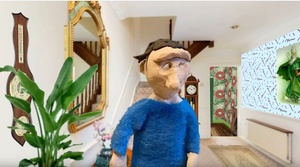
Tadhg in Lockdown.
Restrictions eased.
Still losing the head.
Another stressful minute from Marla animations.
Last week: In My Room
From Marla Animations

 From top: a new cycle lanes taking one lane of the road from Blackrock Village through to Sandycove, county Dublin; Dan Boyle
The twentieth century, without much debate, can be considered the century of the motor car. It was probably the invention that had greatest impact on people’s lives. It undoubtedly was the most significant contributor towards greater personal autonomy for many people.
It’s greater use certainly made life easier for horses. The greater prevalence of the motor car soon challenged the transport story of the nineteenth century – the railways.
Its greater effect was on the then preferred runaround – the bicycle. In Ireland, a more slowly industrialising country, it effects for most of the twentieth century were less marked.
Flann O’Brien chronicled this relationship in The Third Policeman in developing his molecular theory positing that the molecules of cyclists became interchangeable with those of the bicycles they were riding.
As the country inched towards greater economic prosperity, the bike developed a reputation as being the poor man’s car. It was seen as something to be cast aside to achieve the status car ownership would confer.
The coming of the millennium brought the first questioning of our collective love affair with the motor car. Part has been the belated realisation that surface space is not infinite, that constant and continuing congestion is the obvious result of a growing car fleets.
The environmental effects of too many journeys in too many motor cars has also become better understood. One third of all carbon emissions come from transport, mainly from cars.
It is the economics of car usage and car ownership that is becoming focused. Our cars are parked 92% of the time. The 8% of time they are being used by us is funded by one of the biggest capital outlays many will experience in their lifetime.
The great car rethink has created an opportunity for a bike comeback. That is though more imagined than real. A back to the future revolution was bound to invite reaction
A what we have we hold attitude has developed regarding road space. Car dominance has been such, that no understanding has been fostered that there are different categories of transport users who can, and should, share the available space.
Strange alliances have been formed where the car lobby has got some pedestrians to buy into the demonisation of cyclists as kamikaze inspired mowers down of the innocent.
This urban myth is easier for some to believe due to the fact that there are some bad cyclists. They exist in a smaller proportion than bad drivers, but the fact that they do exist helps feed the myth.
Another factor that may hinder a smoother transition is battling a perception that the cycling renaissance is seen as a largely middle class activity. Something of an irony when large scale bicycle use once had been the transport of choice of the plain people of Ireland.
Encouraging less car journeys and greater use of bicycles should be a win win situation. Better use of space, better health outcomes and a much better quality of life.
It should be easier but the reluctance to change is understandable. The pop up infrastructure that has appeared over the last number of months, across the country, may help to convince.
To misquote George Orwell – Two wheels good four wheels not so good.
Dan Boyle is a former Green Party TD and Senator and serves as a Green Party councillor on Cork City Council. His column appears here every Thursday. Follow Dan on Twitter: @sendboyle
