
Category Archives: Nature

Behold: Valles Marineris on Mars – the grandest canyon in the solar system. To wit:

…the grand valley extends over 3,000 kilometers long, spans as much as 600 kilometers across, and delves as much as 8 kilometers deep. By comparison, the Earth’s Grand Canyon in Arizona, USA is 800 kilometers long, 30 kilometers across, and 1.8 kilometers deep. The origin of the Valles Marineris remains unknown, although a leading hypothesis holds that it started as a crack billions of years ago as the planet cooled. Several geologic processes have been identified in the canyon. The featured mosaic was created from over 100 images of Mars taken by Viking Orbiters in the 1970s.

(Image: NASA, USGS, Viking Project)

apod

Behold: the Moon, Mars, Saturn and Venus lined up – a complete coincidence, but not by coincidence. To wit:

…all of the planets orbit the Sun in (nearly) a single sheet called the plane of the ecliptic. When viewed from inside that plane — as Earth dwellers are likely to do — the planets all appear confined to a single band. It is a coincidence, though, when three of the brightest planets all appear in nearly the same direction. Such a coincidence was captured about a month ago. Featured above, Earth’s Moon, Mars, Saturn, and Jupiter were all imaged together, just before sunrise, from the Black Sea coast of Bulgaria. A second band is visible diagonally across this image — the central band of our Milky Way Galaxy. If you wake up early, you will find that these same planets remain visible in the morning sky this month, too.

(Image: Mihail Minkov)

apod

Incy wincy spider out of shot.

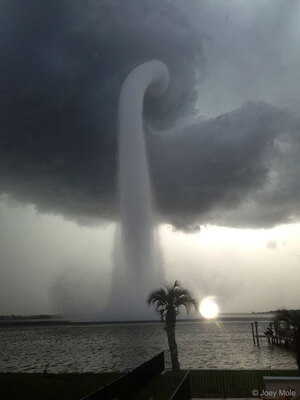
Behold: arguably the most impressive ever picture of a waterspout (a tornado that occurs over water) To wit:

Waterspouts are spinning columns of rising moist air that typically form over warm water. Waterspouts can be as dangerous as tornadoes and can feature wind speeds over 200 kilometres per hour. Some waterspouts form away from thunderstorms and even during relatively fair weather. Waterspouts may be relatively transparent and initially visible only by an unusual pattern they create on the water. The featured image was taken in 2013 July near Tampa Bay, Florida. The Atlantic Ocean off the coast of Florida is arguably the most active area in the world for waterspouts, with hundreds forming each year.

(Image: Joey Mole)

apod

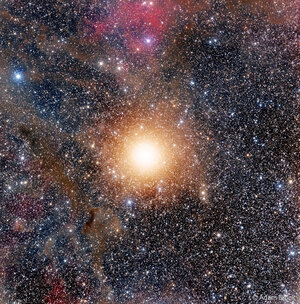
What’s behind Betelgeuse? Quite a few things as it happens. To wit:

One of the brighter and more unusual stars in the sky, the red supergiant star Betelgeuse can be found in the direction of famous constellation Orion. Betelgeuse, however, is actually well in front of many of the constellation’s other bright stars, and also in front of the greater Orion Molecular Cloud Complex. Numerically, light takes about 700 years to reach us from Betelgeuse, but about 1,300 years to reach us from the Orion Nebula and its surrounding dust and gas. All but the largest telescopes see Betelgeuse as only a point of light, but a point so bright that the inherent blurriness created by the telescope and Earth’s atmosphere make it seem extended. In the featured long-exposure image, thousands of stars in our Milky Way Galaxy can be seen in the background behind Betelgeuse, as well as dark dust from the Orion Molecular Cloud, and some red-glowing emission from hydrogen gas on the outskirts of the more distant Lambda Orionis Ring. Betelgeuse has recovered from appearing unusually dim over the past six months, but is still expected to explode in a spectacular supernova sometime in the next (about) 100,000 years.

*popcorn*

(Image: Adam Block, Steward Observatory, University of Arizona)

apod