
Category Archives: Science

Behold: Mars. Right there – wandering along through the constellation Taurus, close (in the sky) to the Seven Sisters or Pleiades star cluster. To wit:

In fact, this deep, widefield view of the region captures Mars near its closest conjunction to the Pleiades on March 3. Below centre, Mars is the bright yellowish celestial beacon only about 3 degrees from the pretty blue star cluster. Competing with Mars in colour and brightness, Aldebaran is the alpha star of Taurus. The red giant star is toward the lower left edge of the frame, a foreground star along the line-of-sight to the more distant Hyades star cluster. Otherwise too faint for your eye to see, the dark, dusty nebulae lie along the edge of the massive Perseus molecular cloud, with the striking reddish glow of NGC 1499, the California Nebula, at the upper right.

(Image: Petr Horalek / Institute of Physics in Opava)

apod

Behold: IC 5070, aka the Pelican nebula – an unusual, constantly changing, highly active mix of star formation and evolving gas clouds. To wit:

The featured picture was processed to bring out two main colours, red and blue, with the red dominated by light emitted by interstellar hydrogen. Ultraviolet light emitted by young energetic stars is slowly transforming cold gas in the nebula to hot gas, with the advancing boundary between the two, known as an ionisation front, visible in bright red across the image centre. Particularly dense tentacles of cold gas remain. Millions of years from now this nebula might no longer be known as the Pelican, as the balance and placement of stars and gas will surely leave something that appears completely different.

(Image: M. Petrasko, M. Evenden, U. Mishra (Insight Obs.)

apod

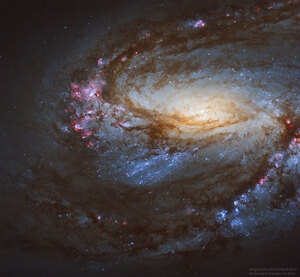
Behold: a spectacular view from the Hubble Space Telescope of nearby spiral galaxy M66. Open for business if you don’t mind the journey. To wit:

A spiral galaxy with a small central bar, M66 is a member of the Leo Galaxy Triplet, a group of three galaxies about 30 million light years from us. The Leo Triplet is a popular target for relatively small telescopes, in part because M66 and its galactic companions M65 and NGC 3628 all appear separated by about the angular width of a full moon. The featured image of M66 was taken by Hubble to help investigate the connection between star formation and molecular gas clouds. Clearly visible are bright blue stars, pink ionized hydrogen clouds — sprinkled all along the outer spiral arms, and dark dust lanes in which more star formation could be hiding.

(Image: NASA, ESA, Hubble, Janice Lee; Processing & Copyright: Leo Shatz; Text: Karen Masters)

apod

Behold: starships! To wit:

Specifically, they are launch-and-return reusable rockets being developed by SpaceX to lift cargo and eventually humans from the Earth‘s surface into space. The two rockets pictured are SN9 (Serial Number 9) and SN10 which were captured near their Boca Chica, Texas launchpad last month posing below January’s full Wolf Moon. The Starships house liquid-methane engines inside rugged stainless-steel shells. SN9 was test-launched earlier this month and did well with the exception of one internal rocket that failed to relight during powered descent. SN10 continues to undergo ground tests and may be test-launched later this month.

(Image: John Kraus)

apod

Behold: the Rosette Nebula, aka Caldwell 49 or NGC 2237 or NGC 2238 or NGC 2239 or NCG 2244 or NGC 2246 depending on what way you look at it. To wit:

The bland New General Catalog designation of NGC 2237 doesn’t appear to diminish the appearance of this flowery emission nebula, at the top of the image, atop a long stem of glowing hydrogen gas. Inside the nebula lies an open cluster of bright young stars designated NGC 2244. These stars formed about four million years ago from the nebular material and their stellar winds are clearing a hole in the nebula’s centre, insulated by a layer of dust and hot gas. Ultraviolet light from the hot cluster stars causes the surrounding nebula to glow. The Rosette Nebula spans about 100 light-years across, lies about 5000 light-years away, and can be seen with a small telescope towards the constellation of the Unicorn (Monoceros).

(Image: Adam Block & Tim Puckett)

apod

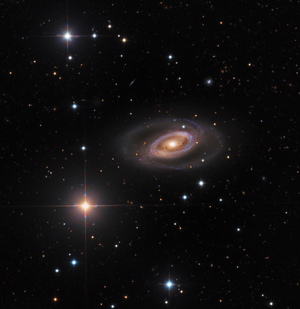
Behold: spiral galaxy NGC 1350 – a beautiful island universe 85 million light years away in the constellation of Formax. To wit:

Inhabited by young blue star clusters, the tightly wound spiral arms of NGC 1350 seem to join in a circle around the galaxy’s large, bright nucleus, giving it the appearance of a cosmic eye. In fact, NGC 1350 is about 130,000 light-years across. That makes it as large or slightly larger than the Milky Way. For earth-based astronomers, NGC 1350 is seen on the outskirts of the Fornax cluster of galaxies, but its estimated distance suggests that it is not itself a cluster member. Of course, the bright spiky stars in the foreground of this telescopic field of view are members of our own spiral Milky Way galaxy.

(Image: Mike Selby, Warren Keller)

apod

Behold: the constellation of Cygnus near the northern end of the Great Rift, or ‘Dark River’: the cosmic dust clouds that normally obscure the centre of the Milky Way from our view. To wit:

Composed over a decade with 400 hours of image data, the broad mosaic spans an impressive 28×18 degrees across the sky. Alpha star of Cygnus, bright, hot, supergiant Deneb lies at the left. Crowded with stars and luminous gas clouds Cygnus is also home to the dark, obscuring Northern Coal Sack Nebula and the star forming emission regions NGC 7000, the North America Nebula and IC 5070, the Pelican Nebula, just left and a little below Deneb. Many other nebulae and star clusters are identifiable throughout the cosmic scene. Of course, Deneb itself is also known to northern hemisphere skygazers for its place in two asterisms, marking a vertex of the Summer Triangle, the top of the Northern Cross.

(Image: J-P Metsavainio (Astro Anarchy)

apod

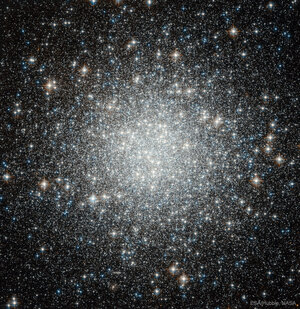
Behold: M53, aka NGC 5024 – one of the Milky Way’s 250 surviving globular clusters – a cosmic nightclub filled with stars, among them, late arrivals to the party, clearly under the influence of recent ‘refreshment’. To wit:

Most of the stars in M53 are older and redder than our Sun, but some enigmatic stars appear to be bluer and younger. These young stars might contradict the hypothesis that all the stars in M53 formed at nearly the same time. These unusual stars are known as blue stragglersand are unusually common in M53. After much debate,blue stragglers are now thought to be stars rejuvenated by fresh matter falling in from a binary star companion. By analyzing pictures of globular clusters like the featured image taken by the Hubble Space Telescope, astronomers use the abundance of stars like blue stragglers to help determine the age of the globular cluster and hence a limit on the age of the universe. M53, visible with a binoculars towards the constellation of Bernice’s Hair (Coma Berenices), contains over 250,000 stars and is one of the furthest globulars from the centre of our Galaxy.

Melon-twisting full sized image here.

(Image: ESA/Hubble, NASA)

apod

Stars – artists of the cosmos, panting in particles with interstellar gas as their canvas. Sigh. To wit:

… a massive and tumultuous Wolf-Rayet star has created the picturesque ruffled half-circular filaments called WR32, on the image left. Additionally, the winds and radiation from a small cluster of stars, NGC 3324, have sculpted a 35 light year cavity on the upper right, with its right side appearing as a recognisable face in profile. This region’s popular name is the Gabriela Mistral Nebula for the famous Chilean poet. Together, these interstellar clouds lie about 8,000 light-years away in the Great Carina Nebula, a complex stellar neighborhood harboring numerous clouds of gas and dust rich with imagination inspiring shapes. The featured telescopic view captures these nebulae’s characteristic emission from ionized sulfur, hydrogen, and oxygen atoms mapped to the red, green, and blue hues of the popular Hubble Palette.

(Image: Ariel Cappelletti)

apod