
Category Archives: Science

Behold: the snaky, braided filaments of glowing gas emanating from Abell 21, also known as the Medusa nebula. To wit:

…this Medusa is an old planetary nebula some 1,500 light-years away in the constellation Gemini. Like its mythological namesake, the nebula is associated with a dramatic transformation. The planetary nebula phase represents a final stage in the evolution of low mass stars like the sun as they transform themselves from red giants to hot white dwarf stars and in the process shrug off their outer layers. Ultraviolet radiation from the hot star powers the nebular glow. The Medusa’s transforming star is the faint one near the center of the overall bright crescent shape. In this deep telescopic view, fainter filaments clearly extend above and right of the bright crescent region. The Medusa Nebula is estimated to be over 4 light-years across.

(Image: Josep Drudis)

apod

Behold: the 4 light years wide centre of M8, aka, the Lagoon Nebula – 4,000 light-years away within the boundaries of the constellation Sagittarius. To wit:

Visible light images show the glowing gas and obscuring dust clouds that dominate the scene. But this infrared image, constructed from Hubble Space Telescope data, peers closer to the heart of the active star-forming region revealing newborn stars scattered within, against a crowded field of background stars toward the centre of our Milky Way galaxy. This tumultuous stellar nursery’s central regions are sculpted and energised by the massive, young Herschel 36, seen as the bright star near centre in the field of view. Herschel 36 is actually a multiple system of massive stars. At over 30 times the mass of the Sun and less than 1 million years old, the most massive star in the system should live to a stellar old age of 5 million years. Compare that to the almost 5 billion year old Sun which will evolve into a red giant in only another 5 billion years or so.

(Image: NASA, ESA, Hubble; Data Archive: MAST, Processing: Alexandra Nachman)

apod

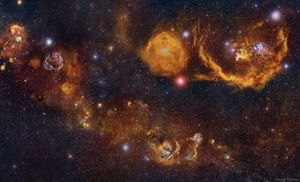
A 34 image digital composite of the skyscape from Auriga to Orion- the fruit of a total of 430 hours of exposure. But what are we seeing? Many old friends of this series of posts, certainly. To wit:

Starting on the far upper left, toward the constellation of Auriga (the Chariot driver), is the picturesque Flaming Star Nebula (IC 405). Continuing down along the bright arc of our Milky Way Galaxy, from left to right crossing the constellations of the Twins and the Bull, notable appearing nebulas include the Tadpole, Simeis 147, the Monkey’s Head, the Jellyfish, the Cone and Rosette nebulas. In the upper right quadrant of the image, toward the constellation of Orion (the hunter), you can see Sh2-264, the half-circle of Barnard’s Loop, and the Horsehead and Orion nebulas. Famous stars in and around Orion include, from left to right, orange Betelgeuse (just right of the image center), blue Bellatrix (just above it), the Orion belt stars of Mintaka, Alnilam, and Alnitak, while bright Rigel appears on the far upper right. This stretch of sky won’t be remaining up in the night very long — it will be setting continually earlier in the evening as mid-year approaches.

(Image: Alistair Symon)

apod

Behold: the ‘Leo Trio’. To wit:

This popular group leaps into the early evening sky around the March equinox and the northern hemisphere spring. Famous as the Leo Triplet, the three magnificent galaxies found in the prominent constellation Leo gather here in one astronomical field of view. Crowd pleasers when imaged with even modest telescopes, they can be introduced individually as NGC 3628 (right), M66 (upper left), and M65 (bottom). All three are large spiral galaxies but tend to look dissimilar, because their galactic disks are tilted at different angles to our line of sight. NGC 3628, also known as the Hamburger Galaxy, is temptingly seen edge-on, with obscuring dust lanes cutting across its puffy galactic plane. The disks of M66 and M65 are both inclined enough to show off their spiral structure. Gravitational interactions between galaxies in the group have left telltale signs, including the tidal tails and warped, inflated disk of NGC 3628 and the drawn out spiral arms of M66. This gorgeous view of the region spans over 1 degree (two full moons) on the sky in a frame that covers over half a million light-years at the trio’s estimated distance of 30 million light-years. Of course the spiky foreground stars lie well within our own Milky Way.

(Image: Francis Bozon)

apod

Stardust. That’s right, Joni Mitchell.

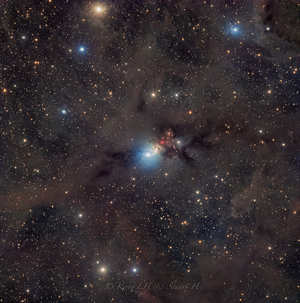
Behold: plumes of the stuff drifting across the Perseus molecular cloud 850 light years away. To wit:

Dusty nebulae reflecting light from embedded young stars stand out in the nearly 2 degree wide telescopic field of view. With a characteristic bluish colour reflection nebula NGC 1333 is at centre, vdB 13 at top right, with rare yellowish reflection nebula vdB 12 near the top of the frame. Stars are forming in the molecular cloud, though most are obscured at visible wavelengths by the pervasive dust. Still, hints of contrasting red emission from Herbig-Haro objects, the jets and shocked glowing gas emanating from recently formed stars, are evident in NGC 1333. The chaotic environment may be similar to one in which our own Sun formed over 4.5 billion years ago. At the estimated distance of the Perseus molecular cloud, this cosmic scene would span about 40 light-years.

(Image: Kerry-Ann Lecky Hepburn (TWAN), Stuart Heggie)

apod

Behold: the Butterfly nebula, aka IC1318 – a gas cloud in the constellation of the Swan near the Pelican nebula next to a star called the Hen.

That star, given the proper name Sadr, is just to the right of the featured frame, but the central Butterfly Nebula, designated IC 1318, is shown in high resolution. The intricate patterns in the bright gas and dark dust are caused by complex interactions between interstellar winds, radiation pressures, magnetic fields, and gravity. The featured telescopic view captures IC 1318‘s characteristic emission from ionised sulfur, hydrogen, and oxygen atoms mapped to the red, green, and blue hues of the popular Hubble Palette. The portion of the Butterfly Nebula pictured spans about 100 light years and lies about 4000 light years away.

(Image: Alan Pham)

apod

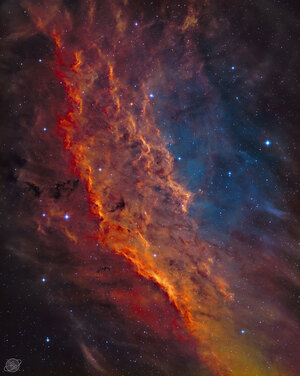
Behold: NGC 1499, also known as the California nebula, for obvious reasons. To wit:

Could Queen Calafia‘s mythical island exist in space? Perhaps not, but by chance the outline of this molecular space cloud echoes the outline of the state of California, USA. Our Sun has its home within the Milky Way’s Orion Arm, only about 1,000 light-years from the California Nebula […] The classic emission nebula is around 100 light-years long. On the featured image, the most prominent glow of the California Nebula is the red light characteristic of hydrogen atoms recombining with long lost electrons, stripped away (ionised) by energetic starlight. The star most likely providing the energetic starlight that ionises much of the nebular gas is the bright, hot, bluish Xi Persei just to the right of the nebula. A regular target for astrophotographers, the California Nebula can be spotted with a wide-field telescope under a dark sky toward the constellation of Perseus, not far from the Pleiades.

(Image: Yannick Akar)

apod

Behold: countless newborn stars forming in the Eagle Nebula. To wit:

Gravitationally contracting in pillars of dense gas and dust, the intense radiation of these newly-formed bright stars is causing surrounding material to boil away. This image, taken with the Hubble Space Telescope in near infrared light, allows the viewer to see through much of the thick dust that makes the pillars opaque in visible light. The giant structures are light years in length and dubbed informally the Pillars of Creation. Associated with the open star cluster M16, the Eagle Nebula lies about 6,500 light years away. The Eagle Nebula is an easy target for small telescopes in a nebula-rich part of the sky toward the split constellation Serpens Cauda (the tail of the snake).

Previously: Behold The Pillars Of Creation

(Image: NASA, ESA, Hubble, HLA; Processing: Luis Romero)

apod