Category Archives: Science

A spectacular (and very rare) ice halo photographed (on an iPhone) by Michael Schneider this month in the Swiss Alps. According to Schneider, the phenomenon developed gradually as fog dissipated at the top of a ski resort.

The annotated overlay (using information from this site on atmospheric optics) was created by Mark McCaughrean.

Previously: Dublin Rainbow

kottke

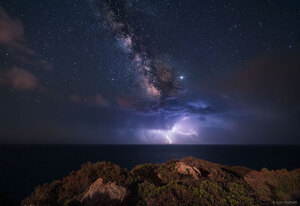
Not really. What appears to be an electrical discharge from the Milky Way is actually a distant storm photographed from the  Italian island of Sardinia last June. To wit:

The foreground rocks and shrubs are near the famous Capo Spartivento Lighthouse, and the camera is pointed south toward Algeria in Africa. In the distance, across the Mediterranean Sea, a thunderstorm is threatening, with several electric lightning strokes caught together during this 25-second wide-angle exposure. Much farther in the distance, strewn about the sky, are hundreds of stars in the neighbourhood of our Sun in the Milky Way Galaxy. Farthest away, and slanting down from the upper left, are billions of stars that together compose the central band of our Milky Way.

(Image: Ivan Pedretti)

apod

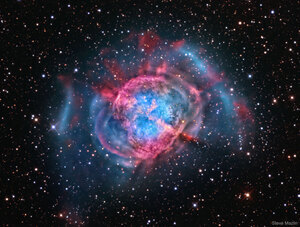
Behold: M27 – the Dumbell Nebula – possibly what will eventually happen to our own sun. To wit:

…the type of nebula our Sun will produce when nuclear fusion stops in its core.,M27 is one of the brightest planetary nebulae on the sky, and can be seen toward the constellation of the Fox (Vulpecula) with binoculars. It takes light about 1000 years to reach us from M27, featured here in colors emitted by hydrogen and oxygen. Understanding the physics and significance of M27 was well beyond 18th century science. Even today, many things remain mysterious about bipolar planetary nebula like M27, including the physical mechanism that expels a low-mass star’s gaseous outer-envelope, leaving an X-ray hot white dwarf.

(Image: Steve Mazlin)

apod

Or, pre-1998, Opal Fruits.

Behold: the spiral galaxy NGC 4736, aka Messier 94 – 15 million light years away in the in the northern constellation of the Hunting Dogs (Canes Venatici). To wit:

A popular target for Earth-based astronomers, the face-on spiral galaxy is about 30,000 light-years across, with spiral arms sweeping through the outskirts of its broad disk. But this Hubble Space Telescope field of view spans about 7,000 light-years across M94‘s central region. The featured close-up highlights the galaxy’s compact, bright nucleus, prominent inner dust lanes, and the remarkable bluish ring of young massive stars. The ring stars are all likely less than 10 million years old, indicating that M94 is a starburst galaxy that is experiencing an epoch of rapid star formation. The circular ripple of blue stars is likely a wave propagating outward, having been triggered by the gravity and rotation of a oval matter distributions. Because M94 is relatively nearby, astronomers can better explore details of its starburst ring.

(Image: ESA/Hubble & NASA)

apod

Behold: Europa –  fourth largest of Jupiter’s 79 moons and fictional forbidden location of future intelligent life in Arthur C. Clarke’s ’2010: Odyssey Two’ (1982) and Peter Hyam’s 1984 film adaptation ‘2010: The Year We Make Contact’.

Looping through the Jovian system in the late 1990s, the Galileo spacecraft recorded stunning views of Europa and uncovered evidence that the moon’s icy surface likely hides a deep, global ocean. Galileo’s Europa image data has been remastered here, using improved new calibrations to produce a color image approximating what the human eye might see. Europa’s long curving fractures hint at the subsurface liquid water. The tidal flexing the large moon experiences in its elliptical orbit around Jupiter supplies the energy to keep the ocean liquid. But more tantalizing is the possibility that even in the absence of sunlight that process could also supply the energy to support life, making Europa one of the best places to look for life beyond Earth. What kind of life could thrive in a deep, dark, subsurface ocean? Consider planet Earth’s own extreme shrimp.

Larger image here.

(Image: NASA, JPL-Caltech, SETI Institute, Cynthia Phillips, Marty Valenti)

apod

Behold: Hoag’s Object – an unusual extragalactic thingy we still don’t know a great deal about despite it  being discovered by astronomer Arthur Hoag in 1950. What is it? One galaxy? Two? The Eye of Sauron? The Doughnut Of Doom?  To wit:

On the outside is a ring dominated by bright blue stars, while near the center lies a ball of much redder stars that are likely much older. Between the two is a gap that appears almost completely dark. How Hoag’s Object formed, including its nearly perfectly round ring of stars and gas, remains unknown. Genesis hypotheses include a galaxy collision billions of years ago and the gravitational effect of a central bar that has since vanished. The featured photo was taken by the Hubble Space Telescope and recently reprocessed using an artificially intelligent de-noising algorithm. Observations in radio waves indicate that Hoag’s Object has not accreted a smaller galaxy in the past billion years. Hoag’s Object spans about 100,000 light years and lies about 600 million light years away toward the constellation of the Snake (Serpens). Many galaxies far in the distance are visible toward the right, while coincidentally, visible in the gap at about seven o’clock, is another but more distant ring galaxy.

(Image: NASA, ESA, Hubble; Processing: Benoit Blanco)

apod

Behold: a close-up of the eastern Veil Nebula and – within it – NGC 6995, aka the Bat Nebula. Smaller, but perfectly formed. To wit:

The Veil Nebula itself is a large supernova remnant, the expanding debris cloud from the death explosion of a massive star. While the Veil is roughly circular in shape and covers nearly 3 degrees on the sky toward the constellation of the Swan (Cygnus), the Bat Nebula, NGC 6995, spans only 1/2 degree, about the apparent size of the Moon. That translates to 12 light-years at the Veil’s estimated distance, a reassuring 1,400 light-years from planet Earth. In the composite of image data recorded through broad and narrow band filters, emission from hydrogen atoms in the remnant is shown in red with strong emission from oxygen and nitrogen atoms shown in hues of blue.

(Image: Josep Drudis)

apod

Behold: Arp 273 – a great interstellar battle featuring upper galaxy UGC 1810 and its smaller collisional neighbour UGC 1813. War is hell. To wit:

The overall shape of the UGC 1810 — in particular its blue outer ring — is likely a result of wild and violent gravitational interactions. The blue colour of the outer ring at the top is caused by massive stars that are blue hot and have formed only in the past few million years. The inner part of the upper galaxy — itself an older spiral galaxy — appears redder and threaded with cool filamentary dust. A few bright stars appear well in the foreground, unrelated to colliding galaxies, while several far-distant galaxies are visible in the background. Arp 273 lies about 300 million light years away toward the constellation of Andromeda. Quite likely, UGC 1810 will devour its galactic sidekicks over the next billion years and settle into a classic spiral form.

(Image: NASA, ESA, Hubble; Processing: Rudy Pohl)

apod