


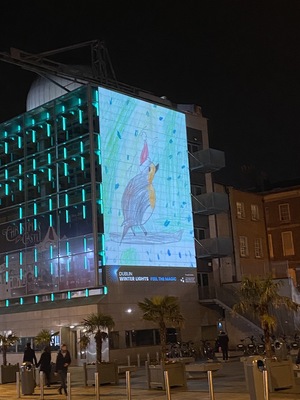



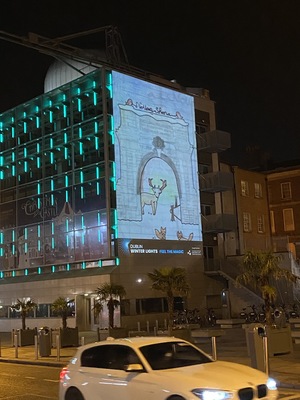

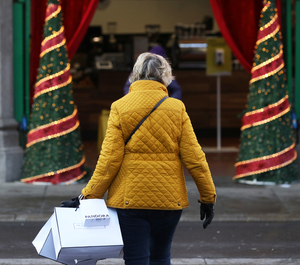
Last night.
Dame Street, Dublin 2.
Thanks Przemyslaw Zbieron



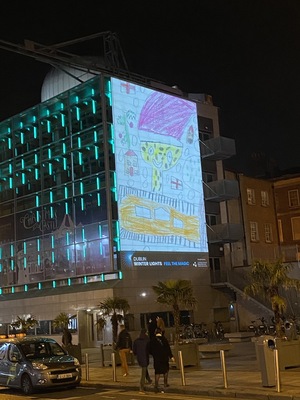
Last night.
Dame Street, Dublin 2.
Thanks Przemyslaw Zbieron

This afternoon.
Plans to build a whitewater rafting course in Dublin ‘appear to have been shelved‘.
Via RTÉ News:
According to the council’s Captial Programme 2022-2024 which will be discussed at meeting later tonight, there has been significant hostility towards the project and it has been unable to convince the various State funding bodies to support the project.
The report, from the council’s Chief Executive Owen Keegan, also says there has been a ”considerable amount of negative commentary related to this project […] that appears impossible to reverse and that has undermined the planned funding of the project”.
Dublin whitewater rafting facility appears to be shelved (RTÉ)

 From top: Minister for Health, Stephen Donnelly and Taoiseach, Micheál Martin TD; Derek Moonery
Many years ago I was asked to help in the re-structuring and re-invigoration of a voluntary organisation. I was one of a group of outsiders. Each tasked with reviewing key aspects of the organisation’s work, operations, and structures.
Each of us brought a different skillset to the mission, HR, communications, fund raising and organisation. Towards the end of the assignment they brought us together to compare notes.
Governance had been a major issue in the organisation with the odd board member accused of crossing the line and getting involved in the day-to-day operations. So, we were all interested to see and hear what the person looking at organisation and governance would recommend.
We were expecting him to come with a set of complex system of checks and balances. He didn’t. His analysis was remarkably straight forward. He succinctly delineated the roles and responsibilities of elected board of directors versus those of the full-time management, with a simple phrase: Management proposes, board decides. Management implements, board oversees.
It’s a comprehensive statement of the fundamentals of good governance.
The same key principle applies when it comes to government, but with more significant consequences. One of those, the delineation paradox, was neatly summarised in the opening line of a 2007 OECD paper entitled The Delineation of Responsibilities Between Ministers and Senior Civil Servants. It says:
“democratic regimes find themselves having to balance two values that can be in some tension: (1) fair and non-politically partisan public service delivery and, subject to the law, (2) the responsiveness of public servants to the policies of the current executive.”
So, just as democratic accountability demands that an incoming political administration is able to change the direction of government policy – i.e. Board decides, public servants need protection against being misused for partisan purposes – management implements.
Avoiding any crossover between this separation and delineation is critical. While some stepping across the boundaries may suit the passing whims, or lethargy of a given Minister or Secretary General of the day... it is damaging in the long term. Today’s operational convenience can all too easily become tomorrow’s policy impediment.
Or, to put it another way using one of my late father’s favourite sayings, you can’t sit on the swing and push. But all too often that is what we see and hear from NPHET.
This is not a criticism of their latest set of recommendations. I have neither the expertise nor the knowledge to meaningfully critique them, but I can comment on how they convey them. And on how it all too often seems that ministers get to hear what may be coming from NPHET via the media.
NPHET is there to advise. It is there to propose – management proposes, but it is not there to decide on them – either by casting the deciding vote or by encouraging public pressure on ministers to act. That is the prerogative of politically accountable element of government.
This is not to let ministers off the hook. They are the ones who have most to lose by any blurring of the delineation boundaries, so they have both a responsibility and a duty to ensure their strict observation. Telling the Sunday papers that you plan to put manners on NPHET is both a dollar short and day late.
Having NPHET as a handy scapegoat for tough decisions is political cowardice. Not alone that. It is politically naïve to imagine you can scapegoat any organisation, be it private or public, and they will just meekly and quietly absorb it.
This is too small a country with too politically savvy a polity for that to happen.
Blurring the lines hurts both – a point that was well illustrated in Richard Chambers’ book on the government response to the Covid crisis A State of Emergency.
Of the very many interesting insights and observations in that book, the one that resonated most with me comes from October 2020. Explaining the decision not to directly contact the Taoiseach to forewarn him of the lockdown recommendation, Dr Holohan’s colleagues at NPHET told the author that Holohan had said that “If Martin Fraser found out I was ringing the Taoiseach just off my own bat… they already think we have ideas above our station.”
This suggests a worrying level of dysfunction at the top of government where key actors are more worried about the Secretary General at the Department of the Taoiseach resenting someone going over his head to the Taoiseach.
I have no idea whether the additional restrictive measures announced by An Taoiseach is the government acting with due caution or an excess of caution. But I have major qualms with the perceived vilification of the hospitality sector.
Maybe the prevailing political view is that people are content to see the sector continue to take it? There may be some validity to view with yesterday’s Irish Mail on Sunday/Ireland Thinks poll finding that 65% of people support the additional restrictions. But politicians should not confuse a public desire to see government taking firm action, with them accepting just any old action.
There may well be overwhelming and convincing evidence for having only six people at a table, or for a family of eight having to decide which ones to leave at home because they cannot book two tables of four… but I doubt it is as convincing as the evidence that we need more ICU beds, or that we need high efficiency particulate air filtration, i.e. hepa filter systems in indoor public spaces including classrooms, restaurants and venues?
Elected representatives across the Dáil should heed the other finding in the Irish Mail on Sunday poll, the one showing that 56% of 18–24-year-olds disagree with the latest measures.
Sometimes you require an outside perspective to help you to get a better grasp on what’s happening here. Which is why I strongly recommend watching last Friday’s BBC Newsnight. It contained a segment on Taoiseach Micheál Martin’s announcement that asked why the UK and Ireland were taking such different approaches?
This included a live interview with DCU Professor, Anthony Staines (see part of it here). Staines said he broadly supported the latest Irish government actions, saying that it “..has had the courage to say we need to step backwards.”
He rejected outright the notion that the scientists in the UK and Ireland are far apart in their assessments, saying that it was the political response to the science that was far apart. He told Newsnight’s Kirsty Wark that…
“…the price paid in your country has been high even by European standards. Most of Europe did not cover themselves in glory but Britain stands out in all the wrong ways.”
But while Staines may back the latest moves by Irish government, his assessment of its overall approach was less than glowing. He said Ireland was in the mid-range of European countries when it came to the effectiveness of its response and compared unfavourably with countries like Finland and Norway.
Most significantly, in terms of the latest actions by the Irish government, Staines said
“The message from the science is clear. You do all the things you can to control this virus. And lockdowns and restrictions are the very last thing you do.
“So, before you do those, you wear masks, you use air filtration. Covid passports may be useful. Antigen testing. You ramp up public health, so we identify cases. We trace the cases; we trace their contacts. We support them on how to isolate. As soon as the vaccine becomes available you push it out as quickly as possible.” [my emphasis]
While the Irish government scores high marks on some of these points, it scores very poorly on others. The situation in hospital ICUs is pitiful. The average number of ICU beds per 100,000 of the population across the EU is 11.5. In Ireland it is just under 6.5.
In 2018, the Department of Health’s capacity review planned for a total of 330 ICU beds by the end of 2021. That not especially ambitious target was set pre-covid. If anything they should have increased the target when the pandemic hit. They didn’t.
That pre-covid target will be missed. Two weeks ago the Taoiseach told the Dáil that “we are at close to 300 or 301 ICU beds now”, and that “the intention now is to go, at a minimum, to 340 by the end of 2022”.
But fear not – we will not miss the target to close nightclubs, halve theatre capacity, or keep pub and restaurant tables to a maximum of six people.
We have been slow and confused on Antigen testing – this Twitter thread is a useful primer on the part Antigen tests can play in tackling covid spread, even though they are not as accurate a diagnostic tool as PCR testing. Yesterday the Scottish government’s national clinical director was advising Scots to “do LFD (lateral flow device/Antigen) tests on every occasion before socialising with others.”
To use Anthony Staines phrase, it is good to see NPHET step backwards a little on its hostility to antigen testing. It had to do something similar on mask wearing in mid-2020.
But this brings us back to the problem. There should not be the scope or space for idle chatter on what NPHET thinks about A; how The Tánaiste feels about B; or how the Taoiseach views C or D. As we discovered when we did a survey on attitudes to emergency preparedness back in the 2005/06, the public want to know that there is a plan.
There should be one clear government approach and one clear government message. If even there was a time for P.J Mara’s uno duce, una voce, it is now. Just as it is time, to paraphrase another great Mara saying, for NPHET, Martin, Varadkar, Harris, Donnelly et al to stop the “nibbling at each other’s bums.”
Derek Mooney is a communications and public affairs consultant. He previously served as a Ministerial Adviser to the Fianna Fáil-led government 2004 – 2010. His column appears here every Monday. Follow Derek on Twitter: @dsmooney

This afternoon.
Orla writes:
A colleague of mine cannot access indoor dining because she doesn’t have a Covid-19 certificate.
She doesn’t have a vaccine certificate because she can’t get the vaccine for medical reasons. I was shocked to find out that there is no exemption for people who can’t get the vaccine.
I’ve tried to find politicians discuss this and can only find this reference to Senator Denis O’Donvon raising the case of a woman, a pharmaceutical worker with Jannsen and lecturer, who can’t get the cert after she had an adverse reaction to her first shot. There is no mention of her having any underlying condition. The senator relayed to the Senate what she told him:
‘I am not a crackpot anti-vaxxer. I want to do my part in reducing the risk. But right now, the only way I can have a normal life like the rest of my family is to get Covid-19 myself and recover in order to get a Covid-19 certificate.’
In response, the Minister for Health Stephen Donnelly said:
“Covid passes for those who cannot be vaccinated is something we have discussed previously. It is a difficult balance. In many cases the reason people cannot be vaccinated is that there are underlying conditions that put them at higher risk. When I have discussed this with officials and public health doctors previously they have pointed out that it is not fair to say to people who cannot get vaccinated, the vast majority of whom would choose to be vaccinated, that they cannot avail of pubs and restaurants indoors.
“The counter to that is that while it may not be fair, if they have an underlying condition that puts them at higher risk of Covid-19, there is a real risk to them in some of these situations. There is no clean or easy answer to this. It is a deeply unfair situation. It is a small number of people, but it is an unenviable position. The current position is based solely on their health and safety and minimising the risk of exposing them to Covid.”
So health officials say it’s unfair and even NPHET strongly recommended in its letter of October 18 to Minister Donnelly that the Rapid Testing Expert Advisory Group examine “the potential role and feasibility of rapid testing as a component of the COVID pass for those for whom, on medical grounds, it is not been possible to get fully vaccinated.”
Has this not happened? If not, why not? How is this fair?
Anyone?



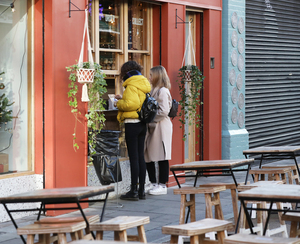
This afternoon.
Grafton Street, Dublin 2.
Update: a previous version of this post claimed today was Little Christmas or Nollaig na Mban, hence most featured (above) are female. It is January 6. Sorry.

This morning.
Dublin 3.
Brendan Furlong tweetz:
“Starting work this morning on our extended studio space on Vernon Avenue, Clontarf and we uncovered this gorgeous hand-painted sign “The Clontarf Bookshop” above a mosaic-tiled shopfront.”
Year, anyone?
Friday.
Dáil Eireann.
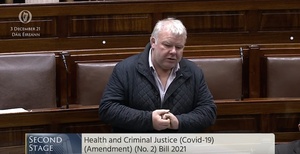
Roscommon-Galway independent TD Michael Fitzmaurice made a passionate response to news of new covid restrictions….
“When I saw stuff coming up on my phone today, it reminded me of the song about “the day the music died”. For the youngsters of this country, the announcement this evening is devastating. It is devastating not alone for them but for any person who talks about being a politician or being involved in politics because we politicians saw what was coming from NPHET today on our phones. It was not from a Minister. We did not get any briefing.
It is similar to every bit of emergency legislation that has come in to this Dáil in the past year. Some of it was got ready on a Thursday or Friday and, over the weekend, every journalist was able to write about what we would look at next week. If we are elected by the people, we should be informed.
Government Ministers, especially, should be informed of what is coming down the line and not reading it on a phone, like we did two to three hours ago, before our Taoiseach came out to tell the people. It was not a new story because it was on the phones before he came out. We knew what was going to happen.
Unfortunately, Ministers are in a no-win position. The likes of NPHET will make their decisions. If a Minister does not go with it, he or she is made a pariah in the media.
Between the media and the doctors running this country, we are like the last link in the chain. We come in here and we vote one way or the other, be it on a Wednesday, Friday or Saturday evening, but all we are really doing is endorsing what unelected people have advised be done.
I worry where we as a nation are going. Sometimes, you have to stand up and be counted. Everyone in this House and society in general wants to suppress Covid and to get rid of it. Some of the youngsters in Ireland have never been to a disco. That is sad.
It is all right for us, we have lived life, been to places and we did not have to wear masks for years, but the youngsters who are of an age to go out do not know what is to go into a normal place. This will be the second Christmas they do not have a lot to look forward to. This Christmas they will be under the feet of their mothers and fathers, which is not a normal Christmas.
If I want to travel from some other country into this country, I have to get a negative PCR test 72 hours beforehand or a negative antigen test 48 hours beforehand and I can sit beside another person on the aeroplane for up to two hours while, at the same time, when it comes to the local pub, I cannot go to the bar, I cannot sit at a table with more than six persons and I have to produce a document confirming that I am vaccinated and, if not, I have to go outside to a shed with my drink. Where are we going as a country? We need to make sure that we bring people with us.
I worry about democracy. There will always be debate, disagreement, people who have different views, right and wrong, and people to whom you could not tell one thing or the other. I worry when I look at what is happening in Australia and what is being talked about in Austria and in Germany by the German Chancellor, Angela Merkel, and her sidekick, Ursula.
I hope Ireland does not go down that road. I believe in democracy and the political system, whether on one side or the other. We should always respect each other. We should not shut down debate and questioning. Unfortunately, in the media you are put into a box. You could be the biggest supporter of something, but if you ask a question against it you are now put into a little corner and you are one of them. That is not the way politics should be done.
“I worry as well about powers. We were told by the so-called experts that if we reached an 85% or 90% vaccination rate, it would be happy days, happy Christmas and happy everything. I talk to people from around the country.
Ordinary, hard-working people are asking me if this is ever going to end. They were told this and that a year ago, something else six months ago and now we are back to square one. I understand that Covid is a virus and that nobody knows the ins and outs of it but, my God, we are at a crossroads in our country.
We need to give people hope, in particular those working in the hospitality sector. In a normal year, disc jockeys would have 16 nights’ work over Christmas. This year, they will have none and they will get only approximately €200 per week because the PUP will come back. They are not part of an employment because they are subcontractors. That is the reality. What did they earn in the past year? The PUP came down and because they had no tax, they were not open.
Will this be a happy Christmas for them? Definitely not. Make hay when the sun shines is a lesson we in rural Ireland always learned. Unfortunately, those people have gone into darkness tonight. I urge the Government to think of all aspects of the hospitality sector.
“As a Dáil, we need to start scrutinising some of the decisions that are coming forward. The Government cannot keep wobbling, twisting and turning. We need leadership or we will lose the people around this country who, in fairness, have made an honest effort this past year.
“We need to bring everybody with us. If someone has a reaction to a vaccine, let us not be afraid to talk about it. Let us talk about it and not shut it down. In being open and transparent we bring people with us.
“I do not believe in bringing in more and more powers. Powers will not solve this. I have trust in the people of Ireland, who are making an honest effort. We do not need to make criminals out of them.”
Earlier: Derek Mooney: Filtering NPHET
Meanwhile…
Taoiseach says he will investigate circumstances over the weekend where members of NPHET were declared ‘unavailable’ for interviews in various outlets [including my radio programme] and says public health officials should remain available for media and to issue independent advice pic.twitter.com/TNzFRA2H0I
— Gavan Reilly (@gavreilly) December 6, 2021
Hmm.

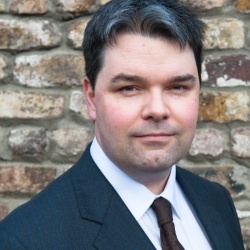
Solicitor Simon McGarr is fighting to get access to records for a Mother and Baby Home survivor
This afternoon.
The Government promised to ensure Mother and Baby Home survivors would get access to their personal information, contained within the Commission of Investigation into Mother and Baby Homes’ records, in line with EU law, or more specifically General Data Protection Regulation (GDPR).
But it hasn’t done so, citing a Statutory Instrument from 1989.
However, the SI is inferior to GDPR.
Solicitor Simon McGarr, in his latest Gist article, explains:
“…on behalf of a client, on the 17th September my office reported Ireland for this ongoing breach of EU law to the European Commission.
“On the 10th November 2021 the Commission wrote back, confirming it had opened an investigation on foot of that complaint and that it had written to the Department;
‘We wrote to the Department of Children, Equality, Disability, Integration and Youth as part of the investigation of this complaint. They informed us that the Minister for Health is progressing new Regulations concerning access to health data as a matter of priority and that officials from the Department of Children are also liaising with the Department of Health on this issue. The Department have informed us that the new Regulations intend to take into account of the requirements of the GDPR, and the issue of mandatory consultation with a health practitioner will be given further consideration. They stated that it is anticipated that the new Regulations will be in place by the end of the year.’
“In response, I pointed out that the Minister had not accepted that the requirement for a mandatory consultation with a health practitioner would be changed, but merely that it would be given ‘further consideration’.
“I then supplied the Commission with a copy of the new Legislative Heads for the same Minister’s proposed Birth Information and Tracing Bill, drawing their attention to Section 10(2), which repeats and continues the same block on direct access, and maintains the same requirement from the 1989 SI, that survivors’ medical records would be sent to doctors, not to them directly.
“We’re awaiting their reply, but it appears as though Ireland remains under investigation.
“And, for survivors, a right that everyone seems to acknowledge they have—to access their medical data under the GDPR—continues to be blocked.”
Anyone?


Dun Leary House, Dun leary Hill, Dun Laoghaire, county Dublin
Ah Here.
This morning.
Via Irish Times:
Plans to remove the roof and add four storeys to a protected 19th-century house in Dún Laoghaire as part of a build-to-rent development have been submitted to An Bord Pleanála.
Ted Living Ltd is seeking permission for 146 rental-only apartments in blocks up to eight storeys on the old Tedcastles Yard industrial site, opposite the town’s west pier, using the Strategic Housing Development system due to be discontinued next year.
The site includes Dun Leary House, a distinctive yellow brick, detached four-storey house dating from the 1870s, built for the original owner of the adjoining coal yard.
Ted Living last year sought permission to demolish the house as part of plans for 161 build-to-rent apartments, but
Build-to-rent plans for Dún Laoghaire yellow brick house (Irish Times)
Google Streetview

Professor Pete Lunn, Head of the Behavioural Research Unit, ESRI
This morning.
The ESRI’s Professor Pete Lunn said they have found that if you take the proportion of the population each week or each day that visits a cafe, pub or restaurant, the proportion of unvaccinated people going indoors is “a little over half the proportion of the vaccinated”.
Speaking on RTÉ’s Today with Claire Byrne, he said unvaccinated people are not getting into pubs and restaurants as much as vaccinated people are.
“But they are doing so more than half the amount, and in pubs and restaurants a bit more again,” he said.
“Not as much as vaccinated people but not far off, so they’re clearly finding places that they can get in.”
Unvaccinated people ‘finding places they can get in’ – ESRI data (RTÉ)
Meanwhile…
Via Irish Times:
…That a small cohort would effectively hold society hostage seems profoundly unfair to many, and how this should be tackled is an open question. This, of course, isn’t solely an Irish problem – Austria’s decision to impose lockdowns on the unvaccinated in mid-November was motivated by alarming strain on ICU capacity, driven almost entirely by those shirking vaccination. In Slovakia, Greece, and the Czech Republic similar restrictions have been imposed on vaccine-refusing cohorts for the same reason. Germany has also now introduced strict curbs on unvaccinated people.
Such measures, however, raise passionate ire, frequently decried as an infringement of liberties. But such arguments fail to recognise that others have a reasonable expectation that they should not be needlessly exposed to avoidable dangerous pathogens, nor should selfish stances be allowed imperil the freedom of others.
Such arguments also fail on another level – the unimmunised ultimately reduce the efficacy of vaccination, effectively functioning as human petri dishes. As the virus runs through them, random mutations eventually endow it with the ability to evade vaccines. The dominance of Delta and the emergency….
Um.
Small anti-vaccine cohort can’t hold society hostage (David Robert Grimes, Irish Times)
Meanwhile…
God they’re a sneaky bunch these unvaccinated – maybe we could set traps for them indoors with a wee bit of cheese or even peanut butter is a good one.
— B (@brianymoran) December 6, 2021
Peanut butter.
*drools*
Meanwhile…
I’ve tried to be compassionate towards unvaccinated people, but I’m losing my patience now.
I don’t want to lose it, but it’s getting really thin.
— Aisling Cusack (@ashQzack) December 6, 2021
Gulp.