
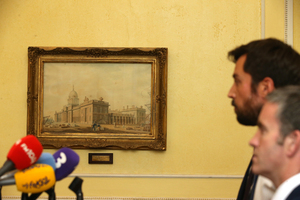
From left: Minister for Housing, Planning and Local Government Eoghan Murphy TD and Damien English TD at the Housing Summit in the Custom House, Dublin last September.

We all know about the €5million the Taoiseach set aside for a PR team. It is generally assume that they advise the Taoiseach on his “look”, but it likely goes a little deeper than that. To paraphrase a Tom Wait’s song, you can’t help wondering “what are they building in there?”

In November 2017 the Taoiseach suddenly took another tack on the subject of homelessness. He decided to downplay it, to describe it as normal, to as good as deny its existence.
This was taken up by others in the government. There was outrage on the internet, but it seems to have burned itself out. Maybe that too was an idea. To be outrageous and burn off the outrage.

An idea that featured in the sudden re-evaluation of homelessness as “normal” was the term “negative narrative”. I first heard it in a quote from Damien English. In the context in which the phrase was used by Fine Gael, and in the new “beliefs” about homelessness that the phrase appeared to inform, the implication appeared to be that homelessness was a consequence of negative thinking and behaviour.

Homelessness was being presented, in a sense, as the result of a failure to think positive.

This seems exactly like something a PR team would dream up. It’s quite good too when you look at it. By attaching the concept of positive thinking to the homeless crisis the aim of the 5million club appears to be to tap into those Irish people, a sizeable minority, if not possibly the majority, who genuinely subscribe to the idea of positive thinking as a progressive strategy for improvement and change.

Positive thinking is seen by many Irish people as a corrective to Irish begrudgery, and is enthusiastically championed by people who genuinely wish to shuck off their inherited Irish pessimism.

The phrase “negative narrative” is essentially a mechanism, which could conceivably be attached to any number of issues, ensuring more or less the same outcomes, i.e. blame the victim for having created the problem.

This time it is homelessness, next time it may serve similar functions attached to some other issue. Such a phrase can imply, across the board, that all problems ultimately are a failure on the part of those with the problem to practise positive thinking.

But, might this be true? Would social conditions improve if everyone thought more positively?

Studies have shown that the concept of positive thinking is very similar to religions in the manner in which it promises positive returns for certain rituals and practises. It is for this reason that the belief system, which is essentially what it is, is often regarded as a cult. The system has garnered a host of critiques, mainly in the US, questioning its claims. It’s no accident either that President Trump is a big positive-thinking aficionado.

But Trump, like Fine Gael, often cynically uses the concept of positive thinking to deny uncomfortable truths, much as Fine Gael appear to have cynically used the concept to downplay the severity of the homelessness crisis.

But positive thinking, when allied to politics, has been described by some critics as “political gaslighting”. Kitty S Jones describes in the web blog, “Politics and Insights” how the Tories in 2015 used the concept of positive thinking to discredit jobseekers when George Osborne installed cognitive behaviour therapists in job centres to “support” people.

The insinuation being that the causes of unemployment are “psychological rather than socio-political” and that the jobseekers simply weren’t thinking right. Cognitive Behaviour Therapy is designed specifically to modify so-called negative thinking. Still, there is a potential growth market in this, creating employment for cognitive therapists “fixing” poor people’s attitudes.

On top of the cynical use of the concept for political ends, an article in the New Yorker in 2014 by Adam Alter cited studies that appeared to demonstrate that even the concept of positive thinking was questionable as an effective agent for the improvement of anything.

“The Powerlessness of Positive Thinking” cites several studies that appear to show that positive thinking may actually be detrimental to positive outcomes, for reasons that are similar to talking up a plan so much that you’ve talked all the energy out and the thing never gets done.

One of the more popular and scathing books on the subject is Barbara Ehrenreich’s “Bright Sided: How the Relentless Promotion of Positive Thinking Has Undermined America” (Review here).

She takes issue with some of the main tenets of the belief system, the idea of shutting all “negative” people out of your life; the idea that the poor make themselves poor by not thinking “rich”; and that most cruel and disgusting idea, the notion that cancer sufferers create their own cancer through negative thinking.

All these questionable ideas from Positive Thinking are quite similar to Eileen Gleeson’s assertion that the homeless create their own homelessness through “bad behaviour”. Similarly, Damien English’s use of the phrase “negative narratives” seems also to be pitched in the spirit of positive thinking as a progressive cure-all.

It is likely that the Taoiseach’s 5million club have identified the popularity of positive thinking in Ireland – it could even be that the concept has filled the vacuum created by the decline in church participation – and have set out to cynically exploit the popularity of the belief system to deny the existence of homelessness.

In much the same way as the Trump administration use denial, often flagrantly, in the face of direct evidence to the contrary, in order to discredit all opposition and “equalise” irrationality with common sense perceptions. But the key strategy appears to be, in the Irish case, to hook into those in the middle ground who subscribe, with genuine good intentions, to the concept of positive thinking as a progressive tool for change.

Taken to absurdity, the concept could be invoked to claim that all political opposition is simply negative thinking in action. Maybe the government could install a team of cognitive behavioural therapists in the Dáil to try and modify the thinking of the left Alliance in order to arrive at a more agreeable political consensus.

Maybe instead of giving food and support to the homeless, which Eileen Gleeson suggests is a bad idea anyway, why not just give them copies of “The Secret”, and let them positive-vibe their way out of the hotels and off the streets?

This amalgam of right-wing religious type cultishness, based on a belief system that identifies a righteous elect and excluded defectives responsible for their own misery through “wrong thinking” is about as dangerous a mix of irrational bullshit as any government or ruling elite could possibly conceive of.

Eamonn Kelly is a freelance writer

Rollingnews


The Echo Chamber Podcast.

Episode 13.

Hosts Martin McMahon and Tony Groves are joined by academic, author, political analyst and activist Dr Rory Hearne.

They discuss the housing crisis; inequality; an alternative, left Government; next week’s Songs and Words: A Home For All event, at which Rory will be speaking; and the day Rory ran with Taoiseach Leo Varadkar in Dublin’s Phoenix Park.

Listen here

Previously: Dr Rory Hearne on Broadsheet

In La Conchita, California.

A man appears to rescue a rabbit from the wildfires currently raging in southern California.

Mmmf

California Fires Enter the Heart of Los Angeles (New York Times)

Winds whip up wildfires, forcing mass evacuations in California (Reuters)

Via Reuters

Saoirse Ronan on last weekend’s Saturday Night Live

Tomorrow night.

On the Late Late…

Via RTE:

With two Oscar nominations already under her belt, Saoirse Ronan looks like she will be hitting the awards circuit again following widespread acclaim for her turn in the critically adored hit Lady Bird, released in Irish cinemas in February next year…

As excitement builds for this year’s series of Dancing with the Stars Ireland, Ryan will be chatting with three of the yet-to-be-revealed celebs

Dublin mum Emma Murphy took a stand against domestic violence in a video that went viral after she was assaulted by her ex-partner, a former TV fitness instructor…she will speak about her ordeal…

As they celebrate the 20th anniversary of their hit album Talk on Corners and the release of Jupiter Calling, their seventh studio album, The Corrs will be performing and they’ll join Ryan on the couch for a catch up.

Children’s charity LauraLynn nominated a very special young boy to visit the Late Late Toy Show set last week. Three-year-old Jake was born with a tumour the size of a fist in his head and doctors thought it unlikely he would see his first birthday. He is still fighting… Jake’s parents Andrea and Padraic Smith will talk about how his illness…

Comedian Pat Shortt will join Ryan in character and music from The Coronas.

*drops telly from roof*

The Late Late Show, tomorrow night, on RTE One at 9.35pm.

This morning.

In the Irish Examiner.

Michael Clifford and Cormac O’Keeffe reported on an answer to a parliamentary question put down by Social Democrats TD Roisin Shortall to the Minister for Justice Charlie Flanagan.

The answer, published on Tuesday, revealed that the email accounts of the former Minister for Justice Frances Fitzgerald and her special advisers were not looked at as part of the “trawl” for documents in the Department of Justice relevant to the Disclosures Tribunal.

The tribunal, overseen by Supreme Court judge Peter Charleton, is examining allegations of a smear campaign against Garda whisteblower Sgt Maurice McCabe.

On the same day, Mr Flanagan, in an answer to a separate parliamentary question, revealed the Disclosures Tribunal issued discovery orders on the Department of Justice in February, April and September of this year.

Readers may wish to note that, in response to the question asked by Ms Shortall, the Minister for Justice Charlie Flanagan said:

While the email accounts of the then Tánaiste and Minister for Justice and Equality and her advisors were not specifically examined as part of the recent trawl for documents, I can confirm that the email accounts of officials working in relevant areas of the Department were searched and that this exercise would of course encompass emails sent from or to the then Minister and her advisors on any such matters.

“I would point out that all discovery orders issued by the Tribunal were complied with fully. The Department has also made extensive voluntary disclosure of other matters including three protected disclosures, reports from the Garda Commissioner under section 41 of the Garda Síochána Act and, most recently, the two email threads that were uncovered following a trawl of documents in the Department.

“In acknowledging receipt of the emails, the Tribunal made reference to my Department’s already extensive discovery which has allowed the Tribunal to place the current documents in context.

I am assured that in the event of further documents being located that may be of relevance to the Tribunal’s work that these will of course be furnished to the Tribunal and I would point out that, the Deputy will be aware, the Taoiseach has announced that there will be an external examination of the way in which my Department fulfilled its obligations in relation to discovering documents to the Tribunal, to conclude before Christmas. That is a step I welcome.”

“I can assure the Deputy that any further Discovery Orders to be made by the Tribunal will also be complied with in full and the Tribunal has been assured of my full and ongoing support in that regard.”

Meanwhile…

Yesterday…

After the a meeting of the joint Oireachtas committee on justice and equality, which was attended by Deputy Secretary General at the Department of Justice Oonagh McPhilips…

In the Dail…

Labour TD Alan Kelly said to Taoiseach Leo Varadkar:

“There is an element of denial about what is going on. I spent a period of time at the Joint Committee on Justice and Equality this morning and genuinely ask the Taoiseach to ask his colleagues, Deputy Colm Brophy and Senator Martin Conway, who made good contributions about what happened. It was extraordinary.

“Given everything that has gone on and the information we have received through persistent questioning and with help from the media, we still have departmental officials coming to the committee to state the Department provided the information that it had been requested to provide during discovery.

“That is it – nothing has changed. The meeting was deeply worrying. I asked a specific question. I asked if private email addresses that potentially had been used by senior officials for departmental business and mobile phone records had been provided for the tribunal. The answer was that they had not been asked for them.

I had to ask the officials to ask Mr. Justice Charleton if he wanted this information. Is that not crazy? Has anything changed? We were also told that the information provided had been provided based on the questions asked and that there might be other documentation available.

In effect, they are acting as judge and jury and as a filtering system in providing information for the Charleton tribunal. The trawl has not changed anything. The culture has not changed.

“There are three specific issues. First, the way in which parliamentary questions are answered has not changed. The Taoiseach made a commitment in the Dáil that it would. I have evidence from yesterday. I am receiving far more text, but I am not getting answers in seeking facts, not speculation.

“Second, when it comes to the information being provided for the Charleton tribunal, we need a volte-face in attitude. The Department needs to provide everything. It needs to err on the side of providing too much. Information on the specific issues I have raised has not been sent.

“Third, I note that last week the Taoiseach was provided with a summary under section 41 by the acting Garda Commissioner. What is he going to do about this? It has to be acted on immediately. It is not a case of writing back and asking more questions.

The tribunal will be live for the next couple of months and we need this unit to be dealt with. We need answers quickly because it is having a dramatic impact on the operations of the tribunal.

The Taoiseach should remember that the Department has received lots of correspondence from certain witnesses who have issues and concerns about this issue, on top of the 29 parliamentary questions from me.”

Transcripts via Oireachtas.ie

Email trawl for Charleton Tribunal omitted Frances Fitzgerald (Irish Examiner)

Yesterday: ‘The Minister Would Have Done Nothing Wrong If She Had… Expressed Her Dissatisfaction With The Approach’

Rollingnews


Pixelated Dublin by Fintan Wall

Give the gift of retro gamer Dublin prints.

Fintan Wall writes:

I am a graphic designer and illustrator based in Dublin and I make fun retro=inspired merchandise, including art prints mugs, t-shirts and enamel pins..shop at link below)..

A ‘Wall’ for your wall, eh?

Suit yourselves.

Fintan Wall Design

Irish-made stocking fillers to broadsheet@broadsheet.ie marked ‘irish-Made Stocking Fillers’. No fee.

Save Poolbeg.

This afternoon.

In the Dáil, during Leaders’ Questions, which were taken by Tanáiste Simon Coveney.

People Before Profit TD Richard Boyd Barrett raised this afternoon’s debate and vote on Permanent Structured Co-operation – an EU security and defence agreement – otherwise known as PESCO.

The ultimate aim of PESCO is to “deepen” defence co-operation among EU members states.

Mr Barrett ended up asking Mr Coveney to publish the Attorney General’s advice on PESCO but Mr Coveney pointed out the AG’s advice is never published.

From their exchange…

Richard Boyd Barrett: “Tanaiste, minister, this is the week that Donald Trump has declared war on the people of Palestine and the wider Arab and Muslim world by recognising Jerusalem as the capital of Israel – threatening to inflame conflict right across the Middle East.

“Now, against that background of war mongering, increased militarism by Trump, it is more important than ever that Ireland holds on to its traditional position of military neutrality and opposing war mongering and militarism.

“And yet, it is precisely in this week, that the Government has rammed through and quite successfully, to this point, buried what is the biggest betrayal of Irish neutrality since the decision to allow US forces use Shannon Airport to bomb Iraq back into the Dark Ages.

“The vote that will take place today, for us to join permanent, structured cooperation on a new common defence project in the European Union is an absolute betrayal of Ireland’s neutrality.

“It is a step towards involvement in what is explicitly being touted by Donald Tusk, by Juncker, by Macron as a new European army and common defence pact.

And you have buried this. You misled the business committee because the decision to join PESCO was taken, we were informed by Minister Kehoe who didn’t know much else frankly about this, but the one thing he informed us last night, was this decision was taken on the 21st of November and yet, for two business committee meetings, afterwards, not a mention that you were planning to push this vote through this week.

“No doubt you’ve been briefing the media that there’s nothing to see here, it’s irrelevant, not significant, there’s no legal implications, but the truth is this is us joining up in a common defence which will require us regularly, I’m quoting, increased defence budgets in real terms, to meet the 2% GDP benchmark, that would mean a quadrupling of our Irish defence expenditure.

“These are binding..common commitments. It will involve bringing our defence apparatus in line with other member states.

“It will involve establishing permanent, inter-operability with NATO, it will involve increased expenditure on arms and weaponry to benefit the European military industrial complex and now my question is not only why have you mislead the country, and try to bury this significant betrayal of Irish neutrality but I want to ask you seriously: is this not unconstitutional?

“Apart from everything else, is it not unconstitutional? Article 29.4.9 of our constitution says the following: ‘the State shall not adopt a decision taken by the European Council to establish a common defence pursuant to Article 42 of the Treaty on European Union where that common defence would include the State’, our state.

“This is a common defence, it is explicit, anybody who wants to, who doubts that, should read the PESCO agreement. We are signing up for a common defence, in defiance of our own constitution and you’ve mislead the public, you’ve mislead the Dail, and played fast and loose with the business committee.”

Later

Simon Coveney:What I don’t agree with you on, deputy, is the attempt by you, and others, in this House, to paint PESCO, Permanent Structured Cooperation, as something that it’s not.

“I’m a former Minister for Defence, I’m somebody who has listened to many debates in relation to this initiative. The truth is, deputy, that is simply a structured initiative that allows member states to opt in and opt out, depending on what they’re comfortable with, on different projects.

“We have other non-aligned countries, and usual countries like Sweden, Austria, Finland that have already signed up. And from an Irish perspective, this is an opportunity for us to essentially share resources and access other resources in areas where we are comfortable in co-operation and it’s no more or less than that, on a case-by-case basis.

I suspect we will want to use this in terms of counter-terrorism, in terms of peace-keeping and training, in areas potentially like marine surveillance, so that Ireland can be part of collective initiatives when it’s appropriate to be a part of those collective initiatives in the context of the European Union.

“As the Taoiseach said yesterday, other countries will see it differently. Other countries may want to get more involved in a more structured way in projects that will not have an involvement in.

“And so I would ask the deputy to actually call this what it is, as opposed to trying to create some kind of conspiracy that simply doesn’t exist.

This is a conversation that’s been happening since the Lisbon Treaty and it is now something that is coming to finality, following a long debate that a lot of countries have been involved in, neutral states, NATO members and others.

“And Ireland insisted, as others did, on language in the context of the setting up of PESCO to ensure that it is constitutional, to ensure that it doesn’t undermine Irish neutrality, to ensure that the triple lock still applies if we’re going to send troops to any other part of the world.

“So, from that point of view, we have tested this in the context of some of the questions that you’ve asked and it does not undermine what is important to Irish people and what is important to me which is that Ireland remains non aligned militarily and a neutral state.”

Boyd Barrett: That is the most cynical rubbish I have ever heard.

“Right. And I really appeal, I really appeal to the public and the press to simply read the document. Notification on Permanent Structure Cooperation. OK?

“It includes, for example, binding commitments. First of all, it refers to 20 binding commitments, there’s no ambiguity about the language. One of those includes commitment to agree on a common technical and operation standards of forces, acknowledging that they need to ensure interoperability with NATO.

“That’s NATO that involves Donald Trump and the United States, right?

“That’s what we’re talking about. We are committing to the integration of Irish defence forces with NATO. It commits us and we still haven’t got answers on this, it commits us to real increases in defence budgets ok?

“Successive medium-term increase in defence investment. Increasing the share of expenditure allocated to defence research and technology which will be reviewed on an annual basis. A national implementation plan to meet these targets.

“This is the military equivalent of the Fiscal Treaty and we are signing up to it. And what, this is what, I’ll just conclude on this.

“This is Tusk said about PESCO, it’s purpose is to protect the bloc from the effects of the migrant crisis and hostile bordering states. Effects of the migrant crisis? 35,000 people drowned in the Mediterranean thanks to Fortress Europe.

And they want to militarise the wall that Donald Trump dreams of building to keep those desperate people out. This is what they’re about. And you have deceived the public. And I would just ask this simple question: Give us the legal advice that that doesn’t run counter to Article 29. Can you give us that advice before we have to take the vote today?

“From the Attorney General that that does not run counter to Article 29 of the constitution.”

Coveney: “Well I can tell you deputy that we wouldn’t be bringing a vote to this house if we hadn’t….sorry…you know only too well, that the AG’s legal advice is not published, ever. So, so. You know. Stop asking for things you know you can’t access…”

The AG’s responsibility is to get legal advice to the Government and the Government then brings proposals to the House that’s consistent with that, that’s the way this House works. That’s the way this House works.

“In relation to interoperability, deputy, there’s nothing new in that. The Irish Defence Forces have worked with NATO in the past. We’ve done it in Afghanistan and any time you send peacekeepers to any part of the world, are you seriously suggesting that our peacekeepers shouldn’t be interoperable with colleagues that they work with? In parts of the world where they put their lives at risk, deputy, to defend peace and stability of strangers that they’ve never met.

“The problem that you have is that you don’t seem to understand the risks that Irish troops put themselves in, in the pursuit of peace and stability

And my job is to make sure that we reduce those risks by making sure that they have the budgets and the equipment to do the job properly to ensure that we have enough people in terms of personnel in the Defence Forces to make sure that they’re well-equipped and well trained.

“And to make sure that when they’re working with others, when we make the voluntary decision and it’s confirmed by they triple lock, to send troops to parts of the world, that they have trained, and that they are interoperable in a professional sense with others that they will be working with.

“And that makes perfect sense to me. It is also absolutely consistent with the new White Paper on defence which was supported and passed in this House.”

Watch the Dail debate on PESCO live here

Related: Dáil hears claims Ireland ‘selling out’ neutrality for EU support on Brexit (The Irish Times)

UPDATE:

UPDATE:

Broadsheet.ie