httpv://www.youtube.com/watch?v=qD-1M_cc0xU&feature=plcp

Gulp.

Darren Smith from Kite Entertainment writes:

Thought you guys might be interested in this, from our new series of Celebrity Bainisteoir: The Rivals. it shows Stephen Ireland’s girlfriend, Jessica Lawlor, being asked by Mícheál Ó Muircheartaigh to tell Stephen to put on the green jersey, she then reveals that she really wants him to and he wants to as well. The clip is taken from this weeks opening episode which is on RTE 1, Sunday at 6.30pm.

httpv://www.youtube.com/watch?v=pR7udiyRnwU

Before the guidebooks.

Came the soothsaying.

He was the David McWilliams of the Irish new wave scene.

Journalist John McKenna gave them a freakishly prescient introduction. “What can I say about these titans among rock & rollers?” he said. “The band for the future – the Eighties or Nineties, who knows? U2!”
His words may not be as memorable as Jon Landau’s “I’ve seen rock & roll future” line about Bruce Springsteen, but it’s still quite remarkable when you look back upon it. Just two months after this appearance U2 were signed to Island Records. That same month, they met with Joy Division producer Martin Hannett about possibly producing Boy. By a crazy cosmic coincidence, they happened to visit during the “Love Will Tear Us Apart” recording session. They wound up working with Steve Lillywhite, who they’ve worked with (off and on) for the past three decades.
But in January of 1980 not a lot of people were calling U2 the band of the Eighties, let alone the Nineties. John McKenna did, and we take our hats off to him.


Flashback: U2 Perform on Ireland’s ‘Late Late Show’ in 1980 (Rolling Stone)

Thanks Barry H

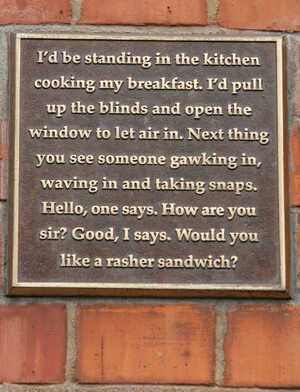
Commissioned through Dublin City Council’s Public Art Programme Chris Reid set out to create a micro history about Nicholas Street, Ross Road, Bride Street and Bride Road [Dublin City].

Based on audio recordings of conversations Chris had with residents and people associated with the area, each contributor participated alongside Chris in the selection of a final 20 short texts for use on the 20 bronze plaques.

(Sam Boal/Photocall Ireland)

From The Irish History Podcast:

In the final years of the 13th century, Ireland settled into a few years of relative calm after what had been a period of chaos, war and famine known as “the time of disturbance” in 1295.

Famine had been more frequent through the late 13th century. They were usually caused by bad weather which resulted in poor harvests. Such poor harvests in turn resulted in less work at the harvest, something many peasants depended on. However in 1299 the weather was unusually good, improving the harvest  and it appears labourers took advantage of the increased demand for work.

On May 3rd 1299 a parliament discussed a few items including the worrying issue facing the nobility

” having heard a complaint of the communities of divers counties, for that servants, ploughmen, carters, threshers, and other their servants refuse to serve about the services for which they were accustomed to serve, on account of the fertility of the present year”


Peasants in the medieval period worked for fixed wages or alternatively many had to work a specific amount of days which for the lands they rented. It appears across Irleand in 1299 in several counties they now tried to renegotitae these conditions.

This is not going to end well.

More here: The Peasant Strike Of 1299 (TheIrishHistoryPodcast)

‘The Corn Harvest’  by Bruegel.

Thanks Fin

Broadsheet.ie