Tag Archives: Abortion

relig blath

In next Sunday’s ‘The Moment of Truth’, Blathnaid Ní Chofaigh talks to Danielle, an Irish woman “who in her late teens became pregnant and travelled to England to have an abortion. It is a choice that has marked her life, but which she still does not regret.”

An RTE Religious programme featuring a guilt-free abortion experience.

Have we turned a corner?

What about the shame and the cancer we were told about?

BazfUrqCYAEQrLo.jpg large

Oireachtas Retort tweetz:

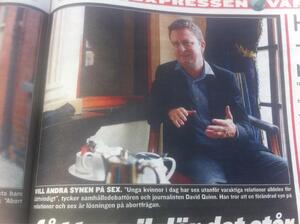
Look who made the Swedish version of Everyday Sexism. Do we even need translation?

For the curious amongst us, the piece [which appeared in the Swedish tabloid Expressen] translates as:

Wants to change the view on sex: “Today’s young women have sex besides than in a relationship way too freely,” thinks relationship debater and journalist David Quinn. He believes a change in the view on relationships and sex is the solution to the abortion question.

You’re welcome.

Thanks Grim Reefer


“It doesn’t matter what people’s feelings are, Audrey. Sure, if 99% of people vote to have babies killed it doesn’t make it right and it doesn’t make it right what you’re doing. God doesn’t allow it. You are flying in the face of God, killing human beings which he has created and you will answer some day for it.”

Caller, ‘Mary’ responds to Audrey Simpson of the Family Planning Association on BBC Radio Ulster’s ‘The Nolan Show’ [with Stephen Nolan] this morning.

Mary opposes current proposals to change the law in Northern Ireland which could allow for abortion in TFMR cases and for victims of rape and incest.

Abortion: Justice Minister David Ford to consult on changing NI’s laws (BBC News NI)

Previously: Meanwhile, In Belfast

Padraig_PIC_FD


Finglas (St. Canices & St. Margaret’s), Dublin Parish Priest Padraig Ó Cochláin.


nolan

Stephen Nolan spoke this morning on BBC Radio Ulster with a newly married woman, Sarah who is pregnant.

She discovered after a scan that her foetus had anencephaly.

Under existing laws in Northern Ireland, Sarah is unable to procure an abortion for her condition.

Her options are to carry the foetus to full-term or travel to Britain for a termination.

As she is 20 weeks pregnant, there is only one clinic that will perform the procedure.

She describes how she was harassed and intimidated by protestors at a family planning clinic in Belfast.

Her story will feature tonight on The Nolan Show, BBC1 at 10:35pm.

Previously: Where Is Your Decency?

Choice Words

A Marie Stopes Protestor

00139255Repeal of Article 40.3.3 from the Constitution

The what?

Article 40.3.3, inserted following the Eighth Amendment referendum in 1983, provides that: “The State acknowledges the right to life of the unborn and, with due regard to the equal right to life of the mother, guarantees in its laws to respect and, as far as practicable, by its laws to defend and vindicate that right.”

Haven’t we just cleared that up?

NO.

Oh. When do we want it?

“In the 30 years since the passing of the 8th Amendment at least 150,000 women have gone overseas for abortions; at least three women have died because they were denied abortions here; and we now have the most restrictive abortion legislation imaginable – which does not even allow abortion on grounds of rape or incest, fatal foetal abnormality, or inevitable miscarriage. Women whose lives are threatened by the risk of suicide due to unwanted pregnancy face so many obstacles that they will probably not even ask for an abortion here.

The perverse logic of Art. 40.3.3, interpreted by the Supreme Court in 1992 and now enshrined in James Reilly’s Act [Protection of Life During Pregnancy], means medical conditions due to pregnancy that are not in themselves life-threatening (eg inevitable miscarriage – like Savita Halappanavar) must be allowed become life-threatening before it is legal to terminate a pregnancy.

Reilly’s Act also says that ‘unborn human life’ should be protected by law from the moment of implantation until delivery, supposedly because 40.3.3 requires it. This effectively rules out fatal foetal abnormality, and inevitable miscarriage, as grounds for abortion. We disagree with Reilly, as do a range of legal experts. Alan Shatter and Alex White claim to support legislation to allow abortion on such grounds: they should put a Bill through the Dáil and see if the Supreme Court says it’s unconstitutional under 40.3.3. Must we have another death before the Dáil acts to protect women’s lives?”


Joan Collins TD


“Even if [Minister for Health James Reilly] Reilly’s Act was less restrictive, 40.3.3 and the X Case ruling would only allow abortion if a woman’s life is at risk due to pregnancy. It is unacceptable that the Constitution should make a distinction between a woman’s health and her life, or ban abortion on other grounds – including a woman’s choice – and force women overseas for abortions. Art. 40.3.3 must be repealed. We call on Alan Shatter and Alex White to also call for the repeal of 40.3.3.

There are many in Ireland who think that it should be left to a woman to decide whether or not to terminate a pregnancy, without legal or medical interference. We agree with that. But we also recognise that many others think abortion should only be available if pregnancy puts a woman’s health at risk, or in cases of rape, incest, or fatal foetal abnormality. None of these changes can be made while 40.3.3 is in the Constitution. We think that people with different views can all work together by making repeal of 40.3.3 the focus of our campaigning over the coming months and years.


Clare Daly TD


Long-term FIGHT!

Thanks Brendan Young

(Mark Stedman/Photocall Ireland)

paul cullen

Aingeala Flannery, sitting in for Matt Cooper on Today FM’s Last Word last night, spoke with Paul Cullen, above, Health Correspondent for the Irish Times about criticism of his paper’s report on the the ‘first abortion’ under the new Protection of Pregnancy During Life legislation.

Aingeala Flannery: “Now, the Department of Health has said a termination of pregnancy carried out at the National Maternity Hospital in Holles Street did not take place under the protection of the ‘Life During Pregancy Act’, as the act has not commenced yet. It was reported in the ‘Irish Times’ today that a procedure carried out a number of weeks ago was the first to be carried out under the Act. Dr. Peter Boylan, the Clinical Director of Holles Street, is extremely unhappy about the newspaper report and says that patient confidentiality has been breached. I’m joined now by Paul Cullen, the ‘Irish Times’ health correspondent, and by Simon Mills, barrister and doctor. Paul, if I could go to you first. You wrote this report in the ‘Irish Times.’ What are the circumstances of the patient who had the termination?”

Paul Cullen: “Well, this my the report in the paper this morning. This concerned a termination which took place at the National Maternity Hospital in Holles Street recently and involved a woman who was in the second trimester and whose membranes had ruptured and there was a threat to her life. And the pregnancy was considered unviable. And after discussions involving the woman and a number of obstetricians and other medics in the hospital, a termination was carried out.”

Flannery: “Now, the Clinical Director of Holles Street, Dr. Peter Boylan, is extremely unhappy about this. He says patient confidentiality has been compromised.”

Cullen: “Yes, I heard that interview this morning. I can hear where people are coming from, when they refer to issues around patient confidentiality. I would say that, while there are rights to patient confidentiality, there are also rights for the public to know what is happening. And in this case – and in all the reporting by ‘The Irish Times’ on this issue, over the last year and before – we’ve been trying to put out there what is in the public interest. And I think it would be acknowledged by everyone that this new leglislation and the issues around it and the medical practices within hospitals are of huge public interest, and it would be also of intense interest to see how the new legislation fares, and whether it does bring the clarity it means to bring.”

Flannery: “But Paul, the Department of Health is saying it has nothing to do with the new legislation, that it didn’t take place under the ‘Protection of Life During Pregnancy Act.’

Cullen: “Well, certainly the case is the first to come to light since the legislation went through the Dail, and I think there was a wide-spread belief… which the department has surprised a lot of people today by pointing out correctly that the legislation has not yet been commenced – somewhat surprisingly. But certainly cases like this would come under the provisions of the Act, particularly section 7, which relate to medical cases, physical threats to a woman’s health. So I think it’s justified on the basis of public interest.”

Flannery: “Okay, Paul, rather than get tied up on whether the act has come into force or not: you say that you believe that this in the public interest. Why is it in the public interest?”

Cullen: Well, because I think people… obviously, this debate about abortion has raged in this country for many decades. I think that there are very strongly-held views on both sides. As a reporter, I’m trying to relay facts to give as comprehensive a picture as I can, and that’s what I tried to do in this article today. I would point out, for example, that our newspaper was the first to report on Savita Halappanavar.

Flannery: “Paul, this is a different case and I’m wondering do you see that this could be distressing for the woman involved, that she may not have wanted her medical details to be splashed across the front page of a national newspaper?”

Cullen: “Yes, I understand, and I have received mail today, for example, from people who are concerned about the report. I understand that entirely. What I was trying to say was that I have to try and balance in my work, and all journalists have to, the right to confidentiality with the right to public disclosure of information which is in the public’s interest. In preparation of this story, we did leave out other details because of that concern. We also went through legal checks for the article, before a decision to print.”

Listen here

Previously: Holles Confidential

First Abortion Mystery

NmhBanner

Further to the report in this morning’s Irish Times about the first abortion performed under the new Protection of Life During Pregnancy law at Holles Street.

In a statement, the Department of Health said that the Protection of Life during Pregnancy Act was signed into law on 30 July, but that it has not yet commenced.
The department said there are operational issues that need to be addressed before it can commence, but added it will be begin as soon as is practicable.
“These include the establishment of a panel of medical practitioners for the purpose of the formal medical review provisions and administrative facilities to enable the review committee, drawn from the review panel, to perform its functions.”

Hospital to Investigate Breach of Confidentiality (RTE)

NotTheBogeyMan writes:

Has no one copped on that the Act has been in place since July, that the Dept of Health is working outside of it, or that the legislation they so enthusiastically supported is being ignored.

The Irish Times is getting a good old slagging for publishing confidential information that’s actually in the public interest.


Earlier: The Floodgates

NmhBannerNational Maternity Hospital, Holles Street

Today, we learn of a woman’s life being saved as a result of the Protection Of Life During Pregnancy Act law.

The Pro-Life movement tried to warn us but would we listen?

First abortion carried out under new legislation (Paul Cullen, Irish Times)

Holles Street to investigate breach of patient confidentiality (RTÉ)

Pic: nmh.ie