(Today’s Irish Independent)
…with this
Statement by the Minister for Justice, Equality and Defence, Alan Shatter, TD
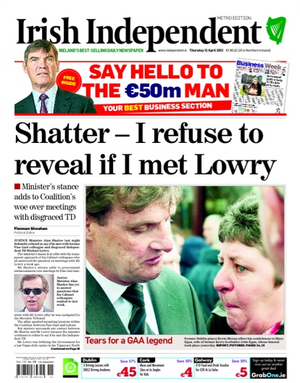
There is predictably a grossly misleading headline in today’s Irish Independent. It quotes me as saying that “I refuse to reveal if I met Lowry”. In fact in reply to a query from the journalist concerned, as reported in the body of the story, he was informed that “As Minister for Justice I am not participating in Independent Newspapers agenda.” This is an agenda that has been in play for some time. As Minister for Justice it is my obligation to uphold the rule of law. The Garda Commissioner is consulting with the Director of Public Prosecutions as to whether aspects of the Moriarty Report may be pursued from a criminal point of view and as Minister for Justice I am determined to ensure that I neither do nor say anything that could prejudice matters. This is entirely consistent with my contribution in the Dáil to the debate on the Moriarty Report.
The loaded question posed by the Independent journalist is designed to elicit a response that facilitates the publication of a story that either condemns Michael Lowry or implies guilt by association or both. I am unwilling to engage in an unethical media project of compiling a blacklist of elected TDs that Ministers should not meet on legitimate official business and also with whom no conversations should ever take place. It is worth asking in this context, in addition to Michael Lowry, who from Sinn Féin, Fianna Fáil and TDs from smaller parties and none should be included in such list? Should Ministers only legitimately engage with those TDs with whose words and deeds, both past and present, they agree or with those approved by the media? This is a slippery slope we should not slide down nor encourage. It has echoes of the discredited McCarthy era of the 1950s in US politics. We should not allow such an approach to gain even a foothold in a robust constitutional democracy that takes political elective office and constituency representation seriously.
Translation: I met the dude.
Earlier: We’ll Take That As A ‘Yes’ So
Flashback:
“Our country needs a new attitude of responsibility and a Government it can trust. This has been explained repeatedly by Deputy Kenny, the leader of Fine Gael, with the principled consistency of a leader who puts personal integrity and responsibility first. We must do the hard work of entrenching a new attitude of responsibility, accountability and more than anything else, a new political morality. There are specific steps we must take. Those who criminally exploited Fianna Fail’s era of light-touch regulation to do financial wrong as a highroad to wealth must be punished. Those who fabricated accounts or who carried out off-the-books or fictitious transactions to misrepresent the true financial position of financial institutions in order to lure others into detrimental deals, should realise that they have written their own tickets to a prison cell.”
Alan Shatter, November 2010




 (Above: the protest outside Stepaside Garda Station yesterday)