
Tag Archives: Alan Shatter

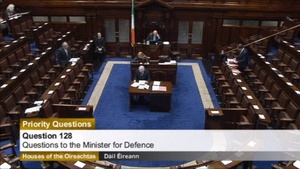
shatter[Justice Minister Alan Shatter in the Dail this morning]

A Cheann Comhairle

Could I start by again paying tribute to Martin Callinan on his retirement as Commissioner of An Garda Síochána. Martin Callinan had a long and distinguished service in An Garda Síochána. He dedicated his career to the fight against crime, and has a record of which he can justly be proud. I want to express my sincere thanks for his commitment and service to the State. In its statement yesterday, the Government indicated that information had come to light indicating that a system for the recording of phone calls to and from many Garda stations had been in place for many years before it was discontinued last November. The fact that such a system was in place, and for so long, is clearly a matter of serious concern, which the Government believes warrants the establishment of a Commission of Investigation.

Let me say at the outset that the circumstances surrounding the establishment of this system of recording, exactly when it started, the number of Garda stations involved, the extent to which recordings were retained, and their relevance to any Garda investigations are still unclear. One of the main functions of the Commission of Investigation will be to establish the facts relating to these and all other relevant issues. I recognise of course that Deputies will have many very reasonable questions on these and other aspects of this matter, but I am greatly constrained in what I can say. We need to establish the facts before we can draw any firm conclusions, and it would be wrong to engage in speculation in advance of that.
Let me, however, say what I know from a letter by the outgoing Garda Commissioner, Martin Callinan.

This letter was sent to my Department on 10 March, and was made under section 41 of the Garda Síochána Act 2005, which provides a mechanism for the submission of information by the Garda Commissioner. This letter was not furnished to me by my officials until approximately 12.40 pm yesterday and I did not have an opportunity to read and consider it until some time later. The letter started off by referring, by way of background, to a case in which civil proceedings are being taken by two persons against the Garda Síochána and the State for wrongful arrest and related matters. Can I say here that I am aware of speculation on the identity of these proceedings, but the House will understand that I cannot comment on proceedings currently before the courts.

The letter from the Garda Commissioner referred to recordings of telephone conversations into and out of a particular Garda station which had come to light as part of the process of discovering documents of relevance to the plaintiffs. That process is still under way, and again I must emphasise the constraints on commenting on a case which is currently being litigated in the courts.

I am advised that my Departmental officials were made aware of recordings of relevance to the specific civil proceedings previously mentioned on 28th February by the Garda Síochána and the Chief State’s Solicitor’s office arising from its involvement in the response to the civil proceedings. I am informed that what was at issue was the discovery of recordings in a specific Garda station, not a more general system of recording calls in Garda stations generally and that no reference to such general recording of calls was made at that time.

In this letter of 10th March, the Garda Commissioner went on to say that it had subsequently transpired that systems would appear to have been installed during the 1980s in Garda stations to allow for the recording of incoming and outgoing calls from designated extensions. The Commissioner explained that the rationale behind this was the recording of Garda radio traffic to and from control rooms, and 999 calls, and the gathering of evidence around calls made to Garda stations regarding bomb threats and other code messages. This practice had continued in some stations over the years, with the recordings being retained within each station, with the original recorders being replaced in the 1990s and again in 2008.

The letter states that the original recorders were replaced with dictaphone recorders during the 1990s (I do not presently know what specific years), and further replaced by what is referred to as NICE recorders, which I understand is a brand name, which were installed in 2008. The Commissioner explained that he had consulted the Attorney General’s office on the matter, and expected that consultation with the office of the Data Protection Commissioner would be necessary, as well as further advice from the office of the Attorney General. However, he made clear in the letter that he had directed that the routine recording of non-999 calls to Garda stations should cease, and he confirmed that all recordings except those made on dedicated 999 lines were fully stopped nationally on 27 November 2013.

In relation to the continued recording of 999 calls, which I think everyone would instinctively understand, the Commissioner, in his letter, explained that there was a legislative underpinning of such recording contained an Act of 2007. The Commissioner went on to say that he was awaiting written confirmation from each Divisional Officer that all audio recordings that had been stored at each Divisional Headquarters outside Dublin had been collected and were now stored securely at Garda Headquarters. The Commissioner noted that the total amount of tapes collected at that stage was 2,485.

The issue the Commissioner identified in the letter was the action he should now take in relation to these recordings, and he particularly referenced his role as Data Controller in respect of the recordings. He stated that he had consulted the Attorney General’s office on 11th November 2013 and established a Working Group to report to him on the issue and that he expected that consultation with the office of the Data Protection Commissioner would be necessary, as well as further advices from the Attorney General.
Whilst the Attorney General, in the context of the civil proceedings previously mentioned, was made aware of the existence of tapes, and the possible existence of other tapes, I am advised that she had no knowledge at that time of the circumstances surrounding the making of tapes, the legal background to their being made, the contents of such tapes, or the number of such tapes.

I understand that on the day the letter from the Commissioner was received there was a consultation held with the senior counsel representing the state in this case to discuss the issues arising, I also understand that on the day after the receipt of this letter of the 10th March in my Department, that is to say 11th March 2014, there was a follow-up meeting between the Garda Commissioner, the Department of Justice and the office of the Attorney General, and I am advised that the discussion covered the ongoing legal consultation in relation to the civil proceedings.

I also understand that the matters covered in the letter of 10th March were being considered by my Department in the context of the ongoing legal consultation in relation to the specific case in question and I am informed that, subsequently, on 19 and 20 March 2014, Garda Headquarters copied my Department with correspondence between the Garda Síochána and both the office of the Attorney General and the office of the Data Protection Commissioner.

As Members of the House may be aware, I flew to Mexico to undertake my duties in respect of Government Ministers St Patrick’s Day arrangements on 15th March and did not return until the 21st March. I was not briefed on this matter until approximately 6pm on Monday 24th March 2014 in the Department of Justice and, as previously stated, was first furnished with the letter from the Garda Commissioner of 10th March 2014 yesterday at approximately 12.40 pm.

Following the initial briefing by my Departmental officials, I met together with both the Taoiseach and the Attorney General on Monday evening to discuss these matters. I know that there are reports that I knew of the system of recording in Garda stations last year, but this is not the case. Reference has been made, for example, to a case investigated by GSOC of a member of the public who was assaulted by members of the Garda Síochána in Waterford. GSOC, I have since learnt, reported on this on 16th June of last year and did make reference in their report to the recording of phone calls in Waterford Garda Station.

However, this was not a report to me or my Department but a press release by GSOC and there was no indication or suggestion of any nationwide system of recording in Garda Stations. I am aware of various commentators referencing this short GSOC report in broadcast and print media since the Governments statement was published yesterday afternoon on this issue and questioning the truthfulness of the account given to date of these matters. Unfortunately, we live in a world where, regardless of the issue, some commentators and opposition Deputies, on first learning of an issue detailed by Government of which they were unaware, feel compelled to accuse those who make the issue known, and seek to address it, of telling untruths or of some incompetence. It is something of an industry, and with members opposite, a wearisome repetitive refrain followed by the usual dosage of contrived outrage.

The simple truth is GSOC did not furnish the report mentioned to me and I am advised that they did not furnish it to my Departmental officials nor bring it to the Departments attention. GSOC no doubt can confirm that. Because of the background to the GSOC Report, GSOC had no obligation under the 2005 Act to furnish it to me but did have a discretion to furnish it to any “person that the Commission considers has a sufficient interest in the matter”.

GSOC obviously did not regard this report as of sufficient importance to furnish it specifically to me or my Department, but issued it as a press release. It also seems, from the checking my officials have been able to undertake to date, that no Deputy in this House regarded the publication of sufficient importance to table a Dail question on it but I am open to correction on that. It may be the case that no member of this House read this report until yesterday or, if they did, they placed no importance on it. Insofar as it received any media coverage, it does not appear as if any member of the media regarded the report as of any major importance. Again, I am open to correction. This is understandable as the report gives no insight into the extent of recordings made by An Garda Siochana, nor did GSOC determine it an issue worthy of further investigation.

GSOC could, if they wished, have initiated a public interest investigation into the matter under Section 102 (4) of the Garda Siochana Act 2002. Had they done so, they would also have had to notify me of such investigation under Section 103 (1) (b) of the Act unless GSOC invoked Section 103 (2) but I cannot see how that subsection could be of relevance. In case I am misunderstood, I am making no criticisms of any nature of GSOC. I am merely setting out what is the position. These are the facts as I have been informed of them, but of course there are many questions which need to be answered. That is why the Government has decided that it is necessary to establish the facts and has announced that there will be a statutory inquiry.Continue reading →

newspapers

The Guardian also understands that a number of Dublin-based journalists are going to allege that their phones have been routinely monitored by gardai.

Since the imposition of the 2005 Garda Siochana Act ,the force has been accused of scanning reporters’ calls to establish if they have been talking to individual gardai. The 2005 Act imposes heavy penalties on Garda officers who brief members of the media.

Ireland’s justice minister faces grilling over Garda bugging scandal (Henry, McDonald, The Guardian)

Thanks Brian Sammon

Leon Farrell/Photocall Ireland

NoonanPT

Finance Minister Michael Noonan went on RTÉ’s Prime Time last night following former Garda Commissioner Martin Callinan’s resignation yesterday morning and the lunchtime announcement by Taoiseach Enda Kenny that he has set up a commission of investigation to look at the widespread recording of phone calls at Garda stations across Ireland over approximately 30 years, up until November 2013.

It’s understood that 2,500 tapes of conversations exist.

Minster Noonan – who was  justice minister from December 14, 1982 to February 14, 1986 – appeared with the caveat that he would have a one-to-one interview and that he wouldn’t have to discuss matters with any oppposition members..

Host Miriam O’Callaghan was keen to get a timeline of events from Minister Noonan, to essentially find out who knew what and when in relation to these recordings.

She was especially determined to find out what Justice Minister Alan Shatter knew and when he knew it. This is largely because of what has been reported so far, specifically:

Enda Kenny told the Dáil that he first he heard about the issue of garda station recordings was when the Attorney General Máire Whelan told him late on Sunday afternoon around 6pm.

– On Monday night, a senior civil servant was sent to have a chat with Martin Callinan – who was under pressure from Labour and Fine Gael’s Leo Varadkar to withdraw his ‘disgusting’ remark about Garda whistleblowers Sgt Maurice McCabe and John Wilson – to talk about the Government’s unease about ‘recent events’.  Callinan was also informed of the Government’s plan to hold an investigation into the garda station recordings.
– On Tuesday, Alan Shatter learned about the garda station recordings for the first time.

However.

RTÉ News reported last night that a letter was sent by Callinan to the Department of Justice on March 10 – five days before Minister Shatter left for Mexico as part of his St Patrick’s Day jaunt – outlining the matter about the garda station recordings, while the Attorney General was made aware of the matter as far back as November 2013 and had been involved in a working group in order to deal with the issues, in consultation with Martin Callinan.

And.

GSOC reported on these issues in June 2013, when it investigated a Garda assault case involving Anthony Holness. The GSOC report said the Garda Commissioner ‘may wish to re-evaluate his practice regarding the recording of such calls and the consents required if it is to be permissible to use such recordings in evidence’.

RTÉ’s Katie Hannon of Prime Time said t she was told Minister Shatter didn’t see that GSOC report and that there was no legal obligation for the GSOC report to be brought to Minister Shatter’s attention.

With that in mind, here’s a transcript of Minister Noonan’s one-to-one interview with Miriam O’Callaghan.

Miriam O’Callaghan: “Minister, first of all, this is a very strange affair, before we go into the substantive problem of obviously recorded phonecalls in Garda stations, it’s important to work out who knew what and when. So if we deal with that issue today, of the recording of the phonecalls in garda stations. People are wondering why it was announced today because that information was in the public domain ever since the court case back in November. As you know, the Holness case and then the GSOC report in June. So, how was it today that it was so important? It was announced and that people only became aware of it in your Government?”

Michael Noonan: “Well, obviously, we don’t know all the facts and that’s why a Commission of Inquiry is being set up and that’s why the gardaí, under the new commissioner and the Department of Justice have been instructed to provide full reports and I can’t give you full answers but I can tell you what I think may have happened.”

O’Callaghan: “I don’t want to cut across you so soon but I’m not asking what actually happened in the gardaí, I’m asking you now about the Cabinet and who knew what and when.”

Noonan: “That’s what I want to address. First of all, the Garda Ombudsman made a report in June of last year and he recommended that because the practice of recording had come to light in Waterford Garda Station, in a particular case that the Commissioner might re-evaluate the practice. This was a very tentative, you know, pitch by the Ombudsman’s office.”

O’Callaghan: “Well it was a direct quote actually, they said ‘Commissioner [Callinan] may wish to re-evaluate his practice regarding the recording of such calls’.

Noonan: “Yeah, he may wish to re-evaluate…

O’Callaghan: “Based on a court criticising that behaviour.”

Noonan: “What I’m saying is that, nothing hangs on it, but it was a tentative enough way of putting a recommendation. Now I don’t know whether the Commissioner re-evaluated or not but, coincidentally, the practice was ended in November [2013], so I presume there was a re-evaluation at some level in the guards.”

O’Callaghan: “But how come Minister Shatter or the Department of Justice was not aware of the GSOC report?”Continue reading →

90335120

[Justice Minister Alan Shatter]

Beware the back spin.

“RTÉ News has learned that former garda commissioner Martin Callinan wrote to the Department of Justice more than two weeks ago about the recording and retention of telephone conversations in garda stations….”

Alternatively…

“The Government spokesman said tonight that Mr Shatter only found out for the first time yesterday about the recording and retention of telephone conversations in garda stations,…”

Hmm.

Callinan wrote to Department of Justice about recordings (RTE)

(Sasko Lazarov/Photocall Ireland)

90324774

[Former Garda Commissioner Martin Callinan and Justice Minister Alan Shatter last year]

“I wish to pay tribute to the Garda Commissioner, Martin Callinan, on his retirement from An Garda Síochána. As Commissioner and throughout his very distinguished service in the Force he has made an enormous contribution to fighting crime and I believe that this contribution will be seen as a legacy of which he can be very proud and for which the community he served are in his debt.
The high reputation of An Garda Síochána has been gained down through the years through people’s experience of dealing with members like Martin Callinan, often at times of great difficulty. I believe, at these challenging times for the Force, the men and women who serve in it will continue to enjoy the respect of the community they serve, often at great risk to themselves. I extend to him my sincere thanks for his dedication and service to the State throughout his long and distinguished career.”

Justice Minister Alan Shatter today.

Earlier: All By Myself

The Commish Hits The Fan

(Sasko Lazarov/Photocall Ireland)

shattershatter2

Mmf.

Justice Minister Alan Shatter taking questions this afternoon in the Dail following the resignation of Garda Commissioner Martin Callinan.

Public Opinion Against Shatter- Byrne (irish Times)

Thanks Stephen Devine and Anthony Behan

Meanwhile…

9033517290335162903351569033514490335165

At Leinster House today, from top: Mick Wallace, Mary Lou McDonald, Niall Collins, Fianna Fail Justice spokesma , Richard Boyd Barratt and Luke Ming Flanagan.

(Laura Hutton/Photocall Ireland)

Gilmore

[Labour leader Eamon Gilmore at the publication of the Government’s programmes of Dáil Reform in Government Buildings last September]


Related: ‘Politcal faultlines have opened’ over Garda Commissioner statement (Irish Examiner)

Gilmore: Shatter should ‘clear up’ his remarks on whistleblowers (Independent.ie)

ShatterRits

“The report mentioned earlier that I received from RITS gives as an opinion, based on the reports provided for RITS, that “there is no evidence of any technical or electronic surveillance against GSOC”; that is, no evidence at all, not merely no definitive evidence. The report also disputes other conclusions reached by Verrimus. I appreciate that GSOC relied on the reports it had received from the security company it had contracted. I cannot ignore the report I received from the company asked to conduct a peer review of the technical documentation furnished by GSOC to me and the information accompanying it. Having regard to the differences that have arisen, the additional information I have received since I made my first statement to the Dáil, the ongoing nature of this controversy, its debilitating impact on the capacity of GSOC to get on with its work and the continuing overhang of suspicion voiced by some, despite the conclusions of GSOC, that the Garda Síochána or a member of the Garda Síochána was engaged in misconduct, I concluded that it was important to do what was possible and reasonable to bring an end to ongoing controversy.”

Justice Minister Alan Shatter – Tuesday, February 18, 2014

“Mr Shatter has failed to give us the alternative explanations that he said he would, and the committee is disappointed and alarmed by this. What he has sent us is non-committal, and just a series of queries, and based on it we have to be alarmed as to what he said in the Dáil. We would have to find at this stage in favour of the Verimus analysis based on what the minister has sent us. As things stand, we have to conclude that — for whatever reason — the minister was talking up the analysis of Rits and was talking down the findings of Verimus without justification. Is there a narrative here? Was the minister trying to disprove the allegations, rather than examine them? That is the concern and it is a very significant matter.”

Sinn Féin TD and chairman of the Public Services Oversight Committee, Pádraig Mac Lochlainn – in today’s Irish Examiner.

Previously: Putting It On Rits

Contradictions In Terms

Dáil transcript: kildarestreet.com

‘Alarm’ at Shatter’s failure to disprove bug claim (Irish Examiner)

WilsonLetter

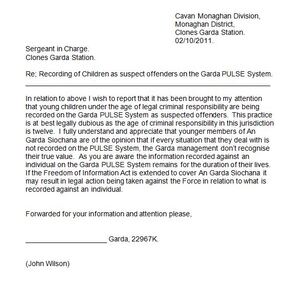
You may recall a post from last October in which we posted the letter, above, Garda John Wilson wrote to his senior management in October 2011.

Mr Wilson alleged that many Traveller babies – one as young as 16 days old – had their names put on the PULSE system, with each child getting a criminal intelligence PULSE number.

Mr Wilson claimed it could happen if a Garda stopped a car driven by a Traveller, and if there were children present in the car, those children’s names would be placed on PULSE.

Mr Wilson said gardaí were encouraged to do this by senior gardaí.

At the time of posting last October, Mr Wilson had yet to receive a reply from Garda management.

Justice Minister Alan Shatter replied to written questions put to him on the matter by United Left Alliance TD, Clare Daly and Sinn Féin TD, Padraig MacLochlainn, on Tuesday.

Clare Daly: To ask the Minister for Justice and Equality if a PULSE file was created on a Traveller child when that child was 16 days old; and was this child ascribed a criminal intelligence number separate from a parent or guardian.

Padraig MacLochlainn: To ask the Minister for Justice and Equality the steps he has taken to confirm whether Traveller children or adults are being assigned separate criminal intelligence PULSE numbers without having committed any criminal conduct; and the action he will take regarding same.

Padraig MacLochlainn: To ask the Minister for Justice and Equality if he has established with the Garda Commissioner the veracity of the allegations that 40 Traveller families were entered on the Garda PULSE system, including a baby of 16 days old; and if he will make a statement on the matter.

Justice Minister Alan Shatter took the three questions together.

Alan Shatter: “The management of the PULSE system is an operational matter for the Garda Commissioner. While An Garda Síochána does not comment on individual cases, I am informed by the Commissioner that PULSE does not solely capture information on offenders, but is also used to store information on Garda interactions with individuals, whether adults or children, such as victims of crime, persons injured in road traffic accidents and child welfare incidents.
All persons are subject to the same PULSE recording policy and procedures.
I have also been assured by the Garda Commissioner that the Garda Síochána does not engage in ethnic profiling, and specifically that it does not engage in data gathering or data mining based upon discriminatory profiling in respect of race, colour, language, religion, nationality, national or ethnic origin, ethnicity or membership of the Traveller community.”

Hmm.

Transcript from Kildarestreet.com

Previously: Early Profiling

MullingarstationMcCabe

[From top: Mullingar Garda Station and Garda whistleblower Sgt Maurice McCabe]

A rally of support for Garda whistleblower Sergeant Maurice McCabe will be held outside Mullingar Garda Station, College Street, Mullingar, Co Westmeath, next Thursday at 6.30pm. organised  by the group Justice 4 All.

Previously: Over To You, Oliver

Pics: RTÉ and Photocall Ireland