
Tag Archives: Anne-Marie on Wednesday

psters2anne-marie-291x300

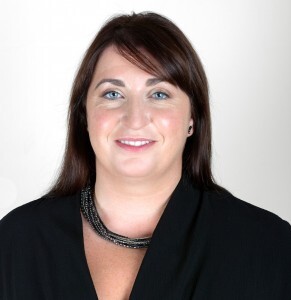
From top: Posters in the hallway; Anne Marie McNally

You may love them, hate them or want to tear them down.

But for every General Election candidate they are vital.

Anne Marie McNally writes:

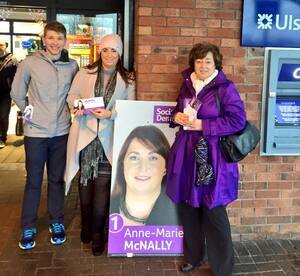
‘Tis the season. It’s upon us and there’s no escaping it. Wherever you look for the next three or so weeks you are going to see election posters.

Big ones, sparkly ones, boring ones, horrific ones and eye-catching ones and they’ll have one objective…to cement the name and face of the person into your brain so that it may leap out at you from the ballot paper come polling day.

Those who hate them will tell you that they represent nothing more than litter, that they are unnecessary and wasteful and that they do not influence voters in any way. Those who love them will point to the academic research which shows they are a vitally important visual communications tool deployed worldwide during election season because they works. There is no escaping that fact.

Do you honestly think US Presidential election strategists would bother with them for example if there wasn’t substantial evidence to prove their worth to a campaign?

As far back as the 16th Century Protestant Reformation posters were being used to communicate messages in a visual way in order to influence decisions. Many people may argue that in this modern era of social media the purpose of posters is obsolete. They’d be wrong.

By and large the people who you will find giving out about election posters are doing so on social media – so they have their access to information already locked down and therefore posters may well be unnecessary for them.

For the vast majority of other potential voters though, the posters may be the only visual representation of exactly who is running in their area and what choices they have available to them.

I recently postered for the first time. I was having a public meeting as a first time candidate and I wanted to spread the word in as an effective and cost efficient way as possible. Posters allowed me to do that. Within two days of them going up my canvasses changed substantially.

Every second interaction involved some variation of ‘oh yes, I saw your posters, you’re the anti-corruption person’. My little old posters had done their job spectacularly and even I, who was fully aware of the academic research on this issue, was taken aback at the impact those few posters had on my recognition factor and also on how people approached interactions with me. There was almost a familiarity – ‘I’ve seen your face loads so I feel like I know you’.

As a candidate I wish it were not so. For this General Election campaign I will have near bankrupted myself to fund the quantity of posters needed to reach across my constituency which houses a population of just over 110,000 people.

My house currently resembles a print works and you have to squeeze past bundles of the things in order to get a drink of water or climb into bed.

By the time you’re reading this there’ll likely be groups of my friends driving around, balancing precariously on ladders and hanging from lampposts in a knot of cable-ties. They’ll all have taken the day of work to poster for me and my gratitude will never be enough to repay them.

So do I wish posters were not important and that I didn’t have to undertake the postering campaign? Yes, I absolutely do! But I also realise that wishing for the easier option might be tempting but it’s unlikely to bring success.

While lots of Labour candidates chose to poster illegally on Monday night by going ahead and erecting them long before the election was called and it was illegal to do so, others among us sat at home and looked around at the piles of posters cluttering the rooms and knew that there they would stay until it was legal and sporting to hang them.

We can’t all be so cavalier about paying €150 fine per poster after having to sweat blood to buy the things in the first place! I wonder about the candidates who can, I really do.

Anne-Marie McNally is a political and media strategist working with Catherine Murphy TD and is a General Election candidate for the Social Democrats in the Dublin Mid-West constituency . Follow Anne-Marie on Twitter: @amomcnally
90347700anne-marie-291x300

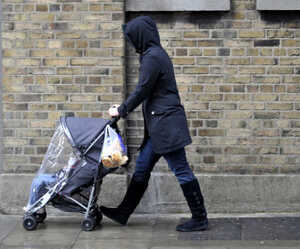
From top: left holding the baby; Ane Marie McNally

In the OECD 12% of a family’s income is spent on childcare.

In Ireland that figure is 35%.

Time for a little subsidiarity.

Anne Marie McNally writes:

You’ll have no doubt heard lots of talk this week from both sides of the tax versus spend debate. On the face of it tax cuts sound lovely don’t they? Oh look, an extra few quid back in my pocket, nice.

Then you hit a point in your life where you find you need to access a basic public service. It could be childcare, it could be the health service, and it could be education…whatever.

You suddenly find that the measly few extra quid you got in your pay packet that time the Government wanted to try and bribe your vote out of you suddenly doesn’t look like such a good deal.

Apart from the fact that you find you have to fork out your hard earned cash for the essential service you’re also likely to find that the service you get will be, at best, second rate. An extra 3 quid a week in your pocket is really not going to make much difference if you find yourself or a loved one in need of medical care.

What would make a massive difference is if those cumulative 3 quids had been invested into building a modern, fit for purpose, universally accessible health service that could ensure you get timely treatment and in a dignified manner. That is the concept of subsidiarity and it creates an overall more healthy and happy society. Who doesn’t want that?

But there’s no point in claiming that’s the society you aspire to while at the same time talking about slashing €4-€5 billion euro from the tax base by saying you’ll abolish USC.

In doing so you not only abolish USC you also abolish the possibility of using that €4-€5 billion euro to strategically invest in quality public services that ultimately reduce the cost of living in a very real way on a day to day basis.

Take childcare as an example. In the OECD, on average, 12% of a family’s income is spent on childcare. In Ireland that figure is 35%. Over double the OECD average. Not only are we paying more but we’re getting an inferior service. In many cases parents are paying ridiculously inflated prices for factory type childcare out of necessity rather than desire.

The choice as to whether to work or stay home should always remain just that – a choice. Most parents these days however don’t have that luxury.

Therefore surely it makes eminent sense to invest heavily in creating a State subsidised childcare system, where standards are ensured, early years education is built into the system, and a maximum cap on the amount parents will be asked to pay is assured.

By guaranteeing a full year’s paid parental leave you free up parents to make the choice as to whether they stay home during the vitally important first year of a child’s life rather than forcing them back to work against their will in many circumstances and jeopardising the ideal development scenario for the children.

Now you may be past the years of child rearing, you may never want to face the horror/joy of it and you may be thinking sure none of that affects me. Actually, it does and in a very real way.

Back to subsidiarity here folks. The children of today are the adults of tomorrow when you and I are in our more senior years.

They are the ones who’ll be tasked with building and safe-guarding society as we pass the mantle over to the generation below us. Doesn’t it make sense to put in place systems that ensure the best outcomes for society as a whole rather than a generation of young adults dealing with the consequences of stressed out parents, poor early years education and overall societal malaise?

The same points can be made about investment in so many other services. Stop thinking about things as individuals and look to the collective and I can guarantee you we all benefit in a far more substantial and real way in both the short and long term.

Anne-Marie McNally is a political and media strategist working with Catherine Murphy TD and is a candidate for the Social Democrats in the Dublin West constituency in the forthcoming General Election. Follow Anne-Marie on Twitter: @amomcnally
galwayanne-marie-291x300

From top: Social Democrat canvassers in Galway this week; Anne Marie McNally

On the campaign trail we find apathy and indifference.

But enough about the politicians.

Anne-Marie McNally writes

There’s always plenty of talk come election time of voter apathy and the disconnect between citizens and the political system.

As someone whose entrance to politics came via a passion to engage people of lower socio-economic backgrounds in the political sphere, I am one of those guilty of constantly talking about the apathy that exists.

No doubt, on the canvass trail over recent months I have heard more than my fair share of ‘sure what’s the point? they’re all the same.’ or ‘I know nothing about politics, they’re all just in it for themselves’.

People worry about young people’s engagement with politics; those on the margins of society; and those people who just never seem to turnout come polling day.

We decry the lack of engagement, we blame apathy for maintaining the status quo and whether you’ll admit it or not, we judge people who don’t go out and vote. How often have you heard the ‘people died for that right’ refrain? I’m guilty of it myself and I do stand by it however this canvass trail has opened by eyes that bit wider as to the reasons for abstention.

While so much of the negative attention is focused on decrying the voter apathy, there is a lack of similar attention given to politicians’ apathy regarding certain sections of society and how that political abandonment of certain areas and demographics might actually be the reason for those people not coming out to vote.

Last Friday night I hit the icy pavements (quite literally hit it at one stage!) and headed off to an estate in Clondalkin that is described in the Maynooth university AIRO research project as being ‘Very Disadvantaged to Extremely Disadvantaged.’

I had headed there because my Canvass Director had identified that of those registered to vote in the area, a high proportion of them actually turn out to vote.

What I found there was joyous. I’m not exaggerating. As someone from a working class background who is passionate about the importance of politics to change our lives, I was giddy from the exchanges I had that night.

I was met with passion, engagement and a sense of relief from people that someone felt it worthwhile to come and speak with them. On too many doors I was told that I was the only politician to have ever knocked on their door. One man said to me, I’ll vote for you purely because you weren’t afraid to come in here. That’s depressing in itself but revealing nonetheless.

The young people I encountered sitting on freezing cold walls around the place that evening were no more interested in politics. But would they be if they got a chance to have a face to face interaction with an actual real person who wanted to listen to them, hear what they had to say and acknowledge both their hopes and their fears?

Certainly that was how I felt with those I managed to speak to. A face and name on a poster is one thing, a real person at your door, engaging with you as a peer is an entirely different thing and I challenge anyone to have that type of interaction and not feel engaged in the political process.

For a political system to be truly representative it must have the voices of all those it seeks to represent at its heart. I would contend that it currently fails in that regard.

I know, from years of political strategy lectures and experience that the process of pulling apart an electoral register is a cynical exercise designed to identify the likely voters and those to be ignored.

That is electioneering rather than politics but it is still not acceptable. I freely admit that I will be focusing my attention, with very limited resources and time, on those areas where we know people actually come out to vote.

But I can guarantee that if I was lucky enough to be elected I would spend the next few years speaking to those people in the other areas, the people who want to be political but don’t know how; the people who are political but don’t yet know it in a formal sense; and the people who have stayed away from voting because they believe, rightly so, that establishment politics doesn’t value them.

Those are the people who deserve our biggest efforts not our apathy.

Anne-Marie McNally is a political and media strategist working with Catherine Murphy TD and is a candidate for the Social Democrats in the forthcoming General Election. Follow Anne-Marie on Twitter: @amomcnally

21anne-marie-291x300

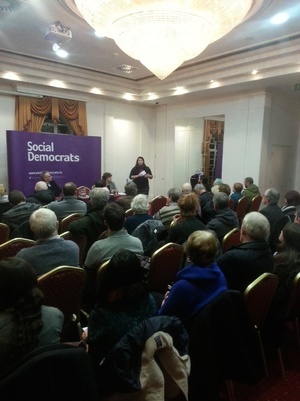
From top: Anne Marie McNally and from left: Fintan O’Toole, Anne Marie and Catherine Murphy TD at the Spa Hotel, Lucan last night; Anne Marie

In the fight against corruption in Irish politics It’s them versus us.

Anne Marie McNally writes:

How do we do things differently? That is the question I posed to a room full of people in Lucan last night as I hosted a public meeting on the topic of corruption in Irish public life.

From 1974’s Commission of Investigation into the Dublin Monaghan Bombings, through the 1980’s phone tapping scandal and Kerry babies scandal, on into the 1990’s plethora of scandals ranging from the Beef Inquiry, the Mahon Tribunal, the Flood Tribunal, the Ansbacher scandal and a host of others I don’t have the word count to mention.

Then we move through the noughties with Haughey/Lowry/Ahern controversies, FÁS expenses, Moriarty Tribunal, now the Cregan Inquiry and blah de blah de blah. We could pretty much map out the political history in Ireland by making a timeline of the corruption scandals that have hit the sitting administrations of the day.

And that’s before you even count in the lower level, yet no less significant, stuff happening at local authority level, town council level and even community level. My point is corruption and malpractice is pretty much endemic in our system. It’s not a new feature and it’s certainly not something that we should be inexperienced in dealing with.

Yet here we are in the height of confusion about how we should proceed with the [Justice Brian] Cregan Inquiry [into certain IBRC transactions].

Before Christmas I attended a meeting with An Taoiseach in the company of Catherine Murphy TD and other political leaders where Mr Kenny belligerently told us that he didn’t know what the opposition expected. That’s easy, they expect what every right minded citizen expects; answers. Not a range of excuses and legal impediments and a Taoiseach making them feel like they are creating hassle and being an inconvenience by seeking those answers.

Instead of an administration that recognises and values the importance of people’s trust we find ourselves with an administration that goes out of its way to create smoke and mirrors to hide, at all costs, the truth to citizens.

What was it Michael Noonan said to Sean O’Rourke when asked why he had evaded the NINETEEN parliamentary questions asked by Catherine Murphy TD regarding Siteserv? Oh yeah, he said, a parliamentary question asked by an elected parliamentarian is not an appropriate forum to provide answers.

He then went on to defend the practice of obliterating the information from any other avenue one might pursue, otherwise known as redacting. It’s telling that the term ‘redacted’ has entered the common lexicon of Irish citizens under this administration. Answers, in any format and through any channel are not this Governments’ desired option. Imagine that.

The truth that is being sought at this time, and in all those other scandals named above, and the ones that will never come to light doesn’t change. It always involves citizens having been disenfranchised and exploited in some way and being left in the dark about who, what, why and invariably how much, they have been exploited by.

And almost more importantly who benefitted from that exploitation, because someone always does and the odds are you’ll find them in the same group of names we tend to refer to as the ‘Golden Circle’. This sense of ‘them vs us’ was palpable in the room last night.

Nobody trusts that Enda and the lads really want you to know why €119million of your money was written off by the board of IBRC when Denis O’Brien managed to acquire Siteserv at a time when he owed the same bank – and by extension, you, the citizen, hundreds of millions of euros.

Or why other huge transactions including Blackstone or Topaz were conducted in the way they were resulting in hundreds and hundreds of millions of euros being taken from the taxpayer while significant, let’s call them ‘net worth individuals’ benefitted.

The fact that citizens don’t believe this administration wants to provide those answers is more than simply problematic for this administration. It is problematic for Irish democracy and society as a whole.

A political system that doesn’t have the trust of its citizens can no longer be regarded as democratic and in the year we will hold glitzy commemoration ceremonies for the heroes of 1916 who battled to establish a democratic Republic, that’s more than ironic, it’s plain tragic.

Anne Marie McNally is a candidate for the Social Democrats in the forthcoming General Election. Her column appears here every Wednesday. Follow Anne Marie on Twitter: @amomcnally

canvassing anne-marie-291x300

From top: Anne-Marie McNally (centre) canvassing at Super Valu, Lucan with Catherine Murphy (right) and Soc Dem member Michael O’Flanagan before Christmas; Anne-Marie

The author has a ‘civil and polite’ response to those encouraging her to behave ‘more like a candidate should’.

Also: a big hug.

Anne Marie McNally writes:

We’re so used to hearing the common refrain that we need more ‘real’ people in politics, that politicians should be ‘ordinary’ people who are ‘just like us’. We seek people with real life experiences and actual personalities and normal lives. But do we really?

In the past four months months since being declared as an election candidate I’ve noticed an insidious attitude start to emerge about how I should behave, or what might be appropriate for an aspiring politician. From those who are from a more traditional background there’s a fear of social media and how you might be presented online.

Then there are those acquaintances who think like to suggest that you should perhaps forego a social life now that people might be looking! There can be no doubt that this invisible bar is set higher for female candidates than it is for their male counterparts either.

If me being me is somehow abhorrent to what a politician should look and act like then I would never have been selected to run in the first place. What I would find truly abhorrent would be to change who I am, how I act and what I say because I am now seeking election.

That would be dishonest and would go against the very reasons I’m standing for election. It would also do nothing but perpetuate the growing divide between ordinary citizens and our political system. What would be the point?

Growing up in the heart of inner-city working class Dublin I never looked at a politician and thought ‘yeah, he’s just like us’ (let’s be honest, on the scale of probability, they were likely male) to me they were always someone different, someone who preached to or about the likes of me and my neighbours.

Indeed the ‘men in suits’ brigade were a large part of the disenfranchisement of areas like mine within which young men, by and large, felt inferior and young women just felt anonymous in terms of the political establishment.

In hindsight I now recognise the likelihood that at least some of the local area representatives were from similar backgrounds and probably spoke the same as me. Yet in an age before social media and the ability to truly interact with a person, we were forced to rely on the carefully moulded party image of that person spewing out the tired central party line.

Fast forward a couple of decades to the social media age and real engagement with people crying for ‘real people in politics’. Yet many of those same people will tell you to be careful of what you say, what you wear or where you go.

But you can’t have it both ways, if you want me to be careful about what I say then you are complicit in me not ‘keeping it real’. Is this really what you want or do you truly want someone who is comfortable enough in their own skin to say what matters even if they know that many people will disagree?

Personally I’m highly educated with decent social media savvy and a passion for political engagement. I am also working class, opinionated, with a strong Dublin accent and social democratic ideologies that I’ll defend to the death.

I have online banter with people and in some cases heated discussions. I’m never anything but civil and polite- because that is my personality, not because it’s how I ‘should’ act now I’m a candidate. I like to go out with friends. I go to pubs. I socialise. I post pictures on Facebook of nights out. I hug my friends, a lot, and yes, most of my friends are male.

And yes you may have seen a picture on Facebook of me hugging that guy. Then that other guy. Is that OK for an aspiring female politician you ask? But guess what, you’ve got similar pictures on your profile. Why? Because you’re an ‘ordinary’ person with an ordinary life just like me. The’ ordinary’ person you want in politics remember?

I won’t be changing anytime soon and I’ll be a better candidate and hopefully better politician because of it.

Anne-Marie McNally is a political and media strategist working with Catherine Murphy TD and is a candidate for the Social Democrats in the forthcoming General Election. Anne-Marie will be hosting a public meeting next Tuesday at the Spa Hotel, Lucan entitled ‘Stamping Out Corruption‘ with Fintan O’Toole and Catherine Murphy. Follow Anne-Marie on Twitter: @amomcnally
0016012090211988

anne-marie-291x300

 From top: Averil Power, Michael Lowr; Anne Marie McNally

Amid the row over ridiculous print orders for Christmas Cards by parliamentarians there is a serious issue

Anne-Marie McNally writes:

What day is it at all? Sure I’m all over the place with the days. Let me just check my calendar. One of the 75,000 Oireachtas calendars from my local parliamentarian perhaps?!

The last week or so has seen lots of hand wringing about Averil Power’s mega calendar order and Michael Lowry’s bumper Christmas card haul (85,000 seriously?!) but behind all the ridiculousness of those numbers and the outrage at the cost to the taxpayer there is a serious issue, namely the expectations of Irish citizens regarding communications from politicians and the political funding system in Ireland.

A recent conversation I had with a senior backroom staffer with many years experience in the Oireachtas went something like this;

Me: “What do you think of her re-election chances?”
Him: “None – sure she hasn’t done a newsletter in over a year!”

Anybody who has had printing needs will tell you that getting a four- page (the standard) newsletter printed on decent paper is not a cheap option. Getting roughly 35,000 of them to cover an average Dáil constituency could bankrupt you and that’s before you consider how you’re going to get them delivered and how much that is going to cost.

Yet it seems that a large majority of the Irish electorate have an expectation to receive regular newsletter updates from their parliamentarians. And why shouldn’t they? It is absolutely vital that politicians communicate with citizens and this is of particular concern to representatives from the smaller parties or Independent benches who don’t have the mainstream media at their beck and call in the same way establishment parties do.

Ironically though, those representatives from the established parties are the ones who make most use of the Oireachtas printing service and who can afford to fork out for constituency-wide delivery every quarter or so – if not more.

It is worth asking ourselves if there is a correlation there – the more we hear from them the more we consider them to be the ‘serious’ parties yet it is us who are paying to hear from them! (And if anyone tries to claim that Michael Lowry doesn’t count as ‘establishment’ then they need to check themselves!)

The Oireachtas print service is strictly controlled – anything deemed to be ‘electioneering’ is strictly prohibited, so, for example, you can not include the word ‘election’ on anything you get printed or you cannot call for a vote etc.

Yet this narrow definition of electioneering ignores the blatant electioneering of the printing of 85,000 Christmas cards! I firmly believe that parliamentarians should have access to a print facility for the purposes of communicating with citizens. I do not believe they should be abusing that service with frivolous ego projects such as Christmas cards in the mouth of an election.

With the upcoming election you will no doubt be seeing increasing numbers of political literature coming through your letterbox and I’d like you to keep in mind that non-elected people (such as myself) do not have access to any such print facilities and anything we manage to get to you will have come from our own pocket.

The likelihood is that it will have been delivered by a volunteer who is helping out on a team because of a desire to see change rather than prop up the establishment – there are very few of us who can afford the fees of a professional delivery company.

As a candidate I now have a decision to make – do I sell off that second kidney and try to fund a decent campaign leaflet and risk the residual ire of people left smarting from the Lowry/Power shenanigans and If I don’t then how do I get my message to people who know nothing of me and what I stand for – especially when I don’t have the mainstream media at my fingertips?

So with that in mind I ask you to consider this when the material starts flying through your door – not all election material is created equally and before you scrunch it up and throw it in the bin, maybe do my kidney sacrifice some justice and just have a little read with an open mind?!

Anne-Marie McNally is a political and media strategist working with Catherine Murphy TD and will be a candidate for the Social Democrats in the forthcoming General Election. Follow Anne-Marie on Twitter: @amomcnally

Meanwhile…

anne-marie

Free January 12?


90403282anne-marie-291x300

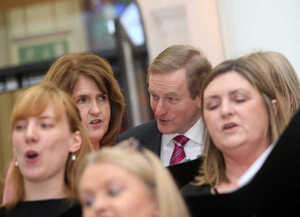
From top: Tanaiste Joan Burton and Taoiseach Enda Kenny during Christmas Carols at government buildings last week; Anne Marie McNally

As Labour actively distance themselves from Fine Gael ahead of a General Election the author warns: don’t get fooled again.

Anne-Marie McNally writes:

So Joan Burton’s mission for this week is to instil fear into the Irish electorate. “Go forth and terrify” she whispered to Labour minions earlier this week.

No, it’s not the terror we’ve come to expect from this FG/Lab Government – not the usual economic terror inflicted upon those on the margins of our society – the homeless, the children living in poverty, the lone parents, the women being forced to travel for reproductive choice, the older people with home help cuts and the loss of the phone allowance, the people who can’t afford private health insurance sitting in waiting rooms or lying on trolleys – no it’s not that mundane day to day terror, this is real bogeyman terror.

This is the prospect of an Enda-led Fine Gael getting its hands on the reins of power without Joan swinging out of his coat tails. Imagine. Enda let loose to go as right wing, wealth-favouring Christian Democrat as he wants on us.

It’s at this point that I stop and remind myself of the almost VERY same terror rhetoric deployed by Labour in the run-in to the 2011 General Election.

‘Don’t fall victim to a one party Fine Gael Government” howled Gilmore. “Imagine the austerity and complete lack of care for ordinary and vulnerable citizens” cried Joan. “Fine Gael need Labour to stave off an all-out attack on working class citizens” was the refrain of the campaign. People believed the hype.

Indeed for my MA Thesis I interviewed former Labour Party strategist Fergus Finlay and a current Labour TD and both agreed that the final opinion poll of the 2011 campaign which showed the possibility of a Fine Gael single party Government was the wake-up call for the electorate which caused them to listen to the Labour cries and thus return a coalition Government.

Yet despite that decision to elect Labour to ‘temper the worst excesses of a Fine Gael Government’ the electorate can legitimately ask “where have Labour been for the past 5 years?”

As the worst excesses of Fine Gael rained down- and continues to do so- upon those struggling in our society, where was Labour? Where were they as the child poverty rate doubled during their 5 year term? Where were they as cuts to lone parents – which Labour had clearly stated would not happen – happened?

Where were they when the damaging Protection of Life During Pregnancy Bill was enacted? And where were they when Water Charges and so many other punitive measures were being rammed through the Dáil and being inflicted on struggling families?

Let me tell you where they were – they were there, right by Fine Gael’s side, cheering them on and supporting every move they made. If they weren’t as supportive of Fine Gael behind closed doors, as they’d now have us believe, that’s their own business because it certainly didn’t manifest itself as any protection for ordinary citizens.

Labour will point to the Marriage Equality Referendum and tell you that without them, it would never have come to fruition – and that may well be the case, and certainly I commend their work on that momentous piece of legislation – but even that became a Fine Gael success as Fine Gael Minister Frances Fitzgerald basked in the media glare of the win.

Labour may have been the tail but it certainly did not manage to wag the vicious dog no matter how much it spends the next few weeks telling you it did.

It is too late now for Joan to start attacking her buddy Enda and accusing him of being capable of perpetrating heinous acts on us ordinary citizens – he already has and you and your comrades raised the pom-poms and cheered as he went about it.

We’re so often told we have a two and a half party system here in Ireland and we bounce from tweedle-dum to tweedle-dee. There comes a time when you buck the trend and stop falling for the campaign rhetoric and outright lies that suit the establishment. Spain’s just had that time. Now it’s Ireland’s time

Anne-Marie McNally is a political and media strategist working with Catherine Murphy TD and will be a candidate for the Social Democrats in the forthcoming General Election. Follow Anne-Marie on Twitter: @amomcnally

00155843 90353386

anne-marie-291x300

Pro-life protesters in Dublin last Summer; Pro Choice protesters in Summer, 2014; Anne Marie McNally

Repealing the Eight Amendment is a fundamental human rights issue but people want and need clarity in relation to the legislative framework that comes after it.

Anne-Marie Mcnally writes:

I’m thinking of booking myself a little holiday. More an exploratory mission than a holiday really. I’m thinking of heading off to this revered, mystical (or mythical?!) place colloquially known as middle Ireland. No, not middle earth, just middle Ireland.

Unless your rock has remained in place above your head in recent weeks you will be aware of the re-emergence, with a vengeance, of the abortion debate in Irish public discourse. As someone who has been out canvassing I can categorically say it is the one issue that has come up for me on every single canvass. Sometimes it’s pro- sometimes it’s anti but it’s always there.

As election fever increases so too does the fervour surrounding this eternally controversial topic and its place in Irish politics. This time out it has to be different. We cannot and should not succumb to another ‘heated debate’ about the rights and wrongs of having this downright dangerous amendment in our constitution.

There is no denying just how dangerous it is, take your pick from most letters of the alphabet at this stage – they almost all represent a woman and her family who have suffered unconscionable heartache and pain under the behest of the eight amendment to our constitution.

Nobody disagrees that the constant ‘he said, she said’ tennis match style of debate is tiresome and full of rhetoric but we need to be careful that rhetoric does not creep into our proposals for legislative solutions in the event of the eight being repealed.

The familiar refrain of ‘rape, incest and fatal foetal abnormalities’ has become ubiquitous and we’re regularly told that this is likely to be as comfortable as ‘middle Ireland’ is prepared to settle for in terms of abortion legislation. But has this really been thought through?

One of the most significant of the many failings of the 2013 Protection of Life During Pregnancy Act was the complete impracticality of its proposed ‘solutions’. Aren’t we potentially running the same risk if we trot out rhetoric about rape and incest?

How exactly do we propose to deal with a situation where a sexual encounter occurs, a charge of rape is made, an arrest happens, an investigation takes place and a conviction is secured – all in the space of roughly 18-20 weeks? Is that honestly realistic? If only our justice system worked so expeditiously. Same goes for incest.

Then we’ve the situation regarding Fatal Foetal Abnormalities where medical opinion can vary widely. A few weeks back we had Renua Senator and GE16 candidate Paul Bradford telling us there’s no such thing as ‘incompatible with life’ – many of our, let’s face it, very conservative medical profession would likely subscribe to such a theory and so who gets to make the final decision?

Are we back to the scenario of a woman going through unimaginable turmoil being dragged from pillar to post to secure the abortion that is the right decision for her at the right time in her life and for her body?

We need to have the conversation but we need to have the real conversation devoid of snappy tag lines or things that are deemed potentially offensive or inoffensive to ‘middle Ireland’.

Repealing the eight has got to be a priority – it is a fundamental human rights issue – but what comes next is equally important and while I agree that people want and need clarity in relation to the legislative framework that comes after it, I want that framework to be agreed in consultation with an Irish public who are not taken for granted or presumptions put upon them about ‘where they are at’ in terms of compassion and understanding for women in vulnerable and often tragic situations.

I want a framework that is not based upon what sounds acceptable but rather on what is actually practical and will ensure that we don’t add yet another letter to our depressingly full alphabet soup of mistreated women.

Anne-Marie McNally is a political and media strategist working with Catherine Murphy TD and will be a candidate for the Social Democrats in the forthcoming General Election. Her column appears here every Wednesday morning. Follow Anne-Marie on Twitter: @amomcnally

hugh-mc-elvaneyodonnell

anne-marie-291x300

From top: Cllr Hugh McElvaney; Cllr Joe O’Donnell; Anne-Marie McNally

Tackling low standards in high places.

Will the government choose party politics over the implementation of a real solution?

Anne-Marie McNally writes:

If it walks like a duck, quacks like a duck then it must be…..a goat. Right?! Well if you are to look at Irish political discourse in the past 48 hours then you could be forgiven for assuming so.

On Monday night the nation sat with bated breath (I may be exaggerating slightly so chill out in the comments) and waited for the much anticipated RTÉ Investigates programme into dodgy local politics in Ireland.

The programme focussed in on the almost ludicrous shenanigans of local councillors but it’s also worth remembering that a brief mention was given at the top of the programme to a number of TDs who had under-declared their assets on the register of interests.

They had ‘forgotten’ to do so it seems. Funnily enough, as soon as RTÉ mooted its impending programme those same TDs suddenly remembered and appropriate declarations were made. Go figure.

So Monday night we sat and watched as elected officials offered to trade services for payments. Decisions regarding vital topics such as planning were being offered for financial reward –in one case “ten grand – a nice little figure.” We watched, we tut-tutted, we wrung the hands and we shouted things at the telly. If twitter and Facebook are anything to go by, we did so collectively, as a nation.

Let’s call a spade a spade here. Offering to skew a political decision for financial gain is corruption. It is an illegal act. To engage in same is to break the law and to fundamentally undermine the democratic system thereby making you unfit for elected office.

Yet we are still hesitant in public discourse to use words like corrupt or corruption. This morning’s reporting of the issues raised by the programme spoke in terms of ‘breaches of standards in public office’ and ‘possible illegality’.

It speaks volumes that on foot of the programme airing not one of the Councillors featured engaging in these acts has actually resigned from public office (at the time of writing). That you could actually have the gall to hold onto your public office after knowing the nation watched you engaging in those acts is breath-taking but unfortunately not surprising.

The general consensus is that these things come and go; ‘ah it’s a storm that’ll blow over’ being the generally held opinion of those who have brass necks. And why wouldn’t they assume that opinion when they are fully aware that the mechanisms of the State to actually penalise them for such acts are wholly insufficient and when those acts are not even termed as ‘corrupt’ when being discussed in the public domain?

The laissez-faire culture we adopt in relation to corruption – or whatever more asinine term you want to apply to it – is an enabler for those who have spent their political life in the nudge-nudge, wink-wink territory that is so synonymous with Irish life. But it has to stop.

Public engagement in the democratic process is vital – without it we are a democracy in name only however it is unfair and impractical to ask citizens to engage in a democratic process that they simply cannot or will not trust. Legislators have a duty to craft a democracy which brings people into the system rather than shutting them out.

Enda and the rest of the Government TDs and those before them can point to various bits of inadequate legislation and disjointed and fragmented bodies and agencies – but they cannot point to a real and meaningful solution or to any evidence that the current regime has been successful in stamping inherent corruption from Irish political life.

Tonight in the Dáil, at roughly 9pm, there will be a vote on the Social Democrats proposal to establish a one-stop shop, with full investigative and enforcement powers to tackle corruption. The very thing that SIPO officials, and so many commentators say is needed – an Independent Anti-Corruption Agency.

Tune in and watch how many, from either side of the house will choose party politics over the implementation of a real solution to the toxic political culture that pervades our democracy. Then remember that vote when watching the next RTÉ Investigates and wringing your hands – because trust me, there will be another one…and another one after that too unless the lip service stops and the solutions begin.

Anne-Marie McNally is a political and media strategist working with Catherine Murphy TD and will be a candidate for the Social Democrats in the forthcoming General Election. Follow Anne-Marie on Twitter: @amomcnally
90401695anne-marie-291x300

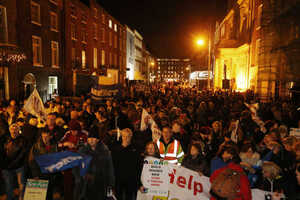
From top: Homeless protest last night in Dublin; Anne-Marie McNally

Seventy three families a month are becoming homeless.

You don’t get to abandon an entire cohort of people and not feel the brunt of that both societally and economically.

Anne-Marie McNally writes:

Housing is a human right. It’s one of the most basic rights enshrined in various international charters and treaties across the world:

Article 25 of the Universal Declaration of Human Rights
Article 11 of the International Covenant on Economic, Social and Cultural Rights
Article 27 of the Convention on the Rights of the Child
Article 5 of the Convention on the Elimination of All Forms of Racial Discrimination
Article 14 of the Convention on the Elimination of All Forms of Discrimination Against Women
Article XI (11) of the American Declaration on Rights and Duties of Man

The fundamental right to shelter should ensure a safe, habitable, secure and affordable home for everyone in society. Most of the charters and treaties articulate the point that this right to shelter/housing must be provided to all persons irrespective of income or access to economic resources.

Yet here in Ireland we seem to view basic housing provision as some sort of luxury that is the preserve of those capable of providing it for themselves.

Yesterday our Taoiseach stood in the Dáil, on what was the first anniversary of Jonathan Corrie’s tragic death just yards from the front gate of the same Dáil, and told opposition leaders that we didn’t have the resources needed to tackle our housing and homelessness crisis, that we’ve now committed all we can and that now it’s time for the private sector to step up its building processes.

A couple of thousand social/Nama units stretched over another decade or so, that’s the extent of the ‘social’ housing provision.

This is not a crisis, it’s a national emergency.

Yesterday evening I took to the streets of the capital along with others from across the political spectrum, volunteer groups, and various unions to protest against the current inhumane system which allows human beings to be abandoned to the streets with little more than a sleeping bag – if they’re lucky.

Speakers on the stage ranged from those struggling under the weight of addiction, those who had run from abusive relationships with only the clothes on their back and those who simply could not keep up with the pace of rent increases, all articulating a similar take of despair and hopelessness.

There is an unfortunate narrative that pervades people’s thinking regarding those they see on the streets. There is a generally held assumption that all these people have some form of addiction – be it alcohol or some other substance.

While there can be no denying that is true for a huge number of those on our streets, it is not true for all of them and nor is it a reason to simply look the other way. Think of the children in hostels tonight, or on the third different couch they’ve slept on that week, watching while their parents fret and exist as a ball of stress and desperation.

The same fears, anxieties and sense of insecurity that those children are feeling were felt by those people currently struggling with addiction issues – the escapism they sought manifested as the addiction they’re now burdened with.

Society has a responsibility in that regard…we have a responsibility in that regard. By standing in the chamber and telling us that we don’t have the resources to deal with the housing emergency now, what Enda is doing is gifting a plethora of societal problems and economic expenses to the next administration, the one after it and the one after that as the children of today’s failed policies become the adults of tomorrow on the streets or suffering with mental illness issues, or addictions.

You don’t get to abandon an entire cohort of people – 73 families a month are now becoming homeless – and not feel the brunt of that both societally and economically. Actions may have consequences but so too does inaction and those consequences are hurtling down the tracks at us.

It’s not enough to say we don’t have any more resources. We have to find the resources. Loud announcements by Alan Kelly are nothing more than words. He won’t be around in the timeframe his measures require. The HAP system (Housing Assistance Payment) that he’s pumping what money there is for housing into is little more than a form of privitisation of social housing.

The only way to solve this emergency is to increase supply now. Look to Nama units, look to vacant units, and ultimately, and simultaneously, build large scale social housing. It has been done before in times of greater hardship than now, it’s not beyond our capabilities but unfortunately right now, it is beyond the political will of the establishment and that right there is the problem.

Anne-Marie McNally is a political and media strategist working with Catherine Murphy TD and will be a candidate for the Social Democrats in the forthcoming General Election. Follow Anne-Marie on Twitter: @amomcnally