Tag Archives: Asylum Seekers

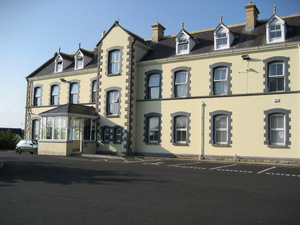
Conventlogo_bridgestock(The Old Convent in Ballyhaunis, Co. Mayo, top, which provides accommodation for 293 asylum seekers and is owned and run by Bridgestock Ltd)

Carl O’Brien, of the Irish Times, reports this morning that unpublished inspection reports of State-funded asylum seeker accommodation centres show evidence of overcrowding, poor fire safety practices and poor hygiene levels.

In the last year alone, Mr O’Brien reports, of the 34 direct provision centres across Ireland, at least three were warned they would be shut down within 30 days, unless they addressed their shortcomings or failings.

The inspectors’ concerns, amongst others, included that a family of six had to live in a single bedroom; there were serious breaches of fire safety; and breaches of child protection.

Specifically, he writes about one centre: The Old Convent in Ballyhaunis, Co. Mayo which provides accommodation for 293 residents, and is owned by Bridgestock Ltd.

It was inspected in March of this year – just a month before Bridgestock Ltd was awarded its highest score in the annual Q-Mark Awards [a quality management award].

From the report:

“The number of general maintenance issues identified was too extensive to catalogue individually . . . It needs to be restated that the prevalence and frequency of the items requiring maintenance was extremely disappointing and is not acceptable to RIA [Reception and Integration Agency] . . . (March 2013)”

“Response: The management said it had responded to issues highlighted, including tackling fire safety risks, deep cleaning and maintenance.”


Meanwhile, back in 2010:

A recent “value for money” review found the Government pays too much to house and feed asylum seekers because it does not run fully open tender competitions to secure contracts with private operators of asylum centres. The review also found the agency maintains too much “excess” bed capacity at accommodation centres nationwide.

One of the findings of the “Value for Money” review is that private hostel owners rather than asylum seekers or taxpayers have been the real beneficiaries of the direct provision system since it was set up in 2001.

It found “restricted competition” among commercial operators meant rates are not “robustly tested and the seven State-owned accommodation centres were €6 a person a day cheaper than those owned by private operators. The review expressed concern about contract renewals agreed by the Government, with 16 private operators in 2008 and 2009 that led to price increases of more than 5 per cent at a time of deflation.”

NGOs complain a culture of secrecy surrounds the award of these multimillion euro contracts because the Department of Justice refuses to disclose the details due to “commercial sensitivities”. This makes it virtually impossible to properly scrutinise payments worth almost €750 million since 2002.

“However, the financial accounts of the four biggest accommodation providers – Mosney, East Coast Catering Ireland Limited, Millstreet Equestrian Services and Bridgestock – demonstrate that housing some of the poorest people in society has proved a very lucrative business for some entrepreneurs.”

“The top four money makers: Bridgestock Limited is owned by Séamus and Kathleen Gillen from Tullamore, Co Offaly. It runs four centres in Athlone, Ballyhaunis, Sligo and Galway with contracts to house 1,249. The firm had net cash flow of €6.29 million in the year to the end of June 30th, 2008, generating operating profit worth €1.57 million. The company paid €1.12 million in rent to properties owned by the Gillens in 2008.”


Value For Money and Policy Review (Reception Integration Agency, May 2010)

Inspections reveal poor standards in centres which house thousands of asylum-seekers (Carl O’Brien, Irish Times)

Previously: Asylum seekers on Broadsheet

Pic: Picasaweb
Direct-ProvisionSE/NA/NE/NWHB IMT M8319 (Page 1)

Ombudsman Emily O’Reilly has released a report into her investigation of a complaint made by a female asylum seeking mother in relation to the non-payment of supplementary welfare allowance by the HSE.

The story goes back to 2007 when  Ms Kileni (not her real name) came to Ireland with her two daughters as asylum seekers, after her husband was murdered in South Africa.

They were placed in Direct Provision accommodation in Mayo. Their Direct Provision accommodation was a four-bedroomed house.

Ms Kileni and her daughters shared one bedroom while three other families shared the three other bedrooms.

In August 2008, they left the accommodation to live with a friend in Dublin because the medical services she needed for her daughter, whose mental health was deteriorating, were only available in Dublin.

The 15-year-old girl had attempted suicide at the centre and was subsequently hospitalised. After she was discharged, she was placed in foster care on a voluntary basis.

In November 2008, Ms Kileni applied for Supplementary Welfare Allowance but her application was refused. (SWA consists of a basic payment and/or a supplement to cover certain expenses a person may not be able to meet. The main purpose of the allowance is to guarantee a standard basic minimum income).

Ms Kileni appealed the decision to the HSE, but was again refused.

She then appealed to the Social Welfare Appeals Office, which prompted an oral hearing in June 2009.

In December 2009, the Appeals Officer allowed Ms Kileni’s appeal and the officer issued a statement on her decision which gave details of the exceptional medical and social circumstances of the case.

But, the relevant Superintendent Community Welfare Officer (who would have paid out the supplementary welfare allowance) queried the outcome.

Despite the responses from the Appeals Officer confirming her decision, and despite the fact Ms Kileni was not living in Direct Provision accommodation, the welfare officer would only pay Ms Kileni the rate of €19.10 per week for herself and €9.60 per week for the daughter then living with her – rates payable to asylum seekers living in Direct Provision.

Ms Kileni, tried to resolve the matter with the HSE before taking her complaint to the Ombudsman but was unsuccessful.

Ms O’Reilly added:

“An obvious consequence was extreme impoverishment for both Ms Kileni and her eldest daughter (a Leaving Certificate student at the time). Another, far-reaching consequence was that the failure to provide the family with an income meant it was not possible for Ms. Kileni’s daughter, who was in foster care, to be re-united with her family.

This was an outcome which the HSE social workers involved in the girl’s care had anticipated as a result of the Appeals Officer’s decision to award the full-rate SWA to Ms Kileni. The failure to implement the Appeals Officer’s decision, and the emotional and financial instability for the family which resulted from that failure, upset these plans.”

The HSE accepted Ms O’Reilly’s findings and agreed to pay the woman arrears of €11,882, and a “time and trouble” payment of €3,000.

These arrears were paid to Ms Kileni in January 2011

– 26 months after her SWA application,
– 13 months after the success of her appeal, and
– nine months after she had complained to the Ombudsman.

Report here.

HSE took ‘discriminatory decisions’ involving asylum seeker (Irish Times)

Pic: Humanrights.ie, Irish Medical Times

CEAS1

CEAS2

But not in Ireland.

Having opted out of the revised laws governing the Common European Asylum System and not signed the Receptions Condition Directive.

This is because signing it would mean Ireland would have to allow asylum seekers work after a certain period of time, should they still be waiting on a decision on their application.

And, as Justice Minister Alan Shatter said, we can’t be having that.

Ireland Will Not Benefit From EU Migration Law Advancements (Brophy Solicitors) 

Previously: Shutting Out The Asylum Seekers

EC Rep Ireland

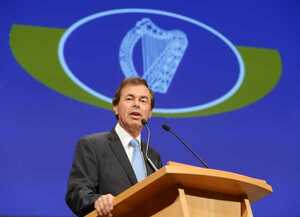
90272235(Alan Shatter at a Citizenship Ceremony in the Convention centre, Dublin, last year)

In January 1999, the High Court ruled that Section five (1) (e) of the 1935 Aliens Act, under which the State deported 60 people in 1998, was unconstitutional.

In May of the same year, the Supreme Court upheld this rule.

And in early July, when Fianna Fáil and the PDs were in coalition, the Dáil passed an Immigration Bill before summer recess, with 74 Government and Opposition amendments taken in one vote, which passed 73-64.

The overriding purpose of the bill was to give the Government statutory powers to resume deporting asylum seekers.

However, much of the discussion in the Dáil in relation to the Bill centered on debating one of the amendments regarding whether asylum seekers should be allowed to work or not.

[Then Justice Minister} John O’Donoghue said this was an amendment that the Government was still considering).

In one of the exchanges, Labour’s Jan O’Sullivan called for asylum seekers, who had been in the country for three months, to be allowed to work.

The Irish Times reported at the time:

“Mr Ivor Callely (FF, Dublin North Central) opposed the amendment because “it would give an asylum seeker false hope if, after going through due process, his or her application was unsuccessful. It would create a lot of difficulties and would be unfair.”

He pointed out that 80 per cent of people with disabilities were unable to find employment. “I do not hear people shouting on their behalf or saying they should be given an opportunity to work.”


However

“Mr Alan Shatter (FG, Dublin South) said Mr Callely’s suggestion of false hope for asylum-seekers was “an extraordinarily asinine argument. Allowing them to work allows them the dignity of earning a living while awaiting a decision about their future, no more and no less than that.”


In late July, 1999, the FF/PD coalition decided to allow any asylum seeker who had entered Ireland and applied for asylum before July 26, 1999, to work – on the basis that the asylum seeker had been waiting for a decision on their application for refugee status for 12 months or more.

The Department of Justice estimated that this would allow between 2,000 and 3,000 asylum seekers work.

At the time, there reportedly were up to 6,000 asylum seekers awaiting a decision, while the average waiting time for a new application was 12 months.

The move followed public disagreement between Minister O’Donoghue, who was opposed to allowing asylum seekers work, and the then Tánaiste Mary Harney, who supported the campaign to allow people in that category to work.

As Mr O’Donoghue put it:

“Giving a right to work would simply create another ‘pull’ factor which would put further pressure on the asylum-processing system and continue to delay recognition for genuine refugees in need of protection.”


So, how did the work permit scheme go?

Not very well.

The right to work was on a restricted, non-transferable basis, meaning the asylum seeker was not allowed to work independently of a job specified by a prospective employer, essentially leaving the asylum seeker open to being exploited.

The employer also had to pay a monthly fee of £25 or a one-off annual fee of £125 to the Department of Enterprise, Trade and Employment.

Also, prospective employers had to prove that the vacancy could not have been filled by an Irish or other EU national – both deterring measures by all accounts.

A study by the Irish Refugee Council, in 2000, found that DoETE figures showed just 67 work permits were issued between July 27, 1999 and December 15, 1999.

The non-transferable work permit system ended in December 1999, to be replaced with a system whereby the Department of Justice would provide a letter confirming their right to work. The letter would be shown by the asylum seeker to the prospective employer.

The IRC found that, by the end of June 2000, 1,032 out of 3,241 asylum seekers entitled to work had either found a job or had stopped claiming social welfare – meaning two thirds of those eligible had still to find a job, a year after the scheme was devised.

Earlier this year, in March, as part of Ireland’s EU Presidency, Justice Minister Alan Shatter announced revised EU laws on the processing of asylum claims.

This is part of the Common European Asylum System which has been designed to maintain consistent and equitable treatment of asylum seekers across Europe.

But Ireland has opted out of this.

Why?

Explaining Ireland’s decision in the Dáil, Minister Shatter said:

“The principal reason for Ireland’s position is the provisions of Article 11 of the 2003 Directive which deals with access to the labour market for asylum seekers. Article 11 provides that if a decision at first instance has not been taken within one year of the presentation of an application for asylum, and this delay cannot be attributed to the applicant, Member States shall decide the conditions for granting access to the labour market for the applicant.”

“This is contrary to the existing statutory position in Ireland which provides that an asylum seeker shall not seek or enter employment. This prohibition in Irish law is maintained in the Immigration, Residence and Protection Bill, which I intend to republish.

“Extending the right to work to asylum seekers would almost certainly have a profoundly negative impact on application numbers.” 


And on it goes.

Shatter transcript via Kildarestreet.com

(Sasko Lazarov/Photocall Ireland)

asylum

Made by 27 young people seeking asylum alone in Ireland during a six-day Easter Camp on human rights In March organised by the Irish Refugee Council and UNICEF.

In a group open letter to government ministers following the camp the children wrote:

letter

The children took up four separate projects at the camp relating to issues of equality, integration, education and resilience.

The results will be on display in the Twisted Pepper, Middle Abbey Street, Dublin from May 24-31.

Voices Of Young Asylum Seekers Exhibition (Facebook)

Irish Refugee Council

Previously: An Irish Asylum Seeker Writes

paulcullentext

Bewildered Student writes:

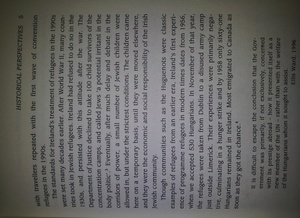
In light of your recent post by [asylum seeker] Hamid, I came upon this this morning. It’s from a small book by Paul Cullen, of Irish Times…written in 2000. Called Refugees and Asylum Seekers in Ireland…part of a series called Undercurrents. I never knew this about Jewish children.


Previously: An Asylum Seeker Adds

cut out

You may recall the post (above) last Tuesday concerning ‘Hadiq’ from Afghanistan.

About the ‘direct provision’ service provided to asylum seekers in ireland.

-1Hadiqullah Niazi (above) writes:

I would like to thank people for their condolences and support. I want to share something with you and that is that  I am a disabled.  I mean I don’t have my right leg so I’m on crutches all the time and the reason why I expressed my anxiety over the system of direct provision is because it it very hard for me to stay in hostels and there is no priority or special attention for disabled asylum seekers. They get the same service as normal asylum seekers so I can’t do all the stuff I need to. While I was back in Afghanistan everything was carried out for me by family accordingly but unfortunately I don’t have anyone here to do it for me so that’s why I said everything. I have to face the difficulty because  I have no other choice and I can’t go back to Afghanistan for some serious reasons. I  beg apology of you all if anyone minds any words that I have said.”


Previously: An Asylum Seeker Writes

The Institutionalisation Of 1,818 Children In Ireland

Related: Voices From Direct Provision (Human Rights Ireland)

Pic : Hadiq

GathAsy1

GathAsy2

GathAsy3

GathAsy4

GathAsy5
GathAsyLastGathasylast2

GathAsy6 gathering

Patron of the Irish Refugee Council and retired Supreme Court judge Catherine McGuinness, second from top, addresses asylum seekers, refugees, human rights supporters and members of the public at a protest outside the Department of Justice earlier today.

And, bottom picture, protesters gather outside the Dáil, Kildare Street, Dublin.

Earlier: An Asylum Seeker Writes

Laura Hutton/Photocall Ireland

Doras

“My name is Hadiq. I am from Afghanistan. I have been an asylum seeker here in Ireland for the last two years. I am standing here today because I wish to express my feelings on the hardships and difficulties that we in the asylum system experience every day. I don’t feel that our asylum cases have been dealt with and assessed as fairly and thoroughly as possible. The Department of Justice constantly makes it difficult for us to access the few rights and entitlements that we have as asylum seekers.”

“Firstly, the system of direct provision is simply not suitable for those who want to live the normal life that any human being is entitled to. There are many reasons for this. For example, you have very little freedom and choice to do what you want while living in Direct Provision accommodation. You must eat whatever is served to you and there are strict rules governing almost every aspect of my life. You are not allowed to work or pursue a higher education. I would love the opportunity to continue my education here in Ireland but unfortunately I am unable due to my asylum status. In Direct Provision accommodation, you must share a room with people from various backgrounds, cultures and religious beliefs and there is very little private space. Every week, I am given 19.10 euro to live on. Luxuries like cigarettes or trips to visit friends are not an option. In addition, we are not allowed to bring friends from outside into the accommodation centres, further adding to isolation, loneliness and frustration.”

“Being kept in this kind of environment for several years is similar to being in a prison. We feel trapped and all we want is the freedom and rights to enjoy life like any person. I ask that all the people of Ireland imagine for a moment that they were living in this kind of environment with their family. Do you think you could accept this kind of situation? I kindly ask the Irish Government to consider these facts and to replace the system of Direct Provision in Ireland. All we ask for is the freedom to enjoy our rights as a normal human being, not be treated like prisoners.”

“Thank you for your time and I greatly appreciate this opportunity to speak with you all.”


A guest post from today on the Human Rights in Ireland blog.

HRI was set up in 2009. It’s a group blog run by academics, mostly lawyers, who work in Ireland or abroad. Their focus is human rights issues in Ireland.

Previously: The Institutionalisation of 1,818 Children In Ireland

Pic: HRI


90192657

Irish Refugee Council CEO Sue Conlon has a piece, entitled Seven Years Like  A Robot, in the current edition of Village magazinedetailing how asylum-seekers live in Direct Provision accommodation in Ireland.

She explains that, as of December 17 last, there were 4,806 residents of Direct Provision, 38% (1,818) of which were children.

She writes:

“The Direct Provision system was set up in 2000 in response to a crisis towards the end of the 1990s when the numbers seeking asylum in Ireland had increased rapidly. Today more than a third of residents in the centres have lived in them for more than three years. What is difficult to understand is why the authorities maintain a system when the evidence is clear that it comes at huge expense – both financial and human.

“The centres are collectively known as ‘Direct Provision’ because the state provides directly for the immediate physical needs of asylum seekers. It is a system that has never been set out in legislation or defined in any publicly available document. But it has been rolled out in the form of accommodation facilities whose original use was for short term stay – mobile homes, holiday chalets, hotels, students’ hostels – with just a small number of purpose-built accommodation centres. All of them have been owned or at least run by private companies.

“The companies have never been required to have any particular training or oversight in order to accommodate, on a long term basis, vulnerable adults and children. Dispersal around the country is a central feature of the system. By and large, it is a system that is on a ‘no choice’ basis. You go where you are told, when you are told and often with little notice.

“In September 2012, the Irish Refugee Council published a report entitled ‘State sanctioned child poverty and exclusion: the case of children in state accommodation for asylum seekers’.  The report contained evidence dating back more than ten years of the way in which children, some of them Irish citizens, have been treated in the Direct Provision system.  The evidence included examples of malnutrition, poverty, overcrowding, lack of play space and the detrimental effect on family life.  To date, there has been no formal response from any Government Minister to the Report.


The IRC is co-ordinating a National Day of Action on April 23, as part of a campaign calling on the Government to end the Direct Provision system.

Seven years like a robot (Sue Conlon, Refugee Council)

Previously: The UN On Ireland’s Human Rights Defenders And Denis 

Top: Samuel Brian whose family is from Nigeria, protesting at the asylum centre in Mosney, Co Meath, in 2010 (Mark Stedman/Photocall Ireland)