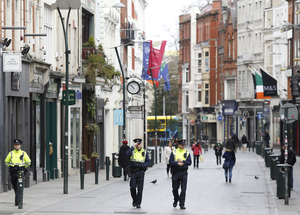
‘sup?
This afternoon.
Undientified Tesco store, Dublin.
Bobaldinho writes:
Every Little Helps indeed…f**k you Tesco.



‘sup?
This afternoon.
Undientified Tesco store, Dublin.
Bobaldinho writes:
Every Little Helps indeed…f**k you Tesco.
This afternoon.
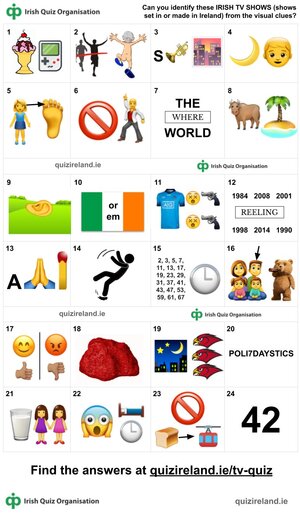
Irish Quiz Organisation tweetz:
Staying safe at home doesn’t mean you can’t enjoy some quizzy fun. Try our Irish TV shows picture quiz and see how many you can identify.
Anyone?


1/3 Three messages from three healthcare workers living in #DirectProvision today: ‘They tell me to work but I am sharing a room with two other women. I feel like this can’t be safe. Please tell me they plan to move us out so we can continue to work’ #MoveTheVulnerableOut
— Graham Clifford (@GrahamJClifford) March 30, 2020
2/3 Message from Healthcare worker in #directprovision today: ‘I have my list of clients but they are vulnerable. The agency says I must go to them each day. But I’m living in Direct Provision and we can’t even social distance. This cant be right’ #MoveTheVulnerableOut
— Graham Clifford (@GrahamJClifford) March 30, 2020
3/3 Message for healthcare worker in #directprovision today “There is a confirmed case in our #Directprovision centre but still we’re told to put on the uniform and work. The Minister called for us last week in parliament. Are they planning to move us out?’ #MoveTheVulnerableOut
— Graham Clifford (@GrahamJClifford) March 30, 2020
From top: A bedroom in a direct provision centre in Swords, Dublin; Assistant Secretary at the Department of An Taoiseach Liz Canavan; tweets from Graham Clifford, of The Sanctuary Runners
Last night.
Journalist Graham Clifford, who co-founded The Sanctuary Runners, tweeted testimonies from three separate healthcare workers (above) who travel from their crowded living conditions in Direct Provision centres to their healthcare work setting.
It’s not known how many healthcare workers live in direct provision.
It comes amid a campaign by refugee and asylum seeker support groups calling on the Government to move out “at risk” residents from the crowded centres where social distancing is, they say, impossible.
It also comes amid reports on RTÉ’s Drivetime last night that there have been several positive tests in at least two centres.
Further to this…
A group of academics in health, law, human rights and migration has today published an open letter in which they’ve outlined their concerns about direct provision and Covid-19.
They’re calling for own-door accommodation and individualised access to sanitation and eating facilities to every family unit and single person in the international protection system. They say the the necessary accommodation is available to provide for this and, to not do so, could see the State falling foul of its legal requirements.
Just before lunch, assistant secretary at the Department of An Taoiseach Liz Canavan told journalists at a press briefing in Government Buildings that the Government was working “tirelessly” to ensure direct provision centres are “well-prepared” and “able to respond” to any Covid-19 issues.
She said 300 new beds – as opposed to rooms – were recently announced at new centres in Tullamore, Rosslare Harbour and Cahircaveen.
She added: “Further beds are being actively sourced for international protection applicants to better support social distancing measures in centres.”
The letter is addressed to Taoiseach Leo Varadkar, the Minister for Health Simon Harris, Chief Medical Officer at the Department of Health Dr Tony Holohan, CEO of the HSE Paul Reid and a number of TDs and ministers in which they’ve outlined their concerns about direct provision and Covid-19.
The letter, signed by around 400 academics and counting, states:
“Dear Government representatives and State officials,
We are specialists spanning fields of health systems, public health, social policy, law, human rights, migration and racism.
We write to express our utmost concern that the State is continuing at this time to require large numbers of people seeking international protection to live in shared bedrooms, and to share sanitary and eating facilities, within the direct provision system.
This has prevented many people from socially distancing according to Government advice, with the aim of avoiding contracting COVID-19 and avoiding passing the virus on to others while they may be asymptomatic.
Many direct provision centres are in rural locations. An outbreak of COVID-19 within a centre, where people have not been in a position to socially distance themselves from one another, could spread rapidly and create a cluster of cases which the local health system in any given location may be unable to manage.
It is also important to note that a number of people living in direct provision centres work as care providers for others in the community.
In every region of Ireland at present there are unprecedented numbers of empty hotel rooms, student accommodation units and self-catering holiday accommodation units.
We implore you to act now, to provide own-door accommodation and individualised access to sanitation and eating facilities to every family unit and single person in the international protection system, given that such action is practicable at this time.
This matter is urgent, given that several cases of COVID-19 in direct provision centres have already been reported.
The small financial allowance provided to people seeking international protection (€29.80 per week for a child, and €38.80 per week for an adult) does not enable those living within the direct provision system to find alternative, private accommodation in order to socially distance themselves from others.
On the other hand, in light of the scale of the emergency socio-economic measures which the Government is putting in place for the rest of the Irish population at this time, it is reasonable to expect the Government also to invest in ensuring the safety of international protection applicants to the greatest extent practicable.
We note that the Government decided in the past few weeks to remove international protection applicants from emergency accommodation (which may have included hotels) into new direct provision centres.
The rationale for this, according to the Minister for Justice and Equality, is that it is easier to communicate HSE advice to people when they are gathered together in direct provision centres.
However, in our view, it is eminently possible to find ways to communicate with people while also ensuring that they are enabled to self-isolate in own-door accommodation.
The Minister for Justice and Equality has further stated that his Department has instructed each direct provision centre to create self-isolation facilities for use by those suspected to have COVID-19, and that the Department of Justice and Equality will pilot ‘off-site self-isolation’ for people suspected of having COVID-19.
There are two major flaws to this approach:
First, as per the HSE’s Guidance and the Government’s current instructions to the rest of the national population, social distancing from others before a person shows signs of infection with COVID-19 is necessary in order to prevent the spread of the virus – since COVID-19 can be transmitted by individuals who are not demonstrating or reporting symptoms.
Second, reports from residents suggest that at least some direct provision centres are creating self-isolation facilities which are manifestly inappropriate, in that they do not allow for physical distancing and provide no privacy for the patient in their illness or recovery.
We further note that the Deputy Secretary General of the Department of Justice and Equality wrote in the past few days to people living in direct provision centres to assure them that the Department is ‘actively sourcing new accommodation to reduce the numbers in some settings’.
We urge the Government immediately to find as many private rooms as necessary to ensure that every family unit and every single person currently within the international protection system is able to socially distance from others. As mentioned above, the accommodation is available and this matter is now urgent.
The Government’s recently published guidance on ensuring an ethical approach to managing the crisis, An Ethical Framework for Decision-Making in a Pandemic, stresses that the implementation of public health measures should protect the interests of vulnerable populations and ensure that measures taken do not result in increased health inequalities.
In other words, in a pandemic, public health measures must apply to all; every person must be able to benefit from public health support, with the assistance of the State if necessary.


To the 4 nurses in Ireland who fought so hard for so many patients, but who themselves fell ill, and have now passed
RIP
— Paddy Cosgrave (@paddycosgrave) March 30, 2020
One nurse had come to Ireland for a better life. So young and so full of hope. Put has passed.
We must do more to protect those on the front lines who are giving their lives to protect us.
RIP
— Paddy Cosgrave (@paddycosgrave) March 31, 2020
@HSELive doesn’t comment on individual cases to protect people’s privacy. However, when we become aware of fake news that causes distress to our staff and families we must act. Contrary to tweets sent yesterday – thankfully none of our nurses have died in Ireland from #COVID19.
— HSE Ireland (@HSELive) March 31, 2020
This afternoon.
Update:
This is very reassuring. Can I ask @paulreiddublin by “OUR staff… and OUR nurses” does the HSE mean to include all HCW, including agency nurses, those working in private nursing homes etc.
Likewise are non-HSE contracted doctors included in “OUR STAFF”? https://t.co/Cgt5pl55GQ
— Paddy Cosgrave (@paddycosgrave) March 31, 2020
Meanwhile…

This tweet has presumably been sent to rebut claims last night that 4 nurses had died, but it was reported last week that a healthcare worker had died. Is it the case that this worker was not employed by the HSE? https://t.co/ts9NwqOhet
— Colette Browne (@colettebrowne) March 31, 2020
Anyone?
Update:
It has been confirmed that a healthcare worker has sadly died from COVID-19, but claims that four nurses have died are wrong. No nurses in Ireland have died from COVID-19.
— Colette Browne (@colettebrowne) March 31, 2020

Dept of An Taoiseach says immediate family members can still attend funerals, burials and cremations once social distancing can be maintained – irrespective of whether death arises from #covid19ireland – but with a total attendance of no more than 10 at any location
— Gavan Reilly (@gavreilly) March 31, 2020
1/5
Funeral Services
The Government’s critical services list issued on Saturday included funerals as one of those services. The Government wants to ensure that families are able to bury their loved ones in a respectful manner while ensuring that all involved https://t.co/NFxCfTi3wO— MerrionStreet.ie (@merrionstreet) March 31, 2020
This afternoon.
The Department of An Taoiseach has clarified the Government’s advice on attendance at funerals, burials and cremation.
It has said the numbers of people attending places of worship or the graveside should not exceed 10 and this may be restricted further in smaller enclosed spaces.
Assistant Secretary at the Department of the Taoiseach Liz Canavan also said individual churches may put in place specific restrictions as a means to respond to specific local circumstances.

This evening.
“Like so many other people in Ireland, I tested positive, but I was in the very fortunate position to have a very unintrusive experience, which I now have come to the end of.
“While I’ve been at home watching television and listening to the radio, I have been bowled over by the extraordinary work of our front line heroes and their families who continue to make Ireland a healthier and safer place.
“I look forward to being back to work really soon.”
Ryan Tubridy
Ryan Tubridy tests positive for Covid-19 (RTÉ)
Previously: ‘Persistant Cough’
Meanwhile….

That’s one unlucky agent.
WHO will be next?
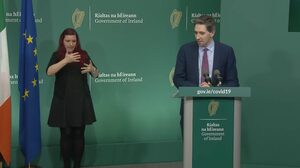
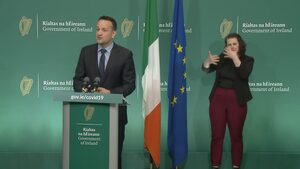
Statement by Taoiseach @LeoVaradkar and Minister for Health @SimonHarrisTD | Follow the latest developments on #Coronavirus with our live blog: https://t.co/uDMsda4VtI https://t.co/Bdr7M04MET
— RTÉ News (@rtenews) March 30, 2020
Taoiseach Leo Varadkar and the Minister for Health Simon Harris at a press conference at Government Buildings this evening
This evening.
Taoiseach Leo Varadkar and the Minister for Health Simon Harris are holding a press conference at Government Buildings to speak about the new public private partnership with private healthcare providers in response to Covid-19.
During the press conference, Hugh O’Connell, of the Irish Independent, asked Mr Varadkar if he could indicate when Ireland might “start to return to normality”.
Mr Varadkar said he didn’t know.
The question follows Dr Jenny Harries, deputy chief medical officer for England, saying yesterday that normal life will not likely resume in the UK for at least six months.
In his response, Mr Varadkar said:
“To be honest with you, we don’t know for sure. You know, this is a new virus and you can only be so much of an expert on a virus that’s only been known to the world for three or four months and some of the estimations and assumptions we might have had two or three weeks ago are different now and they may be different again in two or three weeks again.
“What is going to happen this evening is Philip Nolan, who’s heading up our group on modelling, is going to speak at the press conference tonight with the chief medical officer [Tony Holohan] and the idea is that every week or so the model will be updated and that will be shared with the public because we want to be as transparent as possible.
“But in being transparent we need people to understand that by putting information out there, and we want to put all the information out there, it may turn out to be incorrect and you’ll just have to bear with us on that in many ways or it may change over time.
“Certainly what the UK is talking about and I think what a lot of people around the world are talking about now is that there will come a point after the epidemic is peaked and the number of new cases starts falling, when we will start to ease the restrictions and then we’ll have to see what happens so we won’t be in a situation whereby I suddenly go on TV and make an address to the nation and say everything is going back to the way it was on the 11th of March.
“That’s probably not what’s going to happen. What is likely to happen is that the number of new cases will continue to rise, we’ll reach a peak, hopefully that will be in a few weeks’ time and not in a few months’ time.
“The number of new cases will start to fall and will reach the point where we can start to ease some of the restrictions and then see what happens, whether the number of cases starts to rise again or not.”
Meanwhile…
Later, Jennifer Bray, of The Irish Times, asked Mr Harris about the shipments of personal protective equipment (PPE) that Ireland has ordered from China.
Ms Bray asked if Ireland has any “guarantees” about the quality of the items, in light of the Netherlands recalling hundreds of thousands of masks that it received from China.
This morning, China’s Ambassador to Ireland He Xiangdong told RTÉ’s Rachael English that China would do its best.
Mr Harris said:
“In relation to the quality of the PPE coming into the country, Paul Reid [CEO of the HSE], the head of the HSE, has publicly said that any PPE purchased by the HSE needs to meet World Health Organisation standards and also will be checked on arrival.
“So it’s a job that the HSE needs to do, they’ve a duty of care to their staff and we obviously need to ensure that any PPE distributed throughout the health service meets the WHO standards and they certainly said that’s absolutely their intention and view in relation to the equipment they bought.”
Earlier: “I Think That We Will Try Our Best”


All the hand sanitisers in Kinsale Road Accommodation Centre are empty. How will you prevent the spread of #COVID19 in DP, @HSELive @CMOIreland @CharlieFlanagan @MickBarryTD @EamonRyan @MaryLouMcDonald @DonalOKelly @MikeFitzG @oriordanjac @CorkLifeCentre @CorkMigrant pic.twitter.com/50uPE8lv3f
— Roos Demol (@vlinierland) March 29, 2020
Just off the phone to a friend in #Directprovision – He’s in a mainly male-only centre in Cork – 4 men in a small room, bunk beds, absolutely no way to practice social distancing. Scared to even get food in the canteen. Complete madness @NascIreland @IrishRefugeeCo @DorasIRL
— Graham Clifford (@GrahamJClifford) March 30, 2020
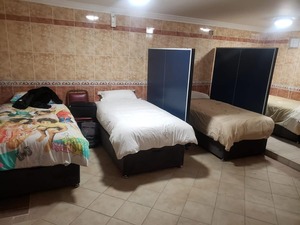
From top: Bedrooms of direct provision centres in Cork City; Roscrea, Co Tipperary; Swords; Miltown Malbay, Co Clare; Cahersiveen, Co Kerry; Newbridge, Co Kildare; tweet from the Kinsale Road Accommodation Centre in Cork City and a tweet from Graham Clifford, of The Sanctuary Runners
Various refugee and asylum seeker support groups have been calling on the Department of Justice to move people deemed to be the “most vulnerable” out of direct provision centres because of Covid-19.
It comes as asylum seekers, some of whom are healthcare workers, say the Government’s direction for people to maintain “social distancing”, “self-isolation” and “cocooning” is impossible at centres where, in most cases, several people share single rooms.
It also follows councils and the Government spending money on information campaigns about social distancing in public places and on facilities such as Dublin Bus.
Last week it was reported that residents in a direct-provision centre in the west of Ireland were informed a person in their building had tested positive for Covid-19.
Further to this, the Movement of Asylum Seekers in Ireland (MASI) write:
“Disgraceful but not surprising that the Department of Justice and Equality refused to provide self-contained units for asylum seekers.
Dublin Region Homeless Executive said it would source self-contained units for people in emergency accommodation so that they can observe social distancing. We hope other service providers for homeless people do the same.
The handling of Covid-19 in Direct Provision shows us once more than the provision of accommodation for asylum seekers should be taken away from the Department of Justice and Equality. Direct Provision operators will always put profits above everything.
Solidarity with people in overcrowded accommodation at this time.”
Meanwhile, MASI has posted the following video from the Grand Hotel Direct Provision Centre in Wicklow where a “self-isolation” room is being set up…
Thud.
A petition calling on the Department of Justice to move people deemed to be “at risk” of Covid-19 out of direct provision can be signed here.
Previously: No Room To Isolate